
Sewer Line Repair: Find the Fault Before Choosing the Fix
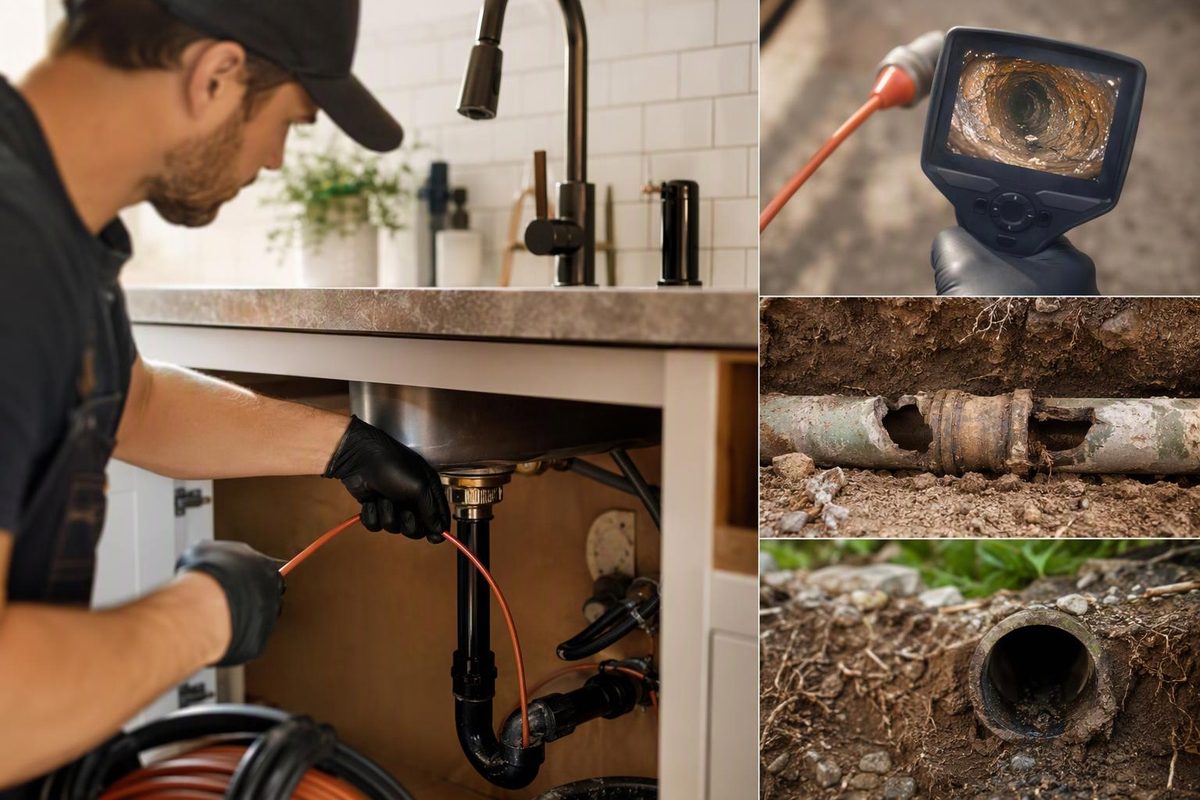
Start with the affected drains, learn when cleaning is enough, and compare spot repair, lining and replacement before approving sewer work.
A sewer backup does not automatically mean the pipe needs replacing. Grease or debris may need cleaning; a broken joint, hole or severe sag may need repair. Start with where wastewater appears and which fixtures are affected, then require evidence of the defect before approving permanent work.
1. Stop water use if wastewater is backing up
If dirty water rises through a shower, floor drain, toilet or sink, stop flushing and stop sinks, showers, laundry and dishwashers. Do not run more water to “test” the blockage. Middleton’s sewer-backup guidance makes stopping household water use the first step.
Keep children and pets away from sewage. Do not enter standing water to reach electrical equipment or a breaker panel; if power cannot be shut off safely from a dry location, get emergency help. Seattle Public Utilities warns against sewage contact and using electrical equipment while standing in water.
Stop point: Active wastewater overflow needs urgent professional attention, not another DIY clearing attempt. Do not add chemical drain cleaner. Tell the plumber about any cleaner already used. If cleaner remains in a blocked drain, plunging can splash it back; for example, Drano Max Gel’s precautions prohibit plunging during or after use.
2. Use the fixture pattern to choose the next call
Record what has already happened rather than deliberately recreating the backup:
| Observed pattern | What to investigate first |
|---|---|
| One fixture drains poorly; others behave normally | The fixture, trap or branch drain—not automatically the outdoor sewer line |
| Several fixtures in different rooms drain poorly | A possible shared house drain or sewer lateral blockage |
| A toilet flush sends wastewater into a shower or floor drain | A possible blockage downstream of the affected fixtures |
| Neighbors also report backups, or trouble coincides with heavy rain | A possible public-system problem as well as the private line |
These patterns narrow the investigation; they do not prove the pipe’s condition. Tacoma’s side-sewer assessment guide distinguishes fixture problems a plumber may resolve from structural side-sewer defects. Neighboring homes can also share a private sewer lateral, as Seattle’s shared-sewer guidance explains. For a closer location check, see main line vs. lateral line.
For a suspected shared-line blockage, check your sewer utility’s backup-reporting procedure and contact a plumber or sewer contractor who handles residential sewer work. The call order varies: Middleton asks residents to call the city first, while Seattle directs homeowners to call a plumber and involve the utility if a public-main or connection problem is suspected.
Do not assume responsibility ends at the property line. For example, Columbine Water and Sanitation District assigns homeowners responsibility for the service line and connection, including pipe beneath the street. Ask your own utility where its responsibility begins.
If the house uses septic, tell the contractor. The investigation must include the septic system rather than a public sewer main; see septic tank repair warning signs.
3. Separate clearing the blockage from repairing the pipe
A successful clearing restores flow. It does not by itself establish that the pipe is sound—or that replacement is necessary.
A camera inspection can help distinguish structural damage from grease or debris. Santa Barbara’s sewer-lateral program specifically recommends video inspection for that distinction. If debris or backed-up water prevents a useful view, ask what can be diagnosed now and whether cleaning followed by another inspection is needed.
Before authorizing repair, request:
- The recording and written findings, not just “the line is bad.”
- The defect’s location: distance from a named access point, surface location and estimated depth where excavation is proposed.
- The inspected extent: whether the camera reached the public connection or septic tank, and which sections remain unseen.
- The defect’s severity: roots, displaced joints, cracks, holes, collapse or standing water in a low spot.
- The reason for the proposed scope: why cleaning, monitoring or a smaller repair would not solve the problem.
Roots alone do not always require immediate full replacement. Tacoma’s guide allows routine removal of roots entering uncracked joints, but explains that permanent exclusion requires a watertight pipe through replacement or rehabilitation. Its recommendations also distinguish minor defects that can be monitored from severe defects needing repair. Local requirements may call for a different response.
4. Match the repair method to the documented damage
| Option | When it may fit | What it does not solve |
|---|---|---|
| Professional cleaning | Grease, debris or roots where the pipe remains serviceable | Holes, collapse, displaced pipe or a sag |
| Spot repair | One localized defect with the surrounding line in good condition | Defects distributed throughout the remaining pipe |
| Cured-in-place pipe lining (CIPP) | A suitable existing pipe that can be rehabilitated with a resin liner | A low spot or incorrect vertical alignment |
| Pipe bursting | Replacement along a suitable existing route while limiting surface disturbance | A sag that needs its elevation corrected |
| Open-cut replacement | Excavation is needed to replace damaged pipe, correct alignment or support it properly | It requires digging and restoration of disturbed surfaces |
These are screening distinctions, not a design specification. Tacoma describes each method and its suitability limits, including the value of spot repairs when most of the line is sound. Its guide rules out CIPP for collapsing or egg-shaped pipes and identifies multiple bends as a limitation for both lining and bursting. Ask the contractor to document why the existing pipe’s shape and route suit the proposed system.
Trenchless does not mean no digging. Pipe bursting generally needs installation and receiving pits. Lining may use existing cleanouts, but access work can still be necessary. Both follow the existing vertical alignment, so neither should be sold as correcting a sewer-line belly. Tacoma’s guidance and Charlotte Pipe’s explanation of how CIPP conforms to existing sags support that limitation.
5. Compare written scope—not just the total price
Get comparable written estimates for planned work once the immediate backup is controlled. Ask each contractor to identify:
- Repair limits and pipe material or lining system.
- Access pits, trenching and any work beneath a driveway, slab or street.
- Permits, utility coordination and required inspections.
- Connections and cleanouts included in the work.
- Backfill and restoration of concrete, paving or landscaping.
- Completion documentation, warranty terms and future cleaning restrictions.
- How concealed damage or a changed scope will be priced and approved.
A spot repair and a full lateral replacement are different jobs. A “trenchless” quote that excludes excavation or restoration is not directly comparable with an all-inclusive replacement quote.
For the homeowner, the safe role is observation and documentation—not excavating a buried sewer or opening a backed-up cleanout. You can locate access and photograph it without removing the cap; see how to identify a sewer line cleanout. Give the contractor the symptom history, previous clearing dates and inspection records, then approve a scope that addresses the documented fault and meets local requirements.