
Which Drain Line Is Clogged? Follow the Affected Fixtures
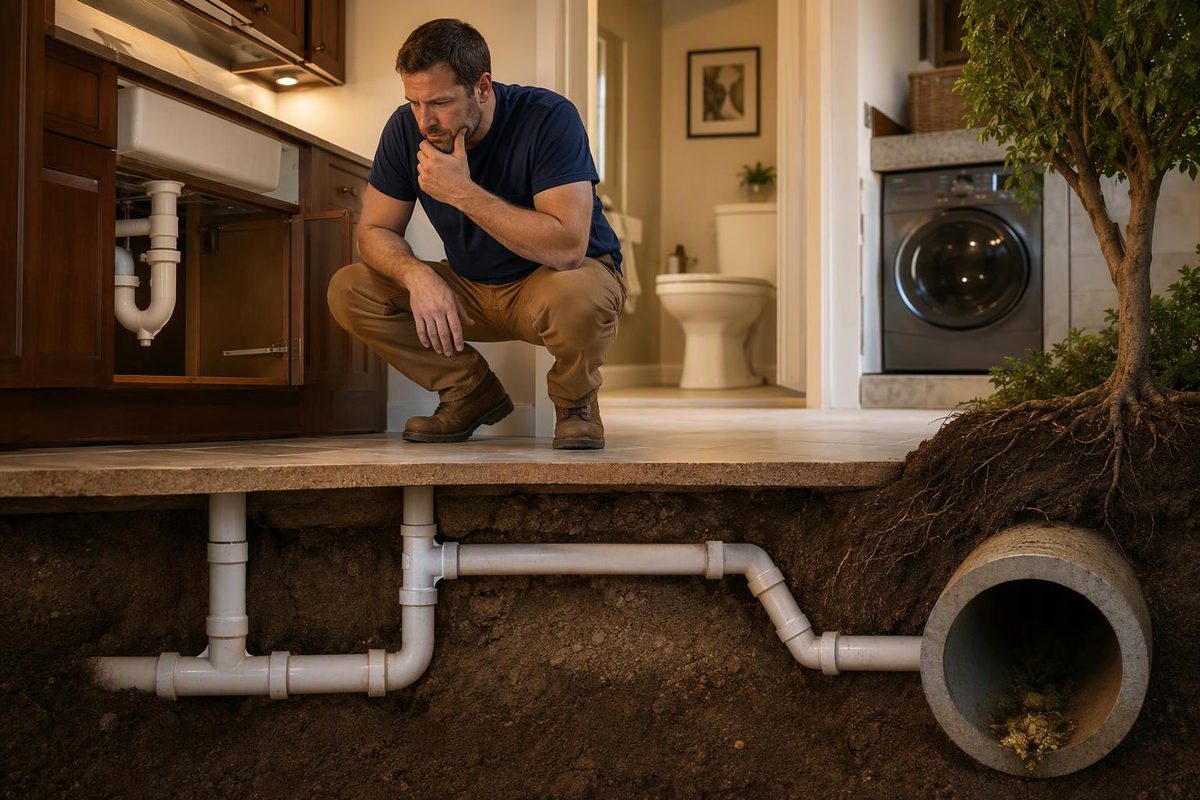
Use fixture patterns to distinguish a branch clog from a house drain, sewer lateral or public main problem, then choose the safest next call.
“Main line” and “lateral line” are not reliable opposites. If one fixture is affected, suspect its fixture drain or branch; if separated fixtures react, suspect the building drain or sewer lateral; if several properties back up, suspect the public sewer main. The decisive clues are which fixtures feed the blocked pipe and where the restriction sits—not simply what someone calls the line.
Select the affected fixtures and current conditions to identify the most likely line and next step.
Which Line Is Most Likely Blocked?
Nearby fixtures draining normally make a main or lateral blockage less likely. Start at the affected fixture and its branch.
Source note: Diagnostic boundaries follow the 2024 IPC model definitions and the municipal guidance cited in the article. Symptom patterns narrow the area but do not prove the exact blockage location.
Four Pipes Can Be Involved
A plumber may use main line for the large drain collecting wastewater inside a house, while a sewer utility uses sewer main for the public pipe under the street. A sewer lateral generally connects a house to that public main, but terminology and ownership boundaries vary by utility.
| Pipe | What It Serves | Typical Location |
|---|---|---|
| Fixture drain or branch line | One fixture or a small group, such as a kitchen sink and dishwasher | Inside the house |
| Building drain, often called the house main drain | Multiple branches | In or below the building and just beyond it |
| Building sewer, often called a sewer lateral or side sewer | The house’s combined wastewater | Outside, toward the street, easement or septic tank |
| Public sewer main | Multiple properties | Usually a street, alley or utility easement |
These distinctions track the 2024 International Plumbing Code’s model definitions. The building drain receives discharge inside and extends 30 inches beyond the exterior wall, while the building sewer continues from there to a public sewer, private sewer or individual disposal system. Local codes may use different terms or boundaries (International Code Council).
Seattle, for example, defines a side sewer as the privately owned and maintained system leading up to—but not including—the connection at the public main. It also recognizes side sewers shared by neighboring properties. That is one jurisdiction’s definition, not a nationwide ownership rule (Seattle Public Utilities).
A septic property has no municipal lateral-to-main arrangement. In a typical conventional system, one main drainage pipe carries household wastewater to the septic tank, after which effluent travels to the drainfield (EPA).
One Affected Fixture Usually Points to Its Branch
If only one sink, tub, shower or toilet has trouble and nearby fixtures drain normally, start with that fixture’s stopper, trap or branch line. A single clogged toilet does not establish a lateral problem.
The same reasoning applies when one appliance-related drain is affected. A slow kitchen sink with a normally operating bathroom does not, by itself, indicate a house-main or sewer-lateral blockage. For a slow sink, follow the sequence in How to Deal With a Slow Drain.
The diagnosis changes if using the affected fixture causes another drain to gurgle, rise or overflow. That response suggests the two drains meet upstream of the restriction.
One Group of Fixtures Points to a Shared Branch
A toilet and tub in the same bathroom—or a kitchen sink and adjacent laundry drain—may share a branch. Trouble limited to that group points more strongly to the common branch than to the whole-house drain.
Watch what happens during normal use, but do not repeatedly run water into a known stoppage. If flushing a toilet makes a nearby tub gurgle or its water rise, the restriction may be downstream of the point where those drains join.
Gurgling can also involve venting. It identifies a shared drainage or pressure problem more reliably than it identifies the exact cause. Fixture relationships and pipe layout still matter.
Separated Fixtures Point Farther Downstream
When fixtures in different rooms or on different floors drain slowly, gurgle or back up, a restriction in the building drain or sewer lateral becomes more plausible. The lowest open drain—often a basement floor drain, shower or first-floor tub—may show wastewater first. Municipal guidance similarly warns that sewer backups enter through the lowest drains first (City of Salem, Virginia).
Stop running faucets, flushing toilets, using the washer and operating the dishwasher. Added water can worsen an overflow. Do not keep testing fixtures to see whether the problem has cleared.
This pattern cannot establish whether the blockage is just outside the foundation or farther into the yard. The location of cleanouts, the behavior of the line when opened safely and sometimes professional cable or camera work are needed to narrow it down.
On a septic property, the same whole-house pattern can involve the building drain, the pipe to the tank or the septic system itself. There is no public sewer main for the utility to inspect.
Problems at Multiple Properties Can Indicate the Public Main
Several neighboring homes backing up at the same time, an overflowing manhole or confirmation from the sewer utility makes a public-main problem more plausible. Green Bay says a defect in its mainline can affect multiple properties, while roots, deterioration and obstructions in an owner’s lateral account for many individual-property backups (City of Green Bay).
Call the local sewer utility’s emergency or after-hours number when sewage is actively entering the home, a manhole is overflowing or neighbors report the same problem. The utility can check its main; that does not establish who must pay for work on the private or connecting line.
A neighbor’s unrelated slow sink is not enough to diagnose a public-main failure. Simultaneous whole-house backups, utility confirmation or a visible manhole overflow are stronger evidence.
The Property Line May Not Be the Responsibility Line
Do not assume the owner’s duty ends at the property line. Boundaries differ by utility and can extend into the public right-of-way.
Seattle says owners are responsible for their side sewer to the public main. Portland assigns owners the line from the house to the curb, including the sidewalk and parking strip, while the city maintains the lateral from the main to the curb (Seattle Public Utilities; City of Portland). These are local rules, not universal boundaries.
Shared laterals, easements and septic systems add further complications. Before approving excavation or lining work, ask the utility for its written service-boundary policy, available sewer maps or connection records, and confirmation of whether it has checked the public main. Also verify permit and right-of-way requirements and any rules that apply to a shared lateral.
Stop Water Use Before Investigating a Backup
- Stop all water use. Tell everyone in the house not to flush toilets, run faucets or operate water-using appliances.
- Keep people and pets away from sewage. Sewage can contain disease-causing pathogens. If limited contact is unavoidable, public-health guidance calls for protective gloves, eyewear and boots (Massachusetts DPH and MassDEP). Do not use electrical equipment while standing in water.
- Do not add chemical drain cleaner. Salem advises that chemical cleaners are unlikely to help a sewer backup and can cause additional damage (City of Salem, Virginia). They can also expose the person who later opens or cables the line.
- Do not casually remove a cleanout cap. A backed-up line may spill sewage when opened. First confirm that the fitting is a cleanout and read Sewer Line Cleanout: What It Is and Where to Find It.
- Call according to the symptom pattern. Contact the sewer utility for an overflowing manhole, simultaneous neighborhood backups or an active backup that may involve its main. Contact a drain professional when the evidence points to the building drain, lateral or septic connection.
When reporting the problem, state whether the backup is active, which fixtures are affected, the lowest fixture involved, whether water use elsewhere triggers it, whether neighbors are affected and whether the problem followed heavy rain.
Opening a line restores flow but does not necessarily identify why it clogged. If the stoppage recurs, ask whether a camera inspection after cleaning is appropriate to check for roots, a sag, a separated joint or a collapsed section.