
Diagnose the Failed Part Before You Pay for Septic Repair
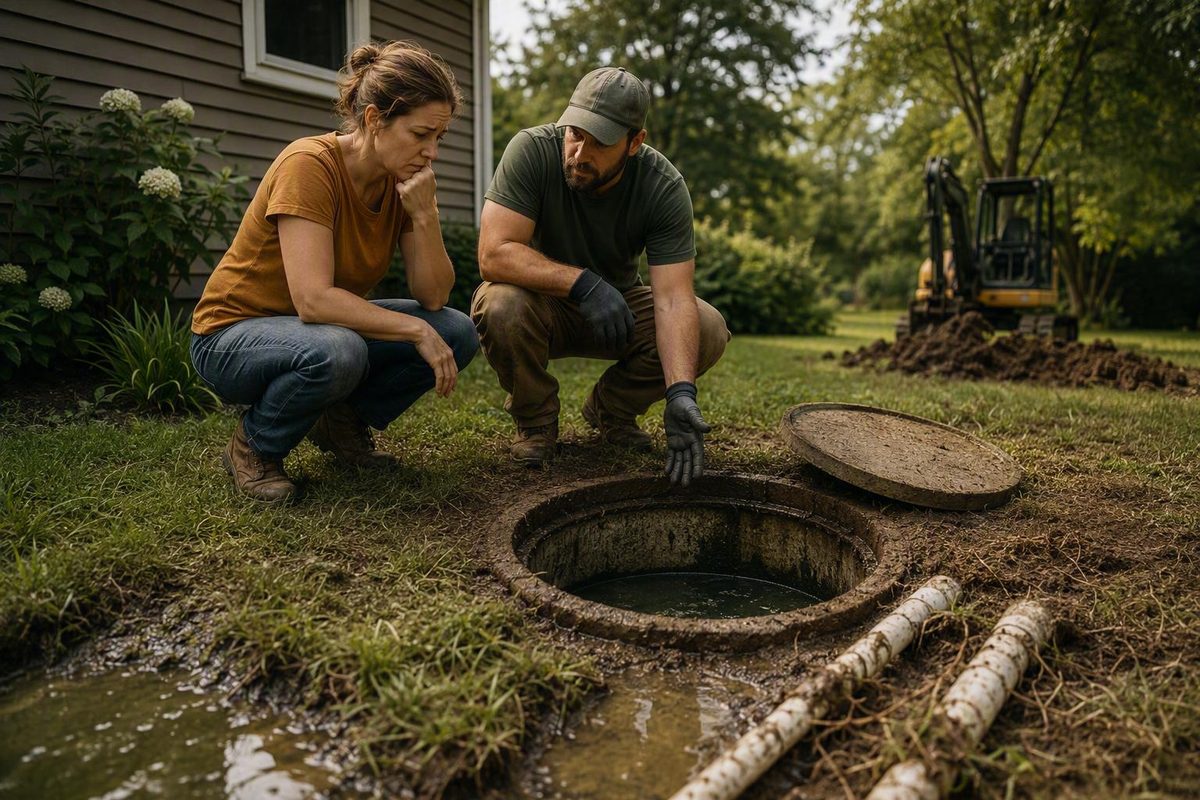
Which septic symptoms mean stop the water and call now, what an inspection must document, and Angi's 2026 repair ranges by part before you approve work.
Most septic tank repairs are component jobs, not system replacements. Angi’s 2026 data puts a typical septic tank repair at $627 to $3,043, with a national average of $1,829 across 1,763 verified projects. What you do first depends on what you see. If sewage is backing up indoors or wastewater is surfacing in the yard, stop discretionary water use now, keep people and pets away from it, and call a septic professional and your local health or environmental authority. For slow drains, gurgling, odor, or wet ground, book an inspection, and do not approve any repair or replacement until someone documents whether the fault is the tank, pump, baffle, filter, pipe, distribution box, or drainfield. The EPA’s septic-malfunction guidance makes the same point: symptoms tell you how fast to act, not which part to replace.
Pick the symptom you see; the urgency and next step update beside it. Once an inspection names the part, use the cost step below to build a planning range.
Septic Symptom Triage and Repair Cost Planner
1. What you see
Urgency and next step
UrgentDo now: Stop discretionary water use, keep everyone out of the affected area, avoid contact with the sewage, and call a septic professional and your local health or environmental authority.
Could be: Main drain or building-sewer blockage, tank at capacity, pump failure, blocked outlet, or a downstream failure.
Inspection should cover: Building sewer, tank level and outlet, pump and controls, then the drainfield. Do not approve a repair until the failed part is documented.
2. After the inspection names the part
Diagnosis only. Includes: inspection. Once the part is known, Angi's typical septic tank repair range is $627–$3,043 (2026 average $1,829).
| Component | Angi 2026 estimate |
|---|---|
| Lid | $150–$500 |
| Filter | $200–$300 |
| Baffle | $300–$900 |
| Pump | $250–$1,000 |
| Line | $1,000–$4,200 |
| Standard inspection | $100–$200 |
| Sewer-camera inspection | $250–$1,175 |
| Labor, when billed separately | $125–$250/hr |
| Drainfield or full-system replacement | — |
Sources: Angi 2026 septic tank repair cost guide (1,763 verified projects; national average $1,829); EPA septic-malfunction guidance for urgency. Marketplace planning estimates, not quotes. Excavation, electrical work, restoration, and drainfield work are priced separately.
Match the Symptom to How Fast You Need to Act
| What you see | Urgency | What to do now |
|---|---|---|
| Sewage backing up into toilets, tubs, showers, sinks, or floor drains | Urgent | Stop discretionary water use, isolate the area, avoid contact, call a septic professional and the local health or environmental authority. |
| Wastewater surfacing or pooling near the tank or drainfield | Urgent | Keep people and pets away, minimize water use, arrange a prompt professional assessment. |
| Wet or spongy ground over the drainfield in dry weather | Prompt inspection | Reduce water use; keep vehicles and equipment off the area. |
| Several slow or gurgling fixtures | Prompt inspection | Have the building sewer and septic system evaluated together, not fixture by fixture. |
| One slow fixture | Investigate soon | Check for a fixture trap or branch-line blockage first. |
| Persistent odor with no backup or wet ground | Investigate, do not assume failure | Check plumbing traps and venting; book an assessment if it continues. |
Household wastewater carries disease-causing organisms, and a malfunctioning system can contaminate soil, groundwater, surface water, or nearby wells. If sewage has entered occupied space, avoid direct contact and get cleanup guidance from the local health or regulatory agency rather than treating cleanup as part of the repair. The EPA’s SepticSmart homeowner guide lays out those health and environmental risks.
Odor deserves attention, especially alongside slow drains, backups, or wet ground. On its own it does not prove septic failure; a dry trap or a vent problem produces the same smell.
Why Symptoms Cannot Name the Failed Part
A symptom pattern narrows the inspection scope. It cannot reliably identify the failed component from the kitchen.
| Symptom pattern | Possible causes | Best next step |
|---|---|---|
| One slow sink, tub, shower, or toilet | Fixture trap or local branch blockage | Evaluate the fixture and branch before assuming a septic problem. |
| Multiple slow or gurgling fixtures | Building-sewer blockage, restricted inlet, high tank level, pump problem, or downstream issue | Evaluate both the building sewer and the septic system. |
| Indoor sewage backup | Main drain or building-sewer blockage, tank at capacity, pump failure, blocked outlet, or downstream failure | Stop water use, isolate the area, call promptly. |
| Standing wastewater near the system | Tank or pipe leak, hydraulic overload, blocked line, or drainfield malfunction | Keep clear and arrange urgent inspection. |
| Wet, spongy, or unusually green drainfield | Excess hydraulic loading, uneven distribution, damaged pipe, high groundwater, stormwater, grading, broken water line, or reduced field capacity | Minimize water use and request a site evaluation. |
| Odor alone | Dry trap, vent obstruction or placement, weather, tank access issue, or septic malfunction | Rule out plumbing and vent causes; never authorize replacement on smell. |
When several fixtures slow down or gurgle together, the shared building sewer and septic system deserve attention. Even then, the pattern cannot separate a blockage from accumulated solids, a failed pump, or a problem farther downstream. Wet soil over the drainfield during dry weather is one of the more serious signs; unusually lush grass over the field points the same way.
What the Inspection Should Document Before You Approve Work
A sound evaluation starts with records and history, then moves through the system in sequence. Before approving anything, gather:
- The original permit and as-built drawing
- System design and installation date, if known
- Pumping and inspection records
- Prior repair invoices and photographs
- Alarm or control-panel history
- Timing of symptoms, recent rainfall, and changes in occupancy or water use
- Any recent landscaping, excavation, vehicle traffic, construction, or power outage
Your local health or environmental department may hold permits, as-built drawings, soil information, and prior approvals, and it sets the permit rules and professional credentials that apply. The EPA’s septic-system FAQ points homeowners to that local permitting authority for property records and qualified local professionals.
Depending on the system and the suspected fault, the inspection may cover tank material and structural condition; cracks, corrosion, leakage, and infiltration; sludge and scum levels; lids, risers, and access; inlet and outlet baffles; the effluent filter; pumps, floats, alarms, and controls; inlet, outlet, and building-sewer pipes; distribution box condition and level; leach lines; signs of surfacing or uneven loading; and drainfield performance with the relevant soil and groundwater conditions.
Different failures have different consequences. A failed outlet baffle lets solids move toward the drainfield. A failed pump stops effluent reaching the next component. A damaged or unlevel distribution box overloads one part of the field while starving another. A blocked, separated, root-damaged, or crushed line causes backups even when the tank is sound.
Camera inspection, line clearing, pump testing, or electrical diagnosis may follow the initial look. The proposal should state what will be tested, why, and what result would confirm or rule out the suspected fault. Pumping is maintenance; it removes sludge and scum, gives access for inspection, and may temporarily relieve a capacity problem, but it is not a diagnosis.
Septic Tank Repair Costs by Component
Angi’s 2026 national average is $1,829, with a typical range of $627 to $3,043 from 1,763 verified projects. These are marketplace planning estimates, not quotes for your property, and they do not cover drainfield or full-system replacement. See Angi’s 2026 septic repair cost data.
| Component | Angi 2026 estimate | Scope reminder |
|---|---|---|
| Lid | $150–$500 | Confirm whether access work or a riser is included. |
| Filter | $200–$300 | Ask whether the price covers cleaning, replacement, or both. |
| Baffle | $300–$900 | Tank condition and access change the work required. |
| Pump | $250–$1,000 | Electrical diagnosis, controls, floats, and wiring may be separate. |
| Line | $1,000–$4,200 | Length, depth, excavation, obstructions, and restoration matter. |
Diagnosis is its own line item. Angi lists a standard inspection at $100 to $200, a sewer-camera inspection at $250 to $1,175, and labor at $125 to $250 per hour when billed separately. It estimates $20 to $50 for some smaller-repair permits and $460 to $2,770 for full-replacement permits; local departments set their own fees. A general septic inspection and a camera run on one specific pipe are not interchangeable, so ask what access, testing, reporting, labor, and regulatory costs each price includes.
Do not fold inspection, pumping, component repair, excavation, drainfield work, tank replacement, and full-system replacement into one assumed total. Price moves with the failed component and extent of damage, conventional versus alternative design, tank material, size, and depth, access for pumping or excavation, soil, groundwater, and slope, pipe length and fault location, local labor and equipment rates, electrical work, permits, design, and testing, and waste handling and landscape restoration. If the evaluation points to the soil absorption area, compare that scope separately using a current drainfield replacement guide; drainfield replacement is a different project from septic tank repair.
When Repair Is Enough and When Replacement Is Justified
Most systems are built from replaceable parts. A failed lid, filter, baffle, pump, float, line, or distribution box does not mean the tank and drainfield both go. The decision should follow a documented finding and local approval requirements.
| Documented finding | Targeted repair | Evidence to request |
|---|---|---|
| Damaged lid, riser, baffle, or filter | Repair or replace the part | Photos, tank-condition notes, part specification, repair method |
| Failed pump, float, alarm, or control | Replace the mechanical or electrical component | Test results, model information, fault diagnosis, post-repair operating test |
| Blocked, separated, root-damaged, or crushed line | Clear, repair, or replace the affected section | Camera findings, damage location and length, proposed verification |
| Damaged or unlevel distribution box | Repair, reset, or replace it and fix connected piping | Distribution findings, loading pattern, field assessment |
| Tank crack, leak, or corrosion | Site- and material-appropriate repair | Condition report, photographs, repair feasibility, local approval requirements |
| Drainfield not accepting effluent | Correct hydraulic or distribution faults if recoverable | Field evaluation covering pumps, pipes, distribution, and excess water use |
Replacement becomes the reasonable call when the evidence shows broader structural deterioration, obsolete or repeatedly failing equipment, extensive line deterioration along the run, field laterals damaged along with the box, severe tank damage that no reliable repair can fix, or lost dispersal capacity and repeated surfacing. Every one of those conclusions still needs a site evaluation and whatever design review the local authority requires.
Age is context, not an expiration date. Service life depends on design, material, installation quality, soil and groundwater exposure, maintenance, household loading, and component type. A newer system fails from damage or poor siting; an older one keeps working if condition and performance hold up.
Before authorizing full replacement, get a written diagnosis that explains:
- What failed and how that conclusion was reached.
- Which smaller repairs were considered.
- Why a targeted repair would not restore compliant operation.
- Whether the tank, field, and connecting components were evaluated separately.
- What permits, design work, and final inspections apply locally.
If the explanation rests mainly on odor, age, or a generic symptom list, get a second septic-specific opinion. The local onsite-wastewater authority can also confirm whether the proposed scope matches the property records.
How to Compare Two Septic Repair Bids
Compare identical scopes, not bottom lines. Ask each bidder to separate inspection, pumping, component repair, drainfield work, tank replacement, and full-system replacement, then check:
- Diagnosis: the failed component and the evidence behind it, in writing.
- Credentials and insurance: any license, certification, or registration your jurisdiction requires, verified with the issuer, plus current proof of insurance for the work proposed.
- Parts and labor: replacement components named clearly enough to compare; labor, equipment, and subcontractors included or listed.
- Pumping and excavation: whether pumping is included or required first; who locates utilities, digs, shores, and backfills.
- Electrical: pumps, floats, alarms, controls, wiring, and any electrician.
- Permits: who applies, pays, coordinates review, and answers corrections.
- Cleanup and restoration: waste removal, grading, topsoil, seed or sod, hardscape, fencing, irrigation.
- Testing and warranty: how flow, pump operation, watertightness, or blockage removal will be verified; what parts and labor are covered, for how long, with which exclusions.
- Change orders and exclusions: which conditions can raise the price, whether changes need written approval, and which foreseeable costs are left out.
A proposal that says only “repair septic system” without naming the component, excavation limits, testing, restoration, and exclusions cannot be compared to anything. After completion, collect permits, inspection approvals, test results, photographs, warranty terms, replaced-part information, and updated maintenance instructions, and file them with the as-built drawing and pumping records.
Directory ratings and promotional claims do not establish septic expertise, licensing, insurance, or workmanship. Verify those through the regulator, the insurance documents, references, and the written proposal.
Keeping the Repaired System Out of Trouble
The EPA’s general guidance is to inspect most household systems every one to three years and pump every three to five years. Timing depends on tank size, household size, water use, accumulated solids, garbage-disposal use, and system type; alternative and complex systems often need more frequent service. Those intervals come from the EPA malfunction guidance cited above.
Keep the load inside the design. Flush only human waste and toilet paper; keep grease, wipes, food solids, coffee grounds, drain cleaners, solvents, paints, pesticides, and pharmaceuticals out; limit garbage-disposal use; fix leaks; and spread laundry across the week instead of running it all on one day.
Treat the drainfield as infrastructure. Keep vehicles, livestock, and heavy equipment off it, do not pave or build over it, divert roof drains, sump discharge, and stormwater away, keep trees and deep-rooted plants clear, and do not dig or regrade without knowing the layout.
Additives are not maintenance. The EPA does not recommend them for domestic wastewater treatment because they are unnecessary, do not eliminate pumping, and may impair performance or harm the environment; the homeowner guide cited earlier says the same. Keep the permit, as-built drawing, pump-out reports, inspection findings, invoices, photographs, and test results together. Good records shorten the next diagnosis and separate a recurring defect from a new problem.
Can Septic Tank Pumping Fix a Backup?
Sometimes, when the cause is excess accumulated solids or a temporarily overfull tank. Pumping does not fix a failed pump, cracked tank, blocked or crushed line, damaged distribution box, unsuitable site, or a drainfield that has lost capacity. Ask the professional to document why the backup happened rather than treating temporary relief as proof of repair.
Who Should I Call First for a Suspected Septic Problem?
For an indoor sewage backup or surfacing wastewater, a septic-specific service professional and your local health, environmental, or onsite-wastewater authority. A plumber is the right first call when only one fixture is affected and the building drain or sewer line is the likely cause. If sewage has entered occupied space, get local health guidance for cleanup.
How Can I Find My Septic Permit or As-Built Drawing?
Contact the agency that permits onsite wastewater systems, usually a county or municipal health, environmental, building, or planning department. Search by address, parcel number, owner name, or permit number. Closing documents, original building plans, prior inspection reports, and pumping or repair company records are the other places it turns up.
How Long Can a Septic Tank or Drainfield Last?
There is no fixed lifespan. The EPA notes that concrete tanks may last 50 years or more under favorable conditions, while pumps and controls need replacement sooner and older drainfields gradually lose capacity; see the EPA’s septic-system FAQ. Condition and performance matter more than age.
If trouble appears, the order is fixed: reduce water use and isolate any sewage-exposed area; gather the system records and contact the local authority or a septic-specific professional; then authorize work only after a documented diagnosis and an itemized scope.