
Find Your Main Sewer Access Before a Backup Becomes an Emergency
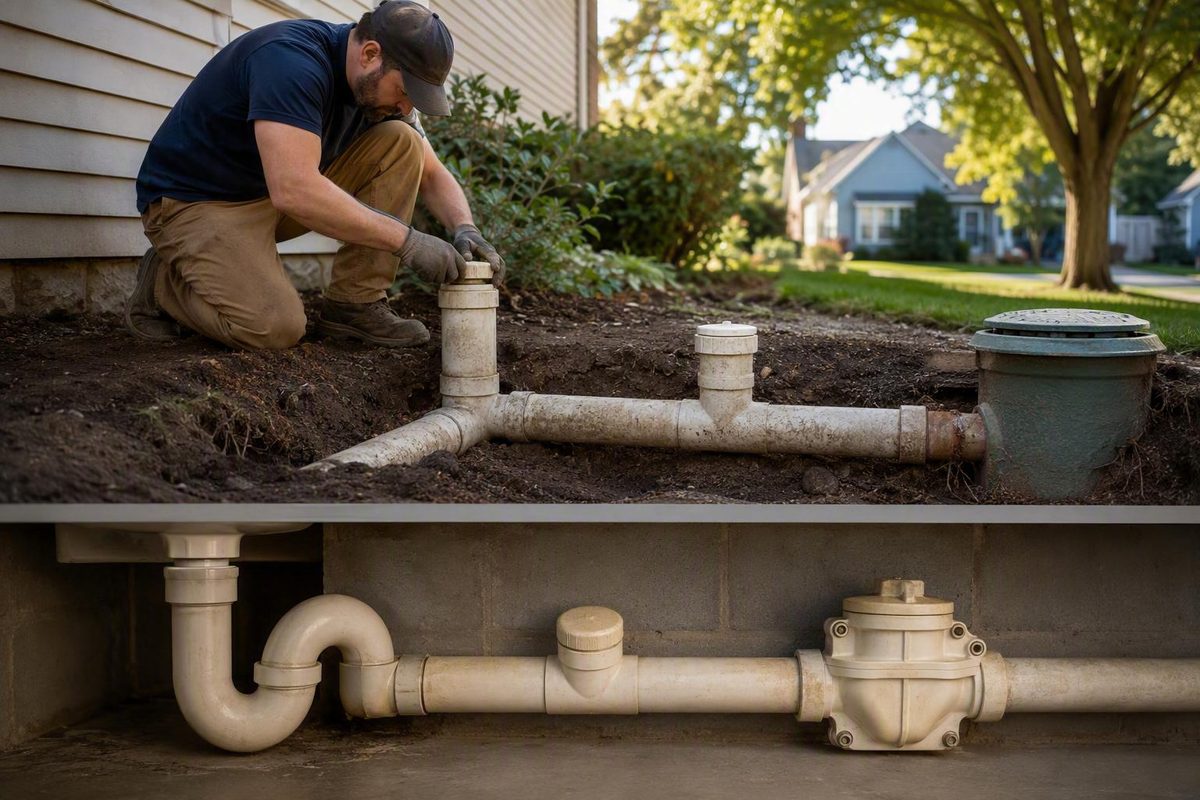
Distinguish main access from branch cleanouts, house traps, and backwater valves—and learn why a backed-up line makes cap removal dangerous.
A sewer line cleanout is a capped fitting connected to your building sewer or private lateral. It gives a plumber direct access for inspection and clearing, but it does not prevent backups. Find and document it before an emergency. If sewage is entering the home, escaping around the cap, or affecting several fixtures, stop using water and contact your sewer utility or a licensed plumber. Do not remove a cap when wastewater may be standing behind it.
What a sewer line cleanout is—and why it matters
The main sewer cleanout provides access to the pipe carrying wastewater away from the house toward a public sewer main or private septic system. That property-serving pipe may be called the building sewer, service line, or private lateral. It is separate from the larger public sewer main serving multiple properties.
A common modern cleanout looks like a short vertical pipe with a removable threaded cap. Many are roughly 3 or 4 inches in diameter, but that is a recognition clue—not a rule. Size, height, material, color, orientation, and cap design vary. Caps may be plastic, brass, or cast iron and can have round, square, or hex-shaped tool features. Examples of modern cleanouts show how their appearance and location can differ.
Through the cleanout, a plumber may:
- Insert a sewer camera to locate an obstruction and examine pipe condition.
- Feed a cable, snake, or rod into the line.
- Use a cutter for some root intrusions.
- Perform water jetting where the access, deposits, and pipe condition are suitable.
- Evaluate where a blockage or defect lies before recommending excavation or repair.
Direct access can be less disruptive than reaching the sewer through a fixture. It does not guarantee that the obstruction is reachable, that cleaning will restore the full pipe opening, or that excavation can be avoided. Cracked, offset, settled, or collapsed pipe may still require structural repair.
The cleanout is also not a protective valve. It provides access to the sewer; it does not stop sewage from reversing direction or prevent a blockage from forming.
Where to look: exterior and interior search checklists
Start by estimating where the main drain leaves the house. On a municipal system, the line generally heads toward a street, alley, easement, or other connection point. On a septic property, it heads toward the tank. Additions and previous plumbing alterations can make the route less obvious.
Exterior search checklist
- Check near the foundation where the main waste pipe is likely to leave the building.
- Follow the likely route toward the street, property line, alley, or septic tank.
- Look at or slightly above ground level for a removable round, square, or hex-featured cap.
- Check behind shrubs, ground cover, utility equipment, and stored materials.
- Inspect the edges of patios, driveways, walkways, and later additions.
- Note unexplained covers or capped fittings, but do not open them merely to identify them.
- Review plumbing permits, inspection documents, septic plans, and available property records.
Interior search checklist
- Follow the largest visible waste pipe in the basement or crawl space.
- Inspect the wall or floor area where that pipe exits the building.
- Check the garage, utility room, and laundry area.
- Look for capped fittings near the base of a main drain stack.
- Distinguish a fitting on a smaller branch from access to the building sewer.
- In an older home, look for a house trap with two nearby caps rather than one straight-through cleanout.
Landscaping, soil, mulch, paving, additions, and earlier repairs can conceal an access point. Some older houses have no readily accessible modern cleanout. If records do not resolve the location, a plumber can trace the probable route and identify targeted access.
Do not excavate blindly or assume that every capped yard pipe belongs to the sewer. An unidentified fitting could be associated with drainage, irrigation, or another system.
Once a plumber or utility confirms the cleanout, measure its position from two permanent landmarks, such as a foundation corner and utility meter. Take photos, note whether it is a main or branch access, and keep vegetation and stored objects away from it.
Confirm that it is a cleanout, not another plumbing component
Color and diameter alone cannot establish what a capped pipe is. Its connection, location, and configuration matter more.
| Component | Typical identifying clues | Purpose | Homeowner access? |
|---|---|---|---|
| Main sewer cleanout | Removable cap on a fitting connected to the building sewer; may be inside or outside | Inspect or clear the main private line | Locate and document; do not open during a suspected backup |
| Branch cleanout | Associated with a smaller line or limited fixture group | Access one branch of the drainage system | Identification does not make opening safe; seek help if pressure, damage, or backup is possible |
| House trap | U-shaped main-line fitting, often with two nearby caps | Maintains a water seal in the main drain | Leave service to a plumber, especially during a backup |
| Backwater valve | Access box or valve body containing a flap or check mechanism | Resists reverse wastewater flow | Follow manufacturer instructions and local requirements |
| Roof vent | Open-ended pipe terminating above the roof | Admits air and vents drainage gases | Do not treat it as routine homeowner access |
| Public manhole | Large cover in a street, easement, or public area | Utility access to the collection system | Authorized personnel only |
A main cleanout reaches the building sewer. A branch cleanout reaches only the line serving a particular fixture group or area. Clearing a branch may therefore do nothing about an obstruction farther downstream.
A house trap is a U-shaped main-line fitting that intentionally retains water and may have two adjacent capped openings. Water visible in its bend can be normal and does not automatically prove that the downstream sewer is backed up.
A backwater valve is a check valve intended to resist reverse wastewater flow. It is not a cleaning access, even when installed on the same private service line. A roof vent belongs to the drainage vent system, while a public manhole belongs to the public collection system and should not be opened by a homeowner.
Use the symptom pattern to judge whether the main line may be involved
The number and location of affected fixtures are more useful than any single symptom. One slow sink, tub, or toilet may have a local fixture or branch clog. Several fixtures affected together—especially low-level fixtures—make a shared drain or sewer restriction more likely.
| Symptom | What it may indicate | Immediate action |
|---|---|---|
| One slow fixture | Local trap, fixture, or branch restriction | Stop using that fixture and investigate locally |
| Several slow fixtures | Shared drain, building drain, or sewer restriction | Limit water use and arrange diagnosis |
| Toilet gurgling | Air displacement from a restriction or vent issue | Check whether other fixtures are affected |
| Wastewater in another fixture | Downstream shared-line blockage | Stop water use and call for help |
| Sewage odor | Dry trap, vent issue, loose cap, leak, or backup | Avoid contact and identify the source |
| Discharge around cleanout | Backed-up line, loose cap, or damaged fitting | Keep clear, stop water use, and call |
| Active indoor sewage backup | Private-line or public-system problem | Stop water use, isolate the area, and escalate |
Cross-fixture behavior is particularly important. Widespread gurgling or sewage rising through low drains also points toward a shared downstream line.
A blockage that returns after cleaning deserves more investigation than a one-time removable clog. Roots may be entering through a joint or break, or the pipe may be deteriorated, offset, settled, or collapsed. Repeatedly opening a temporary path does not correct the underlying defect.
Symptoms alone cannot establish whether the problem is in the private lateral or public main. If neighboring properties are also affected, a public problem becomes more plausible, but the sewer utility should make that determination.
Stop using sinks, toilets, showers, dishwashers, and washing machines when sewage is entering the home, emerging around the cleanout, or affecting multiple fixtures. Additional household discharge can add wastewater behind the obstruction.
Safety first: when not to remove the cap
Do not remove a sewer cleanout cap if the line may be backed up. Wastewater can be standing behind it and may spill or spray as the cap is loosened. Guidance on cleanout access specifically warns that backed-up wastewater can escape when a cap is opened. Treat an apparently dry cap as potentially loaded from behind.
Stopping household water use limits additional discharge, but it does not remove sewage already trapped in the line.
Keep children and pets away and avoid skin, eye, or mouth contact. Sewage and floodwater may contain bacteria, fecal material, viruses, and other hazardous microorganisms, according to Monroe County’s sewage-backup safety guidance.
Call a licensed plumber for:
- An active sewage backup.
- Wastewater leaking or pushing around a cleanout cap.
- A deep or recurring main-line obstruction.
- Suspected roots or structural pipe damage.
- A damaged, seized, or badly corroded fitting.
- Any uncertainty about the fitting or whether wastewater is behind it.
Plumbing service and contamination cleanup are separate tasks. A plumber diagnoses and restores the pipe.
How professionals inspect and clear a sewer through the cleanout
The appropriate method depends on the obstruction, pipe material, layout, access, and structural condition. The cleanout provides an entry point; it does not dictate the tool.
| Method | Purpose | Likely use | Main limitation |
|---|---|---|---|
| Camera inspection | View and locate conditions inside the line | Obstructions, roots, joints, offsets, suspected damage | Diagnoses but does not clear |
| Snaking or rodding | Penetrate, break, or retrieve obstructions | Soft blockages, paper, some foreign material | May create only a partial opening |
| Root cutting | Cut intrusive roots from the flow path | Confirmed root intrusion | Does not repair the root-entry defect |
| Water jetting | Remove suitable buildup with directed water | Grease, sewage, soap, and some deposits | Requires suitable access, equipment, and pipe condition |
A sewer camera may show an obstruction, root intrusion, displacement, or possible structural damage. It can help define the next step when the cause or repair scope is uncertain, but camera inspection is not automatically necessary before every ordinary cleaning.
Snakes and rodders use cables or rods with selected heads to penetrate or retrieve some obstructions. Water jetting directs water through the pipe to remove suitable accumulations. Professional equipment categories include rodders, cutters, augers, and water jetters for different lines and obstructions; manufacturers list grease, sewage, soap, and roots among their intended applications. RIDGID’s drain-cleaning categories illustrate these method differences.
No cleaning method repairs a cracked, offset, collapsed, or otherwise failed sewer. Root cutting may restore flow without sealing the joint, break, or other opening through which the roots entered. After service, ask what was removed, whether the full pipe opening was restored, what an inspection showed if one was performed, and whether structural repair is recommended.
If no usable cleanout exists, a plumber may consider access through a house trap, removed toilet, roof vent, or controlled opening in the pipe. Those options carry configuration-specific risks and are not homeowner procedures.
Keep the access usable and reduce preventable blockages
Routine homeowner maintenance is mainly about preserving access—not running powered equipment through the sewer.
Cleanout access checklist
- Keep the fitting visible above landscaping or clearly marked if properly set at grade.
- Prevent vegetation, soil, mulch, snow, and stored objects from hiding it.
- Do not pave or build over it without an approved access solution.
- Record measurements from permanent landmarks and keep photos with home records.
- Watch for a cracked, missing, loose, leaking, corroded, or damaged cap.
- Protect exposed fittings from lawn equipment and vehicle traffic.
- Have an unidentified or poorly fitting cap assessed before changing it.
A properly fitted cap helps contain sewer gas and keep soil, debris, and pests out. Do not permanently glue shut an access designed for removal, force an incompatible cap, or improvise a cover. The material, thread, seal, and fitting condition need to match.
Prevention starts at the fixtures. Keep cooking fats, oils, grease, and food scraps out of drains. Do not flush wipes, diapers, dental floss, condoms, or personal-hygiene products. Raleigh’s municipal guidance, for example, identifies these materials as items that do not belong in the sewer system.
There is no universal annual cleaning or inspection schedule for every house. Appropriate frequency depends on pipe age and material, tree-root exposure, previous backups, known defects, and professional findings. A line with recurring root intrusion needs a different plan from a newer line with no history of trouble.
Keeping the fitting visible and protected is reasonable homeowner work. Powered augers, rodders, root cutters, water jetters, and structural sewer repairs are not routine DIY maintenance.
Who to call—and why local rules control
Homeowners commonly maintain the private service line or lateral, while the sewer utility commonly maintains the public main. The exact boundary may be the property line, sewer tap, public right-of-way, lot-line cleanout, or another point established by local policy.
Local examples show why the boundary must be verified:
- Raleigh, North Carolina: The city says it handles sewer-main breaks in the street, while owners are responsible for blocked or broken service lines on private property. Raleigh’s sewer FAQ explains this local division.
- Bloomington, Illinois: The city defines the private service line as running from the home to the sewer tap and assigns its maintenance and repair to the property owner. When the blockage location is unknown, the city advises residents to contact Public Works before hiring a drain-cleaning company. Bloomington describes its responsibility and reporting arrangement here.
- Monroe County, New York: In participating areas, a lot-line cleanout may affect how municipal service is handled between that access point and the sewer main. Not every property has one, and the building owner remains responsible for locating and maintaining the cleanout under the county’s described arrangement.
These are local examples, not national rules. Ask your sewer utility:
- Where does private responsibility end at this address?
- Is there a recorded lot-line or property-line cleanout?
- Will the utility check the public main when the blockage location is unknown?
- Must the utility inspect or document the problem before private excavation?
- Are permits required to install, raise, relocate, or replace a cleanout?
Contacting the utility first is particularly useful when several properties may be affected, the blockage location is unknown, or a plumber suspects the public main. Confirm the utility’s process before authorizing extensive excavation unless site conditions require immediate emergency work.
Cleanout size, number, placement, spacing, accessibility, permits, and retrofit requirements depend on the plumbing code currently adopted by the jurisdiction and any local amendments. Historical model-code editions do not establish what is enforceable at a particular home. The 2012 and 2018 International Plumbing Code sanitary-drainage provisions direct building-sewer cleanout location requirements to Section 708, but applicable details must be verified against the current locally adopted code.
Identify and document the cleanout before trouble starts, and keep it accessible and securely capped. If several fixtures are affected or sewage is backing up, stop using water and do not remove a cap that may have wastewater behind it. Contact the sewer utility when the blockage location or ownership boundary is uncertain; contact a licensed plumber for private-line diagnosis, recurring clogs, roots, damaged fittings, or suspected pipe failure.