
How Much Time to Allow for a Septic Pump-Out
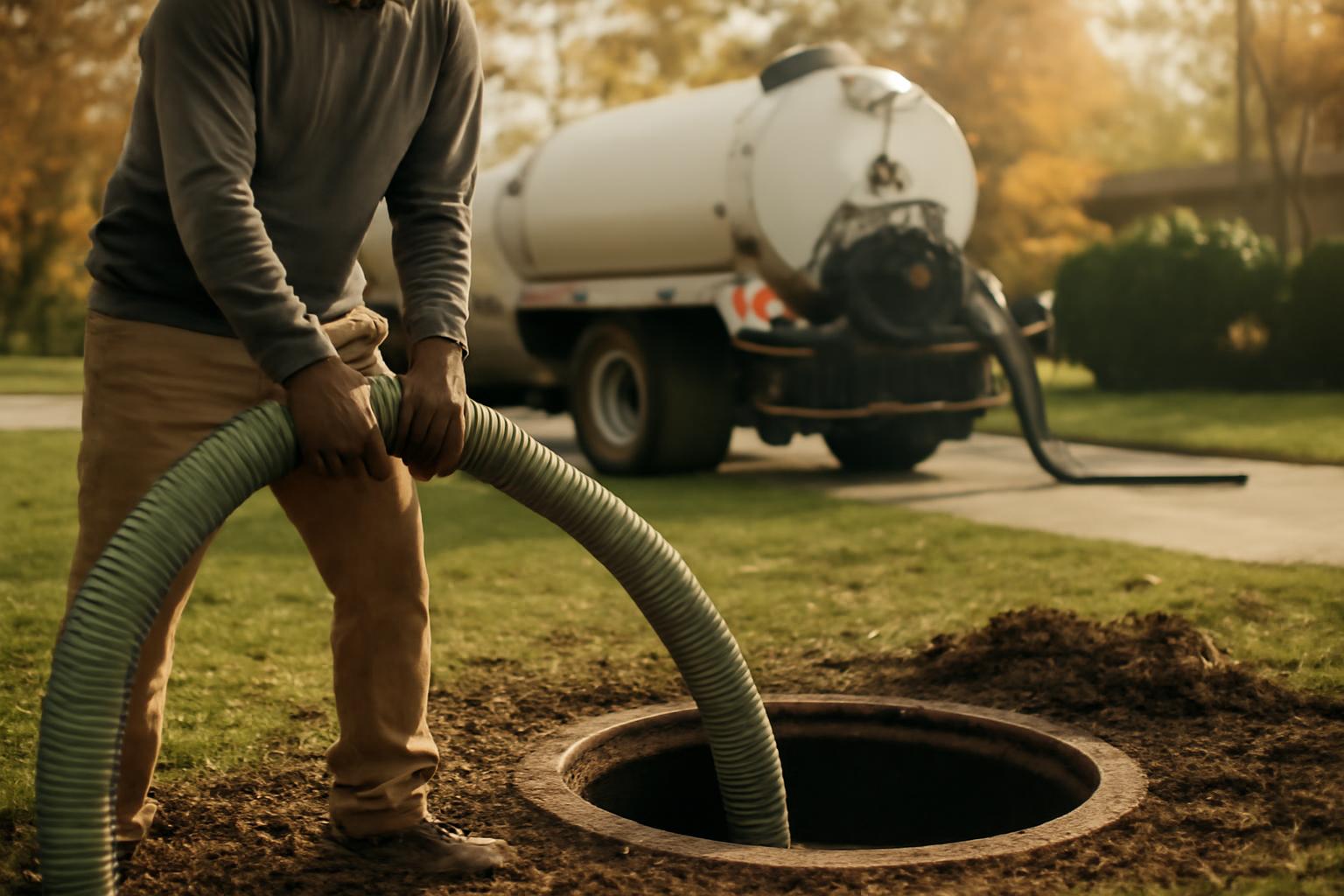
Active pumping may take 20-60 minutes, while the complete visit may last 1-3 hours. Buried access, compacted solids and extra components can extend it.
The short answer: allow more time than the pumping itself
For planning purposes, allow approximately 20–60 minutes for active pumping. This range describes the period when the pumping equipment is removing the tank’s contents, not the technician’s entire visit. It is a commercial provider estimate rather than an independently established industry benchmark.Wind River Environmental describes the 20–60-minute pumping estimate
For the complete residential service appointment, allow roughly 1–3 hours when the tank has good access. That broader estimate includes arrival, assessment, access preparation, equipment setup, pumping, a basic inspection, closure, cleanup, and documentation.Dr. Septic explains the full residential service timeline
An accessible residential tank with ordinary solids commonly falls near the narrower end: about 20–45 minutes of active pumping. One provider further describes 20–30 minutes as a favorable estimate for an accessible 1,000-gallon tank with normal sludge levels.Plumbing Experts describes routine and favorable pumping scenarios
The two ranges measure different things:
- Active pumping time: The period when truck-mounted equipment is removing liquid, bottom sludge, and floating material from the tank.
- Complete appointment time: All technician time on the property, including assessment, access, setup, pumping, inspection within the agreed scope, closure, cleanup, and paperwork.
These figures are practical scheduling estimates reported mainly by commercial septic-service providers. They are not guaranteed national averages.
Reserve more time than the expected pump cycle. Even if waste removal takes less than an hour, do not assume the technician will arrive, open the tank, pump it, inspect accessible components, clean up, and leave within the same window.
Why septic pumping has two different time estimates
Published answers can appear contradictory because they do not always define when the clock starts and stops.
A statement such as “pumping takes 30 minutes” generally describes active pumping: the hose is in the open tank and the truck’s equipment is transferring the contents. A statement such as “allow up to three hours” is more likely to describe total technician time, beginning with arrival and assessment and ending with closure, cleanup, and documentation.
One commercial provider offers this illustrative breakdown:
| Service phase | Provider estimate |
|---|---|
| Initial assessment | 10–15 minutes |
| Access and equipment preparation | 15–30 minutes |
| Active pumping | 20–45 minutes |
| Basic inspection | 15–30 minutes |
| Cleanup and documentation | 10–15 minutes |
This is one provider’s estimate, not a universal service standard. It nevertheless illustrates how several relatively short phases can turn a sub-hour pumping operation into a longer appointment.See the provider’s phase-by-phase septic-service estimate
There is also a scope problem. “Septic pumping” may mean opening an accessible tank and removing its contents. A broader appointment might include locating the tank, excavating buried access points, opening multiple compartments, inspecting visible baffles, replacing disturbed soil, and preparing a written report. Until those inclusions are stated, two contractors’ estimates may not describe the same job.
Routine pumping should be separated from additional work such as:
- Extensive excavation to locate or reach the tank
- Detailed diagnostic testing
- Interior cleaning beyond ordinary pumping
- Replacing lids, risers, baffles, filters, or other components
- Repairing a damaged tank or connecting pipe
- Investigating a malfunctioning drainfield
- Servicing or repairing a separate pump chamber
These tasks may be available during the same visit, but they are not automatically part of a standard pump-out. Ask where the routine scope ends, what requires separate authorization, and which services carry additional charges.
What happens during a typical septic pumping visit
A straightforward residential appointment usually follows this sequence:
- Confirm the tank location. The technician reviews information from the homeowner, visible risers, prior records, or site clues.
- Assess access. The contractor determines whether the truck can be positioned appropriately and whether gates, terrain, structures, vehicles, or landscaping restrict the hose route.
- Uncover and open the tank. Exposed riser lids may be opened directly. Buried access points must first be located and uncovered.
- Position the equipment. The technician parks the truck, lays out the hose, and prepares the pumping equipment.
- Remove the contents. Liquid and accumulated solids are transferred from the septic tank to the truck.
- Inspect accessible components. Depending on the agreed scope, the technician may examine visible baffles, liquid-level clues, lids, walls, or other accessible areas.
- Close the tank. Lids are secured, and any included soil replacement is completed.
- Clean and document the service. The work area is tidied, findings are discussed, and paperwork or service records may be provided.
Inside the tank, heavier sludge accumulates at the bottom. Fats, oils, grease, and other floating solids form a surface layer. Pumping removes these accumulated materials from the tank.
Routine pumping ordinarily concerns the septic tank itself. Drainfield lines and the distribution box are not normally pumped as part of standard tank service. A system with a separate pump chamber or other serviceable components may require a broader scope.
Do not assume that every quote includes:
- Locating an unknown tank
- Excavating buried access points
- Opening every compartment
- Inspecting baffles or tank condition
- Replacing excavated soil
- Restoring disturbed landscaping
- Interior cleaning after pumping
- Written findings or photographs
- Diagnostic work or repair recommendations
Ask whether the contractor will inspect accessible baffles and the visible tank condition while the tank is open. Also ask whether interior cleaning is included or available only as a separate service. One provider specifically distinguishes ordinary waste removal and inspection from optional interior cleaning.Tri-County Pumps describes pumping, inspection, closure, and optional cleaning
The factors that determine how long the job takes
No single variable can reliably predict the appointment length.
Tank size and material volume
A tank containing more material may require more pumping time, but capacity alone cannot determine the duration. The technician must also account for the quantity and condition of accumulated sludge, the liquid level, the pumping equipment, the hose arrangement, and the system configuration.
A neglected tank with a thick or compacted solids layer may require more work than a routinely serviced tank of the same capacity. Plumbing Experts describes stirring or back-flushing as possible responses when solids are difficult to remove. The available evidence does not support assigning a fixed number of extra minutes to those steps.
Lid accessibility
An exposed, serviceable riser provides direct access. An unmarked lid buried below the soil requires the crew to locate the tank, identify the required access point, excavate carefully, and manage the disturbed ground.
Depth is not the only concern. Roots, hard or frozen soil, landscaping, and uncertainty about the tank’s position can complicate access. Location and excavation may also be billed separately, making accessibility both a scheduling and pricing question.
Truck and hose access
The pump truck needs a workable parking position, and the hose needs a clear route to the tank. Potential restrictions include:
- Locked or narrow gates
- Parked cars, boats, or trailers
- Landscaping equipment
- Fences, walls, or dense planting
- Soft or saturated ground
- Steep slopes
- Tight turns or low overhead clearance
- A tank far from practical truck parking
There is no useful universal maximum hose distance for every contractor and property. Equipment and operating practices vary. Describe the route when booking rather than assuming the tank can be reached from the road.
System configuration
Multiple tanks, compartments, pump chambers, filters, or other components can expand the appointment. More access points may need to be located, opened, evaluated, and closed.
Ask whether the quote includes every tank and compartment that the contractor expects to service. Do not assume that all system components are included merely because the appointment is described as septic pumping.
Weather and terrain
Heavy rain, snow, frozen soil, extreme temperatures, saturated ground, and difficult terrain can interfere with excavation, vehicle positioning, hose handling, or access. Ask the contractor how forecast or ground conditions could affect your appointment.
The evidence does not support a rule such as “frozen ground adds 30 minutes.” Conditions must be evaluated at the property.
Unexpected conditions
Roots, broken baffles, unusual liquid levels, damage, or other unforeseen findings can change a routine appointment. Virginia Cooperative Extension identifies accessibility, tank size, broken baffles, and root intrusion as relevant variables while declining to assign a fixed pumping duration.Virginia Cooperative Extension explains septic-pumping variables
These are legitimate reasons for a visit to run long, but they do not support an exact formula for added time. The contractor may need to see the tank, its access points, and its contents before explaining how a particular complication affects the scope.
Easy-access, typical, and delayed pumping scenarios
The most realistic timeline depends on which of the following descriptions resembles your property.
Easy-access routine service
Picture an ordinary residential tank with:
- A visible, serviceable riser
- Normal solids accumulation
- A clear truck and hose route
- No locked gates or terrain problems
- No apparent defects or backup symptoms
Under those conditions, active pumping may take approximately 20–45 minutes, consistent with the Plumbing Experts estimate cited above. The complete visit may also be comparatively short, but a favorable scenario should not be treated as a promise that every routine appointment will finish within an hour.
Typical full appointment
For an ordinary scheduled visit, the technician may need to assess the site, open the tank, position equipment, pump the contents, inspect accessible areas, close the tank, clean up, and complete paperwork. That sequence may keep the technician on site for roughly 1–3 hours, according to the Dr. Septic estimate cited above, even though active pumping occupies only part of the appointment.
This is generally the more useful scheduling range because it leaves room for normal setup and finishing work without assuming a serious complication.
Delayed access or difficult pumping
The visit may move beyond the routine range if the crew encounters:
- An unmarked or buried lid
- Significant excavation
- Restricted truck access
- A difficult hose route
- Compacted or unusually heavy solids
- Multiple tanks or components
- Frozen, wet, or unstable ground
- Steep or obstructed terrain
There is no evidence-based fixed duration for these complications. A condition could cause a modest delay or a substantial scope change, depending on what the crew finds.
Problem discovery
Roots, damaged baffles, leakage, unusual liquid levels, a household backup, or wet conditions near the drainfield may prompt closer investigation. The contractor may complete the pump-out but recommend separate diagnostic work or repairs.
Pumping a full tank may temporarily relieve a backup and make inspection possible. It does not establish that a troubled drainfield has recovered or identify the original cause of the problem. Avoid approving major work based only on a brief verbal conclusion.
Do not request an exact repair timeline based solely on a phone description. Component damage, excavation needs, and drainfield symptoms require on-site evaluation before the cause and repair scope can be established.
How to prepare the property and prevent avoidable delays
Preparation cannot guarantee a short appointment, but it can reduce unnecessary searching, waiting, and access problems.
Before the appointment
- Find prior service records. Look for tank diagrams, installation documents, inspection reports, pumping receipts, photographs, or notes showing access locations.
- Identify or mark the tank. Mark known risers or access points without opening the tank yourself.
- Describe what you know. Tell the contractor the approximate tank size, number of tanks or compartments, previous service date, and any past access problems.
- Clarify excavation responsibility. Ask whether you must expose the lid or whether the contractor will locate and uncover it.
- Ask about separate charges. Tank location, excavation, additional hose setup, soil replacement, and diagnostic work may fall outside the base pumping price.
- Clear the route. Move vehicles, trailers, lawn equipment, toys, and portable landscaping items away from likely truck parking and hose paths.
- Unlock gates. Confirm that the crew can enter every required area.
- Secure pets. Keep animals separated from the crew and work area.
- Report difficult conditions. Mention steep terrain, narrow entrances, soft ground, retaining walls, low branches, or distant tank access when booking.
If you do not know where the tank is, ask the contractor how location work should be handled. Do not excavate solely on a guess.
Questions to ask when booking
Use these questions to define both the schedule and the price:
- Does the appointment estimate include locating the tank?
- Who is responsible for uncovering the lid?
- Is excavation included or billed separately?
- Which tanks and compartments will be opened and pumped?
- Does the service include a basic inspection of accessible baffles and visible tank condition?
- Are cleanup and replacement of disturbed soil included?
- Will I receive written documentation or photographs?
- Is agitation or back-flushing included if solids are compacted?
- How will additional inspection or repair work be authorized?
- Must I remain at the property for the entire appointment?
Preparation may reduce avoidable access delays, but it cannot control the condition inside the tank or the defects found after opening. A complete description of the property is more useful than relying on a precise time-saving claim.
When routine pumping becomes a diagnostic visit
Warning signs include:
- Sewage backing up into household fixtures
- Standing or surfacing water near the drainfield
- Unusual liquid levels in the tank
- Roots in accessible areas
- Broken or displaced baffles
- Visible tank damage or leakage
- Slow drainage that persists after pumping
- Sewage odors or wet ground associated with the system
These observations do not establish one specific cause. A backup or drainage problem may require evaluation of the tank, connecting piping, pumps or controls, distribution components, or drainfield.
It does not repair a broken baffle, fix a damaged tank, correct a pump fault, or restore a failed soil absorption area. It may create the conditions needed for inspection, but temporary improvement is not the same as a completed repair.
Before work begins, agree on how unexpected findings will be handled:
- Can the technician perform additional inspection without separate approval?
- Is there a spending limit for minor additional work?
- Will repairs require a separate written quote?
- Can you review photographs or measurements before deciding?
- Which findings would prevent the routine service from continuing?
When a defect is identified, request documented findings. Useful records may include the affected component, its location, visible condition, observed liquid levels, photographs, and the recommended next step. A statement such as “the field is bad” is not enough information for an expensive decision.
For suspected field failure, consult DrainFinder’s drain-field replacement planning guide for questions about diagnosis, itemized bids, and distinguishing targeted repairs from replacement. The time needed for diagnosis or repair is separate from the duration of routine pumping.
Safety and what to expect after pumping
Septic pumping should be handled by a qualified professional because septic waste and tank gases are hazardous. Ask prospective contractors about qualifications and consult the appropriate state or local authority if you need to determine which requirements apply in your area.
Never enter a septic tank. Virginia Cooperative Extension warns that toxic gases can cause death and also advises against smoking or using flames near an open tank.Read Virginia Cooperative Extension’s septic pumping and safety guidance
After pumping, the tank will refill naturally as the household resumes ordinary water use. It is normal for wastewater to return to the tank; pumping is not intended to leave it permanently empty. Homeowners generally do not need to add water intentionally after service.Wind River Environmental explains normal tank refill after pumping
Record the service date, contractor, tank location, access points, reported condition of the solids, inspection findings, and recommended follow-up. Photographs or a simple property sketch can make the next service easier to arrange.
Pumping frequency is separate from appointment duration. Virginia Cooperative Extension gives a general interval of three to five years for tanks under normal use and upkeep. The appropriate interval varies with tank size, occupancy, household use, maintenance, system condition, and applicable local requirements.
The central planning point is the two-clock distinction: active waste removal may take approximately 20–60 minutes under the Wind River estimate, while the complete visit may last roughly 1–3 hours under the Dr. Septic estimate. Ask what the quote includes and disclose access conditions in advance. Buried access, compacted solids, roots, damaged components, or drainfield warning signs may expand routine pumping into diagnosis or separately authorized work.
Frequently asked questions
How long does it take to pump a 1,000-gallon septic tank?
For an accessible 1,000-gallon residential tank with normal sludge levels, one provider estimates approximately 20–30 minutes of active pumping. Another gives a broader 20–45-minute range for routine pumping. These are the Dr. Septic and Plumbing Experts commercial estimates cited above, not guaranteed industry standards.
Capacity does not determine the duration by itself. Buried access, compacted solids, multiple compartments, truck positioning, or defects may extend both active pumping and the overall appointment. Plan around the full service visit rather than tank size alone.
Does the quoted pumping time include locating and uncovering the tank?
Not necessarily. Some estimates begin after the tank and access point have been located, while others include routine location or excavation work. A contractor may price tank location and excavation separately.
Ask whether the estimate includes locating the tank, uncovering every required access point, replacing disturbed soil, cleanup, inspection, and documentation. If the tank location is unknown, disclose that when booking.
Should I add water to the septic tank after it is pumped?
Generally, no. The tank should refill naturally with household wastewater during ordinary use. Intentionally running fixtures merely to refill it is generally unnecessary, according to the Wind River guidance cited above.
Follow any site-specific instructions the contractor provides after evaluating the tank and property.
Are the drainfield lines pumped at the same appointment?
Normally, no. Routine septic pumping removes accumulated material from the septic tank. Virginia Cooperative Extension states that drainlines and the distribution box are not ordinarily pumped during this service.
A separate pump chamber or other serviceable component may require attention, but its inclusion should be confirmed in the quote. If drainfield work is proposed, ask what observed condition supports it and whether it is a separate diagnostic or repair service.
How often should a residential septic tank be pumped?
Virginia Cooperative Extension gives a general planning range of every three to five years under normal use and upkeep, but this is not a universal schedule.
Tank size, household occupancy, wastewater use, solids accumulation, maintenance history, system design, condition, and local requirements can change the appropriate interval. Keep service records and use actual inspection findings to refine the schedule for your property.