
The Small Buried Component That Directs Flow to Your Drain Field
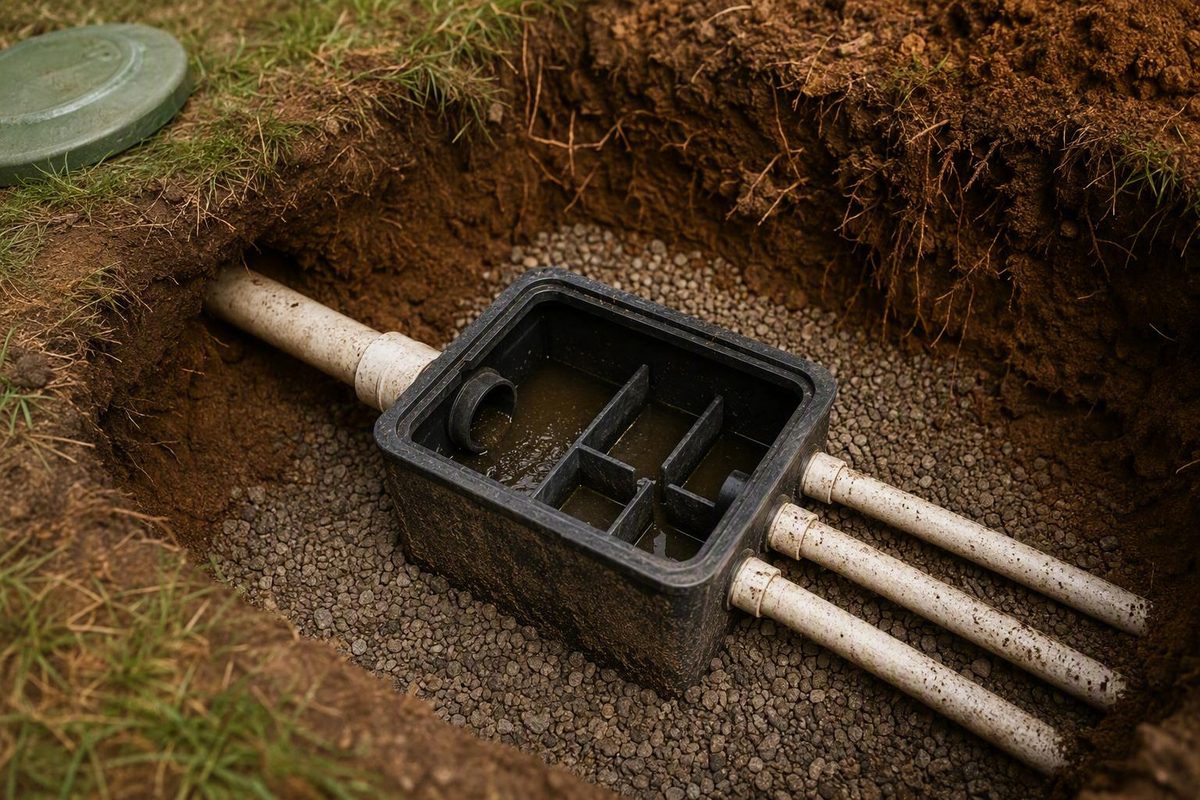
A level, supported box helps share flow, but balance is not guaranteed. Not every system uses one, and wet ground alone does not confirm D-box failure.
A septic distribution box, commonly called a D-box, is an underground flow-routing component installed between the septic tank and drain field in many conventional septic systems. It receives liquid effluent from the tank and directs it into multiple pipes leading to separate drain-field trenches.
Think of the D-box as a traffic director rather than another treatment tank. Its job is to share flow among available trenches so that one part of the drain field does not carry a disproportionate load. Doing that successfully depends on the box remaining level, supported, unobstructed, and connected to functional piping.
A D-box problem can contribute to wet ground, odors, plumbing backups, or localized flooding over the drain field. None of those symptoms proves the box itself has failed. The septic tank, connecting pipes, distribution component, and soil absorption area operate as one system, so diagnosis should cover all of them.
Related: Septic System Filter: Cleaning, Clog Signs and Replacement.
Septic distribution box definition and location in the system
A septic distribution box is a buried control structure that routes septic-tank effluent to multiple drain-field trenches or laterals.
In a conventional gravity system, the basic sequence is:
- Household plumbing: Wastewater leaves sinks, toilets, showers, tubs, and appliances through the building sewer.
- Septic tank: Wastewater enters the tank, where heavier solids settle and lighter material rises.
- Effluent pipe: Liquid from the tank flows toward the distribution component.
- Distribution box: The D-box divides or directs the effluent among multiple outlets.
- Drain-field trenches: Outlet pipes deliver effluent to separate trenches or laterals.
- Soil treatment area: The surrounding soil receives, treats, and disperses the effluent.
The liquid reaching the D-box is effluent—wastewater from which much of the settleable solid material has already been retained in the septic tank. It is not clean water, and the D-box is not intended to finish treating it. Instead, the box determines which parts of the soil absorption area receive it.
That distinction separates the three central components:
- The septic tank settles and retains solids.
- The D-box routes liquid effluent.
- The drain field and surrounding soil provide further treatment and dispersal.
A D-box is therefore not a second septic tank. It is not designed to store accumulated waste. Although its liquid level changes as wastewater passes through, its primary purpose is flow control.
The exact location depends on the approved system layout, terrain, drain-field arrangement, and distribution method. A box may sit between the tank and the near edge of the drain field, but there is no dependable universal rule for its depth, distance from the tank, or position in the yard. Surface depressions, greener grass, or assumptions about downhill flow are not reliable enough to justify digging.
Start with the property’s septic plan, permit drawing, installation record, or prior inspection report. A documented plan is safer and more useful than trying to locate buried components from surface clues alone.
How wastewater moves through a D-box
In a typical gravity-fed arrangement, one pipe brings septic-tank effluent into the D-box. Several outlet pipes then carry it toward separate drain-field trenches. The box provides a common control point where incoming flow can be divided, observed, and—when the design permits—adjusted.
This arrangement is called parallel distribution because multiple trenches in a level or nearly level treatment area receive flow through the same control box. The trenches do not necessarily receive identical volumes at every moment, but they are available in parallel rather than being loaded sequentially down a slope.
A conventional D-box normally has:
- An inlet from the septic tank
- A watertight body and cover
- Multiple outlet openings
- Pipes leading to separate trenches
- Stable support beneath the box and connected pipes
- An inspection opening or other approved means of access
The inlet is positioned higher than the outlets so incoming effluent can enter the box and then leave by gravity. The outlets are intended to be at closely aligned elevations. When the liquid reaches an outlet opening, it flows through the connected pipe toward that trench.
House
  │
  ▼
Septic tank
(settling and solids retention)
  │
  │ Effluent pipe
  ▼
┌───────────────────────────┐
│         Level D-box       │
│                           │
│ Higher inlet → liquid     │
│                           │
│ Outlet 1  Outlet 2  Outlet 3
└────┬─────────┬─────────┬──┘
     │         │         │
     ▼         ▼         ▼
 Trench 1   Trench 2   Trench 3
     └─────────┼─────────┘
          Soil treatment
          and dispersal
Figure: Septic-tank effluent enters a level distribution box through a higher inlet and leaves through multiple outlets serving separate drain-field trenches.
Some boxes use adjustable weirs, equalizers, rotating fittings, or elbows at the outlets. These devices can fine-tune the point at which liquid enters each line. Depending on the approved configuration, they may also allow a line to be isolated or flow to be directed toward selected trenches.
The University of Wisconsin’s technical publication on effluent distribution describes adjustable arrangements that direct effluent to a selected trench or establish different outlet elevations for system management. It also notes that a basic gravity D-box does not inherently deliver equal flow through every outlet (University of Wisconsin effluent distribution guidance).
These fittings provide adjustment, not a cure for defective construction. An equalizer cannot permanently compensate for a box that is cracked, unsupported, badly tilted, incorrectly elevated, or connected to damaged pipes. Before flow is adjusted, the physical installation and downstream condition need to be understood.
Why level installation matters—and why flow is not perfectly equal
Gravity makes outlet elevation critical. Liquid preferentially leaves through the lowest available opening, so even a modest difference among outlet elevations can favor one drain-field line over the others.
Suppose one side of a three-outlet box settles. The outlet on that side may begin receiving flow before the liquid rises high enough to reach the other two. Instead of sharing the load, one trench may receive most of the effluent while neighboring trenches remain underused.
That imbalance can create two problems at once:
- The favored trench receives more liquid than intended.
- The other trenches contribute less of their available absorption area.
If the overloaded section cannot accept the incoming flow, liquid may pond within the trench, back up toward the box, saturate the surrounding ground, or reach the surface. A persistently saturated area may also provide less effective treatment.
For that reason, a D-box and its connected pipes need stable support and appropriate bedding. The objective is to preserve the designed inlet and outlet elevations after installation and backfilling. Poor support can allow the box or pipes to move independently, changing flow patterns or stressing connections. Industry installation guidance emphasizes keeping the box level and supporting both inlet and outlet piping so backfilling does not shift the structure or damage the lines (SOWMA guidance on installing D-boxes).
Balanced does not mean perfectly equal. A level box with aligned outlets improves distribution, but it cannot guarantee that every trench receives the same volume or treats wastewater identically. Real systems contain small elevation differences, changing liquid levels, variations in pipe condition, and different levels of downstream resistance.
Balance can be disturbed by:
- Soil settlement beneath the box
- Movement of an inlet or outlet pipe
- Organic growth around an outlet
- Solids, debris, or grease in the box
- A partially obstructed lateral
- A pipe sag, break, or elevation change
- Ponding or restriction in one trench
- Differences in trench construction or soil conditions
Even when similar amounts leave the box, effluent may not spread uniformly along each lateral. In gravity-fed perforated piping, liquid tends to leave through the lowest available openings. Soil texture, biomat development, moisture, and trench condition can also vary across the absorption area.
The practical goal is to distribute effluent as evenly as the properly designed system can, not to promise mathematically identical loading at every outlet or at every place where effluent meets the soil. A technical discussion in Onsite Installer makes the same distinction: parallel D-box distribution aims for balanced loading, but gravity hydraulics and differences among soils and trenches make perfect uniformity unlikely (comparison of distribution boxes and drop boxes).
Distribution box, septic tank, pump tank, drop box, and drain field compared
Several buried septic components may appear together on a plan or inspection report, but they perform different jobs.
| Component | Primary job | Typical flow method | Position in the treatment sequence |
|---|---|---|---|
| Septic tank | Settles wastewater and retains solids and floating material | Gravity through the tank; the outlet may feed gravity or pumped components | After household plumbing and before distribution |
| Distribution box | Routes effluent among multiple drain-field outlets | Passive gravity flow, sometimes with adjustable outlet fittings | Between the septic tank and parallel drain-field trenches |
| Pump tank | Stores an operating volume of effluent and sends it onward using a pump | Pumped or dosed flow | After a septic or treatment tank and before the dispersal system |
| Drop box | Routes effluent sequentially among trenches at different elevations | Gravity, generally loading one trench before overflow proceeds to another | Between the tank and trenches on a sloping layout |
| Drain field | Receives effluent for further treatment and dispersal in soil | Gravity or pressure through trenches, laterals, chambers, or another approved design | The downstream treatment and dispersal area |
The septic tank is where much of the physical separation occurs. Solids are intended to remain there rather than travel into the distribution network. Liquid effluent leaves through the tank outlet and enters either a gravity conveyance pipe or another treatment or dosing component.
The D-box does not duplicate the tank’s settling role. It passively routes the effluent that reaches it. In a straightforward parallel layout, each outlet corresponds to a separate drain-field trench or lateral.
The drain field includes more than the visible yard surface. It consists of the trenches or other approved dispersal units, distribution piping, and surrounding soil that receives the effluent.
A pump tank serves a different hydraulic purpose.
Consequently, not every septic system has a conventional D-box. The distribution method is selected according to system design, site elevations, soil conditions, applicable rules, and management needs.
A drop box also differs from a parallel distribution box. A D-box usually serves trenches in a common level or nearly level area. A drop-box arrangement is commonly used on a slope, where effluent is routed sequentially: one trench receives flow until liquid rises enough to continue toward the next box and lower trench.
Neither method is universally superior. Terrain, available elevation, field geometry, soil restrictions, local regulations, and management requirements all matter. The supplied technical evidence does not establish that either gravity method always provides better treatment or a longer service life.
Common distribution-box problems and what they do to flow
D-box defects can be grouped into five broad categories: movement, blockage, structural deterioration, root intrusion, and external physical damage. More than one problem may be present at the same time.
Movement or misalignment
Soil settlement, inadequate bedding, poor backfilling, groundwater conditions, or unsupported pipes can change the box’s position. A tilted box changes the relative height of its outlets, often favoring the lowest one. Pipe movement can also alter an inlet or outlet connection even when the box itself appears intact.
Movement may cause:
- Disproportionate flow to one trench
- Underuse of other trenches
- Separation or stress at pipe connections
- Leakage around penetrations
- Cracked pipes or box walls
- Loss of the intended gravity slope
A flow-control fitting may reduce a small outlet imbalance in an otherwise sound box. It cannot stabilize moving soil or replace missing structural support.
Blockage and buildup
Material inside the box can narrow an outlet or interfere with an equalizer, weir, or elbow. Potential obstructions include solids, sludge, debris, fats, oils, grease, and organic growth.
A blocked outlet does not merely take one line out of service. The incoming effluent must leave through the remaining available outlets, which can increase the load on the trenches still receiving liquid.
Unexpected solids in the D-box should prompt an upstream evaluation. It does not conclusively prove any single cause, and cleaning the box alone may leave the underlying defect unresolved.
Structural deterioration
An inspection may reveal cracks, crumbling material, deformation, leaking seams, damaged pipe penetrations, or a failed cover. These defects can allow liquid to escape before reaching the field or permit groundwater and soil to enter.
The significance depends on the defect. Material accumulated around an otherwise sound fitting presents a different repair scope from a broken wall, displaced cover, or collapsed outlet.
Root intrusion
Roots can enter through cracks, joints, gaps around pipes, or damaged sections. Once inside, they can obstruct an outlet, interfere with a flow-control device, widen an existing opening, or contribute to pipe and box damage.
Root removal alone may not solve the problem if roots entered through a structural defect. The entry point and the condition of nearby pipes should also be identified.
External physical damage
Vehicles, construction machinery, and other heavy loads can damage buried boxes and connecting pipes. Weight transferred through the soil may crack a rigid box, deform another material, displace a cover, or crush unsupported piping.
Keep known septic areas free from parking, driving, material storage, and equipment traffic. The risk is not limited to the D-box; the tank, conveyance line, and drain-field piping can also be affected.
D-boxes are commonly made from concrete, plastic, or fiberglass, but material alone does not determine reliability. Installation quality, structural support, groundwater, soil movement, physical loading, pipe connections, and suitability for the approved design all affect performance. Those variables make universal material rankings and fixed service-life promises unreliable.
Possible warning signs versus a confirmed D-box diagnosis
Possible signs of a septic distribution problem include:
- One persistently wet or flooded section of the drain field
- Effluent surfacing over or near a trench
- Localized, unusually lush or green growth
- Sewage odors outdoors
- Slow household drains
- Gurgling plumbing
- Recurrent clogs
- Sewage backups
- A wet area near the distribution component
A localized symptom can fit a D-box problem. If one outlet sits lower than the others, it may send excessive flow to one trench. That trench can become ponded or saturated while the rest of the drain field remains comparatively dry.
But the same observation can have several explanations. A wet area might result from a damaged outlet pipe, restricted trench, surface drainage, groundwater, or broader failure of the absorption area. Slow fixtures and backups can result from a full or obstructed tank, blocked building sewer, failed pump, damaged conveyance pipe, hydraulic overload, or downstream restriction.
Use symptoms to identify what needs inspection, not to select a repair in advance.
| Surface or household observation | Findings that would strengthen or weaken a D-box diagnosis |
|---|---|
| One wet area over a single trench | A low outlet and heavy flow into that line strengthen the case; a level box with reasonably balanced outlets shifts attention toward the trench or its pipe |
| Several wet areas across the field | May indicate broad hydraulic or drain-field trouble rather than an isolated D-box defect |
| Surface effluent near the box | Cracks, leaks, high-water marks, or backed-up outlets support a box or downstream problem; stormwater or groundwater may provide another explanation |
| Unusually green growth over one line | Favored outlet flow is relevant, but irrigation, shade, soil differences, and pipe damage should also be considered |
| Sewage odor outdoors | Leakage or surfacing effluent may be present, but odor alone does not locate the failure |
| Slow drains or gurgling indoors | A backed-up distribution system is possible; the tank, building sewer, filters, pumps, and conveyance piping also require evaluation |
| Sewage backup into fixtures | Indicates an urgent restriction or capacity problem, but does not establish that the D-box is the failed component |
| Solids visible in the box | Supports investigation of upstream solids carryover; it does not show that the box caused the solids to arrive |
| Little or no flow through one outlet | A blocked fitting or pipe is possible; the downstream trench may also be ponded or restricted |
| Box visibly tilted | Strong evidence of impaired distribution, but downstream condition still has to be assessed |
A focused diagnostic inspection may check:
- Whether the box is level and adequately supported
- Relative outlet elevations
- Comparative flow through each outlet
- Standing liquid and high-water marks
- Solids, grease, debris, or organic buildup
- Root intrusion
- Cracks, deformation, leakage, and deterioration
- Inlet and outlet pipe condition
- Evidence of downstream backup
- Tank condition and upstream components
- Surface conditions across the entire field
Do not approve full drain-field replacement solely because the yard is wet or household drains are slow. Ask for a diagnosis that identifies the failed component, explains the supporting evidence, and separates necessary work from optional work. DrainFinder’s drain-field replacement planning guide likewise recommends obtaining a documented diagnosis and itemized local scope before making a major replacement decision.
Prompt evaluation is appropriate when sewage is backing up or reaching the surface. Avoid direct contact with surfacing sewage and arrange qualified assistance; commercial home-services guidance identifies sewage exposure as a reason to leave D-box inspection and servicing to septic professionals (Angi overview of septic distribution boxes).
Inspection, cleaning, pumping, and access
A conventional D-box does not normally require routine pumping in the same way a septic tank does. Solids are intended to settle and remain in the tank, while liquid effluent moves onward to the distribution box.
That does not make the box maintenance-free. Depending on inspection findings, it may need:
- Removal of accumulated material
- Cleaning of an obstructed outlet or fitting
- Adjustment of approved flow-control devices
- Root removal and repair of the entry point
- Correction of a pipe connection
- Releveling or improved support
- Structural repair or replacement
A professional inspection should consider the box as both a structure and a hydraulic control point. A useful checklist includes:
- Access: Can the approved access point be reached without damaging the system?
- Cover condition: Is the cover intact, secure, and appropriate for the installation?
- Level: Is the box level in the directions that affect outlet elevations?
- Support: Are the box and connected pipes stably bedded?
- Watertight condition: Are there cracks, open joints, leaks, or signs of groundwater entry?
- Inlet: Is the incoming pipe intact and properly positioned?
- Outlets: Are the pipes connected, open, and at the intended relative elevations?
- Flow: Does one outlet receive markedly more effluent than the others?
- Water marks: Do stains or residue indicate past flooding or sustained high liquid levels?
- Material: Are solids, grease, debris, or organic growth interfering with flow?
- Roots: Is there intrusion through joints, cracks, or pipe openings?
- Deterioration: Is the box crumbling, deforming, or losing structural integrity?
- Downstream condition: Is liquid backing up from a restricted pipe or trench?
An accessible cover, inspection port, or design-approved riser makes it easier to monitor the box and service adjustable components. Accessibility means controlled access for inspection and maintenance—not an invitation for a homeowner to enter or handle wastewater components.
There is no sound universal interval for D-box inspection. Published recommendations vary, and appropriate timing depends on the system design, permit conditions, local rules, previous findings, household use, maintenance records, and guidance from a qualified local provider. Inspection may also be appropriate when symptoms appear or when related septic components are already being evaluated.
Homeowners can contribute safely by:
- Reviewing the septic plan, permit, and service records
- Recording when and where surface symptoms appear
- Noting whether symptoms follow heavy water use or rainfall
- Keeping vehicles and heavy equipment away from septic components
- Preserving known access points
- Arranging an evaluation by a qualified septic professional
Do not enter a septic tank, pump chamber, D-box, or other septic structure. Do not use this article as an excavation or opening procedure. The supplied evidence does not establish one universally safe method for locating, exposing, or servicing buried components, so access should follow the approved system plan, local requirements, and qualified guidance.
Repair, releveling, or replacement: what the decision depends on
A defective D-box does not automatically mean the entire drain field must be replaced. Depending on the findings, a box may sometimes be adjusted, cleaned, repaired, releveled, or replaced while the existing septic tank and drain field remain in service.
The correct scope depends on four connected areas:
- The condition of the box
- The inlet and outlet piping
- The septic tank and upstream components
- The drain-field trenches and surrounding soil
Examples of potentially targeted work include:
- Adjusting flow-control fittings in a level, watertight, well-supported box
- Cleaning an obstructed outlet
- Removing accumulated material and identifying why it arrived
- Correcting an accessible pipe alignment where the design permits
- Repairing a damaged inlet or outlet connection
- Reestablishing stable support and level where feasible
- Replacing a structurally failed box
- Repairing connected piping damaged by settlement or physical loading
The narrowest repair is not always the correct one. If a box tilted because its support moved, changing an outlet fitting may only conceal the imbalance temporarily. If roots entered through a crack, clearing them without repairing the opening leaves a path for recurrence. If solids arrived from the tank, cleaning the D-box alone does not address the upstream problem.
Conversely, a visibly damaged box does not prove the drain field is beyond use. If the tank, piping, and trenches remain functional, restoring proper distribution may be sufficient. Manufacturer guidance notes that a damaged box can sometimes be replaced without replacing the entire septic system, although the actual scope depends on site conditions (Garrett Precast guide to septic distribution boxes).
There is an important limit: correcting the box cannot reverse irreversible damage in an overloaded or failed trench. If one outlet has favored the same trench for a long period, the downstream area must be evaluated to determine whether it can still accept and treat effluent. A new level box cannot make a blocked, collapsed, or nonfunctional absorption area sound.
Before authorizing major work, ask for written answers to these questions:
- What component has failed?
- What observations or tests support that conclusion?
- Is the D-box level, watertight, and structurally sound?
- Are its inlet and outlet pipes intact?
- Is there evidence of solids carryover from the tank?
- Are any outlets backed up from downstream?
- What is the condition of each drain-field trench?
- Which proposed items are required, and which are optional?
- Does the work require a permit, design revision, or inspection?
- How will the repair preserve or restore the intended outlet elevations?
System-specific plans, local health or environmental authorities, and qualified septic professionals should determine applicable access, code, permit, and design requirements. Cost, service life, and repair thresholds cannot be reduced to universal figures because soil, groundwater, component condition, access, system design, and local rules vary.
The practical distinction is straightforward: the septic tank settles and retains waste, the D-box routes liquid effluent, and the drain field and soil provide further treatment and dispersal. A level, supported, accessible box helps share flow, but balanced distribution is a design goal rather than a guarantee. Review the entire connected system before attributing wet ground, odors, or backups to one buried component.
Frequently asked questions about septic distribution boxes
Does every septic system have a distribution box?
No. Many conventional gravity systems use a passive D-box to serve parallel drain-field trenches, but other systems distribute effluent with a pump tank, pressure network, drop boxes, manifolds, or another engineered arrangement.
The presence or absence of a D-box depends on the approved design, terrain, soil treatment area, elevation, and local requirements. Check the property’s septic plan or permit record rather than assuming every tank has a D-box downstream.
Does a septic distribution box need to be pumped?
Not routinely in the same way as a septic tank. The tank is intended to retain settleable and floating solids, while the D-box receives primarily liquid effluent.
A D-box may still need cleaning if solids, grease, debris, roots, or organic buildup interfere with its outlets or adjustment fittings. Significant solids should prompt examination of the upstream tank and related components rather than being treated only as material inside the box.
What are septic distribution boxes made from?
Common materials include concrete, plastic, and fiberglass. Available materials and configurations vary by manufacturer and system design.
No material is universally best. Suitability depends on structural support, groundwater, soil movement, physical loading, pipe connections, installation quality, approved specifications, and local requirements. Fixed service-life claims should be treated cautiously because those conditions may matter as much as the material itself.
Can a distribution box be replaced without replacing the drain field?
Sometimes. If the failure is limited to a cracked, deteriorated, unsupported, or badly misaligned box—and the tank, connecting pipes, and drain-field trenches remain functional—the box may be replaced as a targeted repair.
Replacing the box will not restore a trench that is already irreversibly damaged or unable to accept effluent. The downstream field should therefore be evaluated before deciding that box replacement is sufficient or that full field replacement is necessary.
What is the difference between a distribution box and a drop box?
A distribution box generally provides parallel distribution to multiple trenches in a level or nearly level treatment area. Its outlets are intended to sit at closely aligned elevations so several trenches can receive effluent through one control structure.
A drop box generally provides sequential distribution on a sloping site. Effluent loads one trench and then rises or overflows toward the next box and trench at a different elevation.
The correct method depends on terrain, system design, soil conditions, regulations, and management needs. Neither should be assumed to provide universally better treatment or longer life without evaluating the specific site.