
Choose a Shower Drain Hair Catcher That Fits and Still Drains
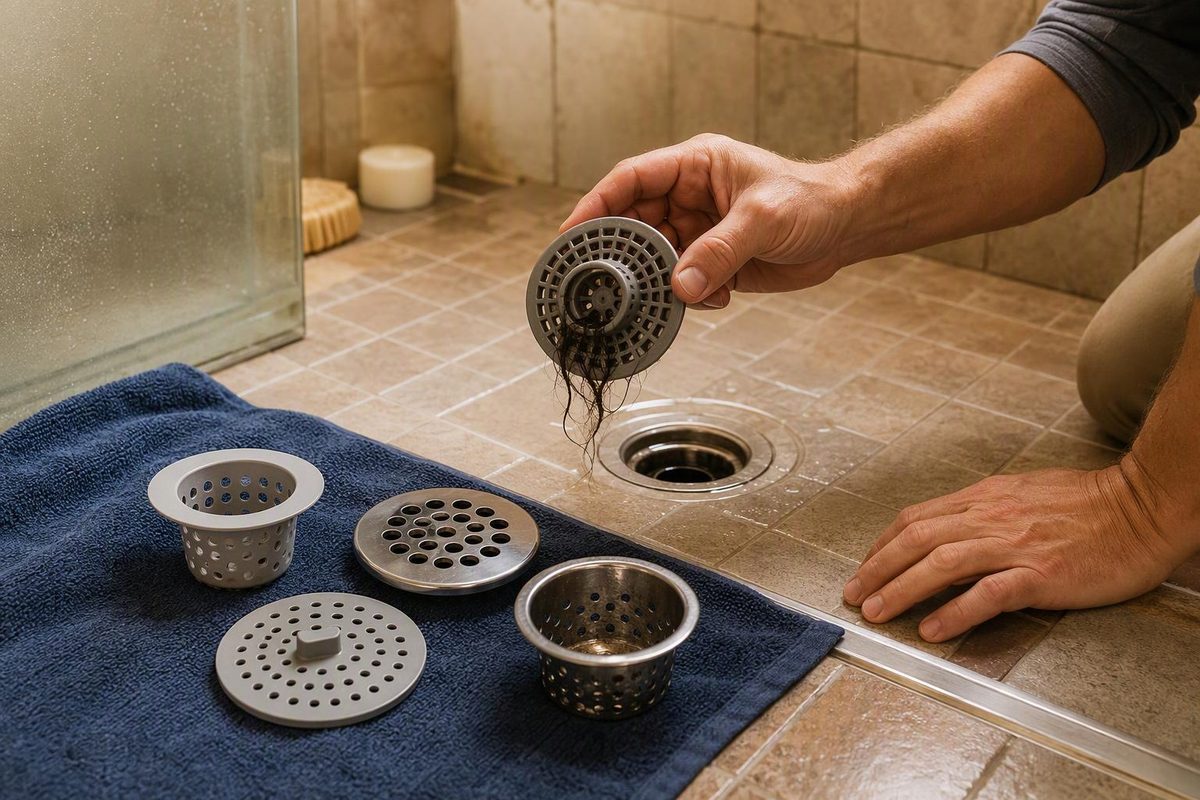
Match a shower hair catcher to the drain type, opening and available depth, then test flow and clean it before collected hair causes pooling.
Choose a drain hair catcher for a shower by drain type and measured fit, not by a “universal” label. The catcher should remain stable, lift out for cleaning and pass the shower’s full flow without water pooling around your feet.
A hair catcher is preventive. If the shower already drains slowly with no catcher installed, clear the reachable hair or diagnose the existing blockage first.
Match the catcher to the drain
| What the shower has | Best starting style | Main fit concern |
|---|---|---|
| Round or square grate over a shower-stall drain | Insert beneath the removable grate, or a compatible replacement cover with a basket | Clear opening, basket depth, screws and crossbars |
| Open round shower drain | Drop-in basket, cup or comb-style insert | Actual inside opening—not the visible trim diameter |
| Tub/shower combination with a stopper | Catcher made for that bathtub drain and stopper arrangement | Stopper movement and the smaller drain opening |
| Linear or tile-in drain | Drain-maker’s basket, comb or maintenance kit | Channel series, outlet position and grate-removal method |
| Grate that should not be removed | Low-profile screen that sits securely on top | Stability, drainage area and raised edges |
Do not assume that a stand-alone shower product will fit a tub/shower combination. For example, one Danco replacement cover is described for a 3-inch shower-stall drain, yet its cover is 4-1/4 inches across and its basket has a 2-1/2-inch outside diameter. Danco expressly says it does not fit bathtub or tub/shower-combination drains. Those different measurements show why “fits a 3-inch drain” is not enough information by itself (Danco).
If the fixture includes a bathtub stopper, identify how that stopper works before buying anything. A catcher must not jam the stopper or prevent the tub from sealing. If hair is already restricting that drain, follow the reachable-cleaning steps in How to Unclog a Bathtub in the Right Order.
Measure the parts that determine fit
Dry the shower, then record:
- Drain shape: round, square or linear.
- Visible cover size: outside diameter or length and width.
- Clear opening: the space available beneath the cover, measured only if the grate is designed to lift or unscrew.
- Available depth: distance from the top of the opening to the first crossbar or other obstruction.
- Fastening method: screws, snap-in tabs, lift-out grate or fixed trim.
- Brand and model markings: check the grate, channel and any installation paperwork.
Take a photo before removing a grate, and keep screws out of the drain. Do not pry up the drain body, clamping flange or waterproofed assembly just to fit an accessory.
Compare every measurement with the manufacturer’s drawing. A nominal drain size may describe the pipe connection or opening rather than the decorative cover. TubShroom, for instance, describes its ShowerShroom as an insert for 2-inch shower-stall drains that sits beneath the cover (TubShroom). That does not establish compatibility with every cover above a 2-inch drain connection.
Replacement parts can also be system-specific. Oatey identifies one snap-in replacement strainer as being for its 130 Series drains, while Sioux Chief lists a removable hair catcher as an accessory for its 821 Series shower-pan drain (Oatey, Sioux Chief). Match a replacement part to the drain series whenever possible.
Choose for flow, stability and cleaning
A workable catcher should meet four practical tests:
- It stays put. A loose top screen that slides off the drain will not reliably intercept hair. Avoid a raised or curling edge that can catch a foot.
- It has enough open area. Fine mesh can collect hair and soap residue quickly. A basket or comb with more drainage area may need less frequent attention.
- It comes out without dismantling the drain. If routine cleaning requires tools, confirm that this is the drain maker’s intended maintenance method.
- It can be cleaned without pushing debris through. Lift the unit out, remove the hair over a trash can and rinse it as its maker directs.
Linear drains deserve particular care. Their baskets and lift-out keys are often matched to a product family; Infinity Drain says it offers different hair catchers and lift-out keys for its product specifications (Infinity Drain). Geberit likewise says its comb insert is integrated into particular Geberit drains and is not compatible with other manufacturers’ products (Geberit). For an unidentified linear drain, locate the maker and model before ordering an insert.
Install it, then test the shower at full flow
Clean reachable hair from the grate and drain opening. Fit the catcher according to its instructions, reinstall the grate correctly, and run the shower at its highest normal flow for several minutes.
Watch the water level:
- Water clears without collecting: the fit and drainage area are adequate.
- Water pools only with the catcher installed: remove and clean it. If it is already clean, the design is too restrictive or the fit is wrong.
- Water drains slowly with the catcher removed: the catcher is not the underlying problem. Continue with a one-fixture versus several-fixture diagnosis.
Empty the catcher when hair is visible or drainage begins to change—before the basket becomes packed. Cleaning frequency depends on hair length, household size, pet washing and catcher design. Geberit advises regular cleaning and says its comb insert can ideally be cleaned after every shower; TubShroom recommends rinsing its strainers whenever hair is removed (Geberit, TubShroom).
Stop using the catcher if it repeatedly causes standing water, will not stay seated or requires altering the drain assembly. If another fixture gurgles or backs up when the shower runs, the issue may extend beyond this shower branch; a hair catcher cannot correct that pattern.