
How to Unclog a Bathtub Safely: A Step-by-Step Guide
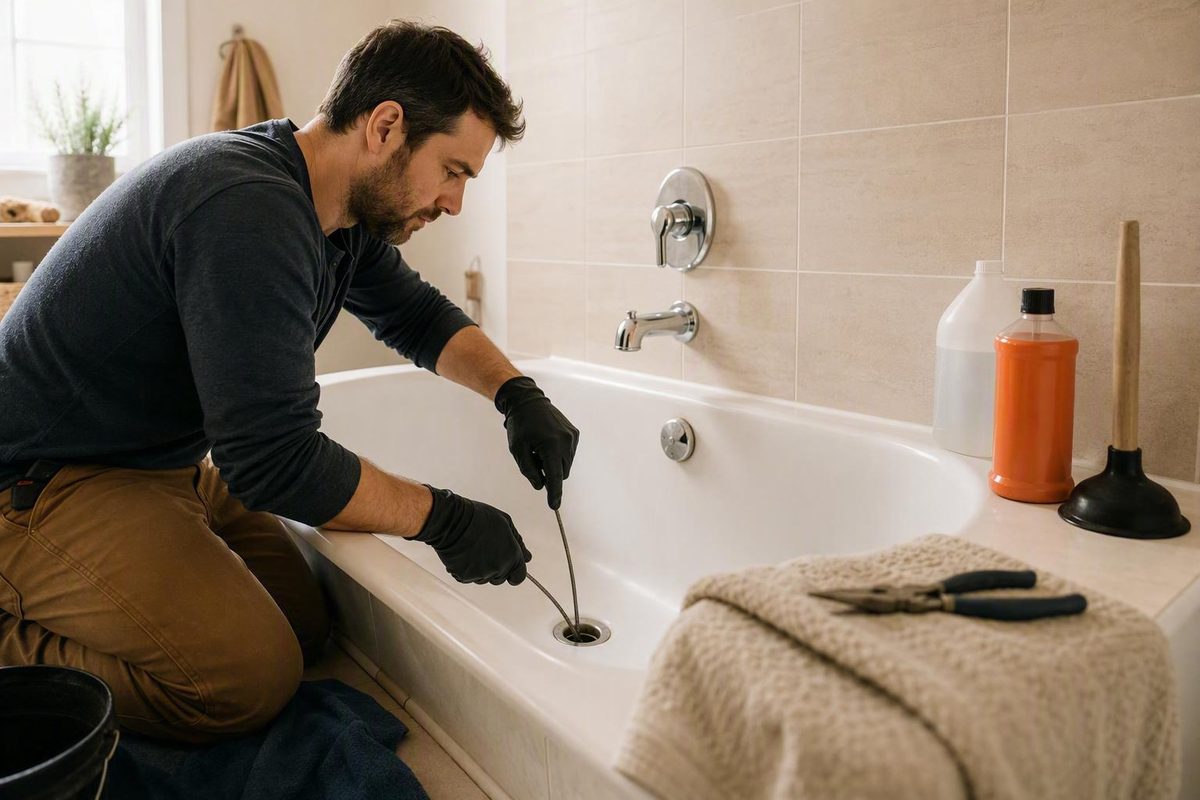
Remove untreated standing water, clean reachable hair from the stopper and drain, plunge with the overflow sealed, then use a hand snake if the blockage remains.
Overview
To unclog a bathtub, first identify whether the problem is limited to the tub and whether chemical cleaner is present. Remove untreated standing water, clean reachable hair from the stopper and drain, plunge with the overflow sealed, then use a hand snake if the blockage remains. Test drainage after every method.
Use the least-invasive effective method and stop as soon as water drains normally. A successful repair restores normal flow without causing another fixture to gurgle or back up. If several fixtures are slow, the clog quickly returns, or an appropriate sequence does not work, arrange a professional assessment instead of repeatedly adding products or forcing tools.
Before you start: choose the right path
The DIY sequence in this guide is intended for an apparently local bathtub clog that has not been treated with chemical cleaner. Before removing parts or inserting a tool, observe whether the tub drains slowly or retains stationary water. Then check nearby fixtures for slow drainage, gurgling, or water appearing in the tub when another fixture runs.
Prepare gloves, towels, a bucket or large sponge, a screwdriver suited to any removable cover, tweezers or another retrieval tool, a cup-style plunger, and a hand drain snake. You may not need every item. Start with inspection and extraction, then advance only if the drain remains restricted.
Slow drain, standing water, chemicals, or multiple affected fixtures
Your starting condition determines whether mechanical DIY work is appropriate.
- Slow tub drain with no prior chemical use: Begin by inspecting the stopper, strainer, and drain opening for reachable material.
- Ordinary standing water with no cleaner in it: Remove as much water as practical before disassembling the stopper or overflow assembly. Buckets, towels, a sponge, or a wet/dry vacuum are supported options, according to Young House Love and Horow.
- Chemical cleaner already used: Do not plunge or snake the drain. Mechanical action can splash chemically contaminated water. Follow the product label and seek product-specific instructions.
- Several slow fixtures, gurgling elsewhere, or cross-fixture backup: Stop treating the tub as an isolated clog and call a plumber. These symptoms justify broader assessment, but they do not identify the exact pipe or system fault by themselves.
Do not pour additional remedies into stationary water without first accounting for what is already in it. Untreated water can be removed for inspection. Water containing cleaner requires a chemical-safety response, not the ordinary preparation step.
Match the method to what it can remove
Choose a method by what you can observe, not by assuming that slow drainage proves a particular clog material. Hair and debris visible around the stopper can be physically pulled out. Material beyond reach may respond to a properly sealed plunger or a hand snake.
Pour-in remedies have a narrower role. Hot water or a baking soda and vinegar mixture may help with residue, odor, routine maintenance, or a mild slowdown, but the cited guidance does not establish that they dissolve a solid hair mass. Horow explicitly distinguishes residue cleaning from hair removal, while Drain Strain directs deeper clogs toward plungers and snakes.
Symptoms alone cannot reliably tell you whether an unseen local restriction is soap residue, minerals, hair, or mixed debris. Let the result of each low-risk method determine whether to stop or escalate.
Unclog the bathtub in the least-invasive order
Work from accessible material toward deeper obstructions: expose the drain, remove reachable debris, plunge with the overflow sealed, and snake only if necessary. This order lets you test simple causes before taking apart the overflow or feeding a tool into the drain.
After each step, run only enough water to check the result. If drainage has returned to normal, reassemble the parts and stop. If it remains restricted, move to the next supported method rather than adding several remedies at once.
Step 1: Remove untreated standing water and expose the drain
If the tub contains ordinary water and no chemical cleaner, remove enough water to reach the stopper and drain opening safely. Scoop it into a bucket, absorb the remainder with towels or a large sponge, or use a wet/dry vacuum as described by Young House Love and Horow.
Keep towels nearby because water may remain in the stopper or overflow components. Do not apply this removal procedure to water containing drain cleaner. In that case, stop and use the chemical precautions below.
This step is complete when you have safe, visible access to the removable stopper, strainer, or drain cover. You should be able to inspect the opening without working blindly through a full tub.
Step 2: Remove reachable hair and debris
Put on gloves and examine how your tub’s stopper or cover is attached. Some supported covers lift or twist away, while others have a small screw. Remove only parts you can identify and reinstall correctly. Quality Plumbing describes removing the drain cover before reaching into the opening, and Drain Strain recommends using gloves or tweezers for visible hair and debris.
Pull accessible material from the stopper, strainer, and mouth of the drain with gloved fingers, tweezers, or a suitable retrieval tool. Avoid pushing the debris farther into the pipe. Clean the removed parts so accumulated material cannot continue restricting the opening.
For a tub with a trip-lever mechanism, the overflow plate may provide access to the attached linkage or plunger assembly. If the design is familiar and removable, take out the overflow-plate screws, withdraw the assembly carefully, and clean off attached hair or residue. Horow advises careful reinsertion so the plunger assembly does not catch.
The step has worked when the opening and removable components are visibly clear. Reposition the parts temporarily if needed, run a small amount of water, and watch the flow. Stop if drainage is normal. If it remains slow, proceed to plunging.
Step 3: Plunge with the overflow sealed
A bathtub plunger needs two seals: one at the drain and another over the overflow opening. Without the overflow seal, the pressure you create can escape into the overflow passage instead of acting on the obstruction. Young House Love and Horow both identify sealing that opening as a necessary tub-specific step.
- Press a wet washcloth firmly into or over the overflow opening.
- Add enough water to cover the rubber plunger cup so its rim can seal against the tub.
- Center the cup over the drain and confirm that the rim contacts the tub surface all the way around.
- Pump the handle up and down while maintaining both seals.
- Lift the plunger and observe whether the water moves away faster.
Movement in the standing water or noticeably faster drainage indicates that pressure is reaching the obstruction. If nothing changes, recheck the two seals and water depth before deciding the method failed. Do not plunge if chemical cleaner has already been used.
Step 4: Snake a deeper clog through the drain or overflow
Use a hand drain snake when reachable debris has been removed and properly configured plunging has not restored flow. A hand snake can reach material beyond a small retrieval tool, according to Horow. Stop if chemical cleaner is present or if you cannot remove and reinstall the access components safely.
- Choose the drain opening if it gives the cable an unobstructed path. If the stopper design blocks that route or the cable does not feed naturally, use the overflow opening after carefully removing its plate and accessible assembly.
- Feed the cable gradually until you feel resistance. Resistance may be an obstruction or part of the drain path, so do not treat every contact as proof of clog material.
- Rotate the snake while working at the resistance. The supported goal is to engage, loosen, or retrieve material, not to force the cable an arbitrary distance.
- Withdraw the cable slowly and remove any captured debris.
- Test with water. Repeat only if the cable retrieved material and the drain remains locally restricted.
Overflow access can provide a more direct route toward the tub’s drain shoe and trap, as explained by Horow. This makes it useful when the drain opening is difficult to navigate, but it does not justify forcing the snake through resistance.
Successful snaking produces an observable result: extracted debris, easier cable movement, or improved water flow. If the snake retrieves nothing and drainage remains poor, stop escalating blindly and use the professional-assessment criteria below.
Success check: reassemble and test the drain
Clean the work area and carefully reinstall the stopper, strainer, linkage, or overflow plate you removed. Confirm that each moving part operates freely and that the stopper opens rather than remaining partly closed.
Run water and watch whether it leaves the tub at a normal, sustained rate. A brief improvement followed by renewed pooling is not a complete fix. Also check whether the test coincides with gurgling or backup at another fixture.
Treat the job as successful only when the tub continues to drain normally after reassembly, no cross-fixture symptom appears, and the restriction does not quickly return. Continued slowness means the verification failed, even if some water now passes through.
Safe remedies and stopping points
Pour-in remedies are not interchangeable with physical removal. Keep their use limited to the conditions supported here, and never layer products in pursuit of a stronger reaction. Prior chemical use, several affected fixtures, and repeated failure all change the next action from DIY escalation to safety management or professional assessment.
Hot water, not boiling water, when pipe material is uncertain
Do not pour boiling water into a slow bathtub drain when PVC is present or the pipe material is unknown. Manufacturer technical guidance from Westlake Pipe & Fittings gives PVC a maximum operating temperature of 140°F. Water boils at 212°F, which is substantially above that stated limit.
A slow drain can also keep heated water in contact with the pipe instead of carrying it away promptly. Williams Plumbing and Drain therefore recommends hot tap water rather than boiling water when there is doubt about the pipe material.
This evidence supports a narrow rule: avoid boiling water with PVC or uncertain piping. It does not establish universal compatibility for every bathtub finish, seal, joint, metal pipe, or drainage system. Hot water may help move light residue, but it is not a substitute for extracting a solid hair obstruction.
Baking soda and vinegar: useful limits
Baking soda and vinegar produce visible fizzing, but visible reaction is not evidence that a dense hair blockage has dissolved. The supported role is limited to residue, odor control, routine maintenance, or some mild slowdowns. Horow states that the mixture can clean residue but will not dissolve a solid hair mass, and Williams Plumbing and Drain similarly says the mixture lacks the pressure to break solid blocks.
If hair is visible, remove it. If a deeper solid obstruction is suspected after inspection, use a properly sealed plunger or hand snake, provided no chemical cleaner is present. Reserve the fizzing mixture for untreated drains and bounded maintenance use, then flush with hot rather than boiling water when pipe material is uncertain.
Do not keep adding more mixture because the drain remains blocked. Failure after a mild-residue remedy is a reason to change methods, not increase the quantity or combine it with another product.
Chemical cleaner precautions
Chemical cleaner introduces compatibility, exposure, and mixing risks that are not present during ordinary physical removal. The evidence pack does not provide a universal product guide for every tub finish, pipe material, septic system, or clog type. If you choose a cleaner, the individual product label controls its use.
Apply these minimum precautions:
- Confirm that the label identifies the product as suitable for the intended drain and follow its directions exactly.
- Ventilate the area and wear gloves and eye protection. Quality Plumbing identifies gloves, goggles, and careful label reading as necessary precautions.
- Never mix drain-cleaning products. Drain Strain warns that mixing cleaners can create toxic fumes.
- Do not combine drain cleaner with bleach. The WikiHow evidence excerpt expressly warns against using cleaner before or after bleach.
- Do not plunge or insert a snake after cleaner has been used because either action can splash contaminated liquid.
If cleaner is already sitting in undrained bathtub water, stop. Do not improvise a scooping, vacuuming, neutralizing, or disposal procedure from this guide. Keep people away from the water, consult the product’s label and manufacturer instructions, and seek product-specific authoritative help. If a plumber becomes involved, disclose exactly which cleaner was used, as Young House Love advises, so the plumber can account for the exposure hazard.
When to stop DIY and call a plumber
Stop when the observations no longer fit a simple, accessible tub obstruction or when appropriate local methods have failed. The following signs justify professional assessment:
- More than one drain is slow.
- Another fixture gurgles while the tub drains.
- Water backs up into the tub when a different fixture runs.
- The tub remains blocked after debris removal, correctly configured plunging, and a reasonable hand-snake attempt.
- The clog returns quickly after material was removed and normal flow appeared to be restored.
- Chemical cleaner is present and further mechanical work would create splash exposure.
Horow lists multiple slow drains, gurgling, cross-fixture backup, and rapid recurrence after snaking as reasons to call a plumber. Drain Strain also identifies persistence after multiple cleaning attempts as an escalation signal.
These signs can indicate that the problem extends beyond reachable material at the tub, but they do not let you distinguish reliably among a branch-line, vent, trap, or main-line fault. Report the symptoms and every method or chemical already used rather than presenting a self-diagnosis as certain.
Troubleshooting failed DIY attempts
A failed attempt does not always mean the obstruction is unusually severe. The setup may be preventing the method from acting on the drain, or the stopper mechanism itself may still be restricting flow. Check those procedure-specific failure points once, then advance or stop instead of repeating the same action indefinitely.
If plunging does not work
First inspect the overflow seal. If the wet cloth has shifted or does not close the opening, plunging pressure can escape through the overflow passage. Young House Love explains that stuffing a wet washcloth into the overflow keeps the applied pressure from escaping.
Next, check that water covers the plunger cup and that its rubber rim makes continuous contact around the drain. Drain Strain requires enough water over the base and a tight drain seal, while Horow identifies both the sealed overflow and covered cup as necessary for effective suction.
Try again only after correcting a visible setup problem. Restored pressure transfer should produce movement at the drain or faster flow. If both seals are sound and the water still does not move, proceed to a hand snake if the problem remains local and untreated. Otherwise, stop.
If the stopper or linkage is not opening fully
A stopper can create or preserve a restriction when debris prevents it from moving freely. On a supported trip-lever design, hair or residue may also collect on the linkage or plunger assembly behind the overflow plate.
Remove only the parts appropriate to the design you can identify. Inspect them for debris or a snag, clean the accessible components, and reinsert them carefully. Horow cautions that the assembly should be reinserted so its plunger does not catch. Young House Love also describes withdrawing the overflow assembly to inspect it for hair or other material.
Operate the stopper after reassembly. The expected result is free part movement and a fully open drain position. Then test with water. Improved drainage after restoring movement suggests that the mechanism contributed to the restriction. No improvement means you should continue with the supported local-clog sequence or stop at the escalation criteria.
Worked example: a slow local drain with no visible hair
Suppose the tub drains slowly, no chemical cleaner has been used, and the sink and other nearby fixtures drain without gurgling or backup. Start by removing and cleaning the tub stopper. Test the drain. If water still pools, the decision point is clear: the accessible opening was not the full restriction.
Next, seal the overflow with a wet cloth, cover the plunger cup with water, and plunge while maintaining a tight drain seal. Test again. Faster, sustained flow means you can reassemble and finish. No movement after correcting the setup means the next supported method is a hand snake.
Feed the snake through the unobstructed drain opening or use the overflow route if it offers better access. Rotate at resistance, retrieve the cable, remove captured debris, and test again. If the tub now drains normally and no other fixture reacts, the procedure has passed verification. If it remains slow, quickly recurs, or produces cross-fixture symptoms, stop and call a plumber rather than adding chemicals.
Prevent the next bathtub clog
Use a removable hair catcher or mesh drain cover to intercept hair before it enters the drain. Empty it regularly so collected material does not become a new surface obstruction. Both Young House Love and Horow identify a hair-catching cover as a practical preventive measure.
Keep the drain’s removable parts clear as well:
- Lift and clean the hair catcher before accumulated debris restricts its openings.
- Inspect and clean the stopper or strainer routinely.
- Check that a removable stopper or trip-lever mechanism still opens freely after cleaning.
- Use only bounded maintenance remedies that are compatible with the known drain conditions.
- Choose hot water rather than boiling water when PVC is present or the pipe material is uncertain.
Prevention should focus on interception and physical cleaning. A maintenance pour cannot replace removing trapped hair, and several cleaners should never be combined. Consistently clearing the catcher and stopper reduces the amount of solid material available to collect deeper in the bathtub drain.