
What the WIPPES Act Means for Every Wipe Type
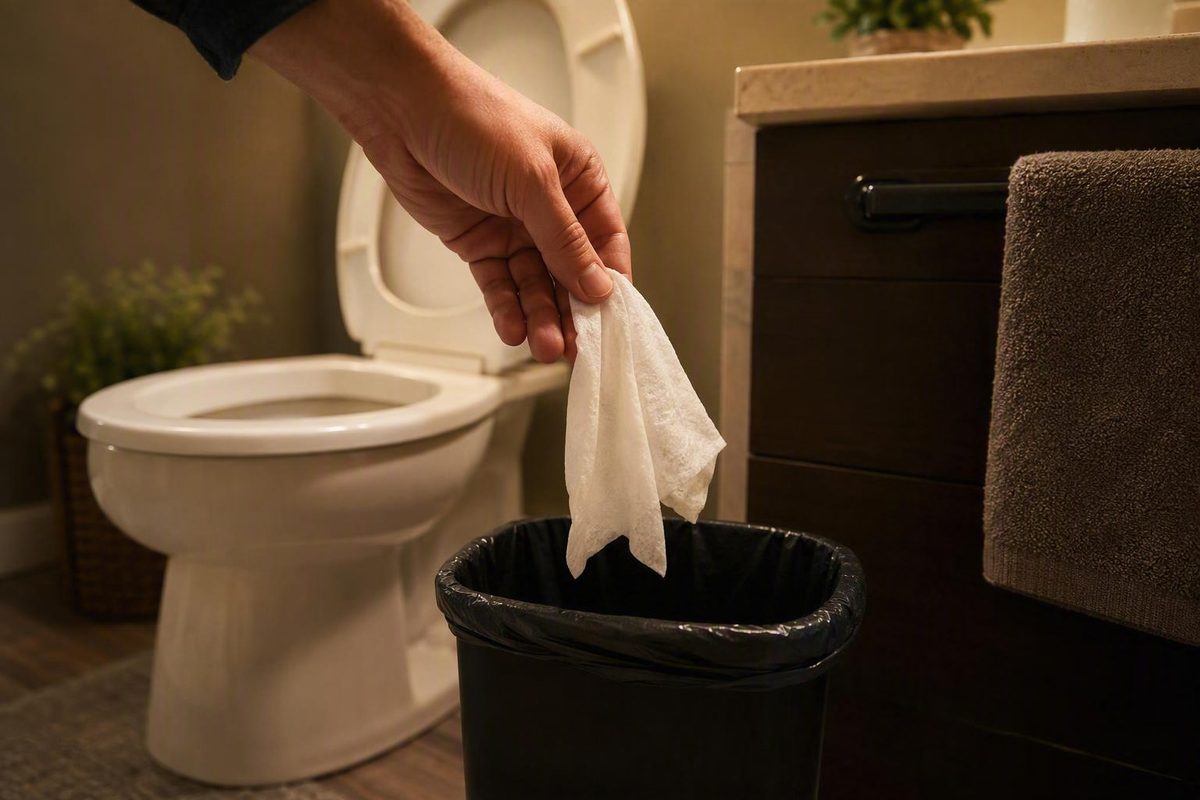
The WIPPES Act requires warnings on non-flushable wipes, but no missing label guarantees sewer or septic safety. See what belongs in the trash.
Products marketed as flushable can still exist under the WIPPES Act, but the act’s label would not certify them as safe for your plumbing. It requires covered non-flushable wipes to say “Do Not Flush”; it does not guarantee that an unlabeled or “flushable” wipe will disperse in your service line, public sewer, or septic system. For the lowest-risk choice, put every disposable wipe in the trash.
Choose the wipe, package wording, wastewater system, and pipe type to get a disposal verdict.
The default low-risk answer is the trash. These selections explain why the label, wastewater destination, and line condition do not create a universal flushability guarantee.
A baby or diapering wipe marked “Do Not Flush” belongs in the trash.
The package gives an explicit disposal warning. Passing through the bowl would not override it.
City sewer: The wipe must first cross your private service line, then public mains and possibly pumps or treatment equipment.
Cast iron: Pipe material does not make the wipe safe. Existing corrosion, deposits, roots, alignment problems, or restrictions can create collection points.
Label to find: “Do Not Flush” wording and crossed-out toilet symbolThe Route the Wipe Would Take
Decision Matrix by Wipe Type and Wording
| Wipe Type | “Do Not Flush” | “Flushable” | Biodegradable or Septic-Friendly | No Wording |
|---|---|---|---|---|
| Baby or diapering | Trash; obey warning | Trash is lowest risk | Trash; degradation speed is unknown | Trash; silence is not approval |
| Disinfecting | Trash; obey warning | Trash is lowest risk | Trash; chemical label does not prove dispersal | Trash; intended use does not prove compatibility |
| Personal-care or makeup | Trash; obey warning | Trash is lowest risk | Trash; eventual degradation is not rapid dispersal | Trash; silence is not approval |
| Household cleaning | Trash; obey warning | Trash is lowest risk | Trash; material may retain wet strength | Trash; intended use does not prove compatibility |
| Branded “flushable” | Trash; warning controls | Trash is lowest risk; check utility guidance | Trash; neither term guarantees system-wide safety | Trash; branding is not federal approval |
What Each Package Signal Means
The product belongs in the trash. The proposed federal framework would require this warning on covered non-flushable wipes.
This is a seller’s claim, not a guarantee for every private line, sewer, pump, treatment plant, or septic system.
The term does not show that the wipe loses strength quickly enough while traveling through plumbing.
An absent warning is not government certification or permission to flush.
Sources: GovInfo status record for S.1092; Senate sponsor announcement; Consumer Reports testing of 11 flushable-wipe brands; Collierville public-utilities guidance. No repair-cost or failure-probability estimate is available from these sources.
The Act Requires Warnings, Not Flushability Approval
WIPPES stands for the Wastewater Infrastructure Pollution Prevention and Environmental Safety Act. The proposal applies to specified premoistened, nonwoven disposable wipes classified as non-flushable. Covered products would need conspicuous “Do Not Flush” wording and a prescribed symbol.
The affected categories include certain baby and diapering wipes, household wipes, disinfecting wipes, cleaning wipes, and personal-care wipes. Coverage ultimately depends on the definitions and conditions in the enacted text, not merely on whether consumers call an item a wipe.
The proposed framework works in one direction: a covered non-flushable product must carry a warning. It does not establish the reverse—that any wipe without the warning is government-approved for toilets.
A missing symbol therefore does not prove compatibility with:
- The toilet trapway
- A private service line
- A public sewer main
- Lift-station pumps or treatment equipment
- A septic tank or soil absorption system
The introduced-version summary named the Federal Trade Commission as the enforcing agency and said the FTC could issue implementing regulations. That enforcement role should not be confused with product certification. The available evidence does not show that the FTC has tested wipes marketed as flushable or approved them for every plumbing and wastewater environment.
The House-passed text for H.R.2269 also prohibited express or implied flushability claims for products within that version’s covered-product definition. A manufacturer could not simultaneously market such a covered non-flushable product as flushable. The reproduced House-passed provisions support that limited point.
That restriction was not a universal ban on the word “flushable.” It applied to products meeting the House version’s definition. Because the Senate passed S.1092 with an amendment in the nature of a substitute, the House language should not automatically be attributed to the Senate-amended bill.
The Verified Record Stops Short of Enactment
The relevant congressional actions in the available record were:
| Date | Action |
|---|---|
| March 24, 2025 | Senator Jeff Merkley introduced S.1092. |
| June 23, 2025 | The House passed the related H.R.2269. |
| March 22, 2026 | The Senate passed S.1092 with an amendment by unanimous consent. |
| March 24, 2026 | The House received S.1092 and held it at the desk. |
The GovInfo status metadata for S.1092 did not show House passage of S.1092, presentation to the president, or enactment through March 24, 2026. The verified conclusion is that S.1092 had passed the Senate but was not shown as federal law in that record.
Passage of H.R.2269 in the House and passage of an amended S.1092 in the Senate cannot simply be combined. Both chambers must approve the same text, whether by accepting one chamber’s version or resolving differences and approving a common measure.
Senator Merkley’s announcement likewise said the proposal had moved closer to becoming law, not that it was already law. It described warnings for non-flushable baby, household, disinfecting, and personal-care wipes (Senator Merkley’s passage announcement).
The federal effort follows seven state “Do Not Flush” laws already in force. Those state measures and the proposed national standard distinguish covered non-flushable products rather than declaring every wipe legally non-flushable (industry overview of the national standard). State labeling requirements do not override more conservative disposal instructions from a sewer utility or septic professional.
“Flushable” Has Three Different Meanings
A wipe can pass one test while failing to answer the broader plumbing question.
| Meaning | What It Establishes | What It Does Not Establish |
|---|---|---|
| Toilet clearance | The wipe passed the fixture under those conditions | Rapid breakup or safe movement farther downstream |
| Downstream dispersal | Evidence that the material loses strength in wastewater | Compatibility with every line, sewer, pump, plant, or septic system |
| Legal marketing | A seller may make the claim under the applicable rules | Government certification of universal plumbing safety |
Toilet Clearance Covers Only the First Few Feet
A wipe disappearing from the bowl proves that it passed the toilet under that particular combination of water volume, placement, load, and fixture condition. It does not reveal whether the wipe stayed intact around the next bend or caught on roots, deposits, debris, or an existing obstruction.
One successful flush also does not reproduce repeated use over months, several wipes sent down close together, an aging line, a pump station, or septic conditions. “It went down” describes the start of the route, not the entire route.
Dispersal Matters After the Bowl Clears
Downstream performance depends on how quickly a wipe loses strength and separates in wastewater. Material that stays intact can catch on obstructions, combine with fats, oils, and grease, or interfere with pumps.
Toilet paper is designed to lose its structure readily. A wet wipe must retain enough wet strength to perform its cleaning job. That functional difference remains relevant even when both products clear the toilet.
“Biodegradable” does not resolve the timing issue. A material may eventually degrade without losing strength during the period when it is moving through household plumbing and wastewater equipment.
A Marketing Claim Is Not a Plumbing Warranty
A manufacturer may rely on a product design or testing framework when making a flushability claim. A local utility may still instruct every customer to flush only human waste and toilet paper because it manages the actual mains, pumps, and treatment equipment.
Neither position establishes that all wipes are identical. The practical point is narrower: a package claim cannot account for every private pipe, public sewer, pump, treatment plant, or septic installation.
Testing Does Not Prove System-Wide Safety
Consumer Reports tested 11 brands labeled flushable under specified laboratory scenarios. None blocked the toilet during an intermediate-load condition, and none blocked the drain pipe when one wipe was flushed without a load.
Those results show that immediate blockage is not inevitable. They do not establish safe performance throughout private service lines, sewer networks, pumps, treatment plants, or septic systems. Consumer Reports still advised people not to flush wipes, including those labeled flushable (Consumer Reports testing and guidance).
The report also cited research finding that more than half of sampled wipes marketed as biodegradable and flushable contained both biodegradable cellulose and slow-degrading synthetic fibers. That finding does not establish the composition of every wipe, but it shows why “biodegradable” and “rapidly dispersible” cannot be treated as synonyms.
Wastewater utilities generally take a system-wide view. Collierville’s public-utilities guidance, for example, tells residents to trash wipes, including products marketed as flushable. It says wipes can combine with fats, grease, and oil, lodge in sewer mains, obstruct flow, and clog lift-station pumps (Collierville utility guidance).
That does not mean one wipe always creates a blockage. The operational risk comes from persistent material discharged by many properties and collecting at roots, joints, deposits, pumps, or other vulnerable locations.
Sewer and Septic Homes Need Different Context
City Sewer Problems Can Start on Private Property
A city-sewer connection usually includes a private service line before wastewater reaches the public main. A wipe can clear the toilet and still catch in that line, particularly where there is an existing defect or obstruction.
Pipe material does not turn a wipe into toilet paper. Cast iron and PVC have different physical characteristics, but neither makes a “Do Not Flush” wipe acceptable. The condition, alignment, joints, roots, deposits, and existing restrictions in the individual line matter more to the immediate clog question than the package claim.
If the wipe reaches the public system, persistent material may contribute to reduced flow, additional cleaning, backups, overflows, or pump maintenance. Private-line work is generally the homeowner’s issue, while public-system costs are spread through utility operations, rates, or taxes. The draft evidence does not support one national wipe-clog repair price; location, access, pipe condition, and local pricing vary.
Septic Systems Call for the Conservative Rule
A septic system receives the wipe after it leaves the house, but toilet clearance remains an incomplete test. A “flushable,” “biodegradable,” “plant-based,” or “septic-friendly” claim does not guarantee rapid dispersal in a particular line, tank, treatment component, or soil absorption system.
The available evidence does not justify claiming that one wipe will destroy a septic system. It does justify avoiding repeated introduction of material designed to retain wet strength. For the lowest-risk practice, flush only human waste and toilet paper and put every wipe in the trash.
Package Wording Leads to One Low-Risk Choice
| Package Wording | What It Establishes | What It Does Not Establish | Lowest-Risk Choice |
|---|---|---|---|
| “Do Not Flush” or crossed-out toilet symbol | The manufacturer directs you not to flush it; an applicable law may require the warning | Whether it can physically pass through the fixture | Trash |
| “Flushable” | The seller makes a flushability claim | Compatibility with every sewer or septic system | Trash |
| “Biodegradable” | Claimed degradation under some conditions | Rapid loss of strength in plumbing | Trash |
| No disposal wording | No clear package instruction | Approval or plumbing compatibility | Trash |
A “Do Not Flush” warning is decisive: follow it. If the package says “flushable” but your sewer utility says toilet paper only, follow the utility’s instruction. If the package says nothing, do not treat silence as permission.
Baby, disinfecting, makeup, cleaning, and personal-care wipes belong in the trash unless authoritative instructions for the exact product and receiving system say otherwise. For a septic home, the toilet-paper-only rule avoids having to interpret marketing terms.
The WIPPES Act makes negative disposal warnings easier to recognize. It does not transform the absence of a warning into federal approval, and it does not make toilet clearance proof of downstream safety.