
Why Facial Tissues Belong in the Bin—and What to Do If You Flushed One
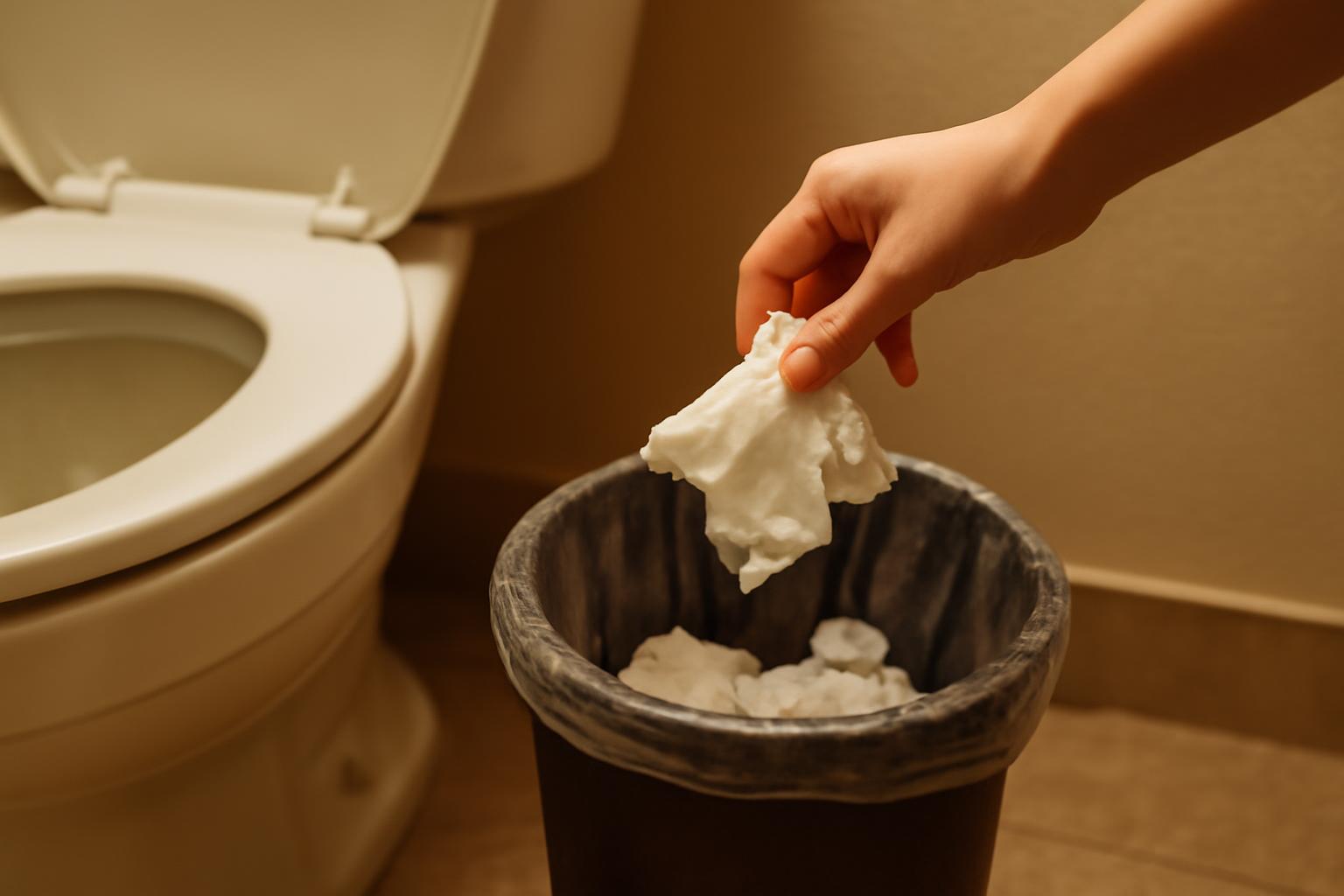
One tissue does not guarantee a clog. If the toilet drains normally, avoid test flushes and watch for slow drainage, gurgling or rising water.
The short answer: put facial tissues in the trash
No—facial tissues, including Kleenex-style tissues, should not be flushed down the toilet. Put them in a waste bin instead.
Toilets and wastewater pipes are intended for human waste and toilet paper. The Milwaukee Metropolitan Sewerage District specifically lists facial tissue among the materials that should not be flushed and warns that an item’s ability to leave the bowl does not make it suitable for plumbing or wastewater systems. See the district’s flushing guidance.
The important distinction is between facial tissue and toilet tissue:
- Facial tissue is sold in boxes or pocket packs for blowing your nose, wiping your face, or absorbing small amounts of moisture.
- Toilet tissue is another name for toilet paper, which is manufactured for use in toilets.
A facial tissue may disappear after one flush, but that only confirms that it left the visible bowl. It does not prove that the tissue dispersed or passed through the toilet trap and every downstream pipe.
The practical rule is:
Toilet paper in the toilet; facial tissue in the bin.
If you have already flushed one tissue, do not assume that a clog has definitely formed. One sheet may pass without causing a noticeable problem, while a wad or repeated flushing introduces more slow-dispersing material. What you should do next depends mainly on whether the toilet continues to operate normally.
Why toilet paper and facial tissue behave differently in water
Toilet paper and facial tissue are both paper products, but they are engineered for different purposes.
Toilet paper must remain usable while dry and then lose strength after entering water. Water and movement cause its structure to disintegrate and disperse into smaller fibers relatively readily. “Disintegrate” or “disperse” is more accurate than saying that paper chemically dissolves.
Facial tissue has a different performance goal. It is expected to absorb moisture from a sneeze, damp skin, or a small spill while remaining intact long enough to be handled. That retained wet strength is useful when wiping your face but undesirable inside a drain.
The Milwaukee Metropolitan Sewerage District explains that toilet paper is designed to break down in water, while facial tissues, napkins, and paper towels do not disintegrate in the same way. Read its comparison of flushable and non-flushable paper products.
Because facial tissue remains intact longer, it has more opportunity to:
- Fold or bunch into a thicker mass.
- Clump with other material.
- Catch at an existing restriction.
- Add bulk to a partial blockage that had not yet produced obvious symptoms.
This does not mean every facial tissue will remain intact indefinitely or that one sheet will always block a toilet. Tissue construction varies, as do toilet design, pipe layout, water flow, and the condition of the drainage system. The relevant difference is comparative: facial tissue is intended to retain useful strength when damp, whereas toilet paper is intended to lose strength and disperse more readily.
Some facial tissues may contain lotions, scents, softeners, or other treatments, but formulations differ. These ingredients should not be presented as a universal explanation for why tissues are unsuitable for flushing. The central issue is the product’s intended performance when wet.
A demonstration in a container would not necessarily reproduce conditions inside a toilet trap or household drain. The practical conclusion does not require a stopwatch: facial tissue does not disperse as readily as toilet paper and belongs in the trash.
How flushed tissues can turn into a blockage
A facial tissue that stays intact longer can fold, clump, or collect with other material along that route. If the pipe already has a partial restriction, the tissue may contribute to a larger obstruction even if it would not have caused a clog by itself.
Possible outcomes include:
- A blockage within the toilet trapway.
- Restricted flow in the drain serving the toilet.
- A clog farther along the household drainage path.
- Additional material collecting at an existing restriction.
- A blockage farther into the wastewater system.
A bowl that clears is not proof that the tissue has passed through the entire drainage system. Conversely, a tissue leaving the bowl does not mean it will necessarily become trapped. Symptoms should guide the response.
Quantity matters. One loose tissue introduces less material than a tightly packed wad or tissues flushed repeatedly over several days. Water Corporation identifies facial tissues as unflushable and says tissues, wet wipes, and paper towels can build up and contribute to wastewater-pipe blockages. Its guidance does not claim that every individual tissue causes a clog. Review Water Corporation’s flush-or-bin guidance.
A proportionate way to think about the risk is:
- One tissue and no symptoms: Stop flushing tissues and monitor the toilet.
- Several loose tissues and no symptoms: Avoid unnecessary flushing and watch drainage more closely.
- A wad or repeated disposal: Be more cautious because more slow-dispersing material has entered the drain.
- Any amount followed by rising water or poor drainage: Stop flushing and address the apparent restriction.
Tissue construction, toilet design, pipe condition, and any existing restriction can all affect the result. It is therefore inaccurate both to guarantee safe passage and to say that one tissue will definitely cause a blockage.
What to do after accidentally flushing a tissue
Start by considering how much was flushed and what the toilet is doing now.
If it was one tissue and the toilet appears normal
Do not panic, and do not repeatedly flush merely to test the drain.
A normal bowl level and an ordinary flush are reassuring observations, although they cannot confirm what has happened in every downstream pipe. Resume normal toilet use, but do not add facial tissues, wipes, paper towels, or other non-flushable material.
Over the next several uses, watch for:
- A weaker flush than usual.
- Water draining slowly from the bowl.
- Gurgling during or after a flush.
- An unusually high bowl-water level.
- Water rising before it drains.
- A clog that clears but soon returns.
They indicate that flow may be impaired and that another flush could worsen the immediate problem.
If several tissues or a wad were flushed
Monitor the toilet more closely and use a lower threshold for taking poor drainage seriously. More material creates more opportunity for clumping or collecting at a restriction.
If the bowl remains at its normal level and there are no symptoms, monitoring is more proportionate than assuming emergency service is automatically necessary. Do not conduct repeated test flushes, however. Each flush adds water and may add more solid material.
If the toilet becomes slow, weak, or inconsistent, stop routine use until the restriction has been addressed.
If symptoms develop
Match your response to what you observe:
- The water rises: Do not flush again.
- The bowl drains slowly but remains contained: Let the level settle before considering a toilet flange plunger.
- The clog persists or quickly returns: Stop repeated attempts and consider an appropriate toilet auger or professional help.
- Wastewater backs up or other fixtures are affected: Avoid using the affected plumbing and arrange an inspection.
Symptoms involving more than one fixture may indicate that the problem extends beyond the toilet, but symptoms alone cannot confirm the location. Commercial guidance from Who Gives A Crap likewise recommends watching for gurgling, slow drainage, and poor flushing after an accidental tissue flush. See its accidental-flush guidance.
If the bowl water rises, stop flushing
Do not flush again if the bowl water is rising.
Another flush can add enough water to overflow the rim.
Take these immediate steps:
- Leave the flush handle alone.
- Close the toilet’s water-supply valve if necessary. The valve is usually on the wall or floor behind the toilet. Turn it clockwise to stop the tank from refilling. Do not force a stuck valve.
- Protect the floor. Move rugs and nearby objects away and place towels around the toilet if water is close to the rim.
- Allow the bowl level to stabilize. Wait until the water is at a manageable level before attempting a minor-clog remedy.
- Use a toilet-specific tool. A toilet flange plunger is the usual first option for a minor toilet clog.
Do not pour boiling water into the toilet because abrupt heat may damage or crack porcelain. Hoffmann Brothers’ plumbing guidance supports stopping further flushing, shutting off the toilet’s water supply if needed, using a flange plunger or toilet auger, and avoiding boiling water. Review the overflow-prevention and clog guidance.
Chemical drain cleaner should not be the default response to a suspected tissue clog. The immediate priority is containment: stop adding water, protect the surrounding area, allow the level to settle, and then decide whether a controlled DIY attempt is appropriate.
How to approach a minor tissue clog
A homeowner may make a reasonable first attempt at a minor toilet-only clog if the bowl is not overflowing and the work can be approached safely.
Start with a toilet flange plunger
Use a toilet flange plunger, which has an extended rubber section designed to fit the toilet outlet and create a seal.
To plunge with control:
- Put on cleaning gloves and remove objects from around the toilet.
- Make sure the bowl contains enough water to cover the plunger cup, but not so much that movement will cause an overflow.
- Lower the plunger into the water at an angle so the cup fills with water rather than air.
- Center the flange over the toilet outlet and establish a seal.
- Begin gently to limit splashing.
- Use steady push-and-pull strokes while maintaining the seal.
- Stop after a controlled series of strokes and let the bowl settle.
Do not follow every attempt with another full test flush. If the bowl level remains abnormal or drainage is still poor, assume the restriction may remain.
Consider a toilet auger if plunging fails
It may be considered when:
- The problem appears confined to the toilet.
- The bowl level has stabilized.
- Controlled plunging has not restored normal drainage.
- You can follow the tool manufacturer’s operating instructions.
Advance and retrieve the cable as directed by the manufacturer.
Hoffmann Brothers recommends a flange plunger or toilet auger for a tissue-related clog and professional assistance if the blockage persists or repeatedly returns. See its recommended escalation path.
Know when to stop
Discontinue DIY attempts if:
- Controlled plunging does not restore drainage.
- The obstruction clears but quickly returns.
- The bowl repeatedly rises toward overflow.
- Wastewater backs up.
- Another fixture begins gurgling, draining slowly, or backing up.
- A tool becomes stuck.
- The work cannot be performed without unsafe exposure.
- You are not confident using a toilet auger correctly.
Persistent or recurring clogs are appropriate reasons to call a plumber. An inspection may find that the tissue joined an existing restriction or that the drainage problem has another cause. A normal-looking bowl or a particular symptom cannot identify the exact blockage location on its own.
Septic systems and biodegradable labels do not change the rule
Facial tissues should not be routinely flushed into a septic system. Their slower dispersal adds material that the system must handle. The result depends on the product, septic design, system condition, maintenance, and household use, so one tissue should not be described as causing inevitable septic failure.
A biodegradable label does not make a facial tissue automatically flushable.
These are separate questions:
- Can the material eventually biodegrade?
- Will it disperse promptly during a flush?
- Does the local wastewater utility accept it?
- Is it appropriate for a particular septic system?
A “yes” to the first question does not answer the others.
Even some products marketed as flushable may not break apart as readily as toilet paper. Water Corporation warns that certain flushable-labelled wipes do not break down as easily as toilet paper in its wastewater system and can contribute to blockages. Read the utility’s guidance on flushable labels.
Check the product instructions and guidance from your wastewater utility or septic authority. If those instructions differ, use the more restrictive disposal rule.
The safest default remains: flush human waste and ordinary toilet paper only.
A practical flush-or-bin guide for bathroom paper products
Use this checklist when deciding what belongs in the toilet:
| Item | Flush or bin? |
|---|---|
| Human waste | Flush |
| Ordinary toilet paper used as intended | Flush |
| Facial tissues or Kleenex-style tissues | Bin |
| Paper towels | Bin |
| Napkins | Bin |
| Baby wipes | Bin |
| Personal-care or wet wipes | Bin |
| Disinfecting wipes | Bin |
| Dental floss | Bin |
| Hair | Bin |
Paper towels, wet wipes, dental floss, and hair should also be kept out of the toilet. A commercial guide from Reel Paper identifies these items alongside facial tissues as unsuitable for flushing. See its list of non-flushable bathroom items.
A “flushable” label should not be treated as a promise that an item disperses as readily as toilet paper or is accepted by every wastewater utility. When in doubt, put it in the bin.
Using fewer tissues reduces the amount of material but does not make the product suitable for flushing. Naked Paper, a seller of toilet paper and facial tissues, likewise advises against flushing facial tissues even when toilet paper has run out. Read its emergency-substitute guidance.
Used facial tissues are generally unsuitable for conventional paper recycling because of contamination. Put them in household waste unless your local recycling authority provides different instructions.
Composting is conditional rather than universal. Whether a tissue is accepted depends on its ingredients, contamination, and the rules of the local composting program. Do not assume that a biodegradable or compostable label means every collection program will accept it.
The simplest prevention measure is to keep a small lined bin within reach of the toilet. Giving facial tissues, wipes, floss, and other non-flushable items an obvious disposal route makes them less likely to end up in the bowl.
Frequently asked questions
Will one accidentally flushed tissue clog the toilet?
Not necessarily. One tissue does not guarantee a clog, but there is also no guarantee that it will pass through the entire drainage system.
If the toilet is draining normally, do not repeatedly test-flush it. Stop adding non-flushable material and watch for slow drainage, weak flushing, gurgling, rising water, or a recurring clog. A wad or repeated flushing is more concerning because more material has entered the system.
What should I do if the toilet water rises after flushing tissues?
Do not flush again. Close the toilet’s water-supply valve if necessary, protect the floor, and let the bowl level stabilize.
Once the water is manageable, a toilet flange plunger is the usual first tool for a minor clog. Do not use boiling water or treat chemical drain cleaner as the default remedy. Call a plumber if the blockage persists, returns, or produces a wastewater backup.
Can I flush facial tissues if I run out of toilet paper?
No. Facial tissue can be used externally as a temporary substitute, but it should be discarded in a lined bin.
Using fewer sheets does not change how the product behaves in water. Facial tissue is made to remain useful when damp rather than disperse like toilet paper.
Does biodegradable mean a facial tissue is flushable?
No. Biodegradable means a material can break down under suitable conditions over time. It does not prove that the product will disintegrate promptly in a toilet or travel safely through household and wastewater pipes.
Follow local wastewater guidance and product disposal instructions. When the guidance is unclear, flush only human waste and ordinary toilet paper.
When should I call a plumber for a tissue-related clog?
Call a plumber when the obstruction persists after controlled plunging, quickly returns, repeatedly sends the bowl water upward, or produces a wastewater backup.
Professional help is also appropriate if other fixtures develop drainage symptoms, a tool becomes stuck, or you cannot work on the toilet safely.
The bottom line
Facial tissues belong in the bin, not the toilet. They retain more strength when wet than toilet paper and can clump, catch, or contribute to an existing restriction.
One accidental tissue does not prove that a clog has formed. Do not repeatedly flush to test it; watch for drainage symptoms instead. If the bowl water rises, stop flushing and contain the problem. Use a toilet flange plunger for an appropriate minor clog, and seek professional help when the blockage persists, returns, or affects other fixtures.