
Cloudy Hot Water: Separate Harmless Bubbles from Sediment Issues
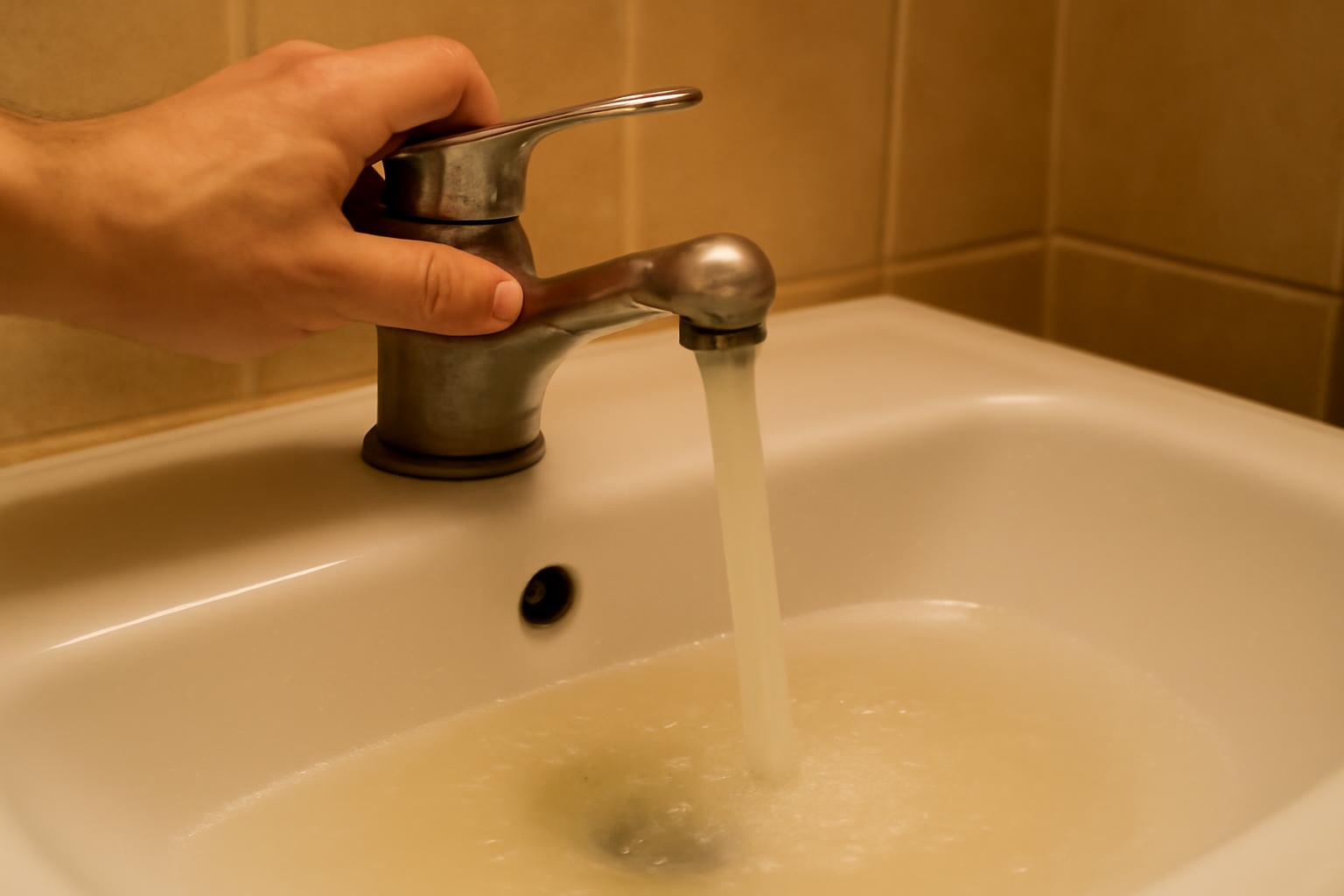
Hot water that stays cloudy, leaves grit, smells bad or looks tinted shouldn't be judged safe by appearance alone. Its behavior in a glass narrows the cause.
If you’re asking why is my hot water cloudy, the answer is usually less dramatic than it looks. In many homes, cloudy hot water is simply tiny air bubbles made visible when water is heated and then released from pressure at the faucet. In other homes, the cloudiness comes from sediment or hard-water minerals being disturbed inside the water heater.
The key is not to guess from appearance alone. A glass of hot water can look milky for more than one reason, and the fix depends on which pattern you actually have. Water that clears on its own points in one direction. Water that stays hazy, leaves residue, or comes with odor, particles, or discoloration points in another.
This guide uses the symptom-first approach that works best for homeowners: compare hot to cold, watch what happens in a clear glass, rule out a single dirty faucet aerator, and know when the issue has moved beyond DIY.
Recognizing Cloudy Hot Water Symptoms
Cloudy hot water usually appears as a milky, hazy, foggy, or whitish look, often most noticeable right when you first draw it from the tap. That first appearance matters, but what matters more is what the water does after it sits for a short time.
The first question is simple: does it clear, or does it stay cloudy?
Utility guidance and homeowner plumbing references generally agree on this basic test:
- if the water clears on its own, especially from the bottom up, the cause is usually trapped air bubbles
- if the haze lingers, leaves a film, drops particles, or feels gritty, sediment or minerals become more likely
For air-related cloudiness, the timing is only approximate. Many sources describe it clearing in seconds to a few minutes, often around a minute or two. Some homeowner guidance allows longer. The stronger clue is the bottom-up clearing pattern, not the exact stopwatch number.
If the water stays hazy, leaves a ring on the glass, or drops visible material to the bottom, that is less consistent with harmless aeration. Persistent cloudiness deserves closer attention because it can reflect sediment, scale, corrosion, or another plumbing or supply issue.
You’ll often notice this more in hot water than cold. That alone does not mean the water is unsafe. Hot water can look cloudier because heating makes dissolved gases less likely to stay in solution, and because heating can also disturb mineral deposits inside a water heater. So clear cold water and cloudy hot water can happen even when the main incoming supply is not the problem.
In practical terms, cloudy hot water is often a harmless appearance issue when all of these are true:
- it looks white or milky rather than yellow, brown, green, or rusty
- it clears after sitting
- it clears from the bottom upward
- there is no odd odor
- the taste has not changed
- there is no visible grit, residue, or film
The less reassuring version is the one that persists, smells bad, looks tinted, or leaves particles behind. In those cases, cloudiness is not the diagnosis. It is the symptom telling you to investigate further.
Primary Cause: Air Bubbles from Heating and Pressure
The most common explanation for cloudy hot water is basic water chemistry and pressure behavior: heated water holds less dissolved gas than cold water.
Water in your plumbing system is under pressure. Under that pressure, small amounts of air stay dissolved in the water. When the water is heated in the water heater, those gases become less soluble. Then, when you open the faucet, the pressure drops and those tiny bubbles become visible. The water can suddenly look cloudy, milky, or almost carbonated.
That is why the cloudiness often disappears in a glass. The bubbles rise and escape, and the water clears from the bottom up. Municipal water FAQs and plumbing troubleshooting articles describe this as the classic air-bubble pattern.
Why hot water shows it more than cold water
Hot water is where this shows up most clearly because two things happen together:
-
Heating reduces gas solubility. Warm water cannot hold as much dissolved air as colder water.
-
Opening the tap changes pressure. Once the water leaves the pressurized system, the dissolved gas becomes visible as microbubbles.
That combination makes the effect much more obvious on the hot side than on the cold side.
What air-related cloudiness looks like
Air-bubble cloudiness is usually:
- bright white or milky rather than muddy or rusty
- fairly uniform through the glass at first
- most visible immediately after drawing water
- quick to fade after sitting
- not accompanied by grit, flakes, or a coating on the glass
If you look closely, you may also see tiny bubbles clinging to the inside of the glass before they rise away.
When it tends to happen
Air-related cloudiness can be more noticeable:
- after a new water heater is installed
- after plumbing work or pressure changes
- during seasonal temperature swings
- when household water pressure is high
- when a faucet aerator changes local flow and turbulence
Several homeowner references also note that a new water heater can make this more obvious for a while. That does not automatically mean the installation was wrong or the heater is failing. A new tank can simply make dissolved air more visible at the tap. Some sources mention the anode rod as a possible secondary contributor in certain situations, but the stronger and more consistent explanation is still normal gas release from heating and pressure change.
Is it harmful?
When the water clears quickly and has no odor, unusual taste, residue, or discoloration, this kind of cloudiness is generally treated as harmless temporary aeration. It changes the appearance of the water more than the quality.
But “harmless” only fits the full symptom picture. If the same cloudy hot water also has a sulfur smell, visible particles, tint, or persistent haze, do not keep treating it as ordinary aeration.
Secondary Cause: Sediment and Mineral Buildup
If the water does not clear cleanly after sitting, the next likely cause is sediment or mineral buildup in the water heater.
Over time, hard-water minerals such as calcium and magnesium can accumulate inside a tank-style heater. Fine sediment can also settle there. As the heater cycles on and off, some of that material can be disturbed and mixed back into the outgoing hot water. At first glance, that can look similar to air bubbles, but it behaves differently in the glass test.
How hard water creates the problem
Hard water carries dissolved minerals. Repeated heating encourages those minerals to form deposits and scale. Over months and years, a tank water heater can develop a layer of buildup and loose sediment. When water moves through the tank and heats up, small bits of that material may get stirred into the hot water line.
That is why sediment-related cloudiness tends to show up more on the hot side than the cold side: the heater is where the buildup forms, and heating helps loosen or agitate it.
What sediment-related cloudiness looks like
Sediment or mineral haze usually differs from simple aeration in one or more ways:
- the cloudiness persists
- particles settle to the bottom
- the glass is left with a film or ring
- the water feels gritty
- the cloudiness looks less like uniform milkiness and more like suspended material
Sometimes the water looks whitish but leaves scale residue after it sits. Other times you may see fine specks or flakes.
Where it is most common
Sediment-related cloudiness is more likely when:
- you live in a hard-water area
- the heater is older
- the tank has gone a long time without maintenance
- you already see spots or scale on fixtures and glassware
- the heater makes rumbling or popping sounds
- hot water flow has gradually declined
Those extra clues matter because sediment affects more than clarity. A scaled or sediment-loaded heater can lose efficiency, heat more slowly, and make noise as water interacts with deposits at the bottom of the tank.
Is sediment unsafe?
Not necessarily. In many homes, sediment and scale are more of a maintenance and efficiency problem than an immediate health emergency. But persistent hot-water cloudiness should not be brushed off, because similar symptoms can overlap with corrosion, aging plumbing, or broader water-quality issues.
A good working rule is this: sediment is common, but persistent unexplained cloudiness deserves follow-up. If you can see particles, feel grit, or notice worsening heater performance, you are past the stage of simply ignoring it.
Why Only Hot Water? Hot vs. Cold Diagnosis
One of the fastest ways to narrow this down is to compare hot and cold water from the same faucet.
If only hot water is cloudy and the cold sample is clear, the problem is more likely tied to the water heater or hot-water side of the plumbing. That points you toward causes such as:
- heating-related air bubbles
- sediment or scale inside the heater
- a hot-side pressure or flow condition
- a local hot-side fixture issue
If both hot and cold water are cloudy, the heater may not be the main problem. In that case, think more broadly about:
- the incoming water supply
- recent municipal flushing or main work
- shared plumbing conditions
- corrosion or debris in supply lines
- private well changes
- a temporary disturbance after repairs
Use the same-faucet comparison first
A simple first test is to fill:
- one clear glass with cold water
- one clear glass with hot water
Use the same faucet and fill them one after the other. Then compare:
- Does only the hot sample look cloudy?
- Does the hot sample clear from the bottom up?
- Does the cold sample stay clear?
- Do either samples leave particles or residue?
If the hot sample is the only one affected, the water heater becomes the main suspect. If both samples show the same issue, look upstream before focusing on the heater.
Check more than one faucet
Next, repeat the comparison at multiple fixtures, such as the:
- kitchen sink
- bathroom sink
- tub spout
This helps separate a whole-house problem from a single-faucet problem.
If only one faucet shows the cloudiness, the issue may be local to that fixture, especially the aerator. A dirty or partially clogged aerator can change flow enough to exaggerate cloudiness or trap debris at the faucet.
If several fixtures show the same cloudy hot water, that pattern points back toward the heater or the hot-water plumbing rather than one faucet screen.
What to do if both hot and cold are cloudy
When both temperatures are cloudy, a heater flush is usually not the right first move.
Instead:
- check whether the issue is happening at every faucet or only a few
- think about recent plumbing work inside the house
- look for utility notices or recent municipal maintenance in your area
- ask whether neighbors on the same supply are seeing the same symptom
- note whether the issue is clearing quickly or coming with odor, color, or particles
Some municipal disturbances are temporary. Plumbing references note that outside line work can stir up air or sediment for a short period. But if the problem lasts, worsens, or includes odor, discoloration, or residue, move toward water testing or a plumber’s inspection rather than more heater-focused DIY.
A clearer well-water branch
If you are on a private well, use a lower threshold for testing.
Why? Because well water can vary more than regulated municipal supply, and cloudiness in a well system can overlap with bacteria, sulfur-related issues, sediment, or changing source conditions. If both hot and cold are cloudy in a well-water home, or if cloudy hot water comes with odor or particles, move to testing sooner instead of assuming it is only heater sediment.
Step-by-Step Glass Test and Initial Checks
If you want a homeowner-friendly answer to “why is my hot water cloudy,” the best first tool is still a clear glass and a few minutes of observation.
This test costs nothing, needs no special tools, and often separates harmless bubbles from a problem that needs more attention.
1. Fill a clear glass with hot water
Use a transparent glass, not an opaque mug. Fill it with hot water from the faucet where you notice the cloudiness most.
Set it where the light is good and watch it immediately.
2. Look for the clearing pattern
This is the most useful part of the test.
More consistent with air bubbles:
- the glass looks milky at first
- it begins clearing at the bottom
- the clear zone moves upward
- the cloudiness fades within seconds to a few minutes
More consistent with sediment or minerals:
- the water stays hazy
- particles drift downward and collect
- the glass develops a film or ring
- the cloudiness does not resolve cleanly
If you want a better comparison, take one photo right after pouring and another a few minutes later. The pattern is often easier to judge in photos.
3. Compare hot and cold from the same faucet
Fill one hot sample and one cold sample side by side.
This tells you whether the symptom is mainly heater-related or broader than the heater. Clear cold water plus cloudy hot water is a strong clue that the water heater or hot side is involved.
4. Repeat the test at another faucet
Do not assume the first fixture tells the whole story. Repeat the same check somewhere else in the house.
- One fixture only: check the aerator first
- Several hot fixtures: suspect the heater or house hot-water conditions
- Hot and cold at several fixtures: think supply, shared plumbing, or well conditions
5. Clean the aerator
A clogged faucet aerator can trap debris and change the way water leaves the tap.
To check it:
- Unscrew the aerator from the faucet tip.
- Rinse out any trapped scale or sediment.
- Reinstall it.
- Run the water again and compare.
If the cloudiness disappears only after cleaning the aerator, you probably had a local fixture issue rather than a heater problem.
6. Run the water briefly and note what changes
Let the water run for a minute or two and pay attention to what happens.
Ask:
- Does the cloudiness improve after the line runs?
- Is there a rotten egg smell?
- Is the water yellow, brown, green, or rusty?
- Are there visible particles?
- Does pressure seem lower than normal?
Those details tell you much more than the word “cloudy” by itself.
7. Repeat at different times
A one-time sample can mislead you. Try the same checks:
- first thing in the morning
- after the heater has been idle
- during a period of heavy water use
- after nearby utility work or house plumbing repairs
Air-bubble cloudiness often behaves consistently and clears fast. Sediment tends to be more stubborn. Supply disturbances may come and go.
8. If the problem is system-wide, switch from fixture checks to supply checks
If you have already confirmed that both hot and cold are cloudy at multiple fixtures, change your troubleshooting path.
At that point:
- review local utility notices if you are on municipal water
- ask nearby neighbors if they are seeing the same issue
- note whether the symptom is temporary or recurring
- if you are on a well, move sooner to water testing
That keeps you from wasting time on heater maintenance when the problem may be outside the heater.
DIY Fixes for Air Bubbles and Minor Sediment
Once you have done the basic diagnosis, the right home response becomes much clearer. The biggest mistake is treating every cloudy-water complaint like a water-heater problem before you have checked whether it is really just harmless aeration or a single dirty aerator.
If the cause looks like air bubbles
If the water clears from the bottom up and leaves no residue, start with the least invasive steps.
Let it sit or run briefly
Air-related cloudiness often resolves on its own. You may find that:
- a glass clears after sitting
- the tap runs clearer after a short burst
- the symptom is strongest on the first draw
That pattern supports a temporary aeration explanation.
Clean faucet aerators
Even when dissolved air is the real cause, a dirty aerator can make the cloudy appearance look worse. Cleaning faucet screens is an easy first step and sometimes solves a one-fixture complaint.
Consider pressure only if you already have other signs of a pressure problem
High household pressure can contribute to aeration symptoms. But cloudy water alone is not enough to diagnose a pressure issue. If you already know your home has unusually high pressure, or you have other plumbing symptoms that point in that direction, have a plumber evaluate the system and the pressure-reducing valve rather than guessing from appearance alone.
Be patient after a new heater install
If cloudy hot water started right after a new heater was installed and the water clears quickly, temporary aeration is a plausible explanation. In that situation, monitoring the pattern for a bit is more reasonable than jumping straight to replacement or assuming the installation failed.
If the cause looks like minor sediment
If the cloudiness lingers, leaves mineral residue, or drops particles after sitting, and you have ruled out a single dirty aerator, tank sediment becomes a more likely explanation.
Think of flushing as maintenance, not a universal first fix
A flush is commonly mentioned for tank-style water heaters with sediment buildup, especially in hard-water homes. But it is not the right first move until your symptom check points in that direction.
Just as important, a generic online procedure is not a universal set of operating instructions. Shutoff, draining, refill, restart, and safety steps vary by heater design and manufacturer.
So if you are considering a flush:
- confirm that you have a tank-type heater
- use the manufacturer’s instructions for your exact model
- stop DIY if you are unsure how to safely shut down and restart the unit
- do not restore service until the tank has been properly refilled and the procedure in the manual is complete
- call a plumber if the heater type, controls, or drain setup are unclear
At a high level, flushing is simply a maintenance process for removing loose sediment from the bottom of a tank. It may help with minor grit, rumbling tied to sediment, and persistent hot-water haze caused by tank deposits. It will not reliably fix cloudiness caused by dissolved air, supply disturbances, corrosion, or broader water chemistry issues.
Many homeowner references discuss flushing on an approximate schedule such as every 6 to 12 months, especially in hard-water homes, but that is not a universal rule. The right interval depends on your heater, water conditions, and manufacturer guidance.
Avoid chemicals as a first response
Chemical products are not the first answer to cloudy hot water. If the water stays cloudy after basic checks, the better next move is diagnosis, testing, or inspection, not pouring treatment chemicals into plumbing or the heater.
Use cold water for drinking and cooking if you’re concerned
Even when the issue looks minor, it is still a sensible household habit to use cold water for drinking and cooking, then heat it separately if needed. That is especially reasonable whenever you are still unsure whether the hot-water cloudiness is simple aeration or something else.
Red Flags: When to Stop DIY and Get Inspection
Cloudy hot water is often benign, but not every cloudy-water problem belongs in the DIY bucket. Some symptoms raise the stakes and point toward professional inspection or water testing.
Call for help if the cloudiness persists
If you have already done the glass test, compared hot versus cold, checked more than one faucet, and cleaned aerators, but the problem remains, that is your sign to stop guessing.
Persistent cloudiness is not the classic harmless-bubbles pattern.
Red flags that justify a plumber or water test
Move past DIY if you notice any of these:
- cloudiness that does not clear
- grit, flakes, or residue
- rotten egg or sulfur smell
- yellow, brown, green, or rusty tint
- bad taste
- low hot-water pressure
- rumbling or popping from the heater
- cloudiness at multiple fixtures
- both hot and cold water affected
- worsening symptoms after repairs or maintenance
These are not typical signs of ordinary air bubbles.
Odor changes the diagnosis
A rotten egg smell shifts suspicion away from simple aeration. Plumbing references tie that kind of odor more to sulfur-related reactions, bacteria, or in some situations to conditions involving the heater and its anode. The evidence is mixed on how often an anode contributes directly to cloudiness, but it is much more consistent that odor deserves separate attention.
If you are on well water, use an even lower threshold for testing. Well systems are more variable and more vulnerable to localized water-quality changes than regulated municipal systems.
If both hot and cold are cloudy, think upstream
When the problem affects both temperatures, the heater may not be the main culprit. Recent municipal maintenance, disturbances in supply lines, corrosion in shared plumbing, or well conditions become more likely.
A clearer next-step path for that situation is:
- Check multiple fixtures.
- Look for utility notices or recent municipal work.
- Ask nearby neighbors whether they see the same thing.
- If the issue lasts or includes odor, color, or particles, arrange water testing or plumbing inspection rather than more heater maintenance.
That sequence is especially useful because some supply disturbances are temporary, while others are not.
When replacement talk is premature
It is common for homeowners to jump from “cloudy hot water” to “my heater needs replacement.” That is usually too big a leap.
Cloudiness by itself does not prove replacement is necessary. Many cases are temporary aeration. Others are manageable sediment.
Replacement becomes more plausible only when cloudy water appears alongside broader failure signs such as:
- visible corrosion
- recurring heavy sediment despite maintenance
- clear performance decline
- leaks
- brown or rusty hot water linked to deterioration
- age-related failure symptoms
A practical stop rule
Stop DIY and arrange inspection when:
- the symptom no longer fits the air-bubble pattern
- the water leaves visible material behind
- smell, color, or pressure changes are present
- the whole house is affected
- you are on a well and cannot rule out a water-quality issue
- you are not comfortable safely working on the heater
This article is general guidance, not an on-site diagnosis. Local water conditions, heater types, plumbing materials, and supply issues vary. Use the checks here to narrow the issue, then rely on direct inspection or testing before making major repair or treatment decisions.
Prevent Recurring Cloudy Hot Water
Once you know the cause, prevention usually comes down to routine maintenance, clean fixture screens, and recognizing when the problem is really in the heater versus in the incoming supply.
Flush the heater on a condition-based schedule
For homes with tank water heaters, periodic flushing is commonly recommended to reduce sediment buildup. Homeowner references often mention an interval such as every 6 to 12 months, with more frequent attention in hard-water homes, but that should be treated as a rough maintenance example rather than a universal rule.
Your actual schedule should follow the heater manual, local water hardness, and how quickly sediment symptoms return.
Inspect the anode on a longer cycle
Anode rods are not the main explanation for most cloudy hot water, but they do matter for overall tank health and can be relevant in some odor-related cases. Homeowner maintenance articles commonly mention checking or replacing the anode on a longer cycle such as every 3 to 5 years, again depending on water quality and manufacturer guidance.
Think of anode service as preventive tank care, not the default fix for cloudy water.
Watch for hard-water signs
If your home regularly shows:
- white scale on fixtures
- showerhead buildup
- spots on dishes or glassware
- chalky residue around faucets
then hard water is likely contributing to the sediment cycle inside the heater. That does not automatically mean you need equipment or major changes. It does mean you should expect more maintenance and a greater chance of mineral-related hot-water haze.
Clean aerators regularly
Aerators are small, but they can exaggerate cloudy-water symptoms at one fixture and confuse the diagnosis. Periodic cleaning helps prevent repeat false alarms and keeps local debris from collecting at the faucet.
Follow manufacturer guidance on heater temperature rather than chasing an exact number from a generic article
Published homeowner advice on water-heater temperature is not perfectly consistent. Some sources discuss residential settings in the 120°F to 140°F range, while other advice focuses on bacteria concerns or hotter operation. Because those tradeoffs involve scald risk, heater design, and household needs, the safer takeaway is not to change temperature settings based on cloudy water alone.
Instead:
- follow the manufacturer’s instructions
- consider local code and household safety needs
- ask a plumber if you are unsure
- if a hotter setup is being used, ask whether mixing valves are appropriate for scald protection
Check local water reports or utility notices when symptoms point outside the heater
If cloudiness suddenly affects both hot and cold water, or appears after neighborhood utility work, check local notices or your water utility’s published information before you assume a heater problem.
That step is especially useful when multiple fixtures are affected at once.
Know when prevention stops and diagnosis starts
Not every recurrence is a maintenance issue. If cloudiness begins affecting:
- both hot and cold water
- multiple fixtures suddenly
- water with odor, color, or particles
then stop thinking “routine heater maintenance” and start thinking “system diagnosis.”
Most cases of cloudy hot water trace to benign air bubbles or manageable sediment. The best way to stay ahead of it is to use the glass test early, keep fixture screens clean, maintain the heater according to its manual and your water conditions, and stop DIY once the symptoms no longer fit the harmless pattern.
Is cloudy hot water safe to drink or use?
Usually, yes if it clears quickly and has no odor, taste change, discoloration, or residue. Cloudy hot water caused by tiny air bubbles is generally considered harmless and often clears after sitting briefly in a glass.
The warning sign is not the cloudiness by itself, but the added symptoms. If the water stays cloudy, leaves grit, smells bad, or looks tinted, do not assume it is safe based on appearance alone. And as a practical household habit, use cold water for drinking and cooking if you have any concern about the hot-water side.
How long should I wait for cloudiness to clear in the glass test?
Treat timing as approximate, not exact. Many references describe air-related cloudiness clearing in seconds to a few minutes, often around a minute or two. Some homeowner guidance allows longer.
The more important clue is the pattern:
- bottom-up clearing suggests air bubbles
- lingering haze, particles, or film suggests something else
If the cloudiness is still there after sitting and you can see residue or settling material, move past the “harmless bubbles” explanation.
Does cloudy hot water mean my water heater needs replacement?
No. Cloudy hot water alone does not mean replacement is necessary. In many homes, it is simply temporary aeration. In others, it points to sediment that may be manageable with maintenance.
Replacement becomes a more realistic discussion only when cloudiness appears with broader heater problems such as leaks, corrosion, repeated heavy sediment, reduced performance, or discolored hot water linked to deterioration.
Why is my hot water cloudy after a new heater install?
A new heater can make air-related cloudiness more noticeable for a while. Heating and pressure changes can release dissolved gases, producing the milky appearance that clears in a glass. That is a plausible explanation when the symptom started right after installation and the water clears quickly.
Some sources also mention the anode as a possible secondary contributor in certain situations, but that is not the default assumption. If the cloudiness is temporary, clears from the bottom up, and comes with no odor or particles, monitoring is reasonable. If it persists or adds smell, grit, or discoloration, have the heater and water conditions checked.
What if cloudy water has a bad smell or particles?
That is the point where you should stop treating it as ordinary aeration.
Cloudy water with a rotten egg smell, visible particles, grit, residue, or discoloration points more toward sediment, sulfur-related reactions, bacteria, corrosion, or broader supply or well-water issues. If the problem affects multiple fixtures, involves both hot and cold water, or does not improve, arrange professional inspection or water testing rather than continuing trial-and-error DIY.