
How Water Softener Regeneration Cycles Work: Stages, Timing, and Fixes for Hard Water Issues
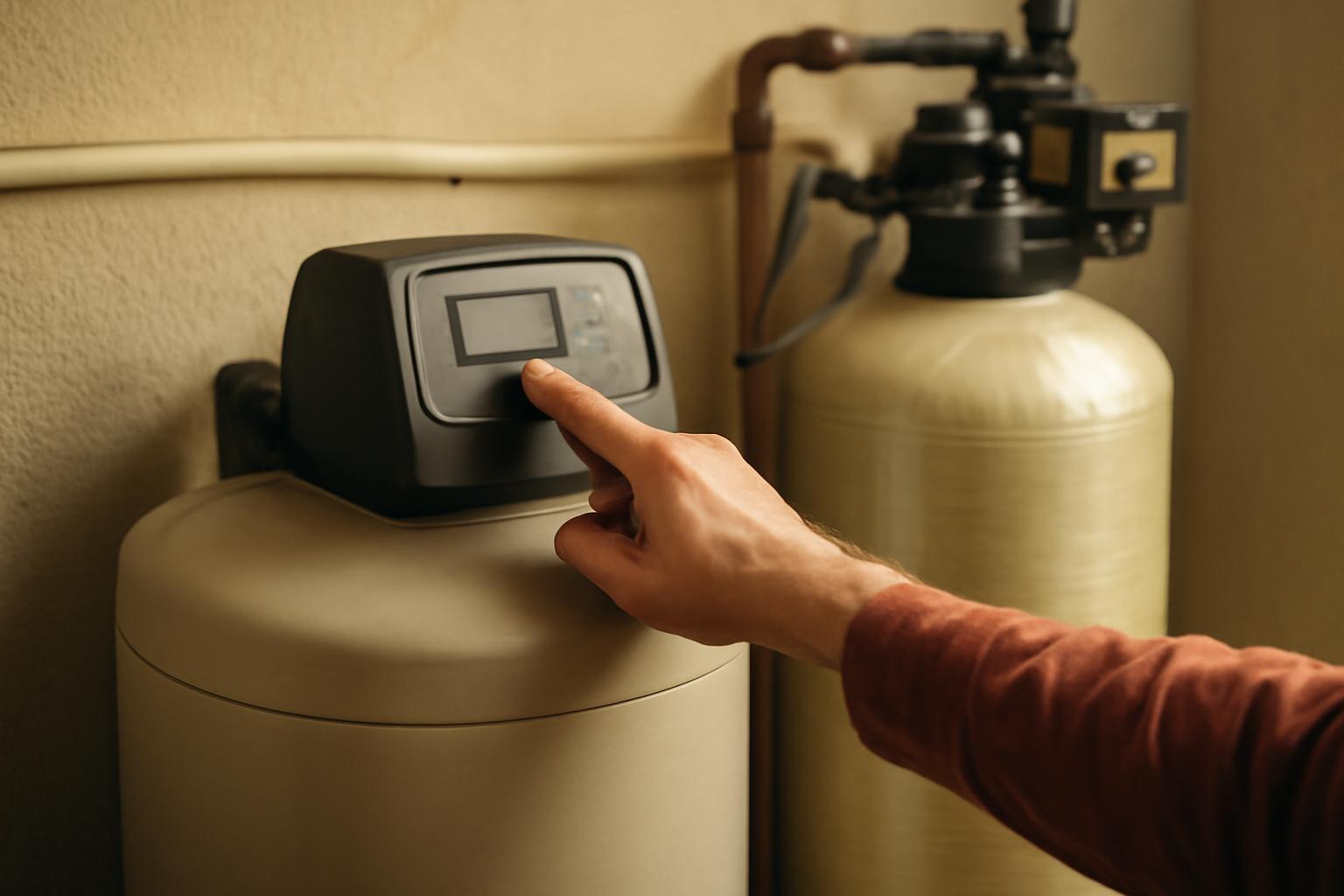
Most residential cycles take about 60 to 120 minutes. Normal operation includes drain flow, a return to service and no quick return of hard-water symptoms.
If you have hard water, your water softener is only as good as its last regeneration. That cycle is the softener’s reset process: it clears accumulated calcium and magnesium from the resin and recharges the system so it can keep producing soft water.
For homeowners, understanding the water softener regeneration cycle matters for two practical reasons. First, it explains why soft water can suddenly turn hard again even when there is still salt in the tank. Second, it helps connect water-quality changes with what you actually see around the house, such as limescale on fixtures, rough-feeling water, and mineral buildup around fixture openings that can add to maintenance problems.
This guide is focused on the most common residential salt-based ion-exchange softeners used in single-family homes: a resin tank, a separate brine tank, and an automatic control valve. Exact programming varies by model, but the core process is the same: the softener removes hardness minerals during normal service, then uses brine to restore the resin during regeneration.
What Is a Water Softener Regeneration Cycle?
A water softener regeneration cycle is the process that restores the softener after its resin beads become loaded with hardness minerals from incoming water.
During normal operation, the resin captures calcium and magnesium, the two minerals most associated with hard water. Over time, those minerals occupy more and more of the resin’s available exchange sites. Once enough of that capacity is used up, the softener starts letting hard water pass through. That is when homeowners begin noticing familiar symptoms again, such as:
- white or chalky scale on faucets and showerheads
- spotting on fixtures and dishes
- more soap scum
- rough-feeling water
- reduced soap and detergent performance
Regeneration fixes that by sending brine—water mixed with dissolved salt—through the resin. The high sodium concentration in the brine pushes the trapped calcium and magnesium off the beads. The system then flushes those hardness minerals to the drain and returns the resin to a sodium-ready condition so it can soften water again.
That means regeneration is not an optional maintenance extra. It is part of how a salt-based softener works.
In a typical residential setup, you have:
- A resin tank containing the ion-exchange beads
- A brine tank that stores salt and holds water used to make brine
- A control valve that switches the unit between service and regeneration stages
One common misconception is that salt directly softens the house water. It does not. The softening happens in the resin tank through ion exchange. The salt is mainly there to make brine for regeneration.
From a plumbing standpoint, poor regeneration matters because it allows hardness back into the house. That can increase mineral deposits on visible plumbing surfaces and around fixture parts. It is important to keep the drain angle in perspective, though: in most homes, actual drain clogs are still more often caused by hair, soap residue, grease, or debris than by mineral scale alone. What hard water more clearly does is add crusty buildup around faucets, aerators, showerheads, stoppers, and similar openings.
So when homeowners ask what a regeneration cycle does, the short answer is simple: it restores the resin so the softener can keep removing hardness instead of letting scale-forming water back into the house.
The Ion Exchange Process Behind Regeneration
To understand regeneration, it helps to understand what the softener is doing the rest of the time.
Inside the resin tank are many small resin beads. Those beads carry a negative charge, which attracts positively charged dissolved minerals. In hard water, the important positively charged minerals are calcium and magnesium. As hard water moves through the resin bed, those hardness ions attach to the beads.
At the same time, the resin releases sodium ions into the water. That swap is why the process is called ion exchange.
In simple terms, the service cycle looks like this:
- Freshly regenerated resin starts in sodium form
- Hard water enters the resin tank
- Calcium and magnesium attach to the resin
- Sodium is released
- Softened water leaves the system and goes to the house
This continues until the resin is carrying too much calcium and magnesium to soften effectively. At that point, the system needs regeneration.
During regeneration, the softener floods the resin with concentrated brine. Under normal softening conditions, calcium and magnesium hold strongly to the resin. But the sodium concentration in the brine is so high that it overwhelms those hardness ions. The resin gives up the calcium and magnesium and takes sodium back on. The released hardness minerals are then rinsed out to the drain.
So the resin alternates between two basic phases:
- Service: capture calcium and magnesium, release sodium
- Regeneration: release calcium and magnesium, recharge with sodium
That chemical reset explains several common homeowner questions.
Why hard water returns even when there is still salt in the tank
Salt in the brine tank does not prove the resin was actually recharged. If the softener did not draw brine, did not complete the cycle, or was programmed incorrectly, the resin may still be depleted.
Why the drain connection matters
During regeneration, the system has to send waste brine and released hardness minerals to the drain. If the drain line is blocked, kinked, frozen, or otherwise restricted, the cycle may not complete properly.
Why settings matter
Demand-initiated systems rely on settings such as hardness and reserve. If those inputs are wrong, the softener can regenerate too soon, too late, or not in a way that matches actual household demand.
The main takeaway is that regeneration is not just a rinse. It is the process that returns the resin to its sodium form so ion exchange can continue.
Stages of a Typical Regeneration Cycle
A typical residential regeneration cycle includes several stages, but homeowners often see different stage orders depending on the brand, valve design, and how a manufacturer labels the process.
That variation is normal. Some systems refill the brine tank first. Others refill it at the end. Some manuals combine brine draw and slow rinse into one step. Others list them separately. The important thing is not memorizing one universal order, but understanding what each stage does.
Most residential softeners include some version of the following:
| Stage | What it does | Why it matters |
|---|---|---|
| Brine Fill or Refill | Adds water to the brine tank so salt can dissolve into brine | Prepares brine for the current or next cycle |
| Brine Draw or Brining | Pulls brine into the resin tank | Recharges the resin with sodium |
| Slow Rinse or Brine Rinse | Continues controlled flow through the resin | Completes ion exchange and carries displaced minerals toward drain |
| Backwash | Reverses flow upward through the resin bed | Loosens the bed and flushes sediment or debris |
| Fast Rinse | Sends fresh water downward at a higher rate | Flushes remaining brine and settles the resin bed |
Here is what those stages mean in practice.
1. Brine Fill or Refill
In a fill-first design, the valve sends water into the brine tank before the main recharge steps. In a refill-last design, the refill happens at the end so the tank is ready for the next regeneration.
So if you notice the unit putting water into the salt tank during regeneration, that may be completely normal for your model.
2. Brine Draw or Brining
This is the core of the cycle. The valve draws brine from the brine tank into the resin tank. As the brine passes through the resin, sodium displaces the accumulated calcium and magnesium.
If this step fails, the softener may appear to regenerate without actually restoring the resin. Common reasons include:
- a salt bridge in the brine tank
- a clogged injector or venturi
- a blocked or leaking brine line
- a valve problem
3. Slow Rinse or Brine Rinse
After or during brine draw, many systems continue a slower flow through the resin bed. This gives the ion exchange more contact time and helps move displaced hardness minerals and leftover brine toward the drain.
4. Backwash
In backwash, water flows upward through the resin bed. This helps loosen the bed and flush out sediment or fine debris. Many consumer explanations list this stage in different places, but it is a common part of residential regeneration.
5. Fast Rinse
Fresh water flows downward through the resin bed at a higher rate. This removes remaining brine and settles the resin back into normal service condition.
Throughout the process, the automatic control valve is directing water flow and timing. If that valve or its controls malfunction, the softener may get stuck in one stage, skip a stage, or fail to start the cycle at all.
The practical homeowner lesson is this: your manual is the final word for your exact valve sequence, but most residential regeneration cycles are some combination of backwashing, brine contact, rinsing, and refill.
Demand-Initiated vs. Timer-Based Regeneration
Not all softeners decide to regenerate the same way. The biggest difference is whether the system regenerates based on actual water use or on a fixed schedule.
Demand-initiated regeneration
A demand-initiated, metered, or on-demand softener tracks water use through a meter. The controller is programmed using values such as water hardness and system capacity. As the household uses water, the meter counts flow. When the softener estimates that the resin is nearing its usable capacity, it schedules regeneration.
In plain terms, a demand system is trying to regenerate when it is needed rather than simply because the calendar says so.
This approach is often a better fit for homes where water use changes a lot, such as:
- households with irregular schedules
- homes with frequent guests
- seasonal occupancy
- uneven weekday and weekend use
Timer-based regeneration
A timer-based softener regenerates on a preset schedule, such as every few days at a programmed time. It does not respond to actual household demand. It follows the clock.
Timer systems can work acceptably in homes with very steady usage, and their logic is simple. But if use rises or falls, the system may regenerate too often or not often enough.
The tradeoff
| Type | Trigger | Strengths | Limits |
|---|---|---|---|
| Demand-initiated | Actual water use measured by a meter, using settings such as hardness and capacity | Better matched to changing household use | Requires correct setup and a working meter |
| Timer-based | Fixed days and time | Simple and predictable | Can waste cycles or allow early hardness breakthrough if usage changes |
For most homeowners, the choice is less about which one sounds more advanced and more about how the house actually uses water:
- Steady use and simpler controls: timer-based may be adequate
- Variable use and better matching to real demand: metered is usually a better fit
A separate wrinkle is single-tank vs. twin-tank design. Single-tank systems are common in homes and can temporarily deliver hard water during regeneration. Some twin-tank demand systems reduce or avoid that interruption, but they are a different class of system and are not the standard residential setup most homeowners have.
Factors Determining Regeneration Frequency
There is no single correct answer to how often a water softener should regenerate. In residential systems, the interval may be every few days, weekly, or longer, depending on several variables working together.
The main factors are these.
1. Water hardness
The harder the incoming water, the faster the resin fills with calcium and magnesium. Hardness is commonly measured in grains per gallon (gpg). Higher hardness means the system uses its capacity faster.
This is why good setup starts with knowing the actual hardness. If the hardness setting in the control is too low, the softener may wait too long and let hard water through before regeneration.
2. Household water use
The more water that flows through the softener, the faster the resin is used up. Two homes can have the same softener and the same hardness but very different regeneration schedules if one household uses much more water.
Usage can change because of:
- more people in the house
- guests
- heavy laundry periods
- seasonal occupancy
- simple lifestyle changes
3. Softener capacity
Capacity is usually expressed in grains. In simple terms, it is the amount of hardness the system can remove before it needs regeneration. More resin generally means more working capacity between cycles.
4. Reserve setting
Many systems keep a reserve rather than using every bit of theoretical capacity. That helps reduce the chance of the house running out of soft water before the next scheduled regeneration. In practice, it means a unit may regenerate before the resin is fully exhausted.
5. System design and programming
Demand controls, timer settings, salt dose, efficiency settings, and changes in local water quality can all affect frequency. Even municipal water hardness can shift if the utility blends different sources.
A useful homeowner shortcut is:
usable gallons between regenerations ≈ usable grain capacity ÷ hardness, then adjusted for reserve
That is not a substitute for your manual, but it explains why one home may regenerate every few days while another goes much longer.
A simple homeowner example
Suppose a softener has about 24,000 grains of usable capacity, and the incoming water is 20 gpg hard.
- 24,000 ÷ 20 = about 1,200 gallons between regenerations before reserve
- If the household uses about 240 gallons per day, that works out to roughly 5 days
- If the controller keeps some reserve, the actual interval may be a little shorter than that
The point of the example is not the exact numbers. It is the relationship:
- harder water shortens the interval
- more daily use shortens the interval
- more usable capacity lengthens the interval
- reserve shortens the practical interval somewhat
What counts as normal?
For many homes, regeneration lands somewhere in these broad ranges:
- every few days in hard-water or higher-use conditions
- weekly or biweekly in more moderate conditions
- sometimes longer in lower-use situations, depending on controller design
Some modern units also include a roughly 28-day override so the softener will regenerate at least once within that period even if water use is low. That is a common feature, not a universal rule, so the exact interval should always be checked against the model documentation.
Practical homeowner checks
If you are trying to decide whether your softener is regenerating often enough:
- confirm or test the incoming hardness
- know the unit’s size or grain rating
- watch how the system performs between cycles
- reassess the settings if the household’s water use changes
If hard water symptoms show up before the next expected regeneration, the problem may be frequency—but it may also be poor brine draw, a bad setting, low salt, meter trouble, or resin condition.
Duration and Timing of Regeneration Cycles
Most residential water softener regeneration cycles are commonly described as taking about 60 to 120 minutes total. Many single-tank home systems fall somewhere around 70 to 90 minutes, while others are closer to 1.5 to 2 hours. The variation is normal because cycle time depends on the controller, tank size, resin volume, stage timing, and water pressure.
So if you hear that regeneration always takes one exact amount of time, that is too rigid. What matters is whether your unit’s timing is consistent with its own design and returns the system to proper service afterward.
When regeneration usually happens
Most residential systems are scheduled to regenerate overnight, often around 2:00 AM, because that is usually when household water use is lowest. That reduces the chance that someone will run water in the middle of the cycle.
If your softener starts making water-flow sounds late at night, that is often normal.
What happens to water in the house during regeneration
On many single-tank systems, the house still has water during regeneration, but the softener is temporarily bypassing softening. In practical terms, if you use water during the cycle, you may get hard water until regeneration finishes.
Some homes may also notice a modest change in available flow while the unit is backwashing or rinsing, because the softener is using water internally. In a typical residential setup, the more common effect is temporary hard water, not a total loss of water supply.
Water use per cycle
For many family-sized residential softeners, regeneration water use is often described in the range of about 35 to 70 gallons per cycle. That is a useful planning range, not a universal rule. Actual water use varies with system size, hardness, settings, and cycle design.
What a normal cycle may sound like
During regeneration, it is common to hear:
- water running to a drain
- periodic valve clicks or motor sounds
- changing flow noise during different stages
- movement in the brine tank
If those sounds happen around the programmed time and the unit returns to service with soft water afterward, that is generally consistent with normal operation.
Signs of Proper Regeneration and Hard Water Prevention
A properly regenerating softener usually proves itself in the house more than on the machine. The real question is not whether the unit “did something.” It is whether the hard water symptoms stay away between cycles.
Here are the most useful signs.
Hard water symptoms stay away
After normal regeneration, you should not see a quick, repeated return of the classic signs of hard water, such as:
- fresh limescale on fixtures
- hard water spotting
- increased soap scum
- reduced lathering
- rough-feeling water
If those symptoms come back quickly, the system may be cycling without effectively restoring the resin.
Salt level gradually drops over time
In a working salt-based softener, the salt level in the brine tank should gradually go down. It may not be dramatic after a single cycle, and tank shape affects what you notice, but a salt level that does not seem to change over multiple regeneration cycles can be a warning sign.
A simple homeowner check is to mark or note the salt level, allow the unit to regenerate, then see whether the system appears to be using salt over time.
The unit behaves consistently
A healthy softener usually:
- regenerates at the expected time
- drains during the cycle
- returns to service afterward
- maintains soft water between cycles
- does not need frequent manual intervention
No obvious abnormal symptoms at the unit
Normal regeneration includes water flow and valve sounds. Less normal signs include:
- constant draining
- brine tank overflow
- obvious leaking
- a unit that appears stuck in one position
How proper regeneration helps with fixture and drain-area buildup
Proper regeneration helps reduce hardness breakthrough, which in turn helps limit mineral deposits on visible plumbing parts. That is most relevant around:
- faucet aerators
- showerheads
- sink and tub stoppers
- fixture trim where water regularly evaporates
That does not mean a working softener eliminates all drain clogs. In most homes, slow drains are still more commonly caused by hair, soap residue, grease, or foreign material. The softener’s role is narrower: it helps remove one ongoing source of mineral deposition that can add to buildup around fixtures and openings.
A quick checklist: mineral buildup vs. a more ordinary clog
If you are trying to decide whether hard water scale may be part of the problem, these observations are useful.
More suggestive of mineral-related buildup:
- white, chalky, or crusty deposits on faucets, aerators, showerheads, or stoppers
- repeated hard-water spotting and limescale elsewhere in the same bathroom or kitchen
- restriction that seems concentrated at visible openings, screens, or spray nozzles
- hard water feel returning at the same time as visible scale
More suggestive of a typical household clog instead:
- hair or soap residue collecting at a bathroom stopper
- grease-related slow flow in a kitchen sink
- multiple fixtures draining slowly at the same time, which points more toward a larger drainage problem
- little or no visible white mineral crust at the fixture itself
In other words, poor regeneration can contribute to scale-related buildup around fixture parts, but it is usually not the first explanation for a deep branch-line or main-line clog.
Troubleshooting Regeneration Problems
If your water softener is not regenerating properly, start with the simple checks first. Many problems come down to salt, settings, bypass position, or a failure to draw brine.
Start with the basics
1. Check the salt level
If the brine tank is empty or nearly empty, the system cannot make effective brine. Add the salt type recommended for the unit and allow the system time to form brine if it has been very low or dry.
2. Look for a salt bridge
A salt bridge is a hard crust in the brine tank that leaves an empty space underneath. The tank may look full even though salt is not dissolving into the water. Carefully break the crust with a suitable tool that will not damage the tank.
3. Make sure the bypass valve is not engaged
If the softener is left in bypass, hard water goes around the unit. This is easy to miss after plumbing work, service, or homeowner adjustment.
4. Confirm power and clock settings
A power loss, blank display, or wrong time setting can prevent scheduled regeneration. If the unit regenerates by timer, an incorrect clock can make it miss the cycle or run at the wrong time.
5. Run a manual regeneration using the manual for your model
Many softeners let you start manual regeneration from the control panel, often with a button labeled REGEN or similar. But the exact process varies by controller. Use the manual for the specific make and model rather than relying on generic instructions from a different unit.
If hard water remains after a cycle
If the softener appears to regenerate but the water still feels hard, possible causes include:
- low or unavailable salt
- salt bridging
- clogged injector or venturi
- blocked or leaking brine line
- inaccurate or failed flow meter
- incorrect hardness or reserve settings
- resin fouling or deteriorated resin
- control valve malfunction
- a drain line restriction that prevents proper cycle completion
One useful clue is when the unit seems to “go through the motions,” but the salt level does not change and soft water does not return. That often points to a brine draw problem rather than a total shutdown.
Reasonable DIY checks
For most homeowners, these are sensible first steps:
- inspect the salt tank
- break obvious salt bridges
- verify bypass position
- confirm power and time settings
- look for visible leaks
- run one manual regeneration
- observe whether the unit drains and returns to service
- watch whether hard water symptoms improve afterward
If the unit ran without salt for a while, a manual regeneration may help restore performance, but it is not a guaranteed cure for every system.
When the issue is beyond basic DIY
Professional service is a better next step if you notice any of the following:
- persistent hard water after a manual regeneration and basic salt checks
- repeated salt bridge or brine tank problems
- continuous draining
- failure to advance through stages
- suspected resin fouling or resin breakdown
- leaking or malfunctioning control valve
- suspected meter, injector, or programming problems you cannot verify
- drain line issues related to the softener discharge
For homeowners who are also dealing with visible scale and recurring fixture restriction, keep the diagnosis grounded: you may have a mixed problem. A bathroom sink, for example, can have both ordinary soap-and-hair residue and added mineral buildup because the softener is not actually restoring soft water.
The right approach is straightforward: do the basic checks confidently, but do not keep forcing manual cycles or taking apart the valve blindly. Once the problem moves beyond salt, bypass, clock, and obvious flow checks, model-specific diagnosis matters.
FAQ
What triggers a water softener regeneration cycle?
Usually one of two things triggers it:
- Demand or metered control: the softener counts water use and regenerates when the resin is nearing its programmed capacity
- Timer control: the softener regenerates on a preset schedule, such as every few days at a set hour
In demand systems, the trigger depends on meter readings plus settings such as hardness and reserve. In timer systems, the clock is the main trigger.
Does regeneration affect water pressure or supply?
Usually the home still has water during regeneration. On many single-tank systems, however, the softener temporarily bypasses softening, so you may get hard water if you use water during the cycle.
Some homes may notice a modest drop in available flow while the softener is backwashing or rinsing, but a total loss of house water is not the normal expectation in a standard residential setup.
How to manually start a regeneration cycle?
The safest answer is: use the manual for your exact model.
On many units, manual regeneration is started from the control panel with a button labeled REGEN, REGENERATE, or something similar. Before doing that:
- Make sure the unit has power
- Confirm it is not in bypass
- Check that there is enough salt
- Look for obvious salt bridging
- Review the model-specific instructions for starting and canceling a cycle
Because controllers vary widely, generic button advice should only be treated as a clue.
Can improper regeneration cause drain clogs?
Improper regeneration can allow hard water to keep circulating through the house, and that can increase mineral scale and residue around fixtures and openings. That buildup may contribute to restriction at aerators, showerheads, or stopper assemblies.
But it is important not to overstate the connection. In most homes, actual drain clogs are still more commonly caused by hair, soap residue, grease, or debris. So improper regeneration is better understood as a contributing factor to scale-related buildup, not the default explanation for a slow drain.
When to call a professional for regeneration issues?
Call a professional when the problem goes beyond basic homeowner checks, especially if:
- hard water continues after manual regeneration
- salt level does not seem to change over multiple cycles
- the softener is stuck draining, leaking, or not advancing
- the brine tank overflows or never appears to draw brine
- you suspect a bad meter, clogged injector, valve problem, or fouled resin
- visible scale and hard water symptoms continue even though the unit appears to cycle
Regular regeneration is what keeps a water softener effective. For homeowners, the practical routine is simple: monitor salt, pay attention to changes in water feel and scale, watch for normal cycle activity, and use the manual for basic checks. If those basics do not restore soft water, move to model-specific service rather than guessing.