
Why PEX Now Wins Most Whole-House Repipe Bids
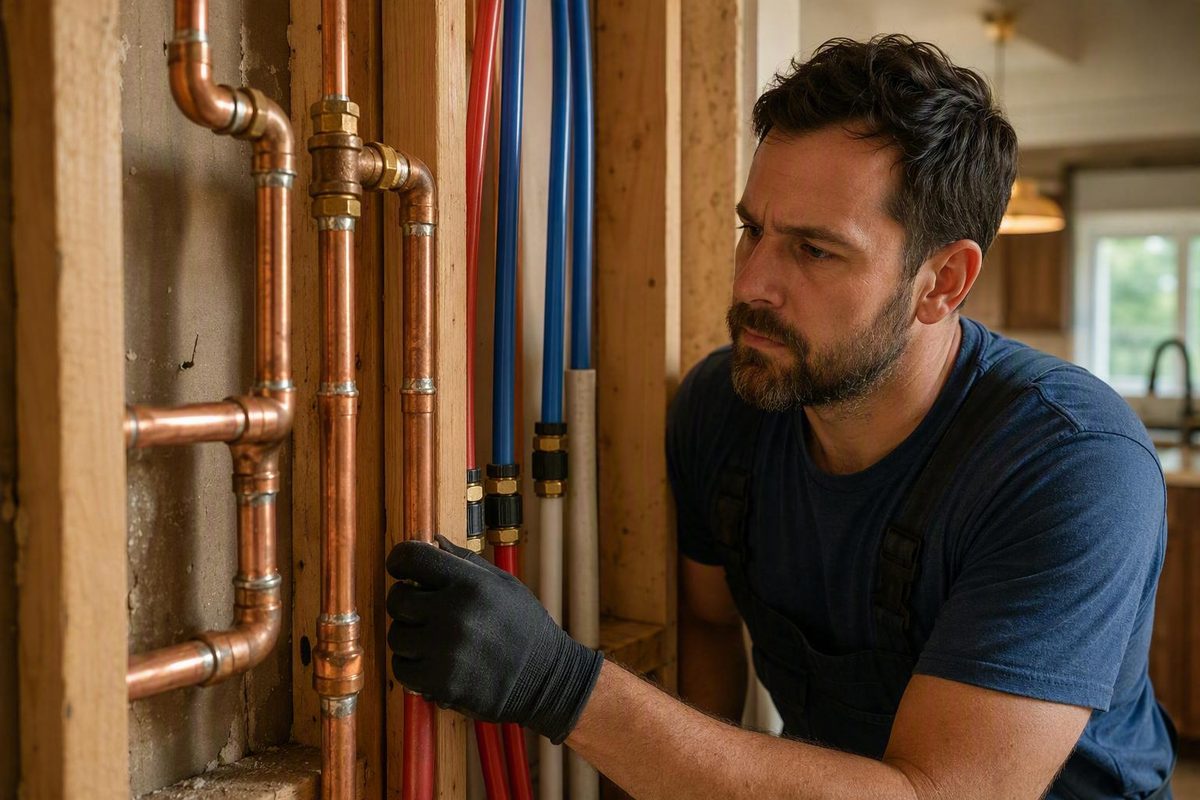
Compare copper and PEX repipe costs, ownership horizons, lifespan claims, access needs, and exposure limits before accepting a whole-house proposal.
At a record $14,527.50 per metric ton for three-month LME copper, PEX is now the better-value choice for nearly every ordinary whole-house repipe. Copper’s durability can still justify selective use, but its higher upfront cost does not pay back within a typical 25-year ownership window unless the house genuinely needs copper for exposed, high-heat, rigid, or damage-prone runs.
That verdict is narrower than saying copper is obsolete. A whole-house repipe and an all-copper repipe are separate decisions. Copper remains viable where its physical properties solve a documented problem; it is simply no longer the automatic premium upgrade for concealed distribution through a finished house.
The Best Case For Copper
The received wisdom has a coherent basis. Copper is rigid, familiar to installers and inspectors, stable under ultraviolet exposure, tolerant of heat, difficult for rodents to gnaw, and commonly credited with a service life exceeding 50 years. It can produce orderly exposed work and straightforward connections to retained copper valves, equipment, and piping.
Copper also avoids PEX’s sensitivity to prolonged sunlight. PEX must be installed within the exposure, temperature, pressure, support, and connection limits of the exact product. Contractor comparisons correctly identify UV exposure as a PEX limitation and copper longevity as a potential advantage, while also acknowledging copper’s susceptibility to corrosion under unfavorable conditions (comparison of copper and PEX tradeoffs).
Those are real advantages. They can justify copper outdoors, in exposed utility areas, near particular equipment, at rigid transitions, or where impact and rodent risks cannot be designed out.
The weak step is extending those specific advantages to every concealed branch in a finished house. Copper’s extra lifespan has little financial value to an owner who sells before PEX would require replacement. Familiarity at inspection is not evidence that an appraisal or sale price will recover the premium.
Record Copper Prices Strengthen The Case For PEX
Around August 25–26, 2026, three-month LME copper reached a record $14,527.50 per metric ton. Financial reporting connected the move to tariff risk and metal being drawn toward the United States; COMEX inventories had risen for 46 consecutive days (reporting on copper prices and inventory flows).
A separate commodities report placed copper’s 2026 increase at approximately 18%, citing U.S. stockpiling, tariff concerns, and reduced inventories outside the country (2026 copper-market commentary). That percentage is market context, not a prediction that a plumber’s complete proposal will rise 18%.
An installed repipe includes tubing, fittings, valves, labor, access, protection, testing, permits where required, restoration, overhead, and contractor risk. Copper’s commodity price therefore affects only part of the proposal. Current scope-matched local bids remain the only dependable measure of the homeowner’s actual price gap.
The supplied evidence also does not contain enough data to calculate an honest copper material bill for a 2,000-square-foot house. It gives no linear pipe requirement, diameter mix, copper weight per foot, fitting schedule, waste factor, or current PEX unit price. Fixture count and floor area alone cannot supply those missing quantities.
Any precise material total built from this record price would therefore be invented. The calculator below uses the defensible comparison instead: complete copper and PEX bids, the homeowner’s ownership period, and explicit service-life assumptions. Its defaults are the midpoints of published commercial ranges, not national averages.
Enter your actual bids and ownership horizon; the result identifies which material costs less for your scenario.
Copper Repipe Ownership-Window Calculator
The default uses midpoint estimates from published $8,000–$15,000 copper and $4,000–$8,000 PEX ranges. Replace them with scope-matched local bids. Floor area and fixtures document the project but do not alter cost because the available evidence supplies no pipe-quantity rates.
House And Market
No fixture-based unit rate was supplied, so this field is contextual.August 2026 reported record; market price is not an installed-price formula.Your Installed Bids
Explicit Lifespan Scenario
These are scenario assumptions, not warranties. The model repeats the same installed bid in constant dollars when replacement falls inside the ownership window.Does The House Need Copper?
Over 25 years, the model shows no replacement for either system, so copper’s claimed extra 25 years do not recover its $5,500 upfront premium. Copper would need to deliver at least $220 per owned year in other usable benefits to close the gap.
| Decision Factor | Copper | PEX | Effect On Choice |
|---|---|---|---|
| Published installed range | $8,000–$15,000 | $4,000–$8,000 | Commercial estimates; use local bids |
| Default midpoint estimate | ~$11,500 | ~$6,000 | Creates a ~$5,500 premium |
| 25-year ownership | No modeled replacement | No modeled replacement | PEX keeps the upfront advantage |
| Claimed extra life | 20–30 years | Baseline assumption | Value arrives only if those years are used |
| Outdoor or UV exposure | Strong fit | Product-specific limits | Consider copper at exposed runs |
| High heat | Heat tolerant | Check exact rating | Use approved transitions where required |
| Finished-wall routing | Rigid; more access possible | Flexible | Usually favors PEX |
| Open-wall project | Cost gap may narrow | Still flexible | Makes copper easier to defend |
| Rodent or impact risk | More resistant | Needs protection | May favor copper locally |
| Unfavorable water | Corrosion risk | No copper wall corrosion | Investigate before choosing copper |
Sources: August 2026 copper benchmark and 46-day COMEX inventory run from Yahoo Finance; 18% 2026 rise from Whalesbook; installed ranges from a commercial 2026 plumbing-company comparison. Lifespans are adjustable assumptions, not guarantees. Unknown fixture-based material rates are shown as — rather than estimated.
The Default 25-Year Result Favors PEX
One national plumbing-company article advertises broad 2026 whole-home estimates of $4,000–$8,000 for PEX and $8,000–$15,000 for copper (contractor-published 2026 repipe ranges). These are promotional estimates rather than national benchmarks, but they illustrate the size of the plausible gap.
The midpoints are $6,000 for PEX and $11,500 for copper, producing a $5,500 copper premium. Over 25 planned ownership years, that is $220 per year the homeowner must recover through benefits that are actually used during ownership.
A claimed extra 20–30 years of copper life does not recover that money if both systems remain serviceable while the owner occupies the house. The benefit arrives after the ownership window. It may matter to a later owner, but the draft evidence supplies no resale figure with which to credit the original buyer.
This is why lifespan alone is not a payback calculation. A genuine payback would require documented avoided replacement or repair costs within the chosen horizon. No such comparative failure-cost figure appears in the supplied evidence.
Copper can eventually win a constant-dollar model if the ownership period extends far enough to require another complete PEX installation while copper remains in service. That outcome depends heavily on assumed service lives, future labor and restoration costs, water conditions, fittings, workmanship, and whether the house is still owned at that point. Published service-life claims are not warranties.
Finished Walls Make The Price Gap More Important
PEX’s main economic advantage is not merely cheaper tubing. Flexible runs can pass through joist bays and wall cavities with fewer directional fittings than rigid copper. In a finished, irregular house, that can mean fewer openings, fewer concealed connections, less installation labor, and less texture and paint restoration.
Copper becomes more competitive when walls and ceilings are already open for construction or a major renovation. With access and restoration removed from both proposals, copper’s labor disadvantage may narrow. It does not disappear automatically; the route and connection count still matter.
Supplier comparisons commonly claim that PEX costs 30% to 40% less than copper, partly because of reduced fitting and labor requirements (supplier estimate comparing PEX and copper). That figure is commercially published and should not be applied mechanically to a particular house.
Project duration can show the same pattern. One contractor describes many PEX repipes as taking two to four days and copper repipes as taking four to six days, while warning that actual timing depends on the house and scope (contractor-published duration examples). Those periods do not necessarily include final inspection, wall closure, texture, paint, or other restoration.
A proposal should separate rough plumbing, testing, any required inspection, water restoration, wall closure, finish work, and cleanup. “Three-day repipe” may describe water-line installation rather than the time until the last room is restored.
Copper Still Wins In Specific Locations
Copper earns its premium when its characteristics are used rather than merely admired.
Exposed And UV-Affected Runs
Copper is the safer default for a permanently exposed outdoor or sunlit run unless the named alternative is specifically approved and protected for that application. PEX should not be treated as an interchangeable outdoor substitute simply because it works well inside walls.
This does not require an all-copper house. A professionally designed hybrid can use copper for exposed transitions and PEX for protected concealed distribution.
High-Heat Transitions
Copper may be appropriate near equipment or in another location where the proposed PEX product is not approved for the expected temperature and pressure. The proposal should identify the equipment, operating conditions, clearances, transition point, and exact product limitations.
“Copper handles heat better” is not a complete specification. The contractor must still follow equipment instructions, product listings, and local requirements.
Rodent, Impact, And Rigidity Concerns
Copper is harder to puncture or gnaw than flexible plastic tubing. That can matter in accessible crawlspaces, workshops, utility rooms, and buildings with a documented rodent history.
Material choice does not replace pest control, protective plates, sleeves, supports, or sensible routing. Copper itself can still be damaged, abraded, or pierced during later construction.
Compatible Existing Copper
Copper may simplify selected tie-ins to retained valves, equipment, and sound copper piping. The proposal should show which old sections remain active, where transitions occur, whether they remain accessible, and which compatible fittings will be used.
“The house already has copper” does not justify replacing every branch with copper. Retaining questionable old sections can undermine an expensive new installation regardless of the new material.
Water Conditions Can Defeat Copper’s Longevity Claim
Copper can develop corrosion and pinhole leaks under unfavorable water or operating conditions. Its performance can reflect water chemistry, temperature, flow, stagnation, tubing characteristics, workmanship, and treatment rather than age alone.
If the existing copper has failed repeatedly, ask a qualified professional to interpret the failure pattern and relevant water information before installing more copper. The review should address the proposed tubing type, fittings, hot- and cold-water conditions, pressure, treatment equipment, and warranty terms.
A softener, neutralizer, filter, or dosing system should be priced separately if it is part of the copper strategy. Include installation, testing, consumables, servicing, wastewater implications, and replacement components. Treatment is not a guarantee against future corrosion.
PEX avoids copper’s particular form of pipe-wall corrosion, but it is not failure-proof. A PEX system still depends on correct sizing, approved fittings, proper tools, support, bend radius, pressure, temperature, protection, and workmanship.
Confirm That A Full Repipe Is Necessary
A material comparison matters only after the house has been shown to need system-wide replacement. Recurring leaks in different locations, multiple pinholes, widespread corrosion, deteriorated galvanized piping, persistent pressure loss across several areas, or discoloration at multiple fixtures justify a broader evaluation.
One puncture, failed valve, bad fitting, localized freeze break, or isolated installation error does not prove that all supply piping is failing. Manufacturer guidance likewise distinguishes repeated or widespread degradation from an isolated defect and recommends investigating cause and extent rather than relying on age alone (guidance on systemic and isolated failures).
Ask the inspector to map active materials and explain the likely failure mechanism. Record where each leak occurred, what component failed, whether it involved hot or cold water, and what previous sections have already been replaced.
A whole-house repipe is professional work. It can involve sizing, concealed junctions, structural penetrations, specialized connections, water shutdowns, pressure testing, and locally required permits or inspections. Soldering also introduces a torch and fire risk; press and expansion systems require the correct tools and procedures (demonstration of copper and PEX connection methods).
Compare Complete Bids On The Same Scope
The copper premium is the complete copper bid minus the complete PEX bid. Internet price ranges cannot substitute for that subtraction.
Each bidder should price the same fixtures, performance objective, restoration standard, testing, permit responsibility, cleanup, and warranty scope. If copper and PEX require different routing or sizing, those differences should be shown rather than hidden in a lump sum.
| Bid Item | What Must Match |
|---|---|
| Distribution | Fixtures, hose bibs, sizing and route |
| Components | Tubing, fittings, valves and transitions |
| Building work | Openings, patching, texture and paint |
| Closeout | Tests, inspections, cleanup and warranties |
“Drywall included” is too vague. Determine whether it means rough patches or finished texture and paint. “Whole-house” should list every included fixture and identify any old supply pipe that will remain active.
Require the exact tubing manufacturer, product line, sizes, fitting system, connection method, expected openings, water downtime, testing procedure, exclusions, and change-order terms. Confirm who obtains any required permit and who corrects work that fails inspection.
Installation quality can overwhelm the material choice. Premium copper cannot rescue poor sizing or workmanship, while inexpensive PEX is not a bargain if it is installed under tension, exposed to UV, poorly supported, or concealed before testing.
The Practical Choice For Most Houses
Choose a targeted repair when the failure has a clear local cause and the surrounding system is sound.
Choose full PEX when replacement is justified and the house has finished walls, complicated routing, a constrained budget, meaningful restoration costs, or no need for copper’s exposure and rigidity advantages. That is the default value choice under the current price evidence.
Choose full copper when water conditions support it, walls are open, the ownership horizon is unusually long, and copper solves several real requirements throughout the layout. A preference for copper or a broad lifespan claim is not enough by itself.
Choose a hybrid when copper adds value only at exposed, high-heat, rigid, or existing-copper transitions. Every transition must use compatible components and comply with product instructions and local requirements.
Do not delay an actively needed repipe solely to speculate on copper prices. The market reporting does not establish when or whether prices will fall, and commodity copper is only one part of the installed bill. Address current leak risk with current, comparable proposals rather than a metal-price forecast.