
Certified Backflow Testing Protects Drinking Water
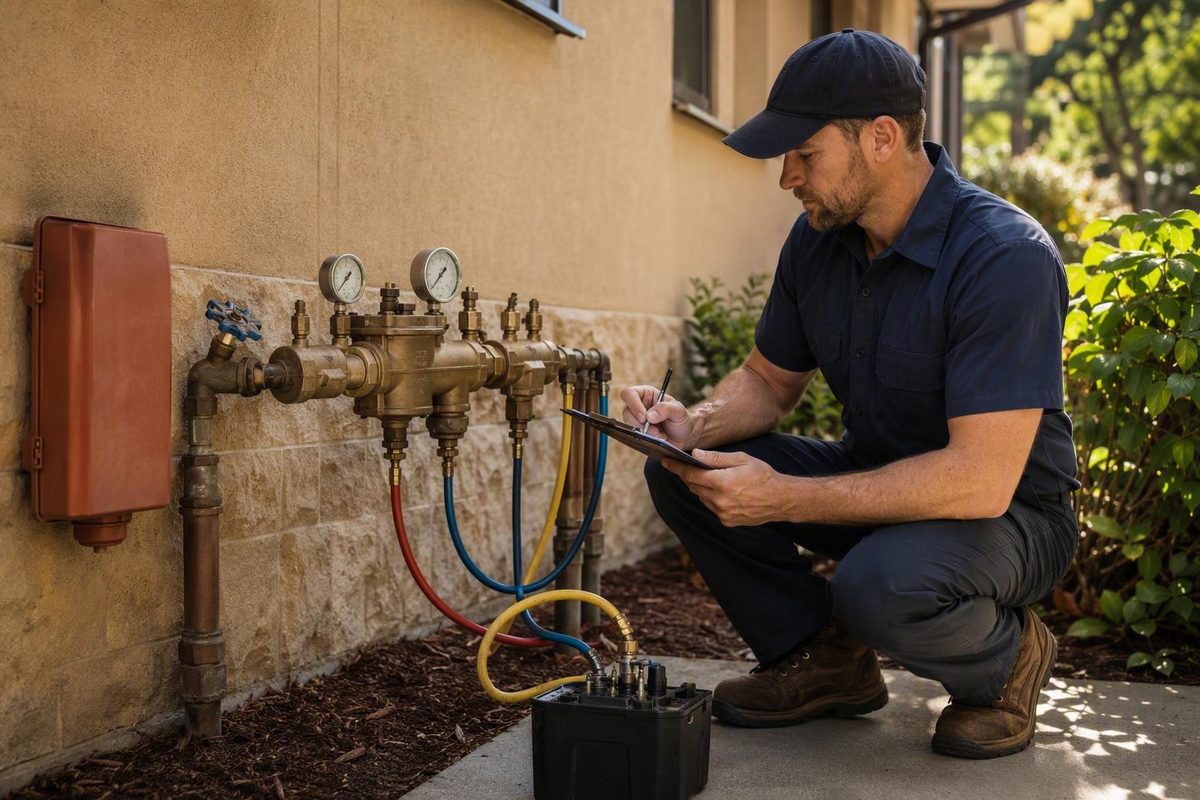
The work can interrupt water service, and local programs often require a certified or licensed tester to file the result, making it a poor DIY project.
Backflow testing is a controlled check of a testable backflow prevention assembly. A qualified tester uses a calibrated differential-pressure gauge to confirm that the assembly’s check valves, relief valve, and other components respond within the required limits. The goal is to verify that water cannot reverse from a potentially contaminated system into drinking-water piping.
This is not the same as looking for a clogged drain, and it is not usually a laboratory test of the water itself. It checks a protective plumbing assembly. Because the work can interrupt water service and local programs often require a certified or licensed tester to file the result, it is not a useful DIY project.
Why backflow can put drinking water at risk
Water should move from the public supply toward fixtures and connected equipment. A cross-connection is an actual or potential link between potable water and a non-potable source. Examples can include irrigation, a chemically treated boiler, a fire-suppression system, a pool, process equipment, or an auxiliary water supply.
Flow can reverse in two basic ways:
- Backsiphonage happens when pressure in the supply drops, as it might during a water-main break or unusually heavy demand.
- Backpressure happens when pressure on the property side becomes greater than supply pressure, such as when a pump or elevated system pushes against the incoming water.
The U.S. Environmental Protection Agency’s cross-connection manual explains both pressure conditions and treats cross-connections as a public-health concern. The preventer is the barrier; the field test checks whether a testable barrier still works after wear, debris, repair, or changes to the plumbing.
Backflow in the potable-water system is also different from a drain or sewer backup. Wastewater rising through a floor drain or fixture points to a drainage problem. It may create an urgent sanitation hazard, but a backflow assembly test will not locate or clear that blockage.
What kinds of backflow protection are tested?
The correct protection depends on the hazard, pressure conditions, plumbing design, and local code. Common testable assemblies include:
- Reduced-pressure principle assembly (RP or RPZ): uses two checks with a relief zone between them and can protect against backpressure and backsiphonage. It is commonly selected where the potential contaminant presents a higher health risk.
- Double-check valve assembly (DCVA): uses two independently acting checks and is generally limited to lower-hazard applications under the applicable local program.
- Pressure vacuum breaker (PVB): protects against backsiphonage, not backpressure, and is often associated with irrigation or similar uses where its installation conditions are appropriate.
An air gap and some simpler vacuum breakers may also provide backflow protection, but not every protective device can be field-tested after installation. Michigan’s March 2026 Backflow Assembly Testing guidance distinguishes testable assemblies from non-testable devices and summarizes where RPZ, DCVA, and PVB assemblies can be used. Local acceptance is not uniform: for example, Portland Water Bureau’s assembly guide applies its own restrictions and installation rules. The label on an existing assembly does not prove it is the right protection for a current use.
What happens during a certified backflow test?
Exact field procedures and pass thresholds depend on the assembly and the standard adopted by the local authority. From the property owner’s perspective, a typical appointment follows this outline:
- Identify the assembly and application. The tester confirms the type, manufacturer, model, size, serial number, location, and hazard it protects. An inaccessible, damaged, frozen, flooded, or incorrectly installed assembly may need attention before a valid test can be completed.
- Control the water service. The tester coordinates a temporary shutdown and isolates the assembly. Fixtures or equipment downstream may be unavailable during this period, so occupants and any fire, medical, irrigation, or process-system contacts may need advance notice.
- Connect calibrated test equipment. A differential-pressure gauge connects to the assembly’s test cocks. The tester follows the approved procedure for that exact assembly rather than improvising a generic sequence.
- Check component performance. The procedure evaluates the applicable check valves, relief valve, and air-inlet function. Readings show whether the components hold or open as required.
- Restore service and document the result. The tester returns valves to the correct operating position, checks for abnormal leakage, records the readings, and completes the report required by the water authority.
Austin Water’s current tester requirements illustrate why qualification and paperwork matter: its registered testers must use approved methods and calibrated gauges, and reports include assembly identification, operational results, repairs, retest results, tester credentials, and gauge information. Requirements elsewhere may differ, but a credible tester should be able to identify the local authority, the adopted procedure, and who files the report.
Do not open test cocks or change valve positions to “see if it works.” An incorrect sequence can interrupt service, discharge water, damage an assembly, or leave protection in the wrong operating state. Keep discharged water away from electrical equipment and areas where flooding could damage the building. If the assembly serves fire protection or critical equipment, coordinate the outage with the responsible parties before testing.
How often is backflow testing required?
There is no single schedule that applies to every property in every jurisdiction. The controlling water utility, plumbing or health authority, adopted code, hazard class, assembly type, and manufacturer instructions can all affect the due date.
Common triggers include:
- initial installation or relocation;
- a repair or replacement;
- a periodic deadline set by the local cross-connection control program;
- a change in property use or connected equipment; and
- follow-up after a failed test.
Annual testing is common for some regulated assemblies, especially at higher-hazard connections, but owners should not turn that pattern into a universal rule. For example, Corpus Christi Water’s program requires testing at installation, repair, replacement, or relocation and annual testing for assemblies at high-health-hazard connections. Michigan’s 2026 noncommunity guidance lists annual and three-year intervals depending on assembly and risk, while also deferring to manufacturers and approved local programs where applicable.
Use the due date on the utility notice or device record, then confirm it with the authority named on that notice. If records are missing, give the utility the service address and any readable assembly details rather than guessing from the last inspection tag.
What do pass, fail, and incomplete results mean?
Pass: The tested components met the adopted field-test criteria at that appointment. Keep the report and verify whether the tester or owner must submit it. A pass does not certify the whole plumbing system, guarantee water quality, or eliminate future maintenance.
Fail: One or more components did not meet the required criterion. The report should identify the failed portion and readings. A qualified professional can determine whether cleaning or repair is permitted, whether parts or the full assembly need replacement, and whether permits or another licensed trade are required. The assembly normally needs a successful retest after corrective work before the compliance item can be closed.
Incomplete or unable to test: Closed or damaged test cocks, missing shutoffs, an inaccessible assembly, active leakage, freezing, flooding, or an installation problem may prevent a valid result. That is not a pass. Ask for the blocker in writing and confirm the correction and deadline with the local program.
A practical checklist for property owners
Before the appointment
- Read the utility notice and confirm the deadline, assembly address, and filing instructions.
- Hire a tester whose certification, license, and local registration match the authority’s rules.
- Ask whether water will be shut off and notify occupants or affected system contacts.
- Clear safe access without removing covers, operating valves, or entering a flooded or electrically unsafe area.
- Have earlier reports and repair records available if they exist.
After the appointment
- Get the result, readings, assembly identifiers, tester credentials, and any repair or retest recommendation in writing.
- Confirm who submits the report and retain proof of submission.
- If the assembly failed, ask the authority or licensed professional what must happen before service or compliance can be restored.
- If the use has changed—for example, a new irrigation chemical feed, boiler treatment, pool, well, septic-related connection, or process system—request a cross-connection review instead of assuming the old assembly remains suitable.
If tap water suddenly has an unusual color or odor, or chemical or sewage intrusion is suspected, stop using it for drinking and cooking and contact the water utility for incident-specific instructions. Do not assume that boiling makes chemically contaminated water safe, and do not treat a passing mechanical backflow test as a substitute for water sampling when the authority recommends it.
The bottom line
Backflow testing verifies a specific protective assembly under a defined field procedure. It is valuable because a preventer can look normal while internal checks, seals, or relief components no longer perform as required. The safe next step is simple: identify the authority responsible for the property, use a properly qualified tester, plan for the service interruption, and keep the filed result. Leave device selection, invasive repair, code interpretation, and suspected contamination to the utility and appropriately licensed professionals.