
What a Bubbling Toilet Is Telling You—and What to Do Next
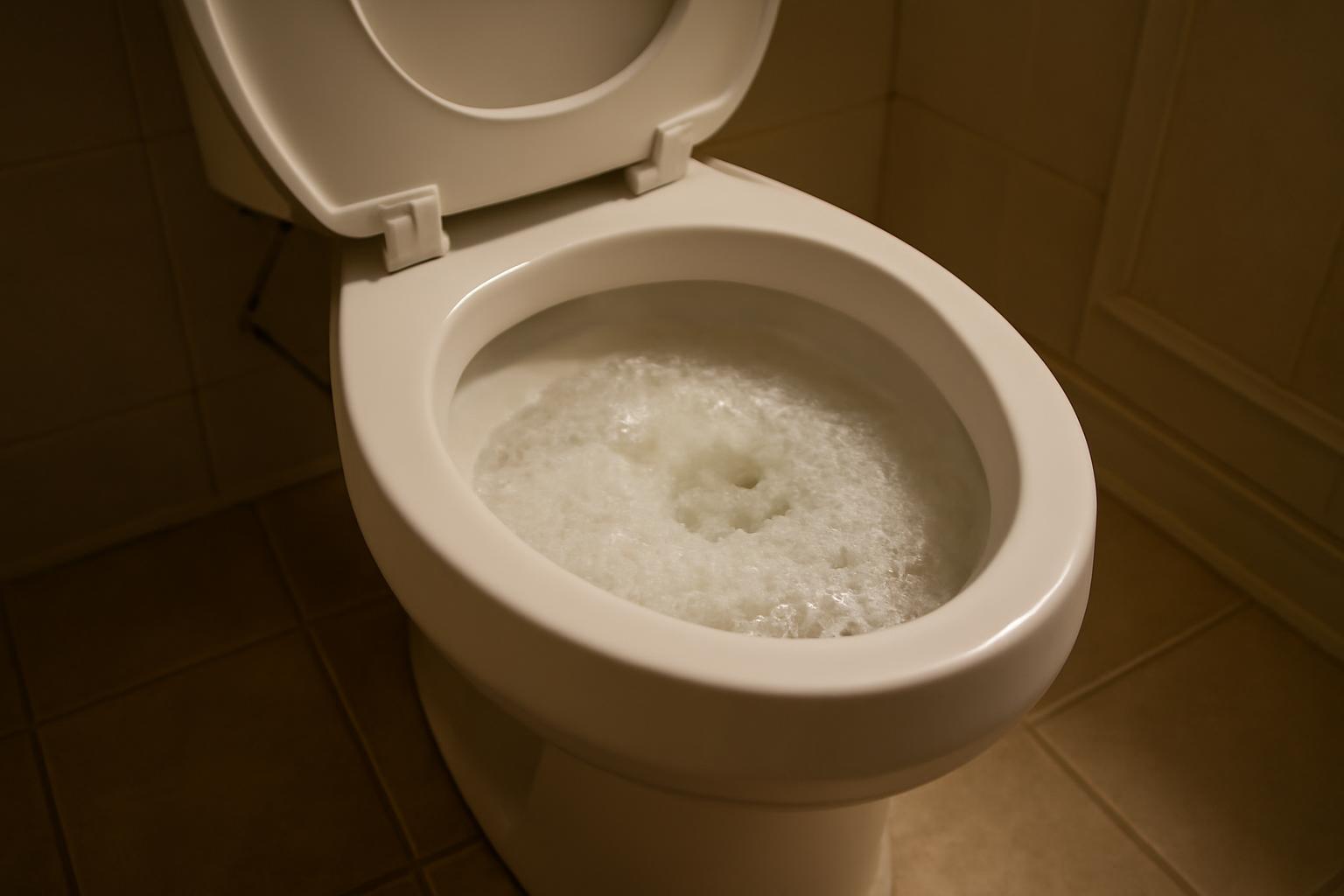
One isolated event with normal drainage can be watched. Rising water, sewage or several affected fixtures mean stop adding water and get professional help.
When a toilet bubbles when flushed, air is moving through the bowl water because normal wastewater flow or plumbing ventilation has been disrupted. The sound indicates a restriction or pressure imbalance, but it does not identify the exact pipe or component at fault.
The problem could be in the toilet’s trapway, a nearby drain, a shared branch, a plumbing vent, the main sewer line, or a septic-connected system. The safest way to narrow it down is to check first for backup warning signs, then note what triggers the bubbling and how many fixtures are affected.
Editorial note: The symptom patterns below are troubleshooting clues, not remote diagnoses. Drain and vent problems overlap, so persistent or widespread symptoms may require an on-site inspection.
First check: should you stop flushing and using water?
Stop flushing immediately if the bowl water rises toward the rim, sewage appears in any fixture, or a floor drain begins to overflow. Reduce or stop household water use when several fixtures are slow, gurgling, or backing up.
Arrange prompt professional help if you notice:
- Active sewage backup in a toilet, tub, shower, sink, or floor drain
- Toilet water rising rather than draining after a flush
- Water or sewage emerging from a basement or utility-room floor drain
- Several fixtures becoming slow or noisy at the same time
- A strong or persistent sewer odor
- Bubbling that returns quickly after plunging or drain cleaning
- Widespread drainage trouble in a home served by a septic system
One brief bubbling event is different from an active backup. If the toilet empties normally, the bowl returns to its usual level, nearby fixtures work normally, and there is no sewer odor or wastewater elsewhere, you can monitor it. Note whether it happens again and what water use triggers it.
There is no useful universal deadline based on bubbling alone. Urgency depends on the accompanying signs. One isolated event with normal drainage can be watched; rising water, sewage, floor-drain activity, or several affected fixtures requires immediate restraint and professional evaluation.
What bubbling in the toilet bowl actually means
A home’s drain-waste-vent system has to move both wastewater and air. When a toilet flushes, a relatively large volume of water enters the drain quickly. Air must be able to enter, leave, and move through the connected piping so wastewater can flow without abnormal pressure changes.
If the water meets a partial obstruction, it may push and compress air ahead of it. If the system cannot draw in replacement air properly, moving water may pull air through a nearby fixture trap. In either case, the toilet bowl can become the visible outlet: air passes through the standing water and produces bubbles or a gurgling sound.
Bubbling is therefore a symptom of disturbed flow or airflow, not a diagnosis. Possible locations include:
- The toilet’s built-in trapway
- The drain immediately below or beyond the toilet
- A branch serving several bathroom or laundry fixtures
- A plumbing vent
- The building’s main drain or private sewer line
- A septic tank, connecting pipe, or another septic-system component
A partial restriction does not have to block a pipe completely. Water may still pass around or through it, so the symptom may appear only when a toilet flushes, a washing machine pumps out, or several fixtures discharge close together. At lower flow, everything may seem normal.
That also explains why bubbling can be intermittent. A quiet period does not necessarily mean the restriction is gone.
Drain and vent problems can produce overlapping symptoms. A restricted drain may push air backward, while inadequate venting may interfere with pressure balance. Both can cause gurgling, changing bowl levels, and interaction between fixtures. Timing and fixture scope narrow the possibilities, but they do not prove the location.
Use the trigger to narrow the problem
Begin with one question:
Does the toilet bubble only during its own flush, or does it bubble when a shower, sink, washing machine, or another toilet drains?
If one toilet bubbles during its own flush and also empties slowly, the pattern is more consistent with an obstruction in that toilet’s trapway or nearby drain. Immediate bubbling after the flush focuses attention near the fixture, but it does not rule out a deeper branch or main-line restriction.
If the toilet reacts when another fixture drains, the fixtures are interacting through connected piping. That points away from a problem confined solely to the toilet bowl and toward a shared branch, vent, main drain, or sewer pathway (Comfort Experts’ overview of toilet-bubbling triggers).
The number of affected fixtures provides another scope clue:
- One toilet affected: A local obstruction is more plausible.
- Several nearby fixtures affected: A shared branch or vent becomes more plausible.
- Fixtures in different areas or on different levels affected: A main drain, private sewer line, or septic-system problem deserves greater consideration.
These are tendencies, not proofs. Plumbing layouts vary, and a downstream restriction may first reveal itself at the lowest or most pressure-sensitive fixture.
| Trigger | Fixtures affected | Accompanying signs | Possible problem area | Safest next action |
|---|---|---|---|---|
| Toilet bubbles only during its own flush | One toilet | Slow emptying, weak flush, repeated need to plunge | Toilet trapway or nearby toilet drain | If the bowl level is safe, try one controlled flange-plunger attempt |
| Toilet bubbles immediately after flushing | Usually one at first | Brief gurgle, delayed drainage, or rising bowl water | Nearby obstruction, although a deeper restriction remains possible | Do not test-flush if the water rises |
| Toilet bubbles when a nearby shower, sink, or tub drains | Two or more nearby fixtures | Slow bathroom drains or changing bowl level | Shared bathroom branch or vent | Limit testing; arrange evaluation if it persists |
| Toilet bubbles when the washer pumps out | Toilet plus laundry or lower-level fixture | Strong gurgle, floor-drain activity, or backup | Shared branch or downstream drain | Stop the washer and reduce water use |
| One toilet reacts when another toilet flushes | More than one toilet | Bowl splashing, water loss, or slow drainage | Shared stack, branch, vent, or main drain | Arrange evaluation if it recurs |
| Several drains gurgle or back up | Multiple areas | Sewer odor, floor-drain overflow, or prior backups | Main drain, sewer line, vent, or septic system | Stop adding water and call the appropriate professional |
| Bowl water rises toward the rim | At least the toilet | Restricted or failed outflow | Local or downstream obstruction | Do not flush again |
| Bowl water falls unusually low | Toilet, sometimes with other fixtures | Gurgling during another discharge or intermittent odor | Pressure change associated with a drain or vent problem | Record when it happens and report it |
Pay particular attention to bowl level. Rising water means the discharge is not leaving normally and ends further test flushing. Unexplained loss of bowl water can accompany a pressure change; it is useful diagnostic information even though it does not identify the cause by itself.
Five possible causes and the clues that fit each one
Several problems can make a toilet bubble, and more than one can produce the same pattern. Treat these as comparisons of likely clues, not definitive diagnoses.
| Possible cause | Clues that fit | Clues that point elsewhere |
|---|---|---|
| Partial toilet trapway or nearby drain clog | One toilet is affected; it drains slowly, rises during flushing, needs frequent plunging, or bubbles during its own flush | Other toilets, showers, or floor drains react at the same time |
| Restricted shared branch drain | The toilet bubbles when a nearby shower, tub, sink, washer, or toilet discharges | The symptom remains confined to one toilet under every condition |
| Blocked plumbing vent | Gurgling or changing trap levels occurs without a clear fixture-only obstruction; connected fixtures may be involved | Symptoms alone cannot confirm a vent blockage |
| Restricted or damaged main sewer line | Multiple fixtures are slow or noisy; lower drains react; symptoms appear during high-flow use; backups have occurred before | Only one toilet shows a consistent shallow-clog pattern |
| Septic-system trouble | Widespread slow drains, odors, backups, or soggy or pooling ground near the system | The home uses a municipal sewer, or only one toilet is affected |
1. Partial toilet trapway or nearby drain clog
A toilet contains a curved internal passage that carries water and waste out of the bowl. Excess paper, waste, wipes, cotton swabs, or another object can narrow that passage or lodge just beyond it. The toilet may continue to drain, but more slowly, while displaced air escapes through the bowl.
This possibility fits best when only one toilet is affected and the bubbling occurs during that toilet’s own flush. Weak or delayed emptying, rising water, or repeated need to plunge adds support. It still does not prove that the obstruction is inside the toilet; a nearby drain restriction can behave similarly.
2. Restricted shared branch drain
A branch drain can receive discharge from several fixtures. If that pipe is partially restricted, water from a shower, sink, tub, washer, or second toilet may push or pull air through the first toilet’s trap.
Fixture interaction is the key clue. A toilet that sits quietly until the washing machine pumps out is less consistent with an isolated trapway clog than a problem involving connected drainage or vent piping.
3. Blocked plumbing vent
Plumbing vents extend through the roof and allow air to move into and through the drainage system. Leaves, nests, branches, and other debris are among the possible vent obstructions described in reviewed plumbing guidance (Family Handyman’s toilet-venting overview).
A vent restriction can contribute to gurgling, slow drainage, or changing water levels in fixture traps. Those symptoms overlap substantially with drain restrictions, however.
4. Restricted or damaged main sewer line
The main building drain and private sewer line carry discharge from multiple branches. A restriction there may become noticeable when a toilet flushes, a washer empties, or several fixtures run at once. Lower fixtures and floor drains may react first because of their position in the system.
Possible causes include root intrusion, accumulated material, a damaged pipe, or a partial collapse. These are inspection possibilities, not conclusions to draw from sound alone. Multiple affected fixtures, previous backups, basement drain activity, and symptoms during high-flow use make a deeper restriction more plausible.
5. Septic-system trouble
In a home not connected to a municipal sewer, the building drain leads to a septic system. Widespread slow drainage, sewage odors, plumbing backups, or soggy or pooling ground near the system warrant evaluation by a qualified septic professional (JK Mechanical’s overview of septic warning signs).
Those signs can result from different problems, so bubbling alone does not prove that the tank, drain field, or another specific component has failed.
If symptoms began after plumbing installation or remodeling, an installation or layout problem is another possibility. Pipe slope and system design cannot be diagnosed reliably from the bubbling pattern alone.
Safe DIY steps for a likely local toilet clog
A limited DIY attempt is reasonable only when all of these conditions are true:
- Only one toilet appears affected.
- No sewage is backing up elsewhere.
- The bowl water is stable and safely below the rim.
- Nearby sinks, showers, tubs, and floor drains are behaving normally.
- There is no strong sewer odor.
- There are no septic warning signs inside or outside the home.
Do not begin by repeatedly flushing. If the bowl is actively rising or approaching the rim, do not operate the handle or attempt a DIY clearing procedure. Keep the toilet out of use and move to professional evaluation; continued flushing or household discharge can worsen a downstream backup (HOROW’s toilet-bubbling troubleshooting guidance).
1. Use a flange plunger
Choose a toilet plunger with an extended rubber flange rather than a flat-bottomed cup intended primarily for sinks. The flange should sit inside the toilet outlet so the main cup can form a complete seal around it.
Seat the flange and use steady, controlled strokes while maintaining the seal.
Reviewed guidance suggests pausing after roughly 10 to 15 firm plunges to reassess (Family Handyman’s toilet-clog guidance). That figure is a practical stopping point for observation, not a guarantee that a particular clog will clear.
Remove the plunger and watch the bowl. If the water drains to its normal level, the attempt may have moved or cleared the obstruction. If the water rises or stays dangerously high, stop rather than adding a test flush.
2. Consider a toilet or closet auger
If plunging fails but the evidence still points to a local obstruction, a closet auger is the next appropriate tool.
Follow the manufacturer’s instructions. Feed and rotate the cable gently rather than forcing it through hard resistance.
Stop if the cable will not advance normally, the tool becomes stuck, or you are unsure what it has reached. A toilet auger is not a substitute for roof-vent, cleanout, branch-line, or main-sewer work.
3. Verify cautiously
After the bowl has returned to its normal level and appears to drain freely, make one observed flush. Be prepared to stop all further testing if the water rises; repeated flushing after a failed attempt can turn a restriction into an overflow (Comfort Experts’ troubleshooting guidance).
Then check:
- Whether the bowl refills to its usual level
- Whether the toilet still bubbles
- Whether nearby sinks, tubs, or showers gurgle
- Whether a floor drain shows water movement
- Whether a sewer odor appears
- Whether the symptom returns during ordinary water use
One normal flush is encouraging, but it does not prove that a partial obstruction has been removed completely. Recurrence means the likely location and scope should be reconsidered.
What not to do—and why
Do not keep flushing a rising toilet. Each flush adds water to a drain that may already be unable to accept it. If another fixture is backing up, stop that fixture too and reduce household water use (Baker Brothers’ backup-warning guidance).
Do not make chemical drain cleaner the default response. Reviewed plumbing guidance warns that some products may damage certain pipes, seals, or toilet components and can complicate later mechanical work (JK Mechanical’s bubbling-toilet guidance). That does not mean every product damages every pipe, but chemicals will not resolve every object, vent restriction, branch clog, or sewer-line defect.
Do not rely on boiling water, dish soap, garden-hose flushing, or similar internet remedies. The supplied evidence does not establish those methods as reliable, generally safe fixes for an unknown toilet or downstream obstruction. Adding more liquid is also unhelpful when the available drainage capacity is uncertain.
Do not climb onto the roof to inspect or clear a vent. When roof access is required, inspection is better left to a qualified professional (Mother Modern Plumbing’s roof-work precautions).
Do not open a sewer cleanout as a casual test or force an auger through resistance. A backed-up cleanout may release wastewater when opened, while aggressive auger use can mark porcelain, damage components, lodge the cable, or fail to reach an obstruction beyond the toilet (HOROW’s cleanout and auger precautions).
Most importantly, do not treat a failed local-clog attempt as permission to escalate automatically to riskier work. Failure of a plunger or toilet auger is diagnostic information: the restriction may be in a shared drain, vent, main line, or septic system rather than the toilet.
When the likely problem is beyond the toilet
Arrange professional drain or plumbing evaluation when:
- More than one fixture is involved
- Sewage backs up
- A floor drain overflows
- The bowl rises toward the rim
- A foul sewer odor appears
- A flange plunger and cautious toilet-auger attempt fail
- Bubbling returns soon after appearing to clear
- The toilet consistently reacts to a shower, washer, or another toilet
- There is a history of root intrusion or repeated sewer backups
For a home connected to a municipal sewer, a plumber or drain professional can assess the accessible private drainage system and help locate the restriction. If the investigation suggests a problem beyond that system, the appropriate next contact will depend on the property and local service arrangements.
For a septic home, contact a qualified septic professional when symptoms are widespread or accompanied by odors, backups, or soggy ground near the system. A plumber may still be needed to assess household piping, but septic-specific signs require someone equipped to inspect the system rather than assuming it merely needs pumping.
Before service, make a concise symptom record. Report:
- Which fixture triggers the bubbling
- Every slow, noisy, or backing-up fixture
- Whether the toilet water rises, falls, or returns to normal
- Any sewer odor
- Any floor-drain activity
- Whether symptoms occur only during high-flow use
- Recent plumbing, drain, or remodeling work
- Known root history
- Previous backups or flooding
- Whether symptoms are constant or intermittent
- Whether the home uses a municipal sewer or septic system
A professional may observe how fixtures interact, inspect accessible drainage and vent components, and clear a line with equipment suited to its size and location. If a deeper obstruction or pipe defect is suspected, a sewer camera may be used once access and flow conditions permit.
Camera inspection can reveal roots, buildup, corrosion, partial collapse, and other internal pipe conditions (Baker Brothers’ explanation of camera findings). The footage still has to be interpreted alongside the symptoms, pipe route, access point, and plumbing layout. A visible defect is not automatically the only cause, and camera images alone do not determine the correct repair in every case.
Why bubbling can return after plunging or sewer cleaning
Possible reasons for recurrence include:
- Incomplete removal of a local obstruction
- A restriction farther down the same branch
- A separate obstruction in another branch
- Returning root growth
- Remaining buildup
- A cracked, corroded, displaced, or partially collapsed pipe
- A vent problem not addressed by drain cleaning
- An installation or layout issue that becomes apparent during high flow
One plumbing-forum case illustrates why fixture scope matters without establishing a universal diagnosis. A homeowner reported a downstairs toilet reacting to an upstairs toilet and shower, along with utility-sink bubbling and basement floor-drain overflow. After several attempted remedies, a camera reportedly found roots in the main drain inside the house. The thread did not confirm that root removal permanently ended the symptoms, so the case is an illustration—not proof that roots cause every bubbling toilet (Terry Love Plumbing forum case).
If bubbling returns soon after professional line cleaning, contact the previous technician and ask:
- What part of the system was cleared?
- From which access point was the work performed?
- Was the toilet branch, main building drain, or private sewer line addressed?
- Was camera verification performed before or after cleaning?
- Were roots, buildup, damage, or standing water observed?
- Was any portion inaccessible?
- Was follow-up inspection or maintenance recommended?
Prior root intrusion, a basement backup, or recent line cleaning is valuable history, but none proves the present cause. The current symptom could involve the same location, a returning obstruction, another branch, or a separate venting issue.
Monitor recurrence without deliberately trying to reproduce it. Record the triggering fixture, number of affected drains, bowl-level change, odors, and floor-drain activity. Ordinary use may provide enough information; repeated test flushing can make a developing backup worse.
How to reduce the chance of another bubbling episode
Prevention depends partly on the cause, but several habits are sensible without assuming a diagnosis.
Flush only human waste and toilet paper. Wipes, cotton swabs, excess paper, hygiene products, and other items that do not break down like toilet paper can contribute to trapway or drain obstructions.
Address slow drainage and recurring gurgling early. A toilet that repeatedly needs plunging, a shower that becomes progressively slower, or a fixture that regularly makes another drain gurgle is providing useful evidence before a full backup occurs.
From a safe ground-level position, look for obvious overhanging branches or debris around visible roof-vent areas. Do not climb onto the roof or insert tools or a hose into the vent. If vent obstruction remains a possibility, arrange safe professional access.
For a home with documented root intrusion or damaged sewer piping, follow the inspection or maintenance plan developed after an on-site diagnosis. There is no universal cleaning schedule that fits every pipe material, defect, root condition, or property.
Likewise, do not apply a universal septic-pumping interval to every system. Widespread slow drains, odors, backups, or wet ground should prompt evaluation rather than an assumption that routine pumping alone is the answer.
Frequently asked questions
Why does my toilet bubble only when I flush it?
Bubbling limited to the toilet’s own flush is more consistent with a partial obstruction in the trapway or nearby toilet drain, especially if the toilet empties slowly or the bowl rises. The flush creates enough flow to disturb air around the restriction.
That pattern is not conclusive. A deeper branch or main-line restriction can first show itself at one toilet. If plunging does not restore normal drainage or the symptom quickly returns, reassess rather than continuing to flush.
Why does the toilet bubble when the shower, washing machine, or another toilet drains?
That trigger suggests the toilet and the other fixture interact through connected piping. Water from the shower, washer, sink, or second toilet may be pushing air ahead of a downstream restriction or creating a pressure change that draws air through the toilet bowl.
A shared branch, vent, main drain, or sewer line may be involved. If the bowl rises, a floor drain reacts, or several fixtures become slow, stop the high-flow appliance and reduce water use.
Can I fix a bubbling toilet with a plunger?
Possibly—if only one toilet is affected, its water level is stable and safely below the rim, and there are no backup, odor, or septic warning signs. Use a flange plunger, maintain a complete seal, and make one controlled series of firm strokes before reassessing.
If the bowl rises, stop. If plunging fails but the obstruction still appears local, a toilet auger may be appropriate. Failure of both tools suggests that the problem may lie beyond the toilet.
Does a bubbling toilet mean the main sewer line is clogged?
No. A main sewer restriction is one possibility, but bubbling can also result from a local toilet clog, a restricted shared branch, a blocked vent, or septic-system trouble.
A main-line problem becomes more plausible when several fixtures are slow or gurgling, lower-level drains react, a floor drain overflows, or symptoms occur during shower, laundry, or other high-flow use. Inspection is still needed to distinguish a main-line problem from a branch or vent restriction.
When should I stop using water and call a plumber or septic professional?
Stop or sharply reduce water use when toilet water rises, sewage appears, a floor drain overflows, multiple fixtures are affected, or a strong sewer odor is present. Seek professional help as well when a reasonable local-clog attempt fails or the bubbling quickly returns.
For a municipal-sewer home, contact a plumber or drain professional to assess the household drainage system. For a septic home, use a qualified septic professional when trouble is widespread or accompanied by odors, backups, or soggy ground near the system.
Bubbling identifies disrupted airflow or drainage—not its exact location. If only one toilet is affected and the bowl level is safe, try one controlled flange-plunger attempt and, if appropriate, a toilet auger. If water rises, sewage backs up, a floor drain overflows, odors appear, several fixtures react, or the symptom quickly returns, stop adding water and arrange the appropriate drain, plumbing, or septic evaluation.