
Identify Your Bathtub Drain Before Replacing Parts
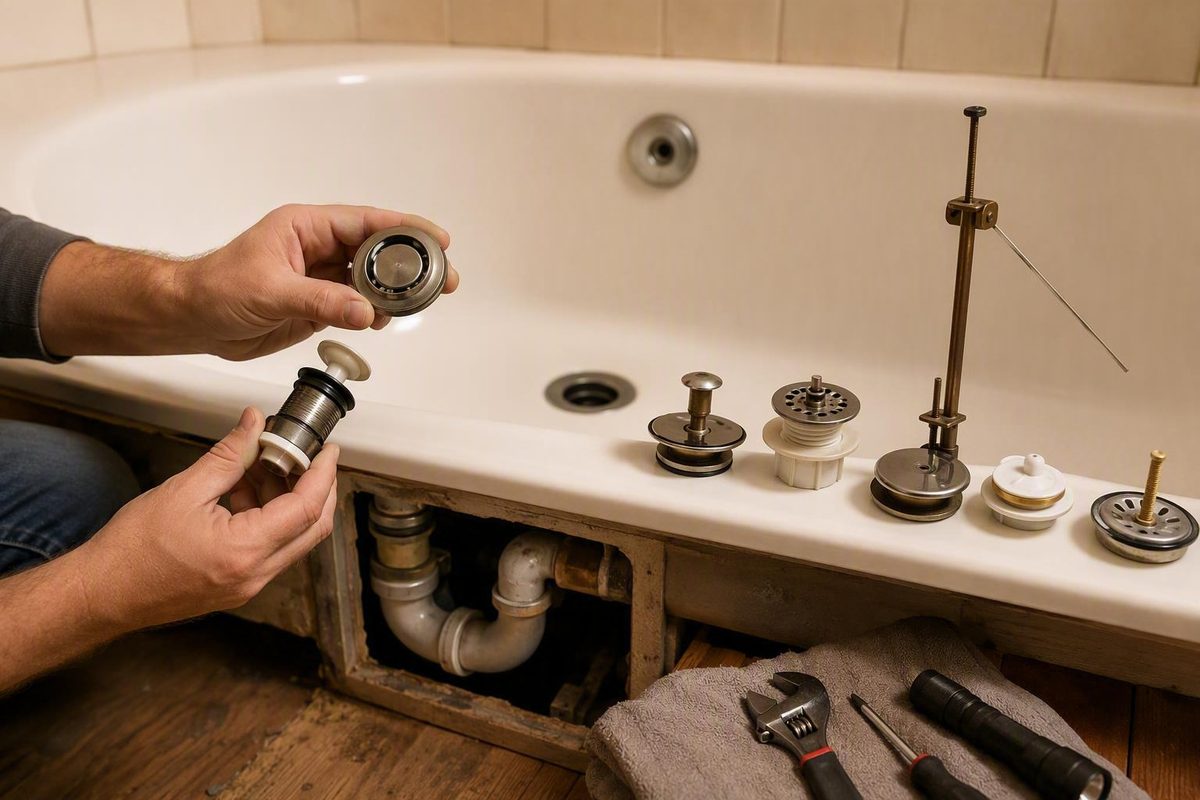
Narrow down yours by how its control works and the tub installation, then verify threads, crossbars, overflow layout and dimensions.
The phrase “types of bathtub drains” usually mixes together two different things: the stopper you operate and the drain-and-overflow assembly hidden below or behind the tub. A lift-and-turn, toe-touch, trip-lever, pop-up, or cable drain describes how the tub opens and closes. A waste-and-overflow, straight drain, or tower drain describes how that hardware connects to the plumbing and to a particular tub style.
That distinction matters when you are identifying a drain or shopping for a replacement. A stopper that looks right may still have the wrong thread, crossbar connection, overflow layout, or dimensions for the assembly already installed.
Bathtub drain parts in plain language
Before comparing types, separate the visible pieces from the concealed plumbing:
- Stopper: The movable plug or cap that holds water in the tub. Some assemblies hide the stopper inside the overflow tube.
- Drain flange or strainer body: The finished ring in the bottom of the tub. It fastens to the drain shoe below.
- Drain shoe: The elbow directly under the tub’s waste opening.
- Overflow plate: The cover near the top of the tub wall. It may be plain, hold a lever, or turn as a control.
- Waste-and-overflow assembly: The drain shoe, overflow elbow, connecting tubes, and tee that bring both openings toward the trap.
- Trap and fixture drain: The plumbing beyond the tub assembly. These are not the same thing as the stopper.
Manufacturer Oatey groups these components as bath waste-and-overflow systems and offers them in different materials, kit scopes, and stopper styles. Its bath waste and overflow reference also shows why the control you see does not always reveal the mechanism behind it.
The main bathtub stopper types
Lift-and-turn
A lift-and-turn stopper has a small knob on top. Lift the cap and rotate it to open; turn it the other way and lower it to seal. The operating parts are concentrated at the drain opening, so there is usually no control lever on the overflow plate.
Identification clue: A raised center knob that must be both lifted and twisted.
Push-and-pull
A push-and-pull stopper also has a knob and a cap at the drain, but the cap moves straight up or down by hand rather than clicking under spring pressure. Some products use a slight turn to hold their position, so confirm the exact model before ordering replacement parts.
Identification clue: A center knob that you grasp to raise and lower the stopper.
Toe-touch or push-button
A toe-touch stopper is a spring-loaded cap at the drain opening. Press it to change between open and closed positions. “Toe-touch,” “touch-toe,” and “push-button” are often used for the same general operating idea, but springs, threads, and removable caps vary by manufacturer.
Identification clue: A low round cap that clicks when pressed and no lever on the overflow plate.
Trip-lever with a concealed plunger
In a traditional trip-lever assembly, the lever is on the overflow plate. Linkage behind the plate raises or lowers a barrel-shaped plunger inside the overflow tube. The tub-floor opening may look like an uncovered strainer because the actual stopper is concealed. Oatey’s reference explains that the hollow plunger can block the waste path while still allowing overflow water into the drain piping.
Identification clue: A lever at the overflow and no movable cap in the bottom opening.
Lever-operated pop-up
This type also uses a control on the overflow plate, but the linkage moves a visible stopper at the tub floor. A rocker arm or related linkage raises and lowers that cap. The Signature Hardware tub drain guide distinguishes this pop-up arrangement from a concealed trip-lever plunger.
Identification clue: An overflow lever plus a stopper that visibly rises at the drain.
Cable-operated drain
A cable drain uses a knob or dial on the overflow plate connected to a cable outside the waste tubes. Turning the control moves the stopper. The cable is part of the full assembly, not merely a decorative overflow cover.
Identification clue: A rotating overflow control rather than a flip lever.
Chain-and-plug or removable stopper
The simplest option is a separate rubber or metal plug, sometimes attached to the overflow plate by a chain. A fixed strainer can remain open until the plug is inserted. Portable flat covers also exist, but they should not be confused with a permanent, fitted waste assembly.
Identification clue: No moving hardware in the drain; the plug lifts out completely.
Drain layouts for different bathtub installations
Stopper style is only half the choice. The tub itself determines the basic assembly layout.
Concealed waste-and-overflow assemblies
Alcove, drop-in, and many skirted tubs use a drain shoe below the bottom opening and a vertical overflow tube behind the tub wall. The two paths meet at a tee before the trap. These assemblies may use a lift-and-turn, toe-touch, trip-lever, pop-up, or cable control.
The concealed location makes access important. A trim-only change may be possible from inside the tub, but a leaking gasket, cracked tube, or poorly aligned connection may require access behind or below the fixture.
Straight and exposed drains
Many freestanding tubs use a straight drain arrangement that connects toward the floor. Some have an extended exposed waste-and-overflow tube, while others conceal the connection below the tub. The Signature Hardware guide describes extended straight drains for freestanding tubs and notes that the visible pipe length and alignment must suit the fixture.
Do not assume that “freestanding” means one universal connection. The drain location, tub thickness, overflow design, floor connection, and manufacturer-specified rough-in all matter.
Tower drains for some clawfoot tubs
A tower drain is an exposed assembly used with some clawfoot tubs that have an overflow opening. Its pop-up control sits near the top of the vertical pipe. Placement and dimensions must match the tub’s drain and overflow holes; a tower drain is not simply a stopper that can be added to any tub.
Factory-specific and integral systems
Some soaking, whirlpool, air, or solid-surface tubs use proprietary drain kits, integral channels, unusually deep overflows, or remote controls. Start with the tub model and its installation manual. Choosing only by finish or stopper name can leave the overflow reach, gasket angle, or drain shoe incompatible.
How to identify your bathtub drain without opening the wall
Use observation first. You can collect most of the information needed for a parts search without disturbing a watertight joint.
- Photograph the drain and overflow. Include the full tub, close-ups of the stopper, the overflow control, and any markings.
- Operate the control gently. Note whether you lift, twist, pull, press, flip a lever, or turn a dial. Stop if it binds; force can damage linkage.
- Watch what moves. A lever with no visible floor movement suggests a concealed plunger. A lever that raises a visible cap suggests a pop-up.
- Identify the tub installation. Record whether it is alcove, drop-in, freestanding, clawfoot, skirted, jetted, or another factory-specific design.
- Look only through existing access. If there is a removable access panel or an open view from below, photograph the material, tee layout, labels, and connection style. Do not cut walls, floors, or framing to investigate.
- Find the tub model if possible. A model label, purchase record, or installation manual is stronger evidence than appearance alone.
If you remove only a replaceable stopper or trim piece, keep every washer and screw in order and measure the actual connection. Conversion products are not truly dimension-free. For example, Watco’s Universal NuFit product sheet specifies different attachment methods for drains with and without crossbars and lists multiple pin thread sizes.
Compatibility checklist before buying a replacement
Match the part to the existing system on all of these points:
- stopper mechanism and how it attaches;
- crossbar present, missing, or damaged;
- thread diameter and pitch rather than cap diameter alone;
- number and spacing of overflow-plate screws;
- distance between drain and overflow openings;
- tub wall thickness and drain-shoe reach;
- straight, side-outlet, direct-drain, or other assembly layout;
- PVC, ABS, brass, or other existing material and the approved joint method;
- access needed to tighten, align, inspect, and test every connection;
- tub manufacturer instructions and locally adopted plumbing rules.
The 2024 International Residential Code provides a useful baseline: its bathtub section calls for a waste outlet of at least 1½ inches, a watertight stopper, and—where an overflow is installed—an overflow of at least 1½ inches. But a model code is not automatically the rule in every jurisdiction. Check the code edition and amendments adopted where the work will occur; the ICC bathtub requirements should not replace local approval or the tub manufacturer’s instructions.
When a stopper swap is not enough
A replacement stopper or trim kit may be reasonable when the assembly is dry, undamaged, accessible as required, and the new part is documented to fit. A whole waste-and-overflow evaluation is more appropriate when you observe:
- water below or behind the tub during a fill-and-drain test;
- leakage only when water reaches the overflow opening;
- a loose drain flange, cracked fitting, damaged crossbar, or heavy corrosion;
- an overflow plate that will not sit flat;
- linkage that is broken or inaccessible;
- damp drywall, staining, soft flooring, or a musty area near the tub.
These observations narrow the inspection; they do not prove which concealed joint has failed. Stop using the tub if water is entering a wall, ceiling, floor, or electrical area. If sewage backs up, avoid contact, keep people and pets away, and use qualified cleanup and plumbing help. Never cut structural framing to make a drain fit—Oatey specifically warns that framing changes require approval because they can weaken surrounding floors or walls.
For a new assembly, invasive replacement, concealed leak, damaged structure, or uncertain code requirement, use a licensed plumber and obtain permits or inspections where required. The safest “type” of drain is the one that fits the tub, seals correctly, remains serviceable, and complies with the rules for that location.
Frequently asked questions
Are bathtub drains universal?
No. A decorative cap may be sold as broadly compatible, but crossbars, pin threads, overflow plates, drain lengths, tub thicknesses, and assembly layouts vary. Verify dimensions and the manufacturer’s fit instructions.
Can a trip-lever drain be changed to toe-touch?
Conversion kits exist, but first identify whether the current lever operates a concealed plunger or a visible pop-up. The old linkage may need to be removed, and the new stopper still has to match the drain body or an approved adapter.
Is the overflow cover the same as the drain stopper?
Usually not. A plain overflow cover protects the overflow opening. A lever or dial on that plate may control a stopper elsewhere, but the plate itself is only one part of the waste-and-overflow system.
Which bathtub drain type is easiest to maintain?
Accessibility and correct fit matter more than the label. A stopper that can be removed according to its instructions makes surface hair easier to clear, while concealed linkage adds parts that may eventually need adjustment. Choose based on the tub and assembly, then follow the product’s cleaning and service directions.
How do I tell whether the drain or the overflow is leaking?
Do not diagnose from a stain alone. A plumber may isolate stages—holding water below the overflow, then testing the overflow and draining—while watching accessible connections. If the area is concealed or water is reaching finished materials, stop using the tub rather than repeatedly testing a leak.