
How Baking Soda and Vinegar React in Drains—and Why the Fizz May Not Clear a Clog
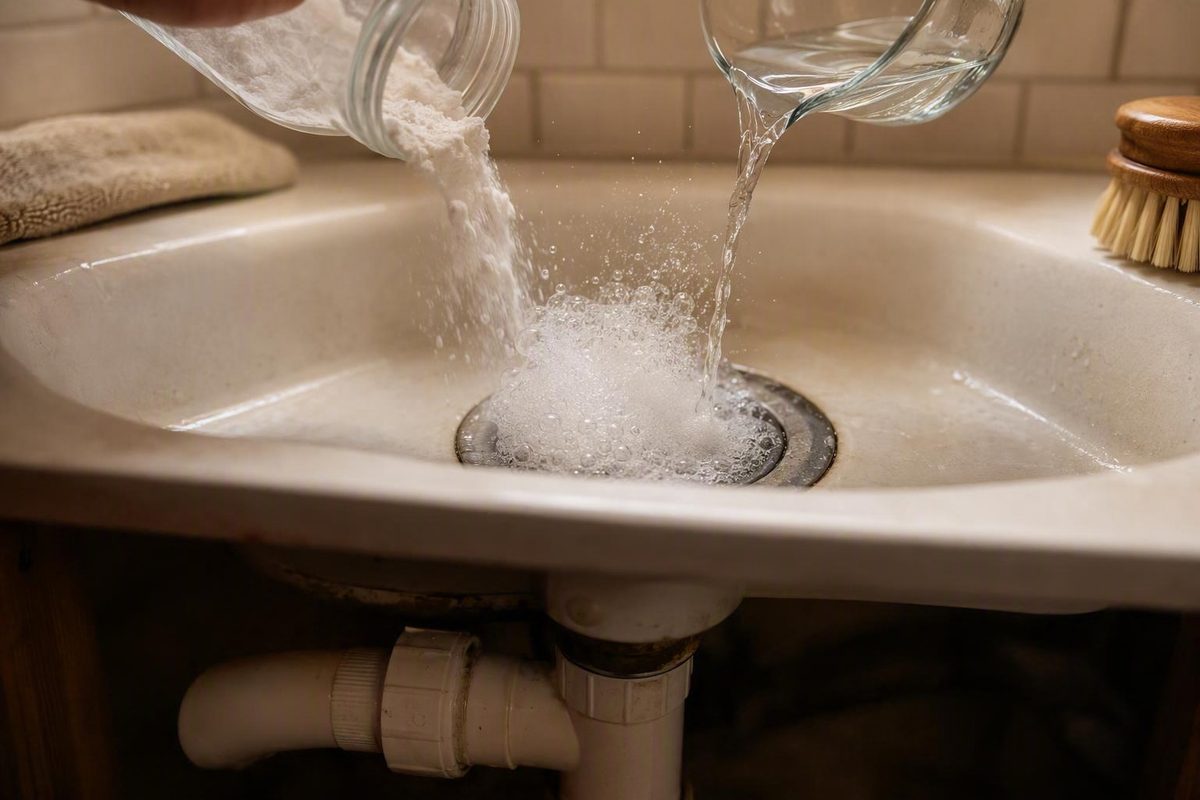
The reaction produces carbon dioxide bubbles, but visible fizz does not prove that the mixture dissolved or removed a clog.
Overview
Baking soda and vinegar react in a drain, producing carbon dioxide bubbles, but the visible fizz does not prove that they dissolved or removed a clog. Any benefit depends on the blockage’s material, depth, and accessibility. Hair, heavy grease, deep obstructions, persistent clogs, and multiple slow drains usually call for physical removal or professional diagnosis.
The reaction is easy to observe, which makes it tempting to treat bubbling as evidence of cleaning. Sources disagree, however, about what those bubbles accomplish. Liquid-Plumr says the reaction can loosen material before water flushes it away. The Spruce argues that an open drain develops too little pressure for the gas to clear a clog reliably.
That distinction matters when you diagnose a slow drain. A treatment might wash away loose residue or make a drain seem fresher without removing the mass restricting flow. Conversely, a drain that runs slightly better after the final hot-water flush may have responded to the water and flow rather than to the fizz itself. The available evidence does not isolate these effects.
Treat baking soda and vinegar as, at most, a limited household trial for minor, accessible buildup. Do not use the amount of foam as your success test. Restored drainage is the relevant result, and a drain that remains slow or blocked needs a method matched to its likely cause.
What Happens When Baking Soda and Vinegar Meet
Baking soda is sodium bicarbonate, a base. Household vinegar contains water and acetic acid. When the two meet, an acid-base reaction produces carbon dioxide gas, water, and dissolved reaction products. The escaping carbon dioxide creates the familiar foam and bubbles, as described by both Liquid-Plumr and Brendid.
The reaction is real, but its location and duration do not guarantee useful contact with a blockage. If the ingredients react near the drain opening, much of the carbon dioxide can escape upward. If standing water dilutes and disperses them, less of the mixture may reach the obstruction in a concentrated form. The Spruce specifically notes that standing water can cause the ingredients to dissipate before reaching the drain.
Neutralization also changes what is present. The acid and base consume each other as they react. Dramatic bubbling therefore does not mean that both ingredients retain all of their separate cleaning properties throughout the treatment. Brendid’s chemistry explanation emphasizes that the resulting mixture is not a detergent capable of carrying grease away as a surfactant would.
This is the central difference between observing a chemical reaction and demonstrating drain cleaning. The fizz confirms that acid and base met and carbon dioxide formed. It does not identify the clog, show that the reaction reached it, or establish that enough material was displaced to restore the pipe’s open area.
Does the Fizz Actually Clear a Clog?
The supplied sources do not establish that fizzing clears a drain better than hot water, detergent, plunging, or physical removal. Some describe the bubbles as loosening clog material, while others argue that the reaction lacks the pressure and cleaning action needed to remove a substantial obstruction. The honest conclusion is conditional and limited.
The favorable mechanism is straightforward. Liquid-Plumr says carbon dioxide bubbles move through the clog and break it into looser material, which a final water flush can carry away. This explanation is plausible as a description of what might happen to loose, shallow residue, but the source does not provide a controlled comparison separating the bubbles’ effect from the subsequent water flush.
The skeptical mechanism focuses on pressure. Gas can push effectively when it is contained, but a household drain is ordinarily open to escape paths. The Spruce says the reaction produces little pressure in an open drain. Covering the opening may retain some gas, but the same source warns that deliberately confining the reaction can create difficult-to-control pressure in thin or delicate PVC components. A more forceful reaction is therefore not automatically a better or safer one.
Hot water is another reason to interpret success cautiously. Recipes commonly finish with a hot or boiling-water flush. Liquid-Plumr credits both bubbling and boiling water, while Brendid argues that hot water and detergent do more of the work on fats, oils, and grease. If flow improves only after the final flush, the observation cannot show how much credit belongs to the reaction, the water temperature, or the volume of moving water.
Clog depth further limits the method. Harmony Plumbing says its procedure is unlikely to work when the obstruction is more than 18 inches down the pipe. That is one provider’s practical threshold, not a universal plumbing rule, but it illustrates the underlying issue: ingredients reacting near the opening may not meaningfully affect a distant blockage.
The supplied corpus contains no controlled trial using representative drains and clog materials to compare baking soda and vinegar with hot water alone, detergent, water flow, or mechanical tools. It also does not establish that periodic use prevents future clogs. Avoid turning a temporary change in odor, surface residue, or flow into a broader maintenance claim.
Judge the treatment by the drain symptom. If normal flow returns and remains stable, loose material may have moved. If the drain still backs up, drains slowly, or becomes blocked again, the fizz has not resolved the underlying obstruction, regardless of how vigorous it looked.
Match the Remedy to the Blockage
Clog type and location are more useful than the amount of fizz when choosing a response. The evidence supports a narrow trial only for minor, shallow buildup. It favors physical removal for hair and professional assessment for deep, persistent, or multi-drain problems.
| Symptom or suspected blockage | What the evidence indicates | Best-supported next action |
|---|---|---|
| Minor, shallow residue with some remaining flow | Some sources say fizz may loosen light material, but comparative effectiveness is unproven. | Remove accessible debris first. A single conservative trial may be reasonable if no other drain chemical is present. |
| Hair near a sink, tub, or shower opening | Brendid says hair requires physical removal. Doctor Pooper also excludes compacted hair from the method’s capabilities. | Pull out visible hair or use a suitable mechanical tool. Do not rely on fizz to dissolve it. |
| Heavy grease or a substantial fats, oils, and grease obstruction | Doctor Pooper says the method cannot dissolve heavy grease. Brendid attributes more grease-moving value to hot water and detergent than to the reaction. | Stop treating the fizz as the active solution. Use an appropriate mechanical method or arrange professional service if the obstruction persists. |
| Soap scum or mineral buildup | The supplied evidence does not isolate either material in controlled drain testing. General claims about “buildup” are not enough to predict removal. | Treat the cause as uncertain. Remove accessible deposits and escalate if flow does not improve. |
| A blockage believed to be well down the branch pipe | The reaction may occur before reaching the obstruction. Harmony Plumbing reports poor prospects beyond its 18-inch threshold. | Use a tool capable of reaching the blockage, or have the drain assessed. |
| More than one slow or clogged drain | Harmony Plumbing and Doctor Pooper identify this as a sign of a more serious main-line problem rather than an isolated fixture clog. | Skip repeated household treatments and seek professional diagnosis. |
| One drain remains blocked after a limited attempt | Persistence indicates that the reaction did not remove the restriction. | Move to plunging, accessible trap cleaning, or a suitable drain snake. Call a plumber when the blockage remains or cannot be reached safely. |
A slow sink after cooking may suggest grease, while a tub that drains poorly and has visible strands around the stopper points more directly to hair. Those clues change the first useful action. Hair can often be retrieved; a deeper grease mass cannot be diagnosed by watching bubbles at the opening.
Do not assign a precise clog material from slow flow alone. Soap residue, mineral deposits, foreign objects, and accumulated debris can produce similar symptoms, and the evidence pack does not validate baking soda and vinegar for each one. If the cause is unclear and the drain remains restricted, a method that retrieves or directly reaches the obstruction provides more information than another dose of ingredients.
How to Try the Method Conservatively
Published recipes share a general sequence but disagree on quantities, waiting periods, whether to cover the drain, and the temperature of the final flush. No supplied evidence establishes one optimal formula. A conservative attempt should therefore focus on limited use, observation, and a clear stopping point rather than treating a disputed recipe as validated plumbing guidance.
Before adding anything, remove hair, food, or other debris you can reach without pushing it farther into the drain. If the basin contains standing water, remove as much as practical. Harmony Plumbing recommends clearing standing water, and The Spruce explains that water can disperse the ingredients before they reach the drain.
A bounded procedure is:
- Confirm that bleach, acid, or a commercial drain cleaner has not already been added.
- Remove accessible debris and standing water.
- Add a measured amount of baking soda, followed by a measured vinegar-and-water solution. One published example uses one cup of baking soda followed by one cup each of water and vinegar, but this is a source recipe, not a proven optimum.
- Let the visible reaction subside without trying to create a tightly sealed pressure chamber.
- Flush with water at a temperature appropriate for the known plumbing materials, then check actual flow once.
- If the drain remains restricted, stop adding ingredients and move to a mechanical or professional response.
The quantities in step three come from Liquid-Plumr’s published procedure. Other sources use different sequences and waiting periods, so the available recipes should not be combined into progressively larger doses.
Repeatedly adding dry baking soda may also introduce more solid material into a drain that is already obstructed. A DIY Stack Exchange discussion contains reports of baking soda settling into a hard mass and worsening a blockage. Brendid also shows baking soda collected in the bottom of a U-shaped trap during an informal demonstration. These reports do not establish how often accumulation occurs, but they support measured use and a one-attempt limit.
Use Hot Water With Pipe Material in Mind
Do not treat boiling water as a universal final step. Safe temperature depends on the pipe material, whether it is pressurized, wall thickness, fittings, seals, fixture components, and the condition of the installed assembly. The available temperature reference covers pipe materials, not every part of a household drain.
For context, Engineering ToolBox lists typical maximum operating temperatures for PVC of 100°F (38°C) with pressure and 140°F (60°C) without pressure. It separately lists 95°C as a maximum short-time temperature for unpressurized PVC. These values describe different operating conditions and must not be collapsed into one universal safe pouring temperature.
The same reference shows why the label “plastic pipe” is too broad. Its typical unpressurized operating values include 180°F (82°C) for ABS and CPVC, compared with 140°F (60°C) for PVC. Working pressure also varies by material and pipe schedule. None of those material figures confirms that an installed drain’s joints, trap, seals, or fixture can tolerate water at the same temperature.
One plumbing source advises using boiling water only with metal drains and hot, not boiling, water with PVC. That guidance is more conservative than copying a material test value into a household procedure. If you cannot identify the complete drain assembly, avoid a blanket boiling-water flush.
Do Not Combine It With Other Drain Chemicals
Do not add baking soda and vinegar when bleach or a chemical drain cleaner may already be in the drain. Doctor Pooper expressly warns against combining the household method with bleach or chemical cleaners because the combination may neutralize effects or release fumes.
The evidence supplied here does not establish a safe waiting time or flushing interval after another product has been used. It also does not support a universal instruction for drains containing unknown acids or cleaners. Because the substance, concentration, retained volume, and drain condition may differ, do not guess that a brief water flush made the next mixture safe.
Stop adding materials, keep people away from splashes or fumes, and use the instructions for the substance already applied. If you do not know what is present, seek product-specific or professional guidance before opening a trap, plunging, snaking, or introducing another chemical. The evidence supports separation of treatments, not a homemade neutralization procedure.
What to Do When It Does Not Work
If normal flow does not return after one limited attempt, stop adding baking soda and vinegar. Repetition can delay physical removal and may leave more undissolved material in an already restricted trap or pipe. The next step should reach, retrieve, or directly move the obstruction.
Use a conservative escalation sequence:
- Remove visible debris from the stopper, strainer, or drain opening.
- Use an appropriate sink or drain plunger. The Spruce recommends a flat-bottomed cup plunger for a drain rather than a toilet plunger with a bottom flap.
- For an accessible sink trap, place a bucket below it before disassembly and clean out captured sludge or debris only if you can remove and reinstall the trap correctly.
- Use a suitable drain snake when the obstruction is beyond the opening or trap. The goal is to snag or break through reachable material, not add another chemical reaction.
- Call a plumber if the clog persists, appears deep, cannot be reached safely, or affects multiple fixtures.
This sequence reflects the alternatives described by The Spruce, while a DIY Stack Exchange response likewise recommends trying a plunger and then a snake. Mechanical methods provide a clearer connection between action and obstruction because they can retrieve material or make direct contact with it.
An accessible sink trap is a plausible inspection point when one sink is affected. The Spruce’s procedure places a bucket underneath, disconnects the curved trap, removes the collected clog, and reinstalls the trap. This is not the right step when the plumbing is inaccessible, damaged, unfamiliar, or may contain another drain chemical.
Persistent single-drain trouble is a stopping signal even when the fixture briefly improves. Harmony Plumbing advises calling a professional if the drain remains clogged after the home remedy. Recurrence can indicate that only part of the obstruction moved or that the actual blockage lies farther down the line.
Multiple slow drains deserve a different response from one sluggish sink. Both Harmony Plumbing and Doctor Pooper associate simultaneous problems at several drains with a likely main-line issue. Baking soda and vinegar poured into one fixture does not diagnose or physically reach that broader problem.
The practical dividing line is simple: use observation to identify the symptom, choose a method that matches the likely material and location, and stop treating fizz as evidence once drainage remains impaired. Baking soda and vinegar visibly react, but restoring flow often requires removing the obstruction rather than producing more bubbles.