
Drain Rock Explained: Choose the Right Size and Type for Your Home Drainage Project
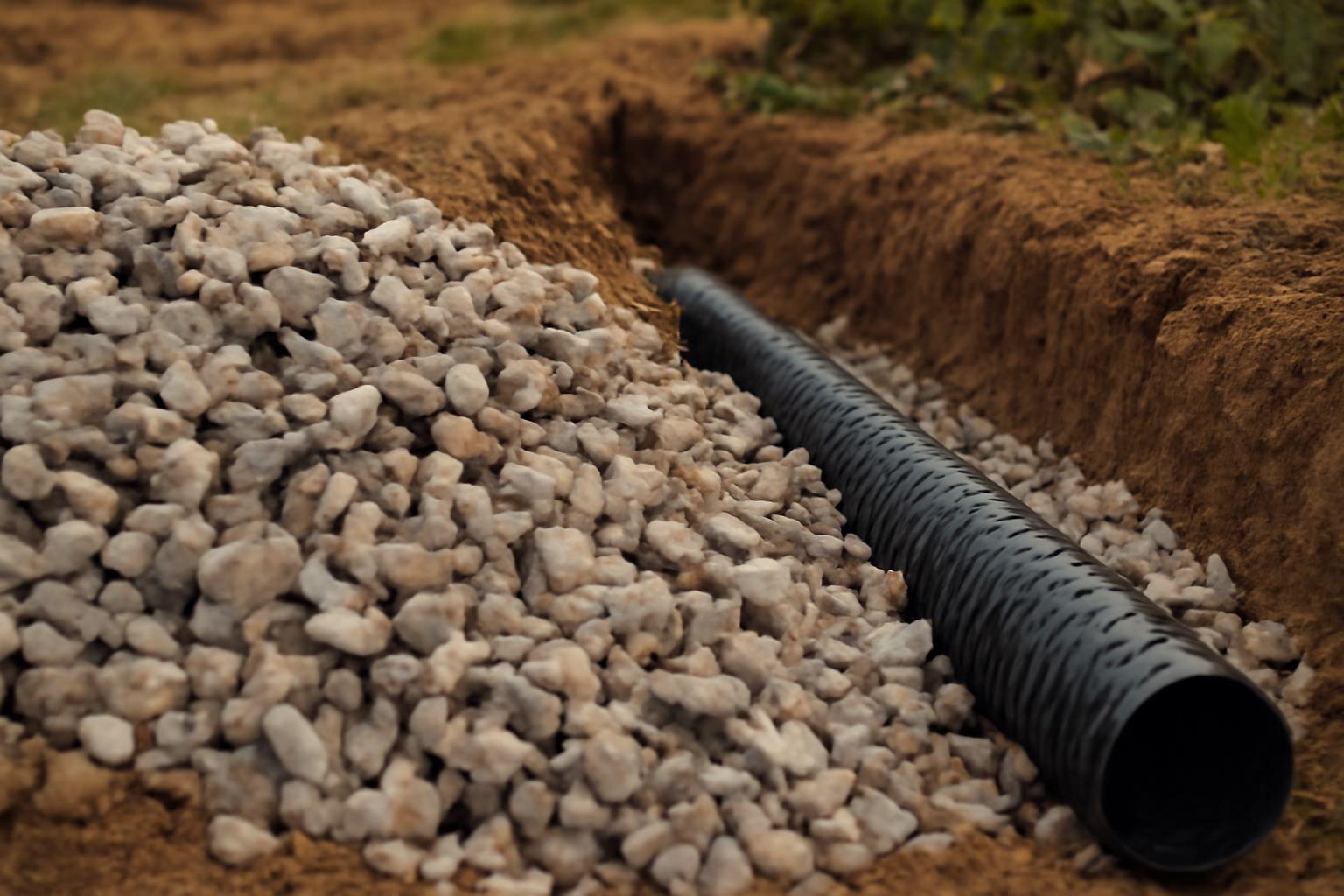
Purpose and cleanliness separate drain rock from regular gravel, not the label alone. See what makes it suitable for a drainage job.
If you are dealing with yard flooding, soggy planting beds near the foundation, or a planned French drain, you will probably hear the term drain rock very early. The problem is that it is not a tightly standardized retail label. In one market, drain rock may mean washed, rounded river stone. In another, it may mean a more uniform crushed or screened aggregate sold specifically for trench drainage.
For homeowners, the practical definition is simpler. Drain rock is clean, coarse stone used where water needs to move through the material instead of getting trapped in compacted soil or fine gravel. That usually means stone with relatively low fines, enough size to leave open spaces between pieces, and a shape that fits the job.
In many residential projects, the most discussed size band is roughly 3/4 inch to 1 1/2 inches. That range shows up again and again in French drains, wall backfill, footing drains, swales, and some septic-related applications. But size is only part of the decision. Shape, cleanliness, and local requirements matter just as much.
What Is Drain Rock?
Drain rock is coarse stone or gravel sold for drainage work where water needs a clear path through the aggregate instead of pooling in soil. A representative retail example is a washed, naturally rounded river rock sold in the 3/4-inch to 1 1/2-inch range for both drainage systems and decorative landscape use. (Portland Rock drain rock listing)
That overlap between functional drainage stone and landscape stone is why the term can feel slippery. One yard may stock rounded river rock under the drain-rock label. Another may stock washed gravel backfill or a uniform crushed stone product. Both can be used for drainage if the material stays open enough for water to move through it.
What usually separates drain rock from “regular gravel” is not the name alone but the purpose and cleanliness of the material. Gravel sold for a driveway base or a “minus” product often includes fines that help it compact.
That is the key idea homeowners should remember: drain rock is meant to create water pathways, not a tightly packed base. Whether the pieces are rounded or angular, the material works because it leaves space for water movement.
In home projects, that makes drain rock common in French drains, footing and foundation drains, retaining wall backfill, dry wells, swales, dry creek beds, and some septic systems. It can be completely buried and purely functional, or it can stay exposed at the surface and do part of the visual work in the landscape too.
Common Sizes and Specifications of Drain Rock
There is no single national size called “drain rock.” Suppliers sell material from 1/4 inch up to 6 inches, but for ordinary residential drainage, the most common options cluster around 3/4 inch and 1 1/2 inches. One supplier that lists a wide size spread describes 3/4-inch drain rock as the most common residential choice and an industry-standard size for French drains. (North Bay Materials drain rock sizes)
For a homeowner, that broad market reality usually turns into a few practical guidelines:
- About 3/4 inch is a common starting point for French drains and yard drainage trenches.
- About 7/8 inch to 1 1/2 inches is also common where a somewhat more open drainage layer is wanted.
- About 1 1/2 inches to 2 inches may show up in heavier drainage layers, some wall backfill zones, and some septic-related work if the design allows it.
- Smaller gravel can still drain, but it is more likely to migrate, pack tighter, or hold sediment if fines are present.
- Very large rock creates bigger voids but can be clumsy around smaller residential pipe and harder to finish neatly in a narrow trench.
Some products are sold under actual gradation standards, not just a plain-English size label. Washington Rock, for example, states that its 7/8-inch drain rock meets AASHTO #57 and WSDOT gravel backfill for drains requirements, including only 0% to 2% passing the #200 sieve. That matters because the specification tells you more than the marketing name: it gives you a clue about uniformity and how much fine material is mixed into the load. (Washington Rock drain rock specifications)
For most DIY yard drainage, you do not need a highway-style spec sheet. But if the project is near a foundation, under a slab, behind a retaining wall, or tied to a permitted plan, it is smart to ask the yard for the gradation or the actual size range rather than relying on “drain rock” as a generic description.
You will also see products described as washed or unwashed. Washed stone arrives with less dust and loose sediment, which reduces the amount of fine material entering the system at installation. Unwashed products can still be sold for drainage use, but they may look dirtier and may need rinsing after placement; Pacific Topsoils, for example, describes its approximately 1 1/2-inch drain rock as unwashed and recommends spraying it with water for a cleaner finish. (Pacific Topsoils drain rock description)
A simple buying rule if you are unsure: ask for clean or washed drain rock with low fines, then confirm the actual size range before the truck leaves the yard. Two materials that sound similar over the phone can behave differently once they are in your trench.
Another useful question is whether the rock is being sold primarily as a drainage aggregate or as a decorative river rock that also happens to drain. The first question helps you understand performance. The second helps you avoid paying for a prettier stone when what you really need is a buried working layer.
Rounded vs. Angular Drain Rock: Key Differences
The rounded-versus-angular question matters because it affects both how the stone behaves and how it looks once installed.
Rounded rock, often sold as river rock, has smooth edges and a softer appearance. Angular crushed stone has broken faces and sharper edges, so it tends to lock together better. (Pantano’s river rock vs. crushed stone comparison)
That does not mean rounded rock is wrong for drainage. Both rounded and angular material can let water pass. The difference is usually in the tradeoff between appearance and stability.
Use rounded rock when:
- the drainage feature is visible and appearance matters,
- flow is moderate rather than highly concentrated,
- the installation is wide and shallow, like a dry creek bed or decorative swale,
- you want a natural streambed look.
Use angular rock when:
- the stone is filling a trench around perforated pipe,
- the material needs to stay put on a slope,
- the backfill is behind a retaining wall,
- the drainage path may see stronger or more focused flow.
A common approach is to place the more functional drainage stone below grade, then finish the top with rounded or decorative rock where the surface will remain visible. That split approach makes sense because the buried layer does the hydraulic work while the surface layer does some of the aesthetic work.
The main caution is not to let appearance override function in a narrow trench. In a French drain, pipe surround stability and separation from surrounding soil usually matter more than whether the top of the trench looks like a streambed.
Primary Residential Applications for Drain Rock
The best-known residential use is the French drain. In that system, drain rock surrounds a perforated pipe in a sloped trench. The rock creates open space for water to enter and move toward the pipe, while the pipe carries the water away from a wet area, foundation edge, or low point in the yard.
Drain rock is also widely used behind retaining walls, under slabs where permeability is wanted, in capillary-break layers, and as pipe bedding. Washington Rock specifically lists uses such as drainage behind walls, under concrete slabs, and pipe bedding, which matches how contractors and homeowners commonly use clean, open aggregate near structures. (Washington Rock drain rock applications)
Other common residential applications include:
- Footing and foundation drains: to move water away from the structure and reduce chronically wet soil near the home.
- Dry wells and infiltration pits: to create temporary storage and encourage dispersal into suitable surrounding soil.
- Swales and dry creek beds: to guide runoff while reducing erosion and mud.
- Pipe bedding: to support and protect drain pipe while still letting water move around it.
- Septic drain fields: to create a free-draining aggregate layer around distribution lines when the approved design calls for rock.
These uses sound similar, but they do not all want exactly the same material. A visible dry creek bed may favor rounded stone and a more natural mix of sizes at the surface. A French drain usually favors a cleaner, more uniform pipe surround. A retaining wall backfill zone typically values stability as much as drainage. A septic field may require a specific aggregate size or type written into the design or local rules.
That is why the better question is not “What is the best drain rock?” It is “What is the rock doing in this system?” Once that answer is clear, the size and shape choice usually gets easier.
There is also a practical difference between intercepting water and displaying water movement. A buried French drain or footing drain is meant to catch and relocate water with minimal visibility. A swale or dry creek bed is partly a landscape feature, so the top course may be chosen with looks in mind. The same yard can need both types of thinking.
If the water problem is inside the home rather than in the yard, an interior basement French drain works differently from an exterior trench and is usually paired with wall drainage and a sump.
How to Install Drain Rock in a French Drain
A DIY French drain is still a real drainage system, not just a trench full of stone. The job is to collect water, give it a low-resistance path, and move it to a place where it can either safely infiltrate or safely discharge.
Before you dig, decide whether the system is supposed to infiltrate water into the ground, convey it to daylight or another outlet, or do a bit of both. Soil changes that answer. A simple percolation check described by Darby Pit is to dig an 18-inch hole, fill it with water, and watch how quickly it drains; if it drains within a few hours, infiltration is more plausible, while slower-draining clay soils usually point toward a system that needs a dependable outlet instead of relying on soak-in-place performance. (Darby Pit drainage planning guide)
Before any excavation, call 811, check local zoning, code, and HOA rules where applicable, and plan an outlet that does not discharge onto a neighbor’s property or into a public drainage connection without permission. Those are not optional details; they are part of building a lawful and safe drainage path. (Lowe’s French drain installation guide)
For a small residential French drain, homeowner guidance commonly lands around 12 to 24 inches deep and 6 to 12 inches wide, with a 1% to 2% slope depending on the system and outlet conditions; 1% is about 1 inch of drop for every 10 feet. The important point is not to maximize slope blindly, but to keep it consistent and appropriate to the outlet so water keeps moving without creating a new problem at the discharge point. (Darby Pit drainage guide, Lowe’s French drain installation guide)
A typical installation sequence looks like this:
- Mark the route and the outlet. If you are intercepting runoff, place the drain on the high-water side of the problem area rather than simply through the middle of the puddle.
- Excavate the trench to the planned depth and slope.
- Line the trench with filter fabric if you are building a conventional conveyance-style French drain.
- Add coarse drainage gravel as bedding.
- Set the perforated pipe.
- Cover the pipe with more drain rock.
- Fold the fabric over the top if you are building a wrapped trench.
- Finish the surface with soil and sod, a decorative rock cap, or another appropriate cover.
For the rock itself, a common retail installation method is to place about 3 inches of coarse drainage gravel in the trench as bedding, set the perforated pipe with the holes facing down, then cover it with roughly 3 to 5 inches of gravel before closing the fabric and finishing the trench.
A few practical choices matter as much as the trench dimensions:
- Keep the slope uniform. A dip can hold water and sediment.
- Do not mix in base gravel with fines. That defeats the reason for using drain rock.
- Match fabric use to the system. In many conventional French drains, fabric helps keep soil out of the rock. In some infiltration-focused designs, Darby Pit notes that full fabric use may be avoided because it can become a clog point over time. (Darby Pit drainage planning guide)
- Make sure the outlet is real. A rock-filled trench with nowhere lawful and workable to drain is not much of a drainage solution.
If the water issue is large, the route passes close to a foundation, the trench crosses utility-heavy ground, or the drainage path is tied to a retaining wall or septic area, the project can move out of DIY territory quickly.
Estimating Drain Rock Quantity for Your Project
The most reliable way to estimate drain rock is by volume.
Start with the trench dimensions in feet:
length × width × depth = cubic feet
Then convert cubic feet to cubic yards by dividing by 27.
For example, if a trench is:
- 50 feet long
- 1 foot wide
- 1 foot deep
then the raw trench volume is:
50 × 1 × 1 = 50 cubic feet
And:
50 ÷ 27 = 1.85 cubic yards
That is the cleanest way to plan a French drain because it is based on the space you are actually filling, not on a guess about how many wheelbarrows the project “looks like.” It also gives you a number you can hand directly to a landscape yard.
For a small residential drain, that math is why many DIY projects end up around 2 cubic yards once you account for bedding under the pipe, cover above it, slight overdigging, and a little waste; one DIY French-drain-and-dry-well project using 3/4-inch to 1-inch gravel reported using about 2 cubic yards total. (French Drain With Dry Well example)
If you prefer to buy by weight, treat supplier conversion numbers as rough planning tools rather than exact science. North Bay Materials gives a planning estimate of roughly 90 to 110 square feet per ton at 2 inches of depth and also notes that buyers often order 5% to 10% extra for irregularities and waste, but that kind of coverage guidance is much looser than trench-volume math. (North Bay Materials coverage guidance)
A good homeowner workflow is:
- calculate the trench in cubic yards first,
- ask whether the supplier sells by yard or ton,
- if sold by ton, ask the yard to convert based on that exact material,
- round up enough to cover minor overdigging and a little waste.
Septic projects are a different scale. One supplier guide uses a rough illustration of 50 to 100 cubic yards of rock for a 1,000-square-foot drain field, which is useful mainly as a reminder that septic aggregate quantities are far larger than backyard French drain quantities and must follow the approved design for the property. (Hello Gravel septic rock guide)
If your estimate comes out close to a round number, rounding up is usually cheaper than stopping the project to order a partial second load.
Drain Rock for Septic Drain Fields
Septic drain fields are where “close enough” aggregate choices can become expensive mistakes.
In ordinary yard drainage, homeowners have some flexibility. One septic-aggregate guide describes septic rock as washed crushed stone such as granite, basalt, or limestone, typically in the 3/4-inch to 2-inch range, with example layering of 1.5- to 2-inch stone at the bottom, 3/4- to 1-inch stone in the middle, and about 1/2-inch stone near the top, plus filter fabric between the rock and soil to limit fines migration. The important part is not to treat that as a universal recipe, but as an example of how specific septic aggregate requirements can be. (Hello Gravel septic aggregate guidance)
Whether that exact layering applies to your property is another matter. Septic rules are highly local.
For homeowners, the safe rule is straightforward: do not assume landscape drain rock is automatically septic-approved. If the project involves a septic trench, leach field, replacement area, or repair, match the rock to the permitted design or the local health-department requirement.
Drain rock can also distract from the real issue in septic troubleshooting. If the soil over the field stays wet, the area smells bad, or the house has recurring slow drains and backups, that is no longer just a landscape-material question. It is a system-diagnosis question.
If you are trying to understand failure risk or budget for a serious problem, a drain field replacement cost guide is more relevant than another load of rock. DrainFinder’s planning page notes that sewage surfacing over a field or a field that no longer accepts effluent can create a health hazard and needs prompt professional attention.
In other words, drain rock matters in septic work, but it is only one piece of the system. Soil, slope, layout, distribution, and permitting usually matter just as much or more.
Maintenance and Longevity Tips
Most drain-rock failures start with contamination, not with the stone itself wearing out.
After major storms, walk the system and check for:
- sediment washing into the top of the trench,
- mulch or soil slumping onto exposed rock,
- leaves and debris collecting at inlets or catch points,
- settlement that creates a low spot over the drain,
- water still pooling where the system used to clear it.
That kind of light upkeep is much easier than digging out a trench that slowly turned into compacted mud.
Filter fabric deserves a more nuanced view than many quick DIY guides give it. In a conventional French drain, fabric often helps by separating soil from rock. But in some infiltration-oriented areas, Darby Pit notes that fabric may be avoided because it can clog over time, so the right choice depends on whether the main purpose of the system is to carry water away or to let water move into surrounding soil.
Weed control matters too. Manual removal early is usually easier than letting roots colonize the rock layer. In visible drainage features, accumulated organic matter is what slowly turns the top few inches into soil.
If performance drops off, do not assume that adding more rock will fix it. Pooling water, reduced flow after storms, or chronic wet soil above a septic area usually means the system needs cleaning, inspection, redesign, or a diagnosis of the problem upstream of the rock itself.
Choosing the right drain rock is mostly about matching size, shape, and cleanliness to the job. For many home projects, that means a clean aggregate in the 3/4-inch to 1 1/2-inch range installed with proper slope, separation from surrounding soil, and a realistic outlet. For tougher problems near structures or septic systems, the rock still matters, but the overall drainage design matters more.
What is the most common size of drain rock for a residential French drain?
For many residential French drains, 3/4-inch drain rock is the most common starting point. Depending on the supplier, you may also see 7/8-inch material or a 3/4-inch to 1-inch blend used for the same kind of work. Larger 1 1/2-inch stone is more common where a project wants a more open backfill layer or a visible rock finish in addition to drainage.
Is washed drain rock necessary, or can unwashed work?
Washed drain rock is usually the lower-risk choice because it starts with less dust and loose fine material. Unwashed stone can still work if it is otherwise coarse enough for the job, but it may look muddier at installation and may introduce more loose sediment into the trench. If you buy unwashed material, it is worth understanding that tradeoff and, where appropriate, rinsing the stone after placement.
Can river rock substitute for drain rock in drainage projects?
Sometimes, yes. Rounded river rock can work well in visible, lower-flow drainage features such as decorative swales and dry creek beds. In a narrow French drain or anywhere the stone needs to resist shifting under more concentrated flow, angular crushed stone is usually the more stable choice. A mixed approach is common: functional drain rock below grade, decorative river rock on top.
When should I call a professional instead of DIY with drain rock?
Call a professional when the drainage issue involves:
- water entering a basement or threatening the foundation,
- no clear legal or practical discharge point,
- excavation near buried utilities or structures,
- retaining walls or footing drains,
- septic trenches or drain-field symptoms,
- repeated flooding after a prior DIY fix.
Once the problem involves structure, code, or septic diagnosis, the rock becomes only one small part of the decision.
How does soil type affect drain rock choice?
Soil type affects the system design more than the rock itself. In sandy or well-draining soil, a rock-filled trench may be able to infiltrate some water into the ground. In clay soil, the same rock can still move water inside the trench, but the surrounding soil may not absorb it quickly enough, so the system usually needs better conveyance to a dependable outlet. Put simply, drain rock can improve the path water takes, but it cannot make slow soil drain quickly on its own.