
Is Standing Water on Your Driveway a Simple Grading Issue or a Hidden Plumbing Problem?
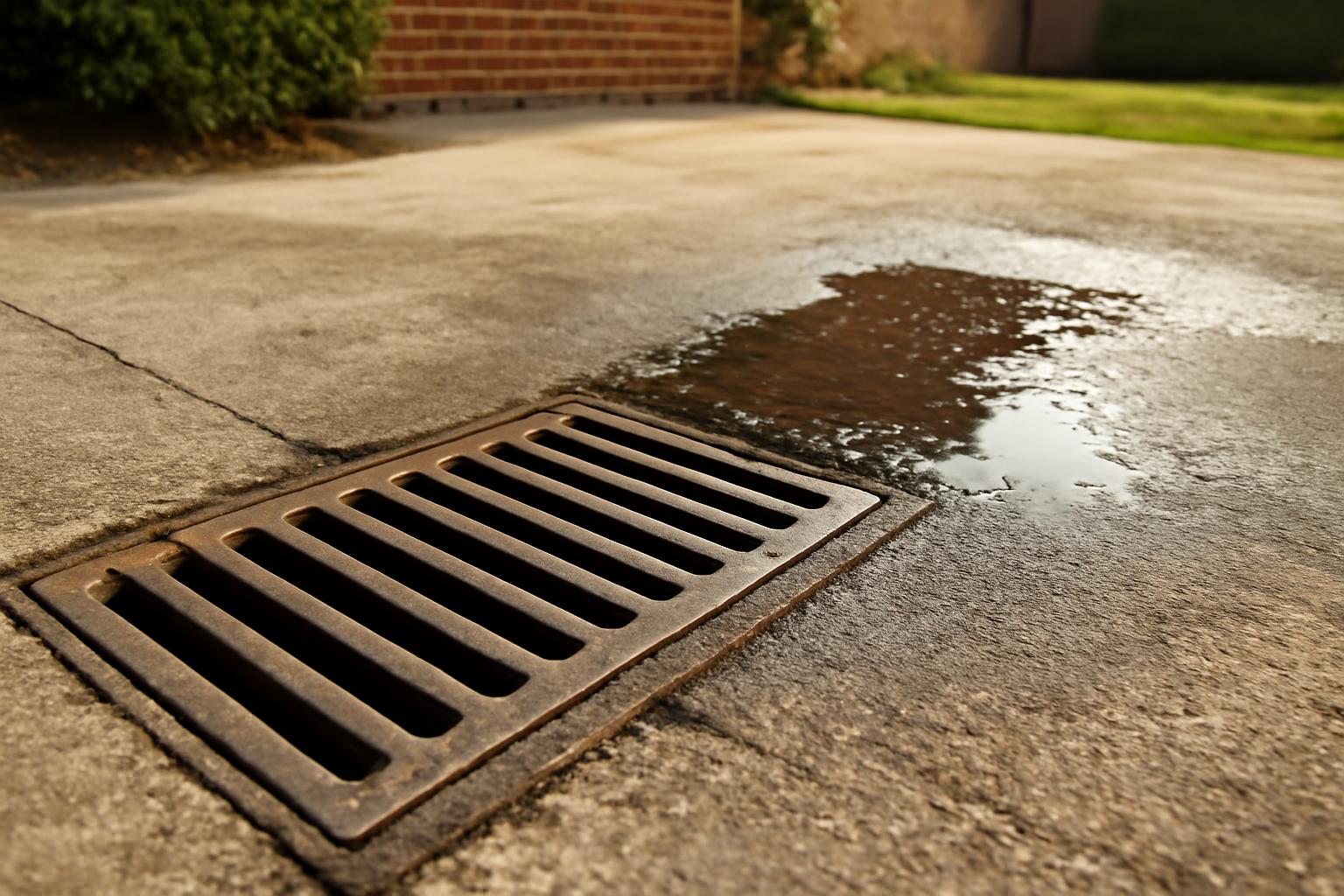
If wetness grows during rain, follows a visible path and recedes after, it points to surface drainage. Indoor drain trouble changes the diagnosis.
If you searched for a driveway drain, you may be thinking of a real surface-drainage system such as a channel or trench drain: a long, narrow drain installed flush with pavement to collect runoff on driveways and other hard surfaces, as This Old House explains in its overview of channel drains. But before you decide you need a new drain, a grading correction, or a plumber, you need to answer a simpler question first:
What is the water actually telling you?
Standing water near a driveway can be a plain outdoor drainage problem. Those are very different failures, and they do not call for the same first move.
The fastest way to sort them is not to start buying parts. It is to read the symptom pattern around the wet spot. Does the water show up only during rain or snowmelt? Does it move across the driveway in a visible path? Are indoor drains acting normal? Or is the driveway wetness showing up with multiple slow fixtures, toilet gurgling, sewer odor, or suspiciously wet ground near a septic area?
This guide is built for that first-pass diagnosis. It will help you tell the difference between a surface-water problem a driveway drain might solve and a plumbing or septic warning sign that needs professional attention.
Understanding Driveway Pooling: Surface Runoff vs Plumbing Symptoms
A useful starting point is to separate surface water behavior from drain-system behavior.
Surface runoff problems happen above grade. Water lands on the roof, driveway, street, or slope beside the pavement and then travels where gravity sends it. On a driveway, that often means visible sheet flow, a stream entering from one edge, a puddle at a low point, or concentrated roof runoff landing in the same place every storm. Where that pattern repeats, a true driveway drain may be part of the solution, especially when the flow path is obvious across a garage entrance, slope break, or other paved low point; trench-drain guidance commonly places them across those hard-surface runoff paths, not as a cure for plumbing failures underground (Trench Drain Co guide).
Plumbing-related wetness reads differently. The driveway may stay damp well after dry weather, show up in nearly the same spot regardless of rain, or arrive with indoor symptoms that surface drainage alone does not explain. Once the outdoor symptom lines up with whole-house drain behavior, the driveway stops being just a pavement problem.
That is why timing matters so much. Watch the area in two conditions: during active rain and again after the property has had time to dry. If the wetness grows while rain falls, follows a visible path, and then gradually recedes, you are still in surface-drainage territory.
Location helps too. A puddle at the bottom of a sloped driveway points you toward runoff concentration.
Color and smell can support the diagnosis, but they should not be the whole diagnosis. Muddy stormwater is still stormwater. Foul odor is a stronger warning sign, but odor alone does not identify the exact failure. The better approach is to pair what you see outside with what the house is doing inside.
So before you assume you need a new driveway drain, ask a more practical question: does the water behave like runoff on a hard surface, or like a symptom tied to the house drain system?
Symptom-First Diagnosis for Driveway Water Issues
The safest way to diagnose driveway water is to start with the symptom pattern, not the repair idea.
If you have a single puddle, no sewage odor, and no indoor drain problems, start with the outdoor side first. Look at the roofline, gutters, downspouts, pavement slope, driveway edges, and any low spot where water repeatedly settles. In that situation, the question is often not “Do I need a plumber?” but “Where is this runoff coming from, and would better surface drainage or a driveway drain intercept it?”
If the driveway wetness shows up with indoor drain trouble, the picture changes. DrainFinder’s symptom-first diagnosis overview says a single slow drain points to a nearby branch clog, while two or more slow fixtures at the same time point away from a branch and toward the main stack or sewer line; the same overview says gurgling and sewer odors are often vent obstructions or dry P-traps rather than simple clogs, and that DIY should stop if a snake meets resistance past 25 feet, sewage backs into a second fixture, or water appears near the foundation.
That framework matters because it keeps you from chasing the wrong system. If only one sink is slow, the driveway wetness may still be unrelated. If several fixtures slow down together and the toilet starts gulping air or making another fixture react, you are no longer dealing with a normal isolated clog pattern.
A sewage smell near the driveway when it has not rained also deserves caution. That does not automatically prove a main-line clog, and it does not rule out vent or trap issues elsewhere in the system. What it does mean is that the problem is no longer behaving like ordinary stormwater on pavement. When odor, unexplained wetness, and indoor symptoms overlap, surface-drainage troubleshooting is not enough.
A toilet that bubbles, gulps, or seems to pull air through the system during flushing is giving you system-level information, not just fixture-level annoyance.
Now look at the property layout. If the wet area is near a known septic field, downhill from it, or next to ground that stays bright green and damp longer than the rest of the yard, the driveway may simply be the low place where evidence collects.
A practical shortcut looks like this:
-
Rain-linked puddle, visible surface flow, no indoor symptoms: start with runoff, grading, gutters, or a surface-drainage solution.
-
Wet or greener ground near a septic area: add septic inspection to the first-call list.
That shortcut is not a final diagnosis. It is a way to choose the right first direction.
DIY Safe Checks and Thresholds for Driveway Pooling
There are several checks a homeowner can do safely before hiring help, as long as the goal is observation, not forcing a fix.
1. Test indoor fixtures one at a time
Run moderate water in the kitchen sink, bathroom sink, tub or shower, and flush each toilet. You are not trying to clear anything yet. You are trying to see whether the issue is isolated or shared.
- If only one fixture is slow, keep a local branch clog in mind.
- If several fixtures are slow, noisy, or begin affecting each other, stop thinking of the driveway as a separate outdoor mystery.
- If flushing one toilet makes another fixture gurgle, do not keep escalating DIY water use.
This check is especially useful because it gives you comparison, not just a single bad symptom.
2. Watch whether the puddle behaves like surface water
A driveway puddle tied to runoff often reveals itself through timing and movement.
Look for cues such as:
- It forms during rain or snowmelt.
- It gets larger when roof water is dumping nearby.
- It follows a visible path from the street, side yard, or upper slope.
- It begins only after gutters overflow.
- It shrinks steadily after the weather clears.
That pattern does not tell you the exact outdoor fix, but it does tell you to stay in the surface-drainage lane first.
3. Use a smell test from a distance
You do not need to touch the water. Just note whether the area smells like wet soil, leaf debris, stale standing water, or something clearly sewage-like.
A sewage-type odor changes the risk level. It does not tell you exactly whether the source is the main line, a vent-related problem elsewhere, or septic wastewater surfacing outside. It does tell you not to treat the situation like a simple puddle after a storm.
4. Inspect gutters and downspouts
This is one of the most practical driveway checks because concentrated roof runoff can mimic a driveway-drain failure.
Look for:
- Overflowing gutter edges during rain
- Downspouts that empty onto or immediately beside the driveway
- Missing or displaced splash blocks
- Algae, staining, or erosion where water repeatedly spills
- A puddle that forms directly under the same roof discharge point
If the indoor plumbing is acting normal and the wet area lines up with roof discharge, a driveway drain may be relevant later, but the first correction may be simpler runoff management.
5. Respect the stop signs
The stop signs for DIY are not subtle. DrainFinder says to stop if a snake meets resistance past 25 feet, sewage backs into a second fixture, or water appears near the foundation (DrainFinder).
At that point, experimentation becomes the expensive part.
6. Avoid the wrong tools for the wrong problem
Chemical drain cleaners and aggressive machine work are poor choices when you do not yet know whether the problem is local, main-line, or septic. DrainFinder says repeated use of sodium hydroxide and sulfuric-acid cleaners can degrade older PVC and rubber gaskets, that those products are poor choices for kitchen grease problems, that enzyme treatments can help as maintenance but not for active clogs, and that a standard 1/4-inch or 5/16-inch hand snake is generally safe on PVC while motorized snakes above 1/2 inch can crack thin-wall PVC fittings (DrainFinder).
The practical rule is simple: if the driveway wetness might be tied to the house drainage system, your job is to gather clues, not overpower the line.
When Driveway Wetness Signals Septic Drain Field Failure
The strongest clue is not the driveway by itself. It is the combination of driveway wetness with other field-style warning signs: slow fixtures, gurgling, sewage odors, wet or unusually green ground over the field, or surfacing wastewater. DrainFinder’s drain field cost guide says those are warning signs and notes that inspection may involve the tank, filters, pumps, controls, piping, the distribution box, and the field itself for surfacing or uneven drainage (DrainFinder drain field cost guide).
That matters because homeowners often jump too fast from “wet near the septic area” to “I need a whole new field.” Sometimes that is true. Sometimes it is not.
A septic system can malfunction for several reasons, including:
- a full or poorly maintained tank
- a clogged effluent filter
- a distribution-box issue
- a broken line
- a pump or control failure
- temporary hydraulic overload
- a genuinely failing soil absorption area
Those are very different failures, with very different price tags and very different urgency.
If a driveway or nearby pavement is collecting suspicious wetness, the key question is not “Is the driveway the problem?” but “Is the driveway simply the lowest visible point?”
That is why diagnosis has to come before replacement. If someone recommends a new field, ask what was checked first. Was the tank opened? Were filters inspected? Were pumps or controls evaluated? Was the distribution box checked? Is the problem widespread across the field, or does it look isolated to one line or component?
From a safety standpoint, the important point is straightforward: sewage surfacing over a field is a health hazard and needs prompt professional attention (DrainFinder drain field cost guide). Treat that as a same-day inspection issue, not a driveway-maintenance chore.
Main Line vs Branch Line: Driveway Ties to Indoor Symptoms
One slow indoor drain usually does not give you enough evidence to connect the problem to driveway wetness.
Branch-line clogs stay local. If the kitchen sink is slow but the bathroom sink, tub, and toilets act normal, the problem is probably near that sink. The same logic applies to a slow shower with no other symptoms.
A main-line problem is different because several fixtures begin sharing the same bottleneck. Water starts competing for a restricted path. One toilet flush may affect another fixture. A tub may slow down at the same time as a sink. Odor and gurgling may join in.
DrainFinder says 80% of kitchen clogs originate at or within 18 inches of the P-trap, which is why a single slow kitchen sink usually points to a localized branch problem rather than a property-wide drainage failure; the same source says a typical plumber drain visit runs about $150 to $400, while many simple DIY branch clears cost under $20 (DrainFinder).
That contrast is exactly why sorting branch symptoms from main-line symptoms matters. Overreact to a local clog, and you pay for an emergency that was never there. Underreact to a main-line warning, and you can turn a manageable restriction into a messy backup.
A working distinction looks like this.
Signs of a branch-line clog
- One sink, tub, or shower is slow
- Other fixtures work normally
- The problem feels tied to one room or one fixture
- There is no matching pattern of multi-fixture trouble indoors
Signs of a main-line issue
- Several fixtures slow down together
- Flushing one toilet affects another fixture
- Gurgling or sewer odor appears with broad drain trouble
- Outdoor wetness appears near the house, sewer route, or another low point at the same time
One nuance matters here: gurgling and sewer odors do not automatically mean “clog.” DrainFinder says those symptoms are often vent obstructions or dry P-traps rather than simple stoppages (DrainFinder). But when those symptoms arrive with multi-fixture drainage trouble and outdoor wetness, the case for system-level diagnosis becomes much stronger.
Planning for Septic Drain Field Replacement if Diagnosed
If professional inspection confirms that the drain field itself has failed, the next question is usually cost.
DrainFinder’s 2026 drain field cost guide gives a U.S. planning range of about $3,000 to $15,000 for the field alone and says soil, slope, access, field size, system type, local design rules, and restoration can push a project below or above that range; the same guide cites an older University of Missouri Extension benchmark of $2,000 to $8,000 as historical context, not current local pricing.
Those numbers are planning references, not bids. Septic work is highly site-sensitive, and driveway access can change the total more than many homeowners expect. If equipment must cross pavement or stage near the driveway, a quote may or may not include driveway repair, grading, or site restoration afterward (DrainFinder drain field cost guide).
That is why itemized proposals matter. When comparing bids, ask whether the price includes:
- design and permitting
- soil evaluation or testing
- excavation and hauling
- distribution components
- restoration of lawn or pavement edges
- final grading
- required inspections or approvals
Also ask what, exactly, the bid is solving. Is the contractor pricing a confirmed full field replacement? Or pricing the worst-case scenario while targeted repair options remain possible?
One helpful guardrail from the same guide: do not try to build your own septic total from scattered online line items, because permits, soil work, excavation, materials, electrical components, inspections, and restoration are bundled differently from one jurisdiction and contractor to another (DrainFinder drain field cost guide).
National ranges help set expectations. Local inspection and a defined scope decide the real number.
When to Stop DIY and Call a Professional
Some driveway water problems are worth a homeowner’s first look. Others are not.
Skip DIY and call a professional when driveway wetness comes with any of the following:
- multiple sinks, tubs, or toilets draining slowly at the same time
- backup into a tub, shower, or toilet
- sewage odor near the driveway, foundation, or house
- water surfacing near a known septic area
- wet or unusually green ground over or near the field
- toilet gurgling that matches the timing of outdoor wetness
- recurrence after you thought the issue had cleared
Also stop if your “simple check” starts turning into a sewer-line project. DrainFinder’s stop conditions are clear: resistance past 25 feet, sewage appearing in a second fixture, or water showing up near the foundation are all signs to stop and call a licensed plumber (DrainFinder).
For septic systems, the same principle applies even more strongly. Slow drains, odors, and wet ground are warning signs. Surfacing wastewater is a health-hazard situation, not a maintenance reminder (DrainFinder drain field cost guide).
As a rough household benchmark, DrainFinder says serious drain cleanings commonly fall on a 3-to-5-year interval in an average household (DrainFinder). That does not mean homeowners should wait that long to react to symptoms. It means recurring or system-wide problems are already past the “poke around and see” stage.
So use DIY for observation and simple elimination:
- Is a gutter overflowing?
- Is a downspout dumping beside the slab?
- Is only one fixture slow?
- Does the puddle appear only during storms?
Once the answers stop being simple, the response should too.
This kind of guide is general triage, not a substitute for an on-site evaluation. The same wet patch can mean different things on different properties depending on grade, soil, sewer routing, and septic layout.
Preventive Maintenance to Avoid Driveway Flooding
Prevention works best when you think about both sides of the problem: the hard surface outside and the drain system inside.
If repeated storms send sheet flow across the same paved path, a true driveway drain may eventually be the right surface-water fix. That distinction alone prevents a lot of wasted effort.
Watch the driveway during real storms
Once or twice a year, go outside during moderate rain and observe.
- Where does roof water land?
- Does water cross the driveway in a sheet?
- Does it pool at one low point?
- Does it enter from a side yard or street edge?
- Does the problem start immediately, or only after gutters overflow?
This kind of observation tells you more than guessing from a dry slab.
Keep gutters and downspouts clear
This is one of the lowest-cost prevention steps because concentrated roof runoff can overwhelm even a reasonably sloped driveway. Clean debris, correct loose joints, and make sure downspouts discharge where you actually want water to go.
Do periodic indoor drain checks
A simple yearly walkthrough of major fixtures helps you notice change early. You are not looking for perfection. You are looking for new slowness, new gurgling, or new fixture-to-fixture interaction before outdoor symptoms join the picture.
Use maintenance products only as maintenance
If you use enzyme products, treat them as slow maintenance, not emergency repair. DrainFinder says enzyme treatments can make sense as ongoing kitchen maintenance, but not for active clogs (DrainFinder).
Likewise, early grease buildup in a kitchen branch may respond to hot water and dish soap, while chemical drain cleaners are a poor choice for grease and can be hard on older PVC and rubber parts with repeated use (DrainFinder).
Match the tool to the risk
A small hand snake can make sense for a known, localized branch clog in PVC. DrainFinder says 1/4-inch and 5/16-inch hand snakes are generally safe on PVC, while motorized machines above 1/2 inch can crack thin-wall fittings (DrainFinder). That is why “I have a snake” is not the same thing as “this is safely DIY.”
Stay cautious around septic areas
If your property has a septic system, keep septic inspection in your long-term maintenance mindset. The field may be nowhere near the exact place where you first notice trouble, and surfacing problems can migrate to the nearest visible low area.
The big picture is simple: control concentrated runoff outside, notice drain behavior inside, and pay close attention when the two start lining up.
Does standing water on driveway always mean a sewer clog?
No. Standing water on a driveway can reflect surface runoff, a low spot, concentrated roof discharge, or a drainage-system problem.
Is driveway pooling a sign of septic drain field failure?
It can be, especially when the driveway sits near or downhill from the field and the wetness appears with slow fixtures, foul odor, wet or unusually green ground, or other signs of wastewater surfacing.
Can I DIY fix water pooling on my driveway?
Sometimes. If the problem is clearly tied to rain and the house drains normally, it is reasonable to inspect gutters, downspouts, runoff paths, and obvious low spots first. DIY should stop once the symptoms suggest a main-line or septic issue, especially if multiple fixtures are slow, toilets gurgle, sewage odor is present, or water is appearing near the foundation or septic area.
What costs to expect for septic drain field replacement?
Expect a wide range. DrainFinder’s 2026 planning guide puts the field-alone range at about $3,000 to $15,000, with soil, slope, access, field size, system type, local rules, and restoration affecting the final number; its older comparison benchmark is $2,000 to $8,000, but that is not current local pricing (DrainFinder drain field cost guide). For a real decision, rely on local inspection and itemized bids, and confirm whether driveway repair or restoration is included.