
Condoms Belong in the Trash, Not the Toilet
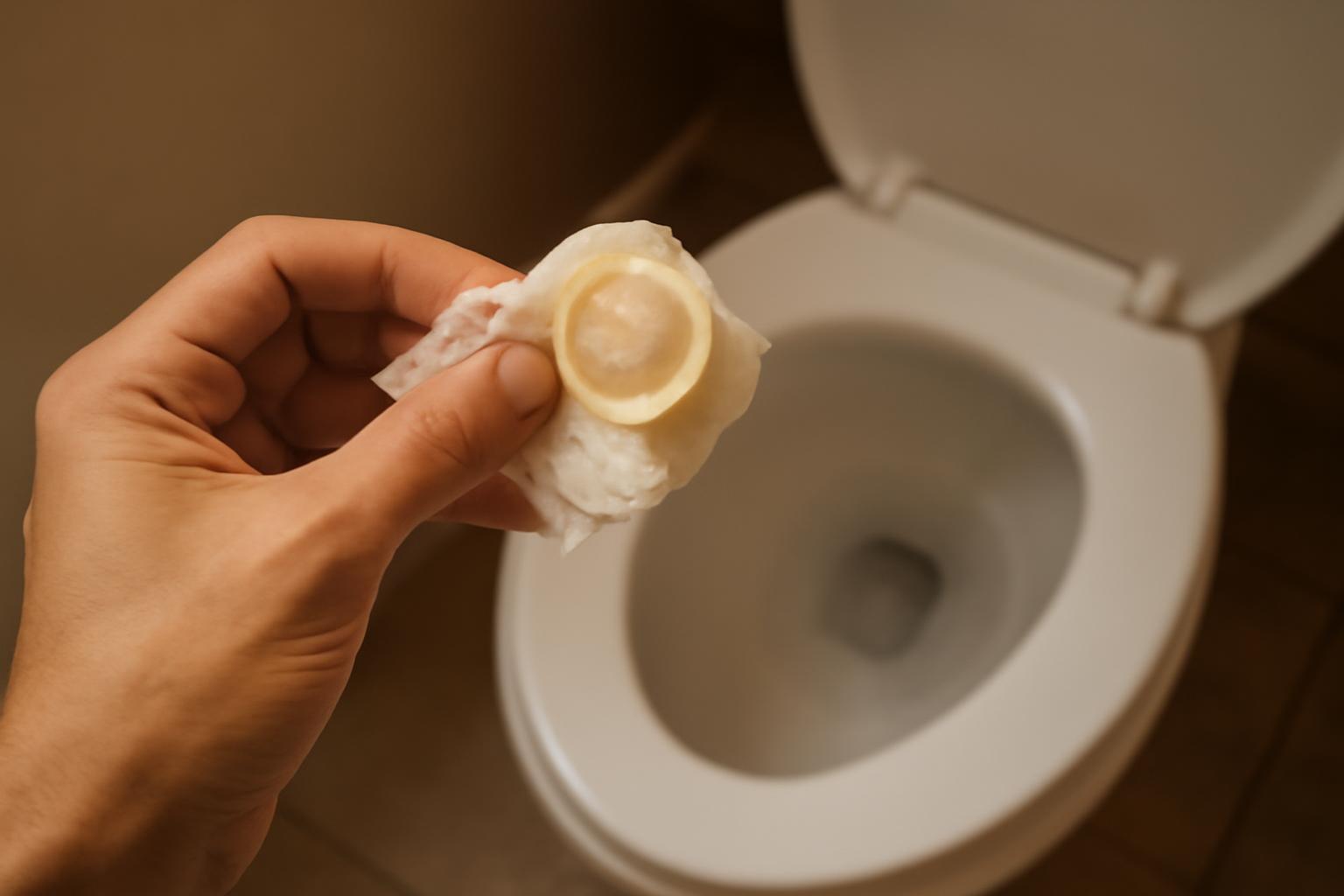
One accidental flush does not guarantee a clog. If drainage stays normal, monitor it. Slow flow, gurgling, odors or backups call for professional help.
The short answer: never flush a condom
No. Never flush a used condom down the toilet. Contain any fluid, wrap the condom in a small amount of tissue or paper, and place it in general household trash. The City of Santa Cruz recycling guide specifically warns that flushed condoms can clog plumbing and wastewater systems (Santa Cruz Recycles condom-disposal guidance).
Wash your hands after handling and disposing of the condom, as recommended in manufacturer disposal instructions (Durex used-condom disposal guide).
Quick disposal checklist
- Do not flush
- Wrap lightly
- Put it in general waste
- Wash your hands
The rule applies whether the toilet connects to a municipal sewer or a private septic system. Flushing does not dispose of the condom safely; it merely sends an intact object into household piping and possibly into equipment or infrastructure farther downstream.
The rule also applies to latex, polyurethane, polyisoprene, natural-latex, vegan, and products marketed as biodegradable. Those descriptions may refer to materials, ingredients, manufacturing choices, or behavior under particular disposal conditions. They do not mean that a condom will disperse like toilet paper inside a toilet or drain.
One accidental flush does not prove that an immediate blockage will occur. A condom may pass through the toilet without producing an obvious symptom, or it may lodge somewhere out of sight. Repeated flushing creates more opportunities for intact material to snag or accumulate. The no-flush rule is therefore based on an avoidable risk—not on a claim that every condom will instantly clog a toilet.
If a condom is still in the bowl, do not flush again simply to make it disappear. Dispose of it in the trash instead.
Why a condom does not behave like toilet paper
Toilet paper and condoms are designed to behave differently in water. Toilet paper is intended to lose structure and disperse as it travels through a functioning drainage system. A condom is designed to remain strong, flexible, and intact during use.
Common condom materials include latex, polyurethane, and polyisoprene. Despite their other differences, these materials do not behave like toilet paper in a drain. Commercial plumbing guidance identifies traps, pipe bends, and joints as places where an intact condom may lodge (Hoffmann Brothers plumbing guidance).
A toilet also does not connect to a perfectly straight, empty pipe. The fixture contains an internal trap, and the drainage path beyond it may include bends, joints, changes in direction, or existing restrictions. After being flushed, a condom might:
- Remain in the toilet trap.
- Catch at a bend, joint, rough area, or partial obstruction.
- Collect paper or other passing material after becoming snagged.
- Move out of the toilet and into a branch drain.
- Leave the household line and enter a municipal sewer or septic system.
These are possible paths, not a way to determine what happened in a particular home.
A successful flush proves only that the condom left the visible bowl. It does not prove that the item was appropriate to flush or that it cleared every part of the drainage system.
It would also be inaccurate to claim that every flushed condom reaches a river or ocean. Wastewater systems and treatment processes vary, and some material may be captured or removed. The narrower and better-supported conclusion is that flushed condoms can burden household plumbing and wastewater systems and may become litter if they escape containment.
Available evidence does not establish how often one flushed condom causes a blockage. The important distinction is between possible obstruction and certain obstruction:
- One flush may cause no noticeable plumbing symptom.
- One condom can still create or contribute to a restriction.
- Repeated flushing gives intact material more chances to snag or accumulate.
- Normal drainage immediately afterward does not reveal where the condom went.
Putting the condom in general waste avoids those uncertainties.
How to dispose of a used condom correctly
Correct disposal is straightforward and does not require special equipment or excessive wrapping.
- Remove it carefully. Hold the condom at its base during removal to reduce the chance of spilling its contents.
- Contain the fluid. Tie a knot if that is practical and helps prevent leakage. Tying is an optional containment measure, not a plumbing requirement.
- Wrap it lightly. Use a small amount of tissue, toilet paper, or other paper—only enough to contain minor leakage and make disposal discreet.
- Place it in general household trash. A lined or lidded bathroom bin can offer convenient, discreet disposal.
- Wash your hands.
An additional plastic bag is optional. It may be helpful if the condom is leaking, the available bin is unlined, or the wrapped condom must be carried elsewhere. Every condom does not need a separate plastic bag.
If no bin is nearby, keep the wrapped condom temporarily in a resealable bag or closed container. Transfer it to general household waste when a suitable bin becomes available. Do not leave it on the floor, beside a toilet, outdoors, or in an open public area.
A small bathroom waste bin can make the correct option readily available. For practical use, it may be:
- Within easy reach.
- Lined for simpler emptying.
- Fitted with a lid when discretion or odor control matters.
- Emptied before it overflows.
Packaging should be handled separately from the used condom. Do not assume an individual foil or film wrapper is recyclable. Put it in general waste unless the local recycling program explicitly accepts it.
Waste terminology differs by location, so “general waste,” “residual waste,” and “household trash” may describe the same disposal stream in different places. Follow local household-waste instructions where you live, but do not use the toilet as an alternative bin.
What to do if you already flushed a condom
Do not panic, and do not keep flushing in an attempt to force the condom farther through the pipe.
One accidental flush does not establish that a blockage will occur. It is also not possible to tell from the bowl whether the condom passed through the entire household line, lodged farther downstream, or entered a sewer or septic system.
If the toilet and nearby fixtures continue to drain normally, the supported response is cautious observation rather than assuming either certain damage or guaranteed safety. Advice in one case-specific discussion involving a symptom-free accidental flush into a septic system similarly favored monitoring rather than immediate inspection; that individual response should not be treated as a universal guarantee (case-specific plumbing discussion).
During subsequent use, watch for:
- Slower-than-usual toilet drainage.
- Water rising unusually high in the bowl.
- A weak or incomplete flush.
- A clog that clears and then returns.
- New gurgling from the toilet or nearby fixtures.
- Persistent sewage or drain odors.
- Water backing up into another fixture.
- Several fixtures beginning to drain poorly.
These symptoms do not prove where the condom is or even that it caused the problem.
If the toilet shows the symptoms of a simple clog, a toilet-appropriate flange plunger is a commonly recommended first tool. If plunging does not restore normal drainage, the clog returns, or other fixtures become affected, contact a plumber rather than continuing repeated attempts.
Do not treat a toilet auger as guaranteed condom retrieval.
Likewise, do not experiment with chemical drain cleaner, boiling water, soap mixtures, enzymes, or similar attempts to dissolve the condom. The available evidence does not establish that these methods safely break down condom materials.
If the bowl is already near overflowing, do not flush again. Arrange professional help if you cannot restore drainage with a straightforward plunging attempt or are unsure whether further use could cause a backup.
Warning signs that the drain needs professional attention
After an accidental flush, focus on how the drainage system behaves rather than trying to guess the condom’s location.
| Warning sign | What it may indicate | Practical response |
|---|---|---|
| Persistent slow drainage | A restriction in the toilet or farther downstream | Stop repeated test flushes and seek help if normal flow does not return |
| Water rising unusually high | The toilet is not draining at its usual rate | Do not flush again while the bowl remains high |
| Recurring clogs | An obstruction may have shifted rather than cleared, or another drain problem may be present | Contact a plumber if the clog keeps returning |
| New gurgling | Drainage or airflow through the system has changed | Pay particular attention if gurgling accompanies slow drainage or affects another fixture |
| Persistent sewage or drain odors | A drainage, trap, vent, sewer, or septic problem may be present | Seek diagnosis if the odor persists or appears with other symptoms |
| Backup into another fixture | The problem may extend beyond the toilet itself | Stop repeated use of the affected plumbing and contact a professional |
| Several slow or affected fixtures | A broader branch, main-line, or septic-system problem may exist | Arrange professional assessment rather than treating it as a simple toilet clog |
For a sewer-connected home, contact a plumber. For a septic-connected property, contact a plumber or an appropriate septic professional when the symptoms appear to involve septic piping, the tank, or broader system performance.
Persistent changes matter more than speculation. Even if the condom appears to have passed through the toilet, recurring clogs, rising water, odors, gurgling, or backups show that the drainage system is not operating normally. Conversely, a symptom that appears after the incident is not automatic proof that the condom caused it; pre-existing buildup or another fault may be responsible.
Why septic systems follow the same no-flush rule
A toilet connected to a septic system is not an exception. Condoms should never be flushed into a septic tank.
The underlying problem remains the same: a condom stays substantially intact rather than dispersing like toilet paper. It may catch in the toilet, household drainage, septic piping, or another part of the system. Reaching the septic tank would not make flushing it appropriate.
Commercial septic guidance specifically identifies condoms as items that should not be flushed because they may clog septic-system pipes, particularly when flushing is repeated (Fuller-Wente septic disposal guidance).
The preventive rule is simple:
- Human waste and toilet paper go in the toilet.
- Condoms and other solid household waste go in the trash.
After one accidental flush with no apparent symptoms, observe the toilet and connected fixtures rather than declaring either certain damage or guaranteed safety. Septic design, use, maintenance history, and site conditions vary.
Contact an appropriate professional if you notice:
- Persistent slow drainage.
- Recurring toilet clogs.
- New gurgling.
- Sewage or drain odors.
- Indoor wastewater backup.
- Several fixtures draining poorly.
- Any other continuing change in septic-system performance.
A septic professional can evaluate the actual system. A homeowner cannot reliably determine from the toilet whether the condom remained in household piping, reached the tank, or contributed to a later problem.
Biodegradable labels, recycling, compost, and other disposal myths
Terms such as biodegradable, vegan, natural latex, lambskin, and eco-oriented do not mean “flushable.”
Flushability in this context depends on how an item behaves during its trip through the toilet and drainage system. A claim that a material can degrade under certain environmental, industrial, or controlled conditions does not establish that a finished condom will disperse like toilet paper inside household plumbing.
“It says biodegradable, so the toilet is fine.” No. Disposal guidance addressing biodegradable products still tells users not to flush them (condom-disposal guidance). The condom should be lightly wrapped and placed in general waste.
“Natural latex will dissolve in the bowl.” No. “Natural” describes an aspect of the material; it does not mean the product will lose its structure during a toilet flush.
“Vegan means it is safe for a septic system.” No. It does not show that a product will disperse in septic piping.
“A non-latex condom will flush better.” No. Polyurethane, polyisoprene, and other non-latex products also belong in general household waste. Changing materials does not change the disposal route.
“Used condoms can go in household recycling.” No. Used condoms are not suitable for an ordinary household recycling bin. Place them in general waste.
“A natural product can go in home compost.” Do not place used condoms in home compost. Guidance covering different condom types directs users to garbage rather than recycling or composting (used-condom disposal instructions).
“The wrapper is automatically recyclable.” Do not assume that foil or film wrappers are accepted by the local recycling program. Put them in general waste unless local rules specifically say otherwise. Clean cardboard outer packaging may be recyclable where accepted.
“Leaving it outside is more natural than sending it to landfill.” No. Do not leave condoms in streets, parks, beaches, storm drains, waterways, or other outdoor areas. General household waste is the practical disposal route.
Flushed condoms may burden wastewater systems or become litter, but their final destination varies with local infrastructure and treatment processes. It is not accurate to say that every flushed condom reaches open water. It is sufficient to recognize that a toilet is not an appropriate disposal point for an intact personal product.
Will one flushed condom definitely clog the toilet?
No. One flushed condom will not necessarily cause an immediate or obvious clog. It may pass through the toilet, stop farther downstream, or produce no noticeable household symptom.
That uncertainty does not make flushing acceptable. Do not flush another condom or repeatedly flush to force the first one along. If drainage remains normal, watch for changes. If slow drainage, rising bowl water, recurring clogs, gurgling, odors, or backups develop, contact a plumber or septic professional.
Should I use a plunger after accidentally flushing a condom?
Use a toilet-appropriate flange plunger only if the toilet is showing signs of a simple clog, such as slow emptying or water rising before draining poorly.
If proper plunging does not restore normal flow, the clog returns, or another fixture develops symptoms, contact a plumber.
Can biodegradable, vegan, or natural-latex condoms be flushed?
No. Those labels do not establish that the condom will disperse like toilet paper in a drainage system.
Regardless of its material or marketing description, lightly wrap the used condom and place it in general household trash.
Can condoms be flushed into a septic tank?
No. Condoms belong in the trash even when the toilet connects to a septic system. An intact condom may catch in household or septic piping, and repeated flushing can contribute to buildup or obstruction.
After one symptom-free accidental flush, monitor system performance without assuming either damage or safety. Contact a septic professional if persistent slow drainage, recurring clogs, gurgling, odors, backups, or other changes appear.
Can used condoms be recycled or composted?
No. Do not place used condoms in household recycling or home compost. Lightly wrap them and put them in general waste.
Handle packaging separately. Put an individual foil or film wrapper in general waste unless the local program explicitly accepts it. Clean cardboard outer packaging may be recyclable under local rules.
The household rule is simple: condoms go in general waste, never the toilet. Contain the fluid, tie the condom if useful, wrap it in a small amount of tissue, bin it, and wash your hands.
One accidental flush is not proof of a clog. If drainage remains normal, monitor it without repeatedly flushing. If slow drainage, rising water, recurring clogs, gurgling, sewage odors, or backups appear, seek help from a plumber or septic professional.