
How to Identify the Threads on Your Home’s Water Meter
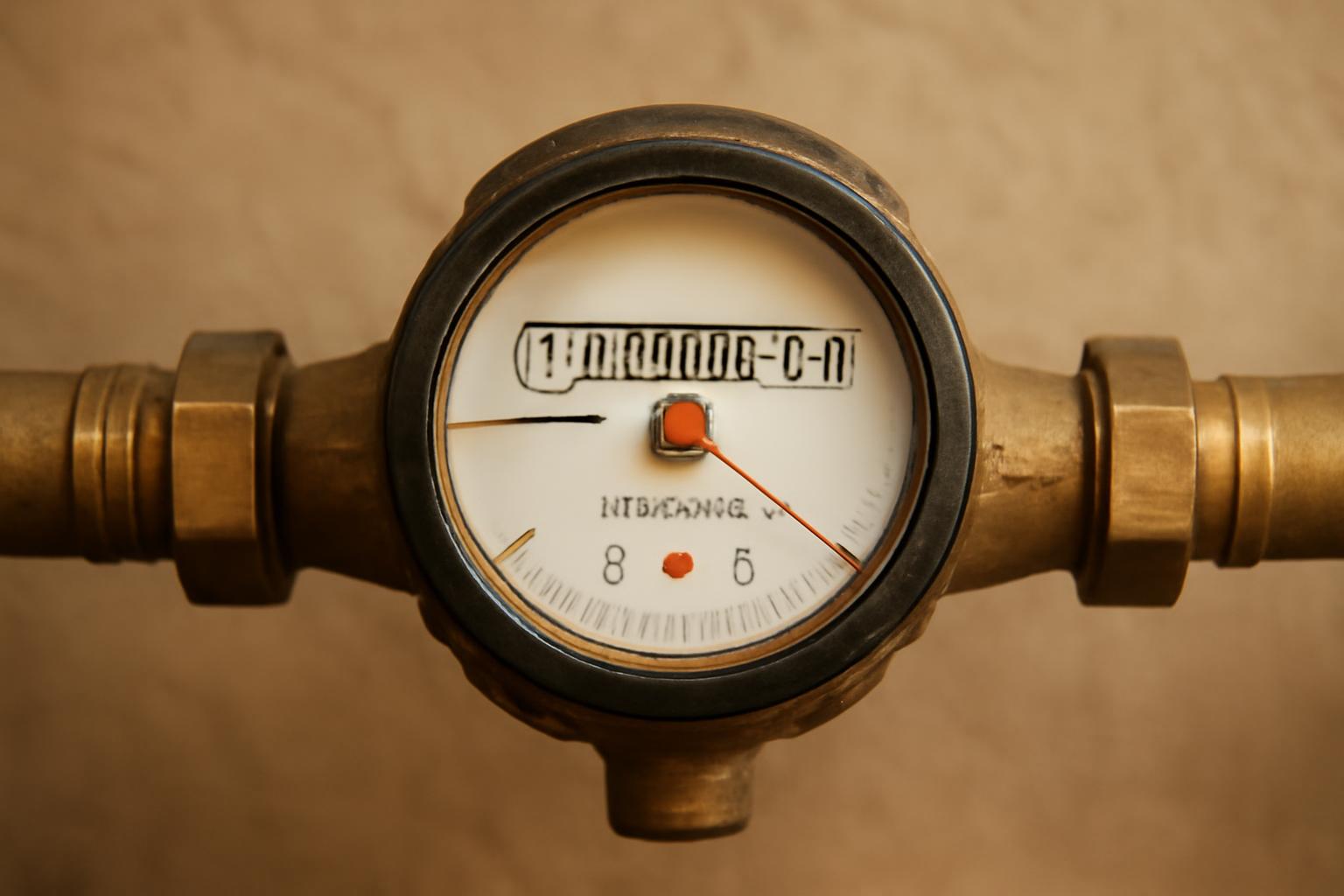
A nominal 3/4-inch AWWA-style connection may measure about 1.39 inches across the male thread crests, so nominal and caliper sizes are not interchangeable.
A house water meter does not have one universal thread size. In a common U.S. installation, the meter has straight male spuds that connect to swivel couplings and seal with gaskets. The service pipe may connect to the opposite end of each coupling through a different thread, often tapered NPT.
That creates several labels for what may look like one connection: meter size, full meter configuration, nominal AWWA-style connection, measured spud diameter, supplier-described NPSM swivel-nut designation, and pipe-side NPT size. These values are related, but they are not interchangeable.
Before ordering anything, identify the complete meter model and configuration, measure the male spud with calipers, determine whether the thread is parallel or tapered, and confirm the coupling and gasket with the utility or manufacturer.
The short answer: common house water-meter thread sizes
There is no single standard thread size for every house. Common U.S. residential configurations include:
- 5/8 × 1/2 meter: commonly a nominal 1/2-inch AWWA-style connection, with a male-spud outside diameter of approximately 1.04 inches.
- 5/8 × 3/4 meter: commonly a nominal 3/4-inch AWWA-style connection, with a male-spud outside diameter of approximately 1.39 inches.
- Standard or short 3/4-inch meter: commonly a nominal 3/4-inch AWWA-style connection, also measuring approximately 1.39 inches across the male spud.
- 1-inch meter: commonly a nominal 1-inch AWWA-style connection, with a male-spud outside diameter of approximately 1.65 inches.
These are approximate field-identification values, not manufacturing tolerances or substitutes for a model-specific drawing. Utility Technologies lists these common U.S. configurations and approximate outside diameters.
The nominal connection name is not the diameter you will see on your calipers. For example, a nominal 3/4-inch AWWA-style connection may measure about 1.39 inches across the male thread crests. That does not make it a “1.39-inch fitting.”
Do not order from the size stamped on the meter body alone. A body marked 5/8 inch could be part of either a 5/8 × 1/2 or a 5/8 × 3/4 configuration, which use different meter connections.
U.S. residential water-meter connection chart
The chart below separates the dimensions and labels most likely to be confused. It is a field-identification aid based on supplier and manufacturer terminology—not a formal standards crosswalk and not proof that a coupling fits a particular meter.
| Full meter configuration | Nominal AWWA-style connection | Approximate male-spud outside diameter | Supplier-described matching swivel-nut designation | Sealing method |
|---|---|---|---|---|
| 5/8 × 1/2 | 1/2 inch | About 1.04 inches | 3/4-inch NPSM | Compressed meter gasket |
| 5/8 × 3/4 | 3/4 inch | About 1.39 inches | 1-inch NPSM | Compressed meter gasket |
| Standard or short 3/4 inch | 3/4 inch | About 1.39 inches | 1-inch NPSM | Compressed meter gasket |
| 1 inch | 1 inch | About 1.65 inches | 1-1/4-inch NPSM | Compressed meter gasket |
The approximate outside diameters and gasket-sealing method come from a commercial U.S. meter-sizing reference. Treat them as identification clues and verify them against the installed meter’s drawing or utility specification before purchasing. See the underlying sizing and connection chart.
The final sizing column reflects terminology used in supplier and manufacturer materials for matching swivel nuts. For example, a nominal 3/4-inch AWWA-style connection may be paired with a swivel nut described as 1-inch NPSM, while a nominal 1/2-inch AWWA-style connection may be paired with one described as 3/4-inch NPSM. These are different sizing vocabularies, not identical nominal-size labels. Uponor’s municipal-meter chart lists the corresponding coupling-nut and spud terminology.
Because the available evidence is supplier and manufacturer guidance rather than a model-specific dimensional drawing for your meter, do not use the NPSM column as a universal compatibility guarantee. Confirm the male spud, swivel nut, gasket, and mating faces as one assembly.
Descriptions such as “close to” a particular iron-pipe size are only rough visual comparisons. They vary among references and are less useful for purchasing than caliper measurements checked against documentation.
Lay length—the face-to-face length of the meter without the coupling tailpieces—can provide a secondary clue. Commonly cited lengths are 7.5 inches for 5/8 × 1/2, 5/8 × 3/4, and short 3/4-inch meters, while a full-size 3/4-inch meter is commonly listed at 9 inches. Several configurations share the same lay length, so it cannot identify the connection by itself. A.Y. McDonald’s comparison shows the overlap among these common configurations.
Thread pitch is intentionally absent from the chart. Pitch can help confirm a thread when measured correctly, but it should come from reliable comparison data or a drawing for the specific meter—not from an assumed nominal-size equivalence.
Why a 5/8-inch meter may not have a 5/8-inch connection
The phrase “meter size” is often used for several different things. Keep these five concepts separate:
- Meter flow-capacity designation: The size used to classify the meter’s measuring configuration.
- Full meter configuration: A label such as 5/8 × 1/2 or 5/8 × 3/4.
- Meter-side thread: The straight male spud on the meter.
- Coupling-nut designation: The size and standard used to describe the female swivel nut that engages the spud.
- Service-pipe size: The nominal size of the piping before or after the meter.
A body marked 5/8 inch does not necessarily have a 5/8-inch physical thread. The marking may identify the meter’s internal or flow-capacity configuration. Depending on the complete assembly, that body could have the smaller connection used for a 5/8 × 1/2 meter or the larger connection used for a 5/8 × 3/4 meter.
In the notation 5/8 × 3/4, the two values are not the numerator and denominator of a thread measurement. The first identifies the meter’s 5/8-inch flow-capacity configuration; the second identifies the larger connection configuration.
For example, if a meter is visibly marked 5/8 inch but its male spud measures close to the approximate value associated with a 5/8 × 3/4 meter, investigate that complete configuration. Do not buy a coupling labeled 5/8 inch merely because that is the largest visible number on the body or register.
The service line is a separate clue. A house may have a nominal 3/4-inch service line while the coupling transitions between that pipe and a meter connection carrying a different nominal label. A 3/4-inch service pipe does not prove that the meter spud is 3/4-inch NPT—or that every component in the assembly has a 3/4-inch designation.
Use these details together:
- Complete size designation
- Manufacturer and model number
- Male-spud outside diameter
- Existing coupling markings
- Meter lay length
- Service-pipe size and material
- Manufacturer or utility documentation
No single clue should override an obvious conflict among the others. If the model information and measurements disagree, resolve the discrepancy instead of selecting the nearest-looking fitting.
Meter-side threads versus pipe-side NPT
Common small U.S. meter spuds use straight, parallel threads. Ordinary NPT pipe threads are tapered. The two connections work differently and should not be treated as substitutes.
The meter connection is essentially a union:
- A gasket sits between the meter’s end face and the coupling or tailpiece face.
- A female swivel nut engages the male meter spud.
- Tightening the swivel nut draws the mating faces together.
- Compression of the gasket creates the seal.
The threads provide clamping action; they are not normally the sealing surface.
A coupling can therefore have different sizes and standards at opposite ends. One documented coupling intended for common 5/8 × 3/4 and full 3/4-inch U.S. meters has a 1-inch female NPSM swivel nut on the meter side and a 3/4-inch male NPT connection on the pipe side. DAE’s C-75 specification documents this arrangement.
That is why a product marketed as a “3/4-inch water-meter coupling” may have a larger meter-side swivel nut. The 3/4-inch description could refer to the pipe-side NPT connection, the intended meter configuration, or the supplier’s product category. Read the complete specification for both ends.
Connection diagram—not to scale:
                         METER SIDE                         PIPE SIDE

[ Meter body ]--[ Male meter spud ]--||--[ Female swivel nut ]--[ Union tailpiece ]--< Tapered NPT end >
                                      ||
                                   Gasket
                              (creates the seal)

Male meter spud: straight or parallel thread
Female swivel nut: draws the joint together
Gasket: compressed between mating faces
Union tailpiece: transitions away from the meter
Pipe end: may be tapered NPT and have a different nominal size
Do not force a female NPT fitting onto a straight meter spud merely because the diameters appear close. Partial engagement does not establish compatibility. Correct thread identification requires checking diameter, pitch, and tapered or parallel form against the applicable specification. General fitting guidance explains why these characteristics must be identified together.
How to measure and identify the connection
Use a process that identifies the entire assembly rather than chasing one nominal number.
1. Determine the country or regional standard
First establish where the meter and fittings were made or specified. The chart above is intended for common U.S. residential arrangements. It does not identify BSP, ISO, or metric connections.
If the manufacturer, utility, or meter label points outside the United States, do not begin by assuming NPT or a common U.S. meter coupling.
2. Record the complete meter label
Photograph the entire label and both ends of the meter before moving or cleaning anything. Record:
- Manufacturer
- Model or series
- Complete size notation
- Serial or identifying information
- Direction-of-flow arrow
- Thread, standard, or connection markings
- Utility tag or seal
A close-up showing only “5/8” may omit the model or second connection dimension needed to identify the assembly.
3. Note the existing union and service pipe
Inspect both meter couplings. Record any cast, stamped, or printed markings on each swivel nut and tailpiece. Identify the size and material of the adjoining service piping separately.
The existing union can be a useful reference even if it is too corroded or worn to reuse. Do not discard it before the replacement has been positively identified.
4. Measure the male spud with calipers
When the spud is safely accessible, measure the outside diameter across the thread crests. Take more than one reading, rotate the calipers, and avoid measuring over heavy scale or a visibly damaged thread.
Identification of a female fitting generally begins with its inside thread diameter. However, a measured swivel-nut opening is not proof that a new fitting uses the same thread standard.
Calipers are more useful than a tape or string. If string is the only option, wrap it around the thread to estimate circumference and calculate:
Approximate diameter = circumference ÷ 3.1416
The result is only a screening estimate. It is not precise enough for a confident coupling purchase when different standards or adjacent sizes have similar diameters.
5. Check whether the thread is parallel or tapered
Compare the thread diameter near the end with the diameter farther back:
- A parallel or straight thread remains substantially consistent in diameter.
- A tapered thread changes diameter along its threaded length.
This observation can eliminate incompatible possibilities, but it does not identify the complete standard by itself.
6. Check pitch when reliable tools and data are available
A thread-pitch gauge can help distinguish standards with similar diameters. Compare the reading with a manufacturer drawing or appropriate technical chart.
A ruler may provide a rough thread count, but short, dirty, damaged, or partly concealed threads are easy to misread. Do not infer pitch from the nominal meter size.
7. Remember that nominal size differs from measured diameter
This principle also applies to ordinary pipe threads. General pipe-fitting guidance lists nominal 3/4-inch NPT at approximately 1.050 inches OD and nominal 1-inch NPT at approximately 1.315 inches OD. Those values illustrate why a nominal name does not equal the caliper reading; they do not identify a meter spud as NPT. Hydraulics Direct explains male-OD, female-ID, pitch, and thread-form measurements.
8. Compare all findings with documentation
A sound identification should agree across:
- Country or regional standard
- Manufacturer and model
- Complete meter configuration
- Spud outside diameter
- Straight or tapered form
- Verified thread pitch, if measured
- Swivel-nut specification
- Gasket requirement
- Pipe-side connection
If a measurement falls between expected values, do not select the nearest part by guesswork. Possible explanations include incorrect caliper placement, debris, damaged thread crests, an uncommon configuration, or a different thread standard. Ask the utility or manufacturer to identify the connection.
Gaskets, sealant, and reconnection mistakes
A common straight meter-spud connection seals by compressing the correct meter gasket between two mating faces. It does not depend on PTFE tape or pipe dope applied to the straight spud threads.
Do not use either sealant on a gasket-sealed meter spud. Adding sealant does not correct:
- A missing gasket
- A hardened or damaged gasket
- The wrong gasket profile or size
- A gasket sitting crooked in the nut
- Dirty or damaged mating faces
- A mismatched nut and spud
- Misalignment that prevents even compression
Use a gasket that matches the specific meter and coupling. Supplier guidance also supports replacing the gasket when a meter is installed or reinstalled rather than assuming the existing gasket remains suitable. The sizing guidance distinguishes gasket-sealed meter threads from tapered pipe-thread joints.
Do not substitute a generic washer based only on approximate diameter. Avoid inventing gasket dimensions, materials, torque values, or tightening procedures; those details depend on the documented meter-and-coupling assembly.
The pipe-side end is a separate joint. If it is tapered NPT, follow the requirements for that specific pipe connection. Do not transfer pipe-side sealing practices to the straight meter-side union.
Treat a leaking, heavily corroded, inaccessible, sealed, apparently utility-controlled, or badly misaligned assembly as a stop condition. Contact the utility or a qualified plumber rather than turning a fitting-identification task into an improvised meter removal.
When the common U.S. chart does not apply
Imported and non-U.S. meters may use BSPP, BSPT, ISO, metric, or other connection systems instead of the common U.S. arrangements described above. Similar diameters do not make NPT, NPSM, BSP, and metric threads interchangeable; pitch, thread angle, taper, and sealing design can differ.
A bounded example shows why the complete designation matters: a European-style 3/4-inch meter may use a 1-inch male BSPP spud, while a documented U.S. coupling for common 5/8 × 3/4 and full 3/4-inch meters uses a 1-inch female NPSM swivel nut with a 3/4-inch male NPT pipe end. Matching only the words “1 inch” would not establish compatibility. The DAE coupling documentation distinguishes the U.S. NPSM/NPT arrangement from the European BSPP example.
The small-residential chart should not be generalized to every meter. Larger or less common meters may use different threaded or flanged connection systems. Identify the actual connection type from model-specific documentation before applying a chart intended for small residential meters.
Before buying a coupling or adapter, record:
- [ ] Country, region, or water utility
- [ ] Meter manufacturer and model
- [ ] Complete size designation
- [ ] Meter lay length
- [ ] Male-spud outside diameter
- [ ] Parallel or tapered thread form
- [ ] Thread pitch, if reliably verified
- [ ] Existing swivel-nut and tailpiece details
- [ ] Service-pipe size and material
- [ ] Pipe-side thread standard
- [ ] Required gasket type
- [ ] Manufacturer or utility confirmation
Retain the existing union as an identification reference when practical, but do not assume that age or prior service makes it reusable. If the meter is unusual, ask the utility or manufacturer to identify the complete connection before purchasing or forcing an adapter.
Know when not to disturb the meter
Responsibility for installing or controlling a residential water meter varies by jurisdiction. On a public supply, the utility may install the meter itself or provide it for installation by an authorized plumber or subcontractor. Uponor notes that the installer and process depend on the jurisdiction and utility arrangement.
Before loosening a coupling, determine:
- Who owns the meter and adjacent shutoff valves
- Whether the meter or valve has a utility seal
- Whether you are authorized to operate the shutoff
- Whether the water can be positively isolated
- Whether the utility specifies particular couplings or gaskets
- Whether corrosion could prevent dependable reconnection
This article identifies fittings. It is not universal authorization to remove a meter and is not a step-by-step removal procedure.
Do not disturb the assembly if:
- The meter, nut, or valve is sealed.
- Ownership or authorization is unclear.
- You cannot confirm that the water is isolated.
- A valve appears damaged, seized, or badly corroded.
- The meter is inaccessible or under stress from misaligned piping.
- The coupling may not reconnect dependably once loosened.
- Your measurements do not match documented sizes.
- The meter model or thread standard remains uncertain.
In any of these situations, contact the local utility, meter manufacturer, or a qualified plumber rather than trial-fitting parts.
The practical answer is that common U.S. homes often use nominal 1/2-inch or 3/4-inch AWWA-style meter connections, while a 1-inch residential meter is another established configuration. The body label alone cannot identify the fitting. Record the complete model, measure the male spud with calipers, separate the straight gasket-sealed meter side from the tapered pipe side, and verify the coupling and gasket before purchasing. If the meter is sealed, utility-controlled, corroded, or inconsistent with the common chart, do not disconnect it on a guess.
Frequently asked questions
What is the most common water-meter thread size for a U.S. house?
There is no single size that can be assumed for every house. Common small U.S. configurations use nominal 1/2-inch or 3/4-inch AWWA-style connections, and a 1-inch residential meter is another established configuration.
Supplier literature may describe the matching swivel nut with a larger NPSM designation. Confirm the complete meter configuration rather than ordering from a general “most common” size.
What thread does a 5/8-inch water meter use?
A 5/8-inch body marking is not enough to answer. A 5/8 × 1/2 meter and a 5/8 × 3/4 meter have the same first number but commonly use different connection configurations. Manufacturer guidance lists matching supplier-described swivel-nut designations of 3/4-inch NPSM and 1-inch NPSM, respectively.
Check the complete designation, model, lay length, measured spud diameter, and technical documentation. Do not order a coupling from the 5/8-inch marking alone.
Why does a 3/4-inch meter connection measure about 1.39 inches?
Because 3/4 inch is a nominal connection designation, not the physical outside diameter of the male thread. Nominal pipe and fitting names routinely differ from caliper measurements.
For the common U.S. configuration described in the chart, approximately 1.39 inches is a field-identification value associated with a nominal 3/4-inch AWWA-style connection. It is not an exact tolerance or a nominal “1.39-inch fitting” size. A plumbing identification discussion also cites that approximate AWWA field value.
Is a water-meter connection NPT or NPSM?
It can involve both, but at opposite ends of the coupling. A common small U.S. meter uses a straight, gasket-sealed meter connection, while the coupling’s pipe-side end may be tapered NPT.
One documented product has a 1-inch NPSM meter-side connection and a 3/4-inch NPT pipe-side connection. The listed Jones Stephens coupling includes those two distinct thread designations. Never assume that the NPT size in a product title identifies the meter-side thread.
Do water-meter threads need PTFE tape, pipe dope, or a gasket?
Common straight meter-spud connections require the correct meter gasket. The swivel nut compresses that gasket between the mating faces to form the seal. Do not apply PTFE tape or pipe dope to a gasket-sealed meter spud.
A separate tapered NPT pipe end is a different joint and must be handled according to its specifications. If the meter-side joint does not seal with the correct, properly seated gasket, stop and resolve the mismatch, contamination, damage, or alignment problem instead of adding thread sealant.