
Essential Guide to Copper Tubing Fittings for Homeowners Tackling Plumbing Repairs
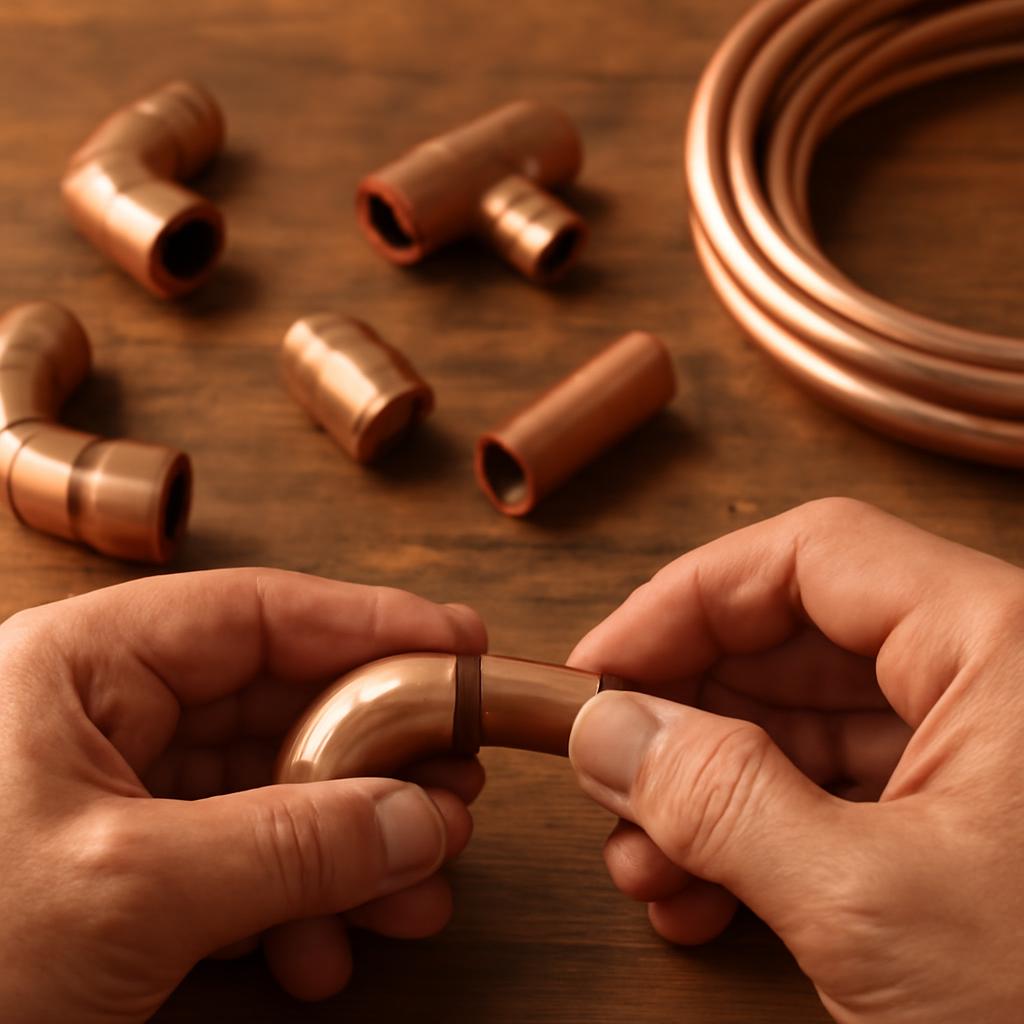
The choice starts with compression, solder or press. Many compression parts use outside diameter; many soldered and press fittings use nominal size.
If you are trying to fix a leaking stop, extend a faucet supply, or reconnect a cut copper line, the hardest part is often not the repair itself. It is figuring out what the fitting label actually means.
Retailers routinely group these parts under copper pipe fittings, copper tubing, or just copper fittings, even when the sizing logic changes from one connection method to the next. Menards uses a combined Copper Pipe, Tubing & Fittings department, Plumbers Supply Co. groups many solder and press items under Copper Pipe Fittings, and The Home Depot organizes a broad Copper Fittings category with multiple connection types side by side. [Menards]]]
For homeowners, the practical way to sort copper tubing fittings is by connection method first—compression, solder, or press—and then by size system—outside diameter for many compression parts versus nominal copper size for many soldered and press fittings. Get those two decisions right, and most routine supply-line repairs become much easier to understand. Get them wrong, and even a part that looks close can leak.
What Are Copper Tubing Fittings?
Copper tubing fittings are the parts that join, redirect, reduce, cap, or adapt copper water-supply lines in a house. In homeowner terms, they are most often used on hot- and cold-water supply piping to fixtures such as sinks and toilets, not on drain, waste, or vent piping. Better Homes & Gardens describes copper as a common supply-line material and notes that copper supply lines are routed separately from drainpipes and vents, while Plumbers Supply Co. lists DWV fittings separately from its copper supply and press categories. [BHG]]
The phrase copper tubing fittings can still be misleading because the market often blurs it with copper pipe fittings. That overlap is real, but it is mostly a naming problem, not proof that every fitting is interchangeable. Menards combines pipe, tubing, and fittings in one department, while Plumbers Supply Co. and The Home Depot use broader copper-fitting taxonomies that mix multiple fitting families in the same shopping path. [Menards]]]
Material also varies by fitting family. Compression fittings for tubing are commonly brass; American Copper & Brass lists brass compression nuts, sleeves, unions, tees, plugs, and reducing adapters in OD tubing sizes. Soldered and press fittings are often copper or wrot copper; Plumbers Supply Co. shows Mueller Streamline solder-cup fittings and NIBCO press couplings in those categories. The Home Depot also surfaces lead-free as a product feature in its copper-fittings filters, but that should be read as a listing feature, not blanket proof that every copper fitting shown is suitable for every potable-water use. [American Copper & Brass]]]
So how do copper tubing fittings differ from copper pipe fittings in practice? Usually by application and sizing convention more than by store wording. A homeowner buying a 3/8-inch OD compression nut is usually shopping by tubing outside diameter. A homeowner buying a 1/2-inch solder coupling is usually shopping by nominal copper size. Because retailer terminology is inconsistent, the safe move is to verify the actual size description on the part, not trust the category name alone. [American Copper & Brass]]
Common Types of Copper Tubing Fittings
The easiest way to understand copper tubing fittings is to group them by how they make the seal.
Compression fittings seal mechanically. American Copper & Brass lists common compression parts including plugs, nuts, sleeves, unions, tees, reducing unions, and male adapters in OD tubing sizes.] For homeowners, these are often the least intimidating copper tubing fittings because they do not require a torch.
Solder fittings, often called sweat fittings, make a metal-to-metal joint when the cleaned fitting and tube are heated and solder is drawn into the joint. Plumbers Supply Co. shows classic soldered forms such as couplings, 45-degree and 90-degree elbows, tees, caps, adapters, and reducing couplings in female solder-cup sizes like 1/2, 3/4, and 1 inch.] These are the standard shapes many homeowners picture when they think of rigid copper plumbing.
Press fittings are a separate copper connection family that use a pressing tool instead of flame. Catalogs clearly show press couplings, elbows, tees, reducers, unions, and adapters as their own system. Plumbers Supply Co. separates press subcategories such as Press Couplings, Press Elbows, Press Tees, and Press Adapters, and The Home Depot lets shoppers filter copper fittings by Press, Solder, Compression, and Threaded connection types.]] For homeowners, the main benefit is obvious: no open flame. The practical limitation is just as important: press only helps if you have access to the correct tool system.
There are also special-purpose fittings that bridge copper to something else or solve a layout problem. Threaded adapters connect copper to male or female pipe threads. Caps close an unused end. Flanges, stub-outs, reducers, and unions handle transitions, branches, or fixture locations. Plumbers Supply Co. lists copper adapters, flanges, stub-outs, reducers, tees, and unions, and The Home Depot’s copper-fittings filters show familiar types such as adapter, tee, elbow, coupling, union, and cap.]]
For a homeowner doing repair work, the practical takeaway is simple:
- Use compression when you need a no-heat connection on smooth tubing.
- Use solder when you want a traditional copper joint and have the skill and safe access to heat it.
- Use press when you want to avoid flame and the proper press tool system is available.
- Use adapters and reducers only when the fitting is explicitly made to bridge different sizes or connection types.
That last point matters because big store categories can make unlike parts look interchangeable. A search for “copper fittings” may place compression, solder, press, and threaded products next to each other even though they are different systems.]
Sizing Copper Tubing Fittings Correctly
The reason is straightforward: compression fittings and solder or press fittings often use different sizing language.
Compression listings commonly use outside diameter, or OD. American Copper & Brass shows brass compression parts in 1/4-inch, 3/8-inch, 1/2-inch, and 5/8-inch OD sizes, including nuts, sleeves, unions, tees, plugs, and reducing unions.]
By contrast, solder and press fittings are commonly sold by nominal copper size. Plumbers Supply Co. shows examples such as 1/2-inch caps, 3/4-inch female solder-cup elbows, 3/4-inch tees, and 1 x 3/4-inch reducing couplings. ABR Wholesalers likewise lists 1-inch 45-degree elbows, 1-inch 90-degree elbows, and 1-inch couplings with CxC connections in its copper pipe and fittings listings.][ABR Wholesalers] When a product says 1/2-inch copper coupling, that usually refers to nominal copper size, not the OD language used for many small compression parts.
For homeowners, the most useful sizing workflow is this:
-
Look at the existing connection type first. If you see a small brass nut and sleeve at a faucet, toilet, icemaker, or appliance supply, you are usually in the compression/OD world. If you see a rigid copper elbow, tee, cap, or coupling that was soldered into the line, you are usually in the nominal copper world.]]
-
Read the fitting description for the sizing language. Listings that say 3/8 OD, 1/2 OD x 3/8 OD, or similar are typically compression-style tubing parts. Listings that say female solder cup, press, or CxC with sizes like 1/2, 3/4, or 1 inch are usually nominal copper fittings.]][ABR Wholesalers]
-
Match like to like unless the part is clearly an adapter or reducer. A 3/8-inch OD compression union is not the same kind of part as a 1/2-inch solder coupling, even if both are described casually as copper fittings.]]
-
Use reducers only when the product explicitly states both sizes. American Copper & Brass lists a 1/2-inch OD x 3/8-inch OD brass compression reducing union, while Plumbers Supply Co. lists soldered reducing fittings such as a 1 x 3/4-inch female solder reducing coupling.]] Both are reducers, but they belong to different size systems.
A quick homeowner reference can make this easier:
- Fixture-supply repair: likely 3/8-inch OD compression parts such as nuts, sleeves, unions, or tees.]
- Rigid branch-line repair: likely 1/2-inch or 3/4-inch nominal solder or press fittings such as couplings, elbows, caps, or tees.]
- Transition between two compression tubing sizes: look for an OD-to-OD reducing union such as 1/2-inch OD x 3/8-inch OD.]
- Transition between two nominal copper sizes: look for a solder or press reducing fitting such as 1 x 3/4-inch.]
Tube type matters too. Plumbing Perspective distinguishes Type K as the thickest-wall copper used for underground or heavier-duty applications, Type L for interior hot- and cold-water lines, and Type M as a thinner-wall option used in domestic plumbing. ABR Wholesalers also separates categories for Copper Pipe Type L, Copper Pipe Type M, and Copper Tubing. [Plumbing Perspective]]
A safe homeowner rule is to slow down and verify the label language. If the listing says only copper fitting, that is not enough information by itself.
Connection Methods for Copper Tubing Fittings
Homeowners usually choose among three main connection methods: compression, solder, and press.
Compression is the least disruptive method for many visible repairs because it needs no heat. The fitting seals when the compression nut tightens the sleeve onto the tubing. American Copper & Brass’s catalog of OD brass compression nuts, sleeves, unions, tees, plugs, and male adapters reflects the kinds of parts commonly used in residential supply work.]
Solder, or sweat joining, is the traditional copper method. It requires clean metal, flux, and controlled heat. Oatey says skipping prep prevents solder from bonding, recommends a thin even layer of flux, and identifies 95/5 and 97/3 lead-free solders as suitable for potable-water plumbing; Oatey also says those solders are NSF 61-certified for drinking-water lines. Plumbing Perspective likewise states that solders containing more than 0.2% lead are not permitted for potable systems. [Oatey]] For homeowners, solder remains a durable option, but it is much less forgiving of rushed prep.
Press fittings form a copper joint with a press tool instead of a torch. Product catalogs do not teach the technique in detail, but they clearly show press as a distinct copper connection family, including NIBCO press couplings in Plumbers Supply Co.’s listings and a Press filter on The Home Depot copper-fittings page.]] The tradeoff is practical access to the correct tool system.
A few connection-method rules help avoid confusion:
- Do not assume one method substitutes for another. If a part is listed as compression, it is not automatically a solder or press part. Retailers separate these families in their connection filters and category trees.]]
- Use an adapter when changing systems. Solder-cup x thread and compression x male pipe adapters are specifically made to bridge connection types.]]
- If you are running new supply tubing, keep the layout sensible. Better Homes & Gardens notes that horizontal runs are often easier in the crawlspace or basement and that copper supply lines are generally routed so they do not cross drainpipes or vents. [BHG]
For most homeowners, the real question is not which method is abstractly best. It is which method matches your tubing, access, tools, and skill without creating new leak points.
Preparing and Installing Copper Tubing Fittings
For cut-and-join work, the prep sequence in the soldering sources is consistent: make a precise cut, deburr the pipe interior, and clean both mating surfaces. Better Homes & Gardens lists a tubing cutter for precise copper cuts and a wire brush for cleaning. Oatey says to deburr the inside of the pipe, clean the pipe exterior with abrasive cloth or a tube-cleaning brush, and polish the fitting hub interior with a fitting brush. Plumbing Perspective echoes the same prep steps.][Oatey]]
For soldered joints, flux control matters. Oatey recommends a thin, even layer of flux and warns that excess flux can turn acidic when heated and contribute to pitting or corrosion. Plumbing Perspective makes the same point.]] More flux is not better.
Heat technique matters too. Oatey advises heating the joint near the fitting hub rather than overheating the pipe and says signs of overheating include a blackened pipe or solder that fails to flow properly. Plumbing Perspective similarly says to heat the fitting evenly and remove the flame once solder flows.]] Once the joint is filled, both sources recommend wiping or cleaning the joint while it is still warm to reduce residue and corrosion risk.
A practical soldering checklist looks like this:
- Cut the tube cleanly with a tubing cutter.]
- Deburr the inside edge so the water path stays smooth and the joint preps properly.]]
- Clean the outside of the tube and the inside of the fitting until both surfaces are ready to accept solder.]]
- Apply a thin, even layer of flux.]
- Heat the fitting area evenly and feed solder when the joint is ready, not before.]]
- Wipe the joint while warm to remove surface residue.]]
The most common installation mistakes are predictable:
- Skipping cleaning or deburring, which keeps solder from bonding correctly.]
- Using too much flux, which both Oatey and Plumbing Perspective warn can encourage corrosion.]]
- Overheating the joint, which can burn off flux and blacken the copper.]
- Leaving the line unsupported. Better Homes & Gardens recommends braces, clamps, hammer arresters, and nailing plates to protect copper supply lines.]
That last point matters even for small repairs. A sound joint can still be stressed by movement, puncture risk, or water-hammer conditions if the line is poorly supported. Better Homes & Gardens specifically advises installing hammer arresters, support braces, and nailing plates where copper runs through framing.]
The tube end should be clean, smooth, and round enough for the sleeve to seat correctly.
Challenges with Flexible or Corrugated Copper Tubing
Older sink supplies sometimes are not rigid, smooth copper tube at all. They may be flexible or corrugated copper risers, and that changes the fitting question.
The evidence here is limited and weaker than the rest of this guide because it comes from a homeowner forum discussion rather than a manufacturer instruction sheet or code text. In that DIY Home Improvement Forum thread, commenters later identified the pictured lines as corrugated flexible copper tubing and questioned whether a standard compression fitting would seal reliably on that uneven surface. [DIY Home Improvement Forum] That is not strong enough support for a broad rule, but it is enough to justify a careful caution.
The useful homeowner takeaway is narrow:
- Do not assume a standard compression fitting that works on smooth copper will behave the same way on corrugated copper.
- A visible compression nut elsewhere in the assembly does not prove that the exposed corrugated section is a good sealing surface for a new compression repair.
- If the section you want to connect to is corrugated rather than smooth, the issue may be compatibility, not just size. [DIY Home Improvement Forum]
The same thread mentioned options such as cutting back to a better transition point, replacing older stop-valve arrangements, or replacing old risers with newer flexible connectors. But because that discussion is anecdotal, it should not be treated as step-by-step authority. The safer editorial conclusion is simply this: corrugated copper deserves extra caution and is a poor place to guess.]
At that point, tightening harder is not a reliable plan.
DIY Thresholds: When to Call a Plumber for Fittings
Copper tubing fittings sit in an awkward middle ground for DIY. Many repairs are realistic for a careful homeowner. Others look simple until access, heat, odd legacy materials, or system importance make them risky.
Better Homes & Gardens also advises homeowners to practice cutting copper and sweating joints before starting.]
A homeowner should usually stop and call a plumber when the repair involves:
- concealed lines inside finished walls, floors, or ceilings
- main supply piping or important shutoff points where a mistake affects the house more broadly
- corrugated or flexible copper where fitting compatibility is unclear]
- repeated leaks after a redo, which suggest the problem may be damaged tubing, wrong sizing, or a poor sealing surface rather than simple technique
- torch work in tight or vulnerable spaces
- press-fitting work when the proper tool system is not realistically available]]
It also helps to separate supply-line problems from drain-system problems. If two or more fixtures drain slowly at the same time, DrainFinder notes that the issue is more likely in the main stack or sewer line than at a branch fixture. It also advises stopping DIY if sewage backs up into a second fixture or if water appears near the foundation. [DrainFinder] In other words, not every plumbing symptom near a sink points to copper tubing fittings.
If the problem turns out to be drainage, backup, or sewer-related rather than a leaking supply connection, see when to call a plumber.
Better Homes & Gardens calls copper supply-line work an intermediate project.] That is a useful framing. If any of those are unclear, the “small repair” can get expensive fast.
Safety, Codes, and Lead-Free Considerations
For drinking-water plumbing, the lead-free point is not optional. Plumbing Perspective states that solders containing more than 0.2% lead are not permitted for potable water systems. Oatey says 95/5 and 97/3 lead-free solders are appropriate for drinking-water plumbing and identifies those solders as NSF 61-certified.]] For homeowners, that means any solder used on a potable-water line should be clearly labeled for that use.
Flux deserves attention too, but with tighter wording. Oatey warns that not all solder and flux products are appropriate for potable-water plumbing, and Plumbing Perspective notes that some petroleum-based flux types require the system to be flushed according to product instructions.]] The safe homeowner rule is to choose flux intended for potable-water plumbing and follow the product instructions, especially for flushing. The evidence here directly supports NSF 61 language for certain solders, not a blanket certification claim for all fluxes.
Torch work adds obvious fire risk. Better Homes & Gardens includes a fiber shield to protect surfaces from heat in its copper supply-line tool list, and Oatey recommends protecting surrounding materials with a flame-resistant cloth.]]
Support and protection matter as well. Better Homes & Gardens recommends braces, clamps, hammer arresters, and nailing plates for copper supply runs.]
Finally, treat any general plumbing guide—including this one—as general reading rather than an on-site diagnosis. DrainFinder’s Terms of Use state that its material is for general reading and makes no warranty as to completeness.] That is the right mindset for copper fitting work too: useful for understanding types, sizes, and methods, but not a substitute for local requirements or professional inspection when a repair has already failed, affects concealed piping, or serves a higher-consequence part of the system.
Copper tubing fittings can support durable residential water-supply repairs when the fitting type, size system, and connection method all match the actual tubing in front of you. Most failures come from mismatched sizing, poor prep, or trying to force a standard fitting onto an unusual tube. Slow down, verify the connection method, and do not guess where the consequences of a leak are high.
What sizes are common for copper tubing compression fittings?
Common residential compression fitting sizes are often listed by tubing outside diameter, with 1/4-inch, 3/8-inch, 1/2-inch, and 5/8-inch OD appearing frequently for brass compression nuts, sleeves, unions, plugs, tees, and reducers on the American Copper & Brass compression-fittings page.] For fixture supplies, 3/8-inch OD is a common example, but the right size is whatever matches the actual tubing and fitting family already installed.
Why do soldered copper joints leak?
The most common causes are poor surface prep, bad flux control, and overheating. Oatey says solder will not bond properly if the pipe and fitting are not cleaned and deburred, warns that excess or incorrect flux can cause problems, and notes that overheating can burn off flux and blacken the pipe.]
Can I use compression fittings on corrugated copper tubing?
Use caution. In a DIY Home Improvement Forum discussion about connecting old copper supply lines to a new faucet, contributors questioned whether standard compression fittings would seal reliably on corrugated flexible copper because the surface is uneven.] That is not strong enough evidence to say “never,” but it is strong enough to say do not assume a standard compression fitting is dependable on corrugated copper without a fitting specifically meant for that tube profile or a better transition point.
What copper types match residential supply fittings?
For residential water-supply work, Plumbing Perspective identifies Type L copper as the typical choice for interior hot- and cold-water lines, Type M as a thinner-wall copper used in domestic plumbing, and Type K as the thickest-wall option used for underground or heavier-duty applications.] The fitting still has to match the size and connection method, but knowing whether you have K, L, or M helps confirm the application and repair context.
When to use lead-free solder for copper fittings?
Use lead-free solder whenever the copper fitting is part of a potable-water line. Oatey says 95/5 and 97/3 lead-free solders are appropriate for drinking-water plumbing and identifies those solders as NSF 61-certified.] Plumbing Perspective adds that solders with more than 0.2% lead are not permitted for potable systems.] For fixture-supply or household drinking-water repairs, lead-free is the standard to look for.