
Find the Hidden Crust Before Adding More Softener Salt
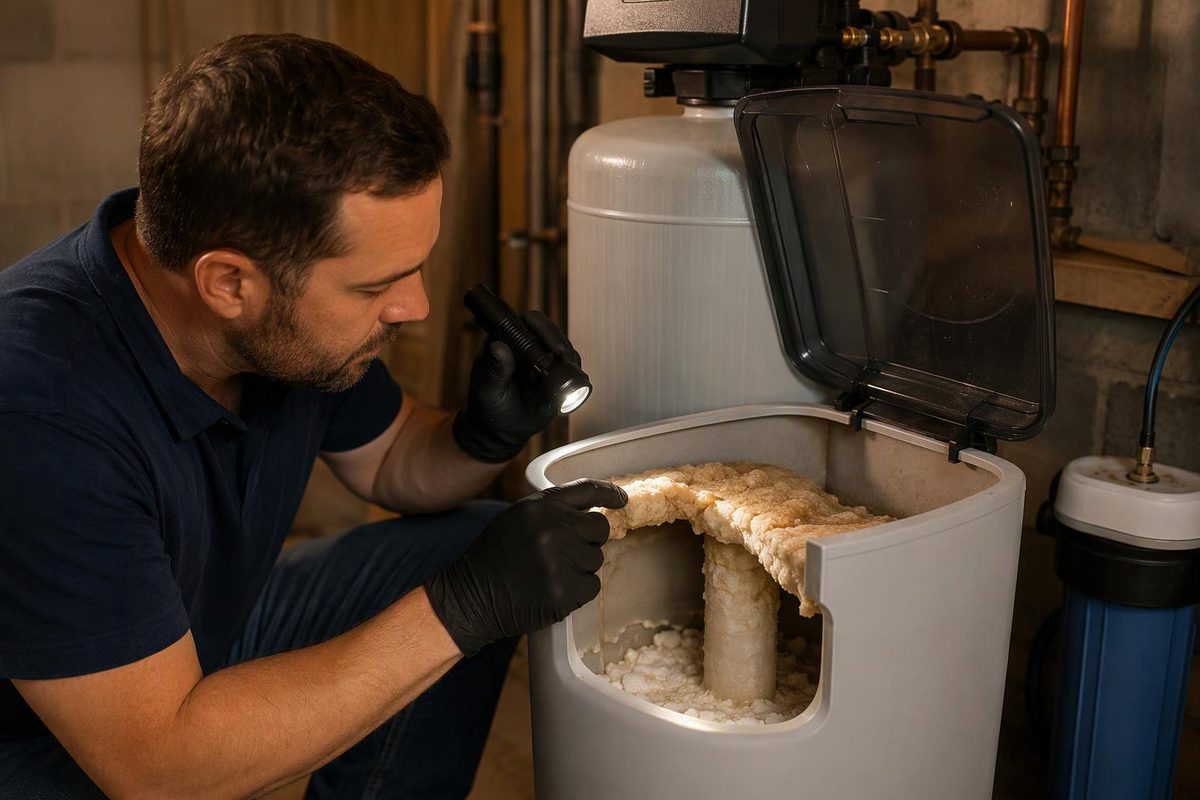
Check a suspected salt bridge safely, distinguish it from salt mushing, follow model-specific clearing instructions and test whether softening has returned.
A salt bridge in a water softener is a hardened crust that suspends salt above the brine-tank water. If your water has turned hard while the salt level barely changes, check for that crust before adding more salt. The gap underneath prevents salt from dissolving into brine, so regeneration can run without properly recharging the resin. Loose salt on top can conceal the bridge, as described in Whirlpool’s WHES40/WHES44 manual.
The distinction that determines the next step is a suspended crust versus a dense, wet mass at the bottom. High water in the tank is another diagnostic branch—not proof of either condition.
Choose what you see in the brine tank; use the result to pick the next check.
Brine-Tank Next-Step Finder
Check for a Hidden Bridge
Confirm hardness at a softened cold faucet, check power and bypass position, then gently probe with a blunt tool using your model’s depth guidance.
An unchanged salt level suggests a check is needed; it does not prove bridging. Keep the tool away from the brinewell and tubing.
All Findings and Next Steps
| Finding | Next Step |
|---|---|
| Salt level unchanged | Confirm hardness, power and bypass position. Gently check for a hidden crust using the model’s depth guidance. |
| Resistance under loose salt | A bridge is possible. Follow the model’s gentle loosening procedure; do not force the tool or improvise a water dose. |
| Tank nearly empty | Follow the model’s salt-refill and regeneration instructions rather than a bridge-clearing procedure. |
| High or rising water | Stop adding salt or water. Investigate a fill or brine-draw problem; arrange service if the tank overfills. |
| Wet bottom sludge | Possible salt mushing. Stop probing and follow the model’s tank-cleaning procedure, or arrange service. |
| Hard after recharge | Check hardness at multiple softened cold faucets. Persistent hardness needs further diagnosis or service. |
Sources: Whirlpool WHES40/WHES44 manual and salt-block procedure; EcoWater troubleshooting and maintenance guidance, linked in the article. Findings guide the next check, not a confirmed diagnosis.
Check for a Suspended Crust Before Breaking Salt
First, confirm the hard-water symptom with a hardness test at a cold faucet supplied by the softener. Check that the unit has power and that its bypass is in the model’s service position. Hard water alone does not establish bridging: incorrect hardness settings, metering trouble and excess brine-tank water are other branches in EcoWater’s troubleshooting guide.
Inspect the tank before using a tool:
| Tank Finding | Next Step |
|---|---|
| Empty or nearly empty | Follow the model’s salt-refill and regeneration instructions. |
| Salt present but no longer being consumed | Check gently for a hidden bridge. |
| Water unusually high or approaching the overflow | Stop adding salt or water; investigate a fill or brine-draw problem. |
Use a clean broom handle or another blunt, round-ended tool to probe gently in several places. Keep it away from the brinewell, the vertical tube housing the brine components, and any visible tubing. Resistance beneath loose salt suggests a crust; it is not permission to push harder.
For WHES40/WHES44 units, Whirlpool instructs owners to measure the floor-to-rim distance and mark the handle before probing. Resistance before that mark reaches the rim suggests a bridge. Use your own manual’s depth guidance, and never drive the tool against the tank bottom or internal parts.
The WHES40/WHES44 manual also warns against pointed tools and pounding the outside of the tank because these can damage or puncture it. If you cannot distinguish the salt crust from a tank component, stop rather than forcing the handle downward.
Clear the Bridge Using Your Model’s Procedure
Remove Accessible Loose Salt
Scoop out accessible loose salt if needed to expose the crust and reduce the amount sitting above it. Whirlpool’s salt-block/bridge procedure begins by removing as much salt as practical.
Loosen the Crust Without Hammering
Where your manual specifies mechanical breakup, apply gentle downward pressure in several spots rather than hammering one hole. Stop if the tank flexes, internal components move or the crust will not yield.
Breaking through one spot does not, by itself, establish that the softener can make and draw brine normally. Complete the applicable procedure and verify the water afterward.
Do Not Improvise a Water Dose
Whirlpool’s online salt-block procedure specifies hot tap water, a measured quantity and a waiting period before recharge. Its WHES40/WHES44 manual describes gentle mechanical breakup instead. Those instructions should not be combined into a universal treatment.
Do not add water unless the instructions applicable to your unit call for it. Use only the specified quantity and temperature. The draft sources do not establish one water dose suitable for every softener. If the manufacturer’s instructions differ, ask its support team which procedure applies to your model before adding water.
Allow Brine to Form Before Regeneration
Follow the model’s waiting and regeneration instructions after loosening the salt. For example, Pentair’s VT 5600SXT system manual specifies waiting two hours after loosening bridged salt before starting regeneration. It also notes that a second recharge may be needed.
That two-hour wait is a model-specific instruction, not a timer for every softener.
Bottom Sludge Needs a Different Fix
If you find dense, wet salt sludge at the bottom rather than a crust suspended over a gap, stop probing. This may be salt mushing, in which recrystallized salt forms a thick bottom layer.
EcoWater’s maintenance guidance distinguishes mushing from bridging and calls for draining the tank and removing the old salt before replacing it. Arrange service if you cannot safely follow your model’s tank-cleaning procedure. Repeatedly poking bottom sludge is not the same repair as gently breaking a suspended crust.
Verify Softening After the Complete Cycle
After regeneration finishes and the unit returns to service, test hardness at cold faucets supplied by the softener. EcoWater’s troubleshooting guide recommends checking multiple cold faucets after recharge.
Do not judge success solely by whether the salt collapsed or the controller ran a cycle. The useful result is softened water at the supplied faucets. Our guide to the water softener regeneration cycle explains what to observe during the process.
If hardness persists, the tank overfills, the unit shows an error or it fails to draw brine, get service. A plugged injector, restricted drain or brine tubing, or a valve fault can also prevent effective regeneration; these appear in Whirlpool’s WHES40/WHES44 troubleshooting instructions.
Give the technician the model and serial number, hardness-test results, salt type, water level, error code and what happened during the attempted recharge. “The salt tank is full” does not distinguish a bridge from a brine-draw or valve problem.
Reduce Bridging Without Repeatedly Topping Off
Use the salt type your manufacturer approves, keep the lid on and avoid overfilling. In humid locations, Whirlpool’s WHES40/WHES44 manual recommends keeping a lower salt inventory and refilling more often.
Check salt movement every few weeks rather than repeatedly topping off an apparently full tank. Whirlpool’s refill guidance includes this routine check. A level that remains unchanged is a reason to inspect—not a reason to keep adding bags.