
Three-Way Diverter Valves in Residential Plumbing: What Homeowners Need to Know Before DIY or Repairs
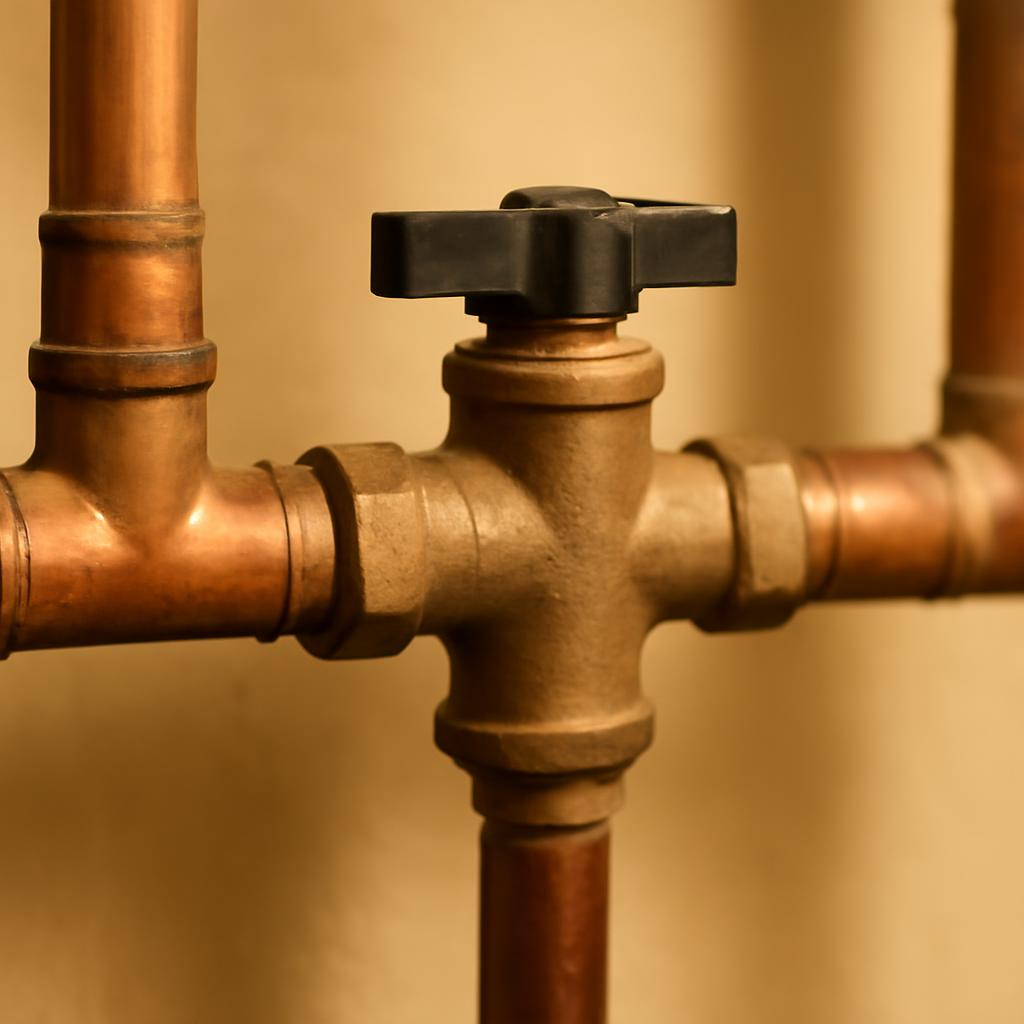
Move to a plumber for corrosion, damaged piping, uncertain shutoff control, multiple affected fixtures or work beyond fixture routing.
That fixture-level meaning is important because “three-way valve” is a broad category. In general valve terminology, a three-way valve has three ports and is typically arranged either as one inlet and two outlets or two inlets and one outlet, depending on whether the valve is being used to divert or mix flow, according to Industrial Monitor Direct. That broad definition includes many products homeowners will never use in a bathroom.
The practical takeaway is simple: not every valve with three ports is interchangeable. Separately, Belimo’s instructions for one three-way diverting ball valve state that product is for closed-loop systems only and should not be installed in an open-loop or atmospheric application, per the Belimo installation instructions.
So this guide stays focused on the residential use case the evidence supports best: bathroom diverter valves that route water between fixture outlets.
What Is a Three-Way Diverter Valve in Home Plumbing?
At the most basic level, a three-way valve is a valve with three ports. Broadly speaking, those ports can be arranged for diverting flow from one inlet to two possible outlets or for mixing flow from two inlets into one outlet, as explained by Industrial Monitor Direct. In a residential bathroom, though, homeowners are usually dealing with the diverting version.
In that setting, a three-way diverter valve is a plumbing component that routes water between multiple outlets, most commonly between a showerhead and a tub spout, according to Christian Plumbing. Its job is to let one fixture switch water where you want it.
That is why the residential mental model matters more than the technical category. A homeowner troubleshooting a tub/shower setup usually does not need to think about actuators, industrial process flow, or specialized port geometry. The useful question is much narrower: when you operate the control, does water go to the outlet it is supposed to feed?
This is also why a three-way diverter can make a fixture feel simpler than the plumbing behind it actually is. Instead of separate controls for separate paths, one mechanism handles the routing. Christian Plumbing describes that as a way to achieve seamless switching between bathroom outlets in a single fixture assembly, which is the main convenience homeowners notice in day-to-day use.
Just as important, the phrase three-way valve should not trick homeowners into thinking every three-port product belongs in household plumbing. The broad definition tells you what the valve category is. The bathroom use case tells you what your part is supposed to do. Those are not the same thing.
So if you are dealing with a bathroom fixture, think of a residential three-way diverter as a fixture-routing part. It belongs at the fixture level, where it helps one faucet or tub/shower assembly perform more than one function. Once the project moves beyond that context, the label “three-way valve” stops being specific enough to guide safe decisions by itself.
Common Home Applications for Three-Way Valves
The clearest supported residential application in the evidence is the bathroom tub/shower setup. Christian Plumbing describes a three-way diverter valve as routing water between outlets such as a showerhead and a tub spout, letting one control switch the fixture between uses without separate standalone valves at each outlet, according to its 3-way diverter guide.
In ordinary home use, the value of the part is straightforward: it gives one fixture multiple outlet functions without asking the user to manage multiple visible controls and separate supply paths.
If you are a homeowner dealing with a shower, tub, or combination fixture, the most relevant meaning is usually bathroom outlet routing. That narrow reading avoids a lot of confusion caused by broader valve terminology.
Where the evidence becomes much less supportive is when a three-way diverting valve is treated as a general-purpose shortcut elsewhere in the plumbing system. In the JustAnswer cabin example, the proposed use was not a bathroom fixture at all; it involved the home’s incoming domestic water line in a combined supply-and-drain concept. In that specific exchange, the plumbing response advised against the arrangement and raised concerns about backflow protection and inspection in that use case, according to the JustAnswer discussion.
A manufacturer manual supports the same broader lesson, though in a different product context. Belimo’s instructions for one three-way diverting ball valve specify that the valve is intended for closed-loop systems only, that the B port is always the common inlet, and that the product should not be installed in an open-loop or atmospheric application, according to the Belimo manual. That is not a residential bathroom diverter manual, and it should not be treated as one. But it does show why “it has three ports” is not enough to prove a valve is suitable for whatever job you have in mind.
So in a single-family home, the supported rule of thumb is this:
- Normal use case: bathroom fixture routing, especially tub-to-shower switching
- Not a DIY shortcut: incoming potable-line arrangements, combined supply/drain ideas, or other applications where approval, backflow protection, and product suitability become live questions
That distinction keeps the homeowner’s focus where it belongs: on the common residential diverter use case rather than on improvised system redesign.
Benefits of Installing a Three-Way Diverter Valve
The most obvious benefit of a residential three-way diverter valve is simpler control. Christian Plumbing describes the valve as an efficient way to manage water flow with a single mechanism, which is exactly why it fits bathroom fixtures so well: one control decides whether water goes to the tub spout or the showerhead instead of making the user work through multiple valves or a more cluttered layout, per Christian Plumbing.
A second benefit is space-saving fixture design. The same source says a three-way diverter can reduce the need for extra plumbing fixtures by combining multiple functions into one bathroom assembly, according to its. For homeowners, that usually shows up as a cleaner-looking tub/shower setup rather than a wall crowded with additional hardware.
There is also a legitimate ease-of-use advantage. Christian Plumbing characterizes the controls as user-friendly because they allow straightforward switching between water outlets in normal use. That may sound minor, but easy-to-use plumbing matters.
The most careful way to describe the cost and maintenance angle is as a conditional benefit, not a guarantee. Christian Plumbing presents a three-way diverter as potentially cost-effective because a simplified system can reduce repair needs and leak opportunities when installed correctly, as noted in its. The phrase “when installed correctly” does most of the work there. A poorly selected or poorly installed valve can create the opposite outcome.
That is why the real benefit is not simply “having a three-way valve.” The real benefit is having:
- the right diverter for the fixture
- installed in the right orientation
- with tight, sealed connections
- in a layout that matches the product’s intended use
When those conditions are met, a three-way diverter can make a bathroom fixture more efficient, more intuitive, and less cluttered. When they are not, the same part becomes a single point of failure in an important fixture.
Professional Installation Process for Three-Way Valves
For homeowners, the safest way to understand installation is to treat it as a sequence, not as a quick swap. Christian Plumbing’s process starts with assessment and preparation: evaluating the existing plumbing layout and deciding where the diverter valve should go, as described in its. That first step matters because compatibility is not automatic. The existing fixture arrangement and piping have to make sense for the new valve.
Next comes a non-negotiable step: shut off the water supply at the main valve. Christian Plumbing specifically warns that this should be done before work begins to prevent leaks or flooding during installation, per its. For homeowners, this is a real threshold.
After isolation, the old valve or related fixture parts are removed. At that point, Christian Plumbing says the surrounding pipes should be inspected for corrosion or damage before the new valve goes in, according to the same. This is one reason apparently simple jobs turn into larger repairs. The old part may not be the only problem.
The new diverter is then connected to the existing plumbing with tight, properly sealed connections and mounted correctly for normal use, as summarized by Christian Plumbing. Only after that does the installer restore water and test the system.
Testing is not just “see if water comes out.” The installed valve should be checked for:
- leaks at the connections
- correct routing to each outlet
- acceptable water flow from each outlet
Christian Plumbing also includes final adjustments as part of the professional sequence, which makes sense because some problems are not obvious until the system is back under pressure.
As for tools, Christian Plumbing lists wrenches, pipe fittings, sealant, and possibly a pipe cutter as common needs for this kind of work, per its. It also says professional installation can take a couple of hours, depending on system complexity, according to the same source.
Homeowners should read that timing correctly. “A couple of hours” does not mean the work is trivial. It usually means a trained person already knows the order of operations, has the right tools on hand, and can spot trouble quickly. The hidden difficulty in diverter work is often not the valve itself; it is everything around it—fit, alignment, condition of nearby piping, and how the system behaves once pressure is restored.
DIY Thresholds: When to Attempt vs. Call a Plumber
The evidence points to a conservative baseline: full installation is usually a professional job. Christian Plumbing explicitly recommends professional handling because plumbing work can be complex and a proper installation produces better results, according to its.
That does not mean a homeowner has no role.
Reasonable homeowner-level steps include:
- confirming whether the problem appears limited to one fixture
- verifying that the water supply can be fully shut off
- looking at any accessible trim, exposed piping, or surrounding area for obvious moisture, corrosion, staining, or prior leak marks
- noting whether the control still appears to route water to the intended outlet during normal operation
Those steps fit the evidence better than jumping straight to replacement. Christian Plumbing specifically supports shutting off the water before work and inspecting pipe condition for corrosion or damage as part of the process, per its.
A practical DIY limit appears when the problem stops being narrow and accessible. If you cannot fully isolate the water, Christian Plumbing’s warning about leak and flood risk applies immediately. If accessible piping already shows corrosion or damage, you are no longer evaluating a simple control issue; you are dealing with pipe condition too.
Another important threshold is when the symptom pattern suggests the issue is not really the diverter. As a homeowner rule of thumb, DrainFinder’s symptom-first guidance says that when two or more fixtures drain slowly at the same time, the problem is more likely in the main stack or sewer line than in a single branch fixture; it also says to stop DIY work if sewage backs up into a second fixture or water appears near the foundation, according to the DrainFinder homepage. Those are not diverter symptoms, but they matter because homeowners often start with the visible bathroom fixture and misread a broader plumbing failure as a local valve problem.
The same narrowing logic applies even more strongly when the project touches the incoming domestic water line. In the JustAnswer cabin example, the discussion was no longer about a bathroom outlet switch at all; it was about using a three-way diverting valve in a main-line supply/drain arrangement. In that specific case, the response was cautionary rather than approving, per the JustAnswer exchange.
A useful homeowner rule is this:
- Stay in DIY territory when the issue is limited to one accessible fixture, the water can be shut off, and your role is mainly confirming symptoms
- Move to pro territory when you find corrosion, damaged piping, uncertain shutoff control, multiple affected fixtures, or any plan that reaches beyond fixture routing into main-line or approval-sensitive work
The threshold is not whether you own tools. The threshold is whether the job remains small, observable, and low-risk.
Key Warnings and Risks with Three-Way Valves
The biggest warning is not that three-way valves are inherently bad. It is that they are highly application-specific.
For a residential bathroom, a three-way diverter is a normal fixture-routing part. But the evidence does not support treating that fact as permission to use any three-way diverting valve anywhere else in the home. The JustAnswer cabin example is useful precisely because it shows a different scenario: an incoming domestic water line with a proposed supply-and-drain arrangement.
The evidence here supports caution and professional review in that situation; it does not support a blanket statement that every three-way valve is forbidden on every domestic main in every jurisdiction.
Manufacturer instructions reinforce the same point from another angle. Belimo’s manual for one three-way diverting ball valve states that the B port is always the common inlet, warns that flow is not possible if the valve is piped incorrectly, and says the valve is intended for closed-loop systems only, not open-loop or atmospheric applications, according to the Belimo installation instructions. That manual is for a specific product, not for residential tub/shower diverters generally. Still, it proves an important homeowner point: a three-port body does not make a valve universal.
This matters because homeowners comparing “three-way valves” online may unknowingly mix together very different things:
- bathroom diverter valves
- mixing valves
- diverting ball valves with specific common-port requirements
- products intended only for closed-loop mechanical systems
Those products share a name, but not a use case.
The practical risks of getting this wrong are straightforward:
- the valve may be mis-piped
- the intended flow path may not work
- the installation may create questions about backflow protection or approval
- a valve chosen for the wrong service may simply be the wrong product for potable or open-loop use
So the homeowner-safe version of the warning is narrower and more accurate than a blanket rule:
- Use a bathroom three-way diverter where it belongs: at the fixture level for outlet routing.
- Do not assume that a three-way diverting valve is automatically suitable for an incoming domestic line, a supply-and-drain arrangement, or any other nonstandard application.
- Read the specific manufacturer instructions for the specific valve, because porting and service limits can be critical.
- If the idea involves potable-water safety, concealed piping, or inspection approval, treat that as professional territory.
Note: DrainFinder publishes homeowner guidance for general reading. Its Terms of Use state that the site makes no warranty as to completeness.
Three-Way vs. Two-Way Valves in Residential Contexts
The clearest difference is function. A two-way valve has one inlet and one outlet and is used for basic isolation or regulation of flow. A three-way valve has three ports and is used to mix or divert flow between paths, according to Industrial Monitor Direct.
In homeowner language:
- a two-way valve is usually the basic open/close or shutoff valve
- a three-way valve is the valve you use when water must be sent here or there
That is why a three-way diverter makes sense in a tub/shower fixture. Christian Plumbing describes it as routing water between outlets such as the showerhead and tub spout, which is a job a simple two-way shutoff cannot do by itself, according to Christian Plumbing.
The comparison also helps prevent overcomplication. If all you need is simple isolation, a three-way valve is usually more complexity than necessary. Industrial Monitor Direct’s overview says two-way valves are the better choice when the goal is straightforward flow stoppage or simple control, while three-way valves are chosen when mixing or diverting is actually required, per its.
That maps cleanly to residential plumbing:
- If you need to shut off a line, isolate a fixture, or stop flow for service, a two-way valve is usually the cleaner answer.
- If you need to route water between outlets in a fixture, a three-way diverter may be appropriate.
This difference also explains why nonstandard “one valve does everything” ideas can go wrong. The more paths a valve manages, the more important correct application and correct porting become. In a bathroom fixture, that extra complexity is justified because the fixture genuinely needs routing. For plain shutoff duties, it often is not.
So if you are comparing a two-way and a three-way option at home, ask one question first: Am I trying to stop flow, or am I trying to route it? If the answer is stop flow, simpler is usually better. If the answer is route it between fixture outlets, the three-way diverter is the category you are actually looking for.
Maintenance, Troubleshooting, and When to Call a Pro
Routine homeowner maintenance for a residential three-way diverter is mostly about watching for change early. Christian Plumbing’s installation guidance emphasizes checking pipe condition, making sure connections are tight and sealed, and testing for leaks after installation, according to its. For homeowners, that translates into observation more than intervention.
Safe, useful things to watch for include:
- visible moisture around accessible trim or exposed piping
- corrosion or staining near the valve area
- water that no longer seems to route cleanly to the intended outlet
- a fixture that behaves differently after installation, repair, or heavy use
Those observations are helpful because they stay at the accessible fixture level. They do not require a homeowner to assume the cause, open walls, or start changing parts without a full diagnosis.
It also helps to separate routing symptoms from drain symptoms. A diverter problem is generally about where the water goes. A broader drain or vent problem shows up differently. If the bathroom also has gurgling drains, sewer odor, backflow into another fixture, or multiple slow drains at once, those clues point away from a simple outlet-routing issue and toward a larger plumbing problem, using the same when to call a plumber thresholds described on the DrainFinder homepage. Replacing or adjusting a diverter is unlikely to solve that kind of whole-system symptom pattern.
That distinction prevents a common homeowner mistake: assuming the visible control must be the cause simply because it is the part you can touch. Sometimes the visible valve is the problem. Sometimes it is just the most noticeable part of a broader failure.
Call a plumber when any of the following happens:
- you see active leaking around the valve or nearby accessible piping
- you find corrosion or pipe damage during inspection
- the water cannot be fully shut off before service
- the issue appears to involve the incoming water line rather than one fixture
- the house shows multiple drain-related symptoms at once, such as backups, gurgling, or simultaneous slow drains
That is also the right place to keep the article’s scope in perspective. A three-way diverter can be a very practical bathroom part. But once the situation involves concealed piping, larger drain symptoms, or a nonstandard potable-water arrangement, the limit of general online guidance has been reached.
For homeowners, the bottom line is this: a three-way diverter valve is most useful when it stays in its proper role—routing water between bathroom outlets. Use a symptom-first approach, keep DIY limited to safe observation and clear isolation, and treat main-line ideas, persistent leaks, and multi-fixture problems as professional territory.
What is a three-way diverter valve used for in a bathroom?
In a bathroom, a three-way diverter valve is used to route water between outlets, most commonly between a showerhead and a tub spout, so one fixture can switch functions with one control, according to Christian Plumbing.
Is it safe to install a three-way valve on my home’s main water line?
Homeowners should not assume that it is. Also, some three-way diverting valves are explicitly limited to closed-loop systems only, as shown in the Belimo manual. So this is professional-review territory, not a general DIY shortcut.
Should homeowners try DIY installation of a three-way diverter valve?
Christian Plumbing recommends professional handling because plumbing work around a three-way diverter can be complex, and it also says the water should be shut off at the main and the surrounding pipe condition checked before work begins, per its.
What tools are needed for a three-way valve install?
Christian Plumbing says a typical three-way diverter installation may require wrenches, pipe fittings, sealant, and possibly a pipe cutter, according to its. The exact tool list still depends on the existing fixture and plumbing layout.