
What the D-Box Does—and How to Investigate Uneven Septic Flow
By Miles Carver ·
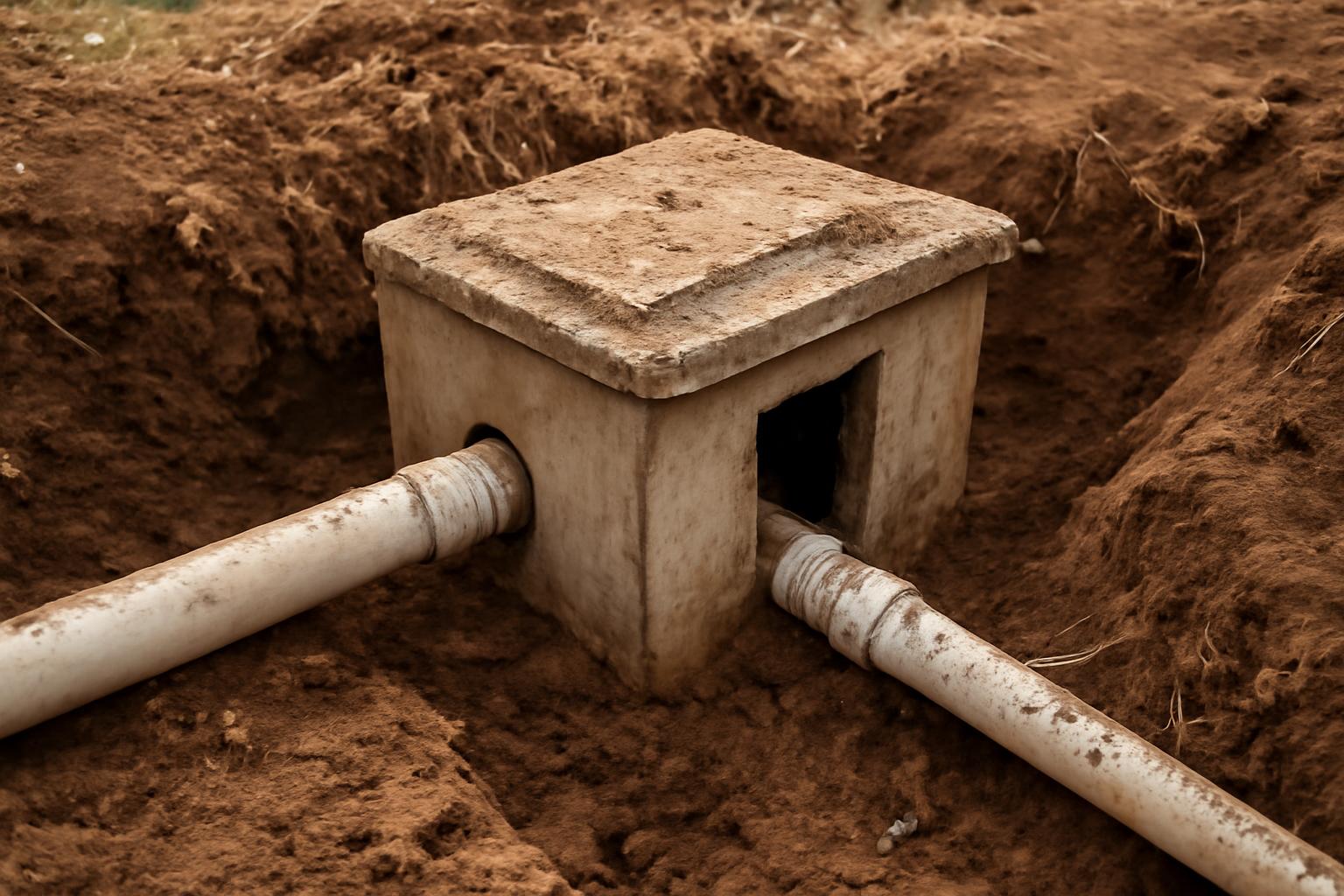
A septic system distribution box is easy to overlook. Yet its position between the septic tank and drainfield makes it consequential: if it directs too much effluent toward one part of the field, that area can become overloaded while other laterals receive less flow.
Slow drains, odors, wet grass, or a sewage backup do not automatically identify a failed D-box. The same symptoms can originate in household plumbing, the septic tank, an outlet filter, connecting pipes, the distribution box, or the drainfield itself. The useful question is not “Which symptom proves the box is bad?” but “What evidence shows where flow is being interrupted, diverted, or released?”
What a septic distribution box does
In many conventional gravity septic systems, the distribution box, commonly shortened to D-box, is the junction between the septic tank outlet and the drainfield laterals.
The normal flow path is:
- Household wastewater enters the septic tank.
- Heavier solids settle and lighter material forms a floating layer.
- Liquid effluent leaves through the tank outlet.
- The effluent travels through a connecting pipe to the D-box.
- The box divides that flow among two or more drainfield lines.
- The laterals disperse effluent into the designated soil-treatment area.
The D-box is not another treatment tank. Its principal job is distribution, not solids storage or primary treatment. Under normal operation, it should receive septic-tank effluent rather than a routine supply of sludge or settled tank solids.
Balanced distribution matters because a gravity field has limited capacity to accept wastewater at a given time. If a lower outlet repeatedly receives most of the flow, the connected section may remain wetter and carry a disproportionate hydraulic load. Other outlets may receive comparatively little flow.
A simplified arrangement looks like this:
 HOUSE
   │
   ▼
┌───────────────────────┐
│      SEPTIC TANK      │
│                       │
│  solids settle here   │
└──────────┬────────────┘
           │ Tank outlet
           │ Effluent pipe
           ▼
     Optional access riser
              │
       ┌──────▼───────┐
       │   D-BOX LID  │
       ├──────────────┤
Inlet ►│              │► Outlet + pipe seal ──► Lateral 1
 seal  │ Distribution │► Outlet + pipe seal ──► Lateral 2
       │     box      │► Outlet + pipe seal ──► Lateral 3
       └──────────────┘
                                      │
                                      ▼
                         DRAINFIELD / SOIL-TREATMENT AREA
This diagram represents a common gravity arrangement, not every onsite wastewater system. Dosing systems may release wastewater intermittently. Proprietary treatment systems may have their own controls and inspection requirements.
Those designs should not be treated as interchangeable merely because two products accept the same pipe diameter. Inlet and outlet elevations, pipe slope, number of laterals, box geometry, hydraulic function, approved design, and local requirements can all affect suitability.
Warning signs—and why symptoms do not identify the failed component
Slow drainage, gurgling, sewage odors, plumbing backups, damp soil, standing water, and unusually lush grass around a septic area all justify investigation. None, by itself, proves that the septic system distribution box has failed.
That distinction matters because replacing the wrong component can leave the actual problem untouched. A whole-house slowdown might reflect a building-sewer obstruction, a high tank level, a clogged outlet filter, a damaged tank-to-box pipe, a blocked D-box outlet, or a drainfield that is no longer accepting effluent.
The EPA identifies backups, very slow drains, gurgling, odors, standing water or damp soil, and unusually green grass as possible signs of a septic malfunction. It also explains that inspection is needed to determine the cause and that odors can arise from conditions unrelated to a D-box, including plumbing vents (EPA guidance on septic-system malfunctions).
| Observation | Plausible D-box connection | Important alternative causes | Urgency | Sensible next step |
|---|---|---|---|---|
| One or more slow fixtures | A restricted outlet or downstream lateral may reduce capacity | Fixture or branch clog, building-sewer obstruction, outlet-filter blockage, high tank level, saturated field | Prompt if several fixtures are affected | Note which fixtures are slow and seek system-level diagnosis if the problem is not isolated |
| Gurgling in multiple fixtures | A downstream restriction may disturb drainage | Building-drain blockage, vent problem, tank or field restriction | Prompt, especially if wastewater is rising | Reduce water use and have the plumbing and septic flow path evaluated |
| Sewage odor outdoors | A leaking or overflowing box may release odor | Tank lid or riser problem, venting, damaged pipe, drainfield malfunction | Prompt if persistent or paired with wet ground | Keep people and pets away from wastewater and request an inspection |
| Sewage odor indoors | A backup may involve a downstream septic restriction | Dry trap, vent defect, failed seal, building-sewer blockage | Prompt; immediate if sewage is present | Avoid exposure and determine whether the problem is plumbing, septic, or both |
| Persistent wetness near one part of the field | Unequal flow may be overloading one lateral; a connection may also leak | Surface drainage, groundwater, broken lateral, localized field impairment | Prompt | Document the location and request findings on the box, outlets, pipes, and field |
| Wetness around the D-box location | The box may be cracked, leaking, overflowing, or poorly sealed | Damaged inlet or outlet pipe, high downstream liquid level, groundwater | Prompt | Do not excavate or open it blindly; seek professional evaluation |
| Unusually lush grass over part of the field | Flow may be concentrated in one area | Irrigation, vegetation differences, drainage patterns, broader saturation | Nonemergency unless paired with odor, wetness, or backup | Compare conditions over time and have persistent unevenness investigated |
| Indoor sewage backup | A D-box obstruction could be one downstream restriction | Building-sewer clog, high tank level, clogged filter, pump failure, field failure | Immediate | Stop unnecessary water use, avoid contact, and obtain professional or local-authority guidance |
| Tank recently pumped but symptoms returned | The box, downstream piping, or field may remain impaired | Plumbing obstruction, rapid hydraulic loading, incomplete diagnosis | Prompt | Request findings beyond the tank rather than assuming pumping resolved the cause |
Uneven saturation can make the D-box a reasonable inspection target. If one end of the field remains persistently wet while another appears comparatively dry, an inspector may check whether the box has shifted, an outlet is obstructed, or a lateral is damaged. That pattern establishes uneven conditions, not the responsible component.
If sewage backs up indoors, avoid contact because it may contain harmful pathogens, stop unnecessary water use, and contact a septic professional or local health authority for guidance. Do not respond by opening buried septic components.
When evaluating an expensive drainfield recommendation, request a written diagnosis that separates the condition of:
- Household and building-drain plumbing
- The septic tank and its outlet components
- The pipe between the tank and D-box
- The D-box structure and position
- Individual outlets and laterals
- The soil absorption area as a whole
A proposal should identify which items are defective and what observations support that conclusion. “The yard is wet” describes a symptom. Photographs of a cracked box, evidence of a blocked outlet, pipe-camera findings, or documented problems with field acceptance provide a more useful basis for deciding what work is needed. A broader 2026 drain-field replacement cost planning guide can also help homeowners compare diagnosis and scope before treating a field-replacement quote as final.
What commonly goes wrong inside or around a D-box
D-box trouble generally falls into three categories: blockage, unequal distribution, and structural leakage. A system can have more than one problem at the same time, but the categories do not necessarily require the same response.
Settlement or tipping
A conventional box relies on elevation and gravity. If the supporting soil settles or the box shifts, lower outlets may receive more flow, concentrating the hydraulic load on part of the drainfield.
The relevant issue is not simply whether the box looks tilted. The elevations of the inlet, outlets, and attached pipes all matter. Moving the box without accounting for those relationships could strain a connection, change pipe slope, or create a new flow problem.
The available evidence does not establish a universal numerical tolerance for “level enough.” Position must be interpreted against the approved design, connected pipe elevations, site conditions, and applicable local requirements.
Solids, sludge, and debris
The septic tank is intended to retain settleable and floating solids. Poor maintenance, excessive solids accumulation, damaged outlet components, or unusual flow conditions can allow material to migrate downstream. Debris may collect in the box, interfere with an outlet, or enter a lateral.
Finding sludge in a D-box should therefore prompt more than box cleaning. The evaluation may also need to address tank solids, baffles or tees, an outlet filter where present, and the tank-to-box pipe. Otherwise, the downstream symptom may return.
Roots and damaged piping
Either condition can restrict flow or release effluent before it reaches the intended lateral.
A pipe defect near the box can resemble a box defect from the surface. Professional exposure of the component or an appropriate camera inspection may be needed to determine whether a restriction is in the box, at a connection, or farther along a line.
Obstructed outlets
The box itself may be structurally intact, but distribution is no longer functioning as intended.
Removing visible material from the box does not establish that the connected lateral is open. Low flow into one lateral also does not, by itself, prove that the outlet is blocked; box position, pipe elevation, and downstream condition may be relevant.
Cracking, deterioration, and leakage
A cracked or non-watertight box can release effluent into surrounding soil before it reaches the designated treatment area. Leakage may occur through the box body, lid interface, pipe penetrations, or damaged connections.
A minor-looking crack still requires context. Location, movement, visible leakage, surrounding soil, box material, and local repair requirements may all affect the decision. The evidence does not support a universal rule that every small crack can be sealed or that every cracked box must be replaced.
Loading from vehicles or equipment
Vehicle and heavy-equipment traffic can damage septic tanks, pipes, boxes, and drainfields. Keep heavy vehicles, construction equipment, and material stockpiles off the known septic area unless that loading was specifically addressed by the approved design.
Drainfield consequences
Correcting the D-box does not erase the field’s loading history. If the box leaked, wastewater may have bypassed the intended treatment area.
Repairing or replacing the box can restore the distribution point, but it does not prove that every connected lateral remains serviceable. The downstream field still needs to be evaluated.
How a distribution-box problem is professionally evaluated
A useful inspection follows the wastewater path rather than viewing the D-box in isolation. That generally means considering household discharge, the tank, outlet components, connecting pipe, distribution box, laterals, and drainfield.
At a high level, an evaluation may address:
- Whether the box matches the expected system configuration
- Structural integrity of the box and lid
- Visible cracking, deterioration, or leakage
- Box position and apparent level
- Accumulated solids, roots, or debris
- Condition and alignment of the inlet
- Outlet openings and pipe seals
- Damaged, separated, or obstructed pipes
- Whether effluent reaches connected lines appropriately
- Signs of unequal loading or surfacing in the drainfield
A professional inspection may also use a camera to examine accessible solid piping or certain leach lines. Ask what section was examined, what could not be seen, and how the images support the diagnosis.
Evidence to request
Before authorizing repair or replacement, ask for:
- Photographs showing the box, inlet, outlets, and visible defects
- Identification of the box material and configuration
- A description of cracks, deterioration, leakage, or damaged seals
- Observations concerning settlement, movement, or changed elevation
- Identification of blocked or damaged outlets
- Findings on the tank outlet, filter, and tank-to-box pipe
- Findings for connected laterals, including inaccessible sections
- An explanation of how flow was observed and interpreted
- The approved plan, permit record, or as-built drawing when available
- A distinction between confirmed defects and suspected ones
- A conclusion about whether the drainfield is still accepting effluent
Be cautious with claims that every outlet must pass one named test or meet one universal field tolerance. Appropriate distribution is the objective, but the supplied evidence establishes neither a universal leveling number nor a standardized homeowner equal-flow test.
Locating the D-box safely
Begin with records, not a shovel. The local health department or onsite-wastewater authority may have an as-built drawing, permit sketch, repair record, or approved design showing component locations. Existing lids and risers can also provide clues.
Washington State’s homeowner field guide identifies as-built drawings, known lids, and professional assistance as ways to locate septic components. It also directs homeowners to stop when conditions are unsafe or the system is malfunctioning or unfamiliar (Washington State septic inspection field guide).
Do not assume that every D-box is a fixed distance from the tank or buried at the same depth. Routing, slope, landscaping changes, system design, and past repairs can alter its location.
Permit, licensing, and inspection requirements vary by jurisdiction. Washington’s guide, for example, states that septic repairs require a permit from the local health jurisdiction; homeowners elsewhere should verify the rules with their own onsite-wastewater authority.
Safety and the limits of homeowner inspection
Septic inspection can expose a person to infectious sewage, hazardous gases, electrical shock, heavy lids, falls into open tanks, and excavation hazards. Washington State’s field guide identifies these risks and directs homeowners to stop and hire a licensed professional whenever they cannot proceed safely (Washington State septic inspection field guide).
Never enter a septic tank, pump chamber, or other enterable confined space. Do not lean over an opening, deliberately inhale gases, reach into an open septic component, or handle wastewater. Keep children, pets, and bystanders away from exposed sewage and open tanks or chambers.
Stop and obtain qualified help when:
- The system type is unknown
- Sewage is exposed or backing up indoors
- A lid is cracked, displaced, unstable, or too heavy to handle safely
- Excavation is required
- Pumps, wiring, or electrical controls are present
- The box or connected piping appears damaged
- A tank, chamber, or opening may be unstable
- You cannot positively identify the component
- The work would require contact with wastewater
- The local authority requires licensed or permitted work
Online guidance cannot determine whether debris removal, hydro jetting, crack sealing, or releveling is safe or appropriate for a particular system.
For a suspected malfunction, contact a qualified septic provider, local health department, or onsite-wastewater regulator. The local authority can explain applicable permits, approved repair procedures, and available lists of licensed or certified professionals.
A gradual difference in grass growth without odor, wetness, or drainage trouble can be documented for a future inspection. Indoor sewage backup, exposed wastewater, an unstable lid, or a possible collapse hazard warrants prompt professional or local-authority guidance.
Repair, releveling, or replacement: how the decision is framed
A D-box is a distinct component. A defect confined to it may sometimes be corrected without replacing the septic tank or entire drainfield. That possibility is not a promise: the appropriate scope depends on the defect and on downstream conditions.
| Defect category | Possible scope to evaluate | Questions controlling the decision |
|---|---|---|
| Debris or blocked outlets | Obstruction removal, tank maintenance, outlet or lateral evaluation | Why did material reach the box? Is the lateral open? Are tank outlet components functioning? |
| Settlement or changed elevation | Support correction, releveling, pipe adjustment, or replacement | Can designed elevations be restored without damaging connections or changing required slopes? |
| Damaged connection | Seal, fitting, or pipe repair; possible box replacement | Is damage confined to the penetration, or have the box and pipe shifted? |
| Limited structural damage | Site-specific sealing or repair may be considered | Is the defect stable? Is the box leaking? Is the repair acceptable to the local authority? |
| Significant cracking or deterioration | Replacement becomes more plausible | Can structural integrity and watertightness be restored reliably? |
| Leakage around the box | Repair of the box, lid, seals, or pipes, depending on the source | Where is effluent escaping, and has field performance been affected? |
| Drainfield impairment | Lateral repair, partial field work, or broader replacement | Which sections remain functional, and is the field still accepting effluent? |
The available evidence does not provide objective universal criteria for deciding when a crack is sealable or a settled box can safely be releveled. Those decisions require inspection, compatibility with the approved design, and review of local requirements.
Replacement becomes more plausible when a box is substantially cracked, leaking, deteriorated, significantly shifted, or incompatible with the approved system. Even then, the new box must preserve the necessary inlet, outlet, and pipe relationships. Matching pipe diameter and port count alone is insufficient.
Broader replacement may be considered when the tank, D-box, piping, and drainfield all have significant defects or when the approved arrangement cannot be restored through targeted repair. A defective D-box alone, however, does not establish that the whole septic system has failed.
Before approving a proposal, ask:
-
What exactly failed? Is the conclusion based on cracking, leakage, settlement, obstruction, pipe damage, or failed field performance?
-
What evidence supports it? Request photographs, relevant measurements, camera findings, and an explanation tied to the system design.
-
Is the field still accepting effluent? Ask which laterals were evaluated and whether previous unequal loading affected them.
-
Are piping changes required? A replacement with different geometry may require more than reconnecting existing pipes.
-
Are permits and inspections included? Clarify who verifies local requirements, applies, schedules inspections, pays fees, and handles required design changes.
-
Are the lid, seals, and riser included? These may be separate line items.
-
What post-work checks are included? The proposal should explain how connection integrity, leakage, box position, and flow will be assessed.
-
Who handles disposal and restoration? The old box, excavated material, backfill, grading, landscaping, and access damage should not remain ambiguous.
Choosing a replacement box without relying on hole count alone
Concrete, high-density polyethylene (HDPE), and polypropylene distribution boxes are available. The evidence does not establish one material as universally superior. Compare measurable characteristics and local suitability rather than relying on broad durability or lifespan claims.
Relevant characteristics include:
- Outside dimensions
- Weight and handling requirements
- Nominal pipe diameter
- Inlet and outlet configuration
- Number and elevation of usable outlets
- Pipe-seal system
- Lid and riser compatibility
- Watertightness requirements
- Required bedding or support
- Regional availability
- Local approval
- Compatibility with the permitted design
A precast concrete box may be substantially heavier than a plastic product, which affects delivery and placement. For example, Jensen Infrastructure lists its residential D6B precast box at 205 pounds, with outside dimensions of 22 by 15.5 by 17 inches and a nominal 4-inch pipe size. Those are specifications for one product, not standard dimensions for all residential boxes (Jensen D6B specifications).
Plastic products also vary. “Plastic” can refer to HDPE, polypropylene, and different molded configurations. Material alone does not establish whether the penetrations, cover, dimensions, or outlet elevations fit the approved system.
Why hole count can mislead
Catalog hole count may include the inlet. Retailer examples state that a 4-hole box can serve up to 3 field lines, a 6-hole box up to 5, and an 8-hole box up to 7. These examples illustrate the inlet-versus-outlet distinction; they do not authorize changes to an approved design (distribution-box configurations).
Before ordering, verify:
- Approved number of laterals
- Number of inlet and outlet openings
- Inlet and outlet elevations
- Pipe diameter and type
- Required plugs for unused openings
- Box dimensions and excavation space
- Cover type and load limitations
- Riser compatibility
- Pipe-seal requirements
- Locally approved manufacturer and model
- Whether the system is gravity, serial, pressure, dosing, or another design
Solid covers versus grates
A septic D-box generally uses a secured solid cover appropriate to its application. Mixed plumbing and drainage catalogs may also display grate-cover products intended for drainage, collection, or drop-box uses. A drainage collection box should not be selected merely because it resembles a septic D-box.
Risers, lids, seals, and flow-control accessories
A riser can bring access closer to grade and reduce future excavation, but it must use a suitable secure cover and be compatible with the approved arrangement. A riser is an access feature, not a repair for a leaking box or impaired field.
Pipe seals are sold for matching box penetrations to particular pipe sizes. Flow-control accessories are also available, but product availability alone does not establish that an accessory is required or suitable for a given design.
Specialized distribution products
These labels describe different hydraulic functions, not merely different marketing categories.
For example, Premier Tech describes Rewatec as a gravity-operated dosing-and-distribution unit that releases measured doses, can be configured with up to seven outlets, and requires no electricity. These are manufacturer-listed characteristics, not proof of suitability for a particular property (Rewatec product description).
Matching pipe diameter, outlet count, or a specialized label does not establish hydraulic or regulatory suitability. Product selection should follow the approved design and local review.
Costs, maintenance, and the questions to ask before approving work
The shelf price of a septic system distribution box and the installed cost of correcting a D-box problem are different figures.
A product-only price may exclude:
- Freight or delivery
- Site-access preparation
- Utility locating
- Excavation
- Groundwater management
- Labor
- Pipe and fittings
- Bedding and backfill
- Seals, plugs, lid, or riser
- Design or engineering
- Permit and inspection fees
- Post-work checks
- Disposal
- Lawn, driveway, patio, or landscape restoration
Dated retailer listings illustrate product-price variation. Tank Depot listed selected products from approximately $61.55 to $87, depending on the model; prices and availability can change (Tank Depot distribution-box listings).
A separate Septic Solutions catalog listed selected solid-cover plastic boxes from $72.50 to $229, depending on hole count and model. These are retail snapshots, not installed-cost estimates (Septic Solutions distribution-box listings).
Installed work is much more site-specific. ATS Environmental published a 2026 New Jersey estimate of $1,200 to $3,000 for D-box repair or replacement. That is a regional, provider-supplied illustration—not a national benchmark, local quote, or guarantee of scope (ATS Environmental’s New Jersey estimate).
A provider’s reported one- or two-day timeline should not be treated as a universal promise.
Maintenance that protects the D-box and field
EPA guidance recommends septic-system inspection every one to three years and tank pumping generally every three to five years or as needed. Actual frequency depends on factors including tank size, household occupancy, water use, garbage-disposal use, and solids accumulation, so those intervals are planning guidance rather than a fixed schedule for every property (EPA septic maintenance guidance).
A conventional D-box generally is not pumped on the same routine schedule as the septic tank. Instead, it may be inspected for:
- Structural condition
- Leakage
- Settlement or movement
- Debris and sludge
- Root intrusion
- Inlet and outlet condition
- Damaged connections
- Appropriate flow toward the laterals
If significant solids repeatedly appear in the box, pumping or clearing the box alone does not address why material is escaping the tank. Tank maintenance and outlet components should also be examined.
Supported preventive practices include:
- Maintain and pump the tank according to actual system conditions.
- Keep heavy vehicles and equipment off the tank, D-box, piping, and drainfield.
- Have damaged lids, risers, roots, and recurring debris evaluated through qualified service.
- Keep the as-built plan and maintenance records available.
- Note changes in wetness, odor, or drainage performance before they become emergencies.
Bid-comparison checklist
Do not compare proposals by total price until you know whether they include the same work. Each bid should identify:
- Documented diagnosis: What failed, and what evidence confirms it?
- Approved replacement specification: Manufacturer, model, material, dimensions, inlet and outlet arrangement, and local approval.
- Excavation and access: Which surfaces will be opened, protected, or restored?
- Piping: Which inlet, outlet, or lateral connections will be repaired or replaced?
- Accessories: Are the lid, riser, seals, plugs, and any specified controls included?
- Permit responsibility: Who verifies requirements and obtains and closes permits or inspections?
- Drainfield evaluation: What establishes whether the laterals and soil area remain usable?
- Post-work checks: How will leakage, connection integrity, box position, and flow be assessed?
- Disposal and restoration: Who removes old materials and restores grade and landscaping?
- Change-order rules: What happens if additional pipe or field damage is discovered?
- D-box inclusion: If the proposal covers drainfield replacement, does it include a new box or reuse the existing one?
The central decision is whether the evidence shows that the defect is confined to the box and that the connected field remains serviceable. Locate the approved records, obtain a safe system-wide inspection, and compare itemized, locally compliant scopes before authorizing D-box or drainfield work.
Frequently asked questions
Does every septic system have a distribution box?
No. A D-box is common in conventional systems that use gravity to divide septic-tank effluent among multiple drainfield laterals, but onsite systems use several distribution methods.
Pressure systems may use pumps and manifolds. Sloped sites may use serial distribution or drop boxes. Dosing and proprietary systems may use specialized controls. Confirm the system type from its approved plan or as-built record rather than assuming every buried junction is a conventional D-box.
Can a tilted septic distribution box be releveled instead of replaced?
Possibly. The decision depends on the box’s structural condition, support, inlet and outlet elevations, attached pipes, leakage, and approved design.
Replacement becomes more plausible when it is cracked, deteriorated, leaking, substantially shifted, or incompatible with the design. The connected laterals should also be evaluated for effects from previous unequal loading.
Does a septic distribution box need to be pumped?
Not routinely in the same way as a septic tank. A conventional D-box is intended to receive liquid effluent and distribute it, not accumulate settled tank solids.
It may be inspected for sludge, debris, roots, structural damage, leakage, and outlet condition. If solids have accumulated, the evaluation should determine why they reached the box and whether the tank, outlet filter, connecting pipe, or laterals also need attention.
How many drainfield lines can a 4-hole or 6-hole box serve?
In common retailer examples, a 4-hole box serves up to three field lines and a 6-hole box serves up to five because one opening is used as the inlet.
That is a catalog convention, not a universal design rule. Verify which opening is the inlet, which ports are usable outlets, whether unused openings require plugs, and whether outlet elevations match the approved field.
Can replacing the distribution box prevent a full drainfield replacement?
It may prevent unnecessary broader work when the box is the actual failed component and the drainfield remains functional. Replacing a leaking box or repairing a damaged connection can restore the intended path to serviceable laterals.
It cannot guarantee field recovery. Previous unequal loading, solids migration, leakage, or saturation may already have impaired part of the field. Before relying on targeted box replacement, request evidence that the connected laterals still receive and disperse effluent appropriately.