
Understanding How Eccentric Screw Pumps Handle Tough Residential Wastewater Flows
If a septic contractor, sewer technician, or wastewater service company mentions a progressive cavity pump, single-screw pump, or eccentric screw pump, most…
By Miles Carver ·
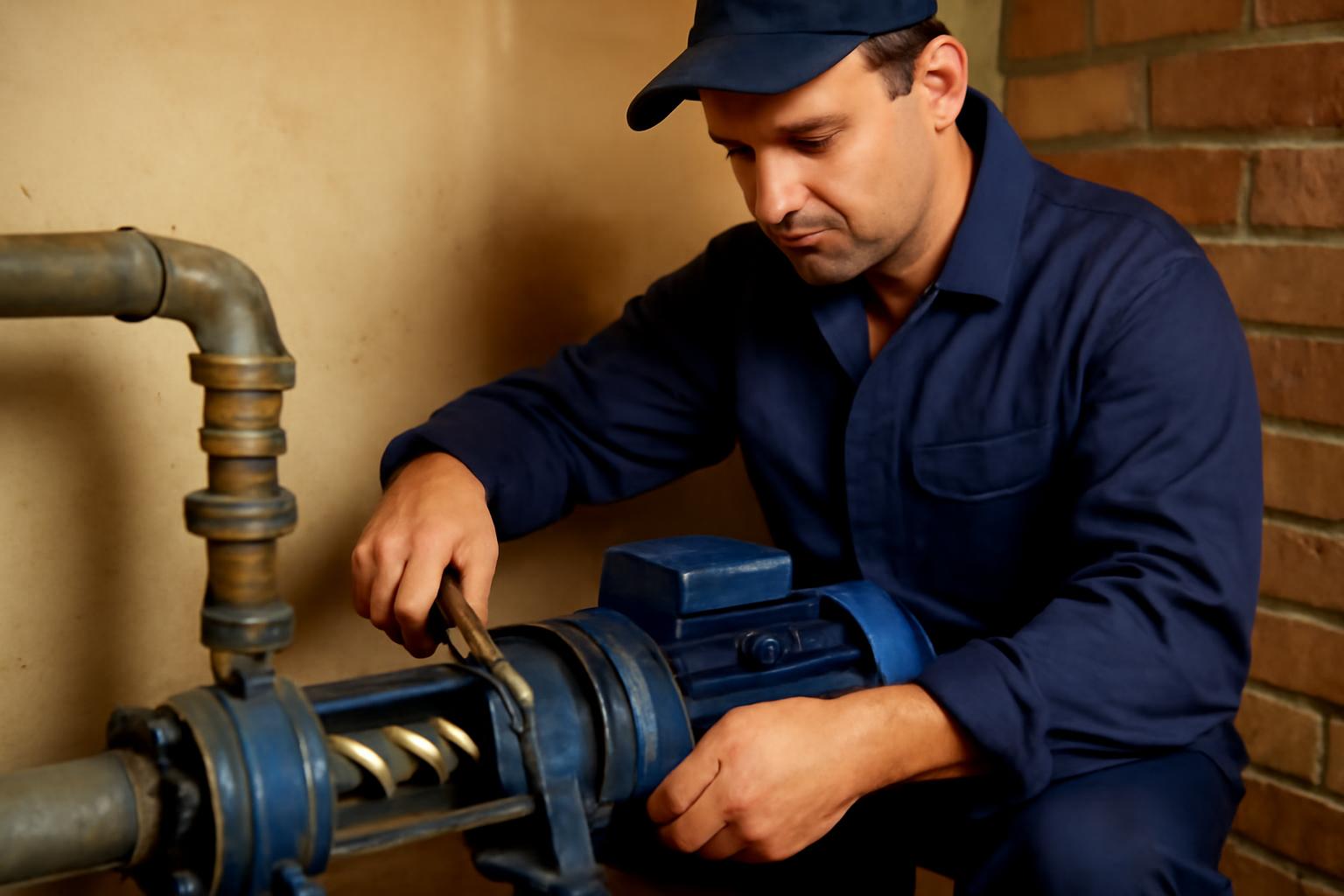
If a septic contractor, sewer technician, or wastewater service company mentions a progressive cavity pump, single-screw pump, or eccentric screw pump, most homeowners do not need a pump textbook. They need to know what the term means, why that equipment might be used on a residential job, and what questions to ask before approving repair work.
That is the purpose of this guide.
In plain language, an eccentric screw pump is a positive displacement pump used for fluids that are harder to move than ordinary water. Its basic action comes from a metal helical rotor turning off-center inside a matching helical stator, creating sealed cavities that carry fluid steadily from the inlet to the outlet. That geometry is why published technical references repeatedly associate this pump type with sludge, sewage, fibrous waste, abrasive mixtures, and other solids-laden or viscous media.
For homeowners, that matters mainly in a few situations:
- a contractor is transferring septic sludge or thick wastewater
- a system has a pump alarm or pump fault
- a backup involves main-line solids, not just a simple branch clog
- a company is setting up temporary pumping for dirty, heavy waste streams
This is not a DIY service guide. DrainFinder’s general threshold is already conservative: if a drain snake hits resistance beyond about 25 feet, if sewage backs up into a second fixture, or if water appears near the foundation, stop and call a licensed professional. Wastewater pumping equipment belongs even farther on the professional side of that line.
So read this article as background for understanding what a contractor means—not as a reason to open a tank, service a pump, or diagnose a wastewater system from the internet.
What Is an Eccentric Screw Pump?
An eccentric screw pump is a rotary positive displacement pump. Instead of throwing liquid outward with an impeller, it traps fluid in cavities and moves those cavities from the suction side to the discharge side.
In the standard form described across technical references, the pump has:
- a single helical metal rotor
- rotating eccentrically, meaning off the centerline
- inside a double-helical stator
- with the stator commonly made as an elastomer-lined sleeve inside a metal tube
That construction explains the different names you may hear:
- eccentric screw pump
- progressive cavity pump
- progressing cavity pump
- single-screw pump
- sometimes Moineau pump, after inventor René Moineau
For practical homeowner reading, eccentric screw pump and progressive cavity pump usually mean the same machine.
That said, the broader term screw pump can be confusing. In wastewater and general industrial conversations, some people use “screw pump” loosely to mean this single-screw design. In other sectors, especially cleaner oil-service applications, “screw pump” may mean a twin-screw or triple-screw all-metal pump instead. Those are different machines with different materials, clearances, and fluid limits. That distinction matters because the progressive cavity style is the one commonly associated with abrasive sludge, fibrous waste, and solids-laden sewage.
Historically, the design is widely credited to René Moineau, and published references describe its early use in aircraft fuel service where continuous feed mattered even under unusual orientation. Over time, the same geometry found much broader use because it could move difficult fluids with relatively steady, low-shear flow.
That difficult-fluid capability is the real reason the pump appears in wastewater work. Across the evidence base, eccentric screw pumps are repeatedly described as suitable for:
- thin liquids
- viscous and highly viscous fluids
- slurries
- fibrous media
- abrasive mixtures
- solids-laden wastewater
- some shear-sensitive materials
Published figures often cite pumpability up to about 100,000 mPa·s for flowable media, but that should be read as a typical published upper reference, not a universal promise. Whether the pump can actually move a very thick material depends on whether that material can reach the suction inlet. In practice, extremely thick media may need assisted feeding, a hopper, or other arrangements.
So the short definition is this: an eccentric screw pump is a single-screw positive displacement pump that uses an off-center helical rotor inside a double-helical stator to move difficult fluids in sealed, progressing cavities.
For a homeowner, the important takeaway is not the label itself. It is what the label implies: a contractor is probably dealing with thicker, dirtier, more solids-heavy wastewater than an ordinary clear-water pump is meant to handle.
Core Working Principle: Cavity Formation and Progression
The working principle is what makes this pump distinctive.
Inside the pump, the helical rotor turns within the stator, but it does not spin straight down the middle like a shaft in a round pipe. It rotates off-center. Because the stator has a matching but different helical form, that motion creates a sequence of cavities between the rotor and stator.
Those cavities act in a repeating pattern:
- A cavity opens at the suction side.
- Fluid fills that cavity.
- Rotor-stator contact creates sealing lines that separate that cavity from adjacent spaces.
- As the rotor continues turning, the cavity progresses axially along the pump.
- The cavity reaches the discharge side and releases the fluid.
Technical references consistently describe these cavities as moving with little change in shape or volume. That is why the pump is classified as positive displacement and why it is often chosen for fluids that do not tolerate high turbulence well.
For homeowners, the useful simplification is this: the pump does not whip sewage around. It moves it forward in a train of sealed pockets.
Why the geometry works
In the common arrangement, the rotor has one lobe and the stator has one more lobe than the rotor—typically a two-lobe internal form. Published descriptions also commonly state that the stator pitch is about twice the rotor pitch.
That mismatch is the design. It creates the moving sealing lines needed for cavity formation.
A simple mental picture helps: imagine the rotor constantly “rolling” through the stator’s interior shape. Because the two shapes are related but not identical, they create pockets of trapped fluid. Those pockets then advance from inlet to outlet.
You do not need the geometry to choose a contractor, but understanding this point explains why the pump is useful for sludge and solids instead of just clean water.
Why flow is smooth
Several cavities are usually moving through the pump at once. One cavity is filling, another is traveling, another is discharging. Because flow comes from overlapping cavity motion rather than piston reversal, the discharge is generally described as low-pulsation or sometimes non-pulsating.
The safer wording is low-pulsation. Real pumps still have some ripple, slip, and wear-related variation. But compared with many reciprocating pump types, the output is much steadier.
That steadier flow helps in wastewater transfer because surging is hard on:
- hoses
- piping
- fittings
- dosing accuracy
- downstream handling
Why shear is relatively low
The fluid is not being chopped by a high-speed impeller or forced through rapidly collapsing chambers. Because the cavities stay close to constant in volume as they move forward, internal fluid velocity stays comparatively low. Published references connect that with low shear.
That matters in industrial settings for emulsions and delicate process fluids, but in wastewater it still has practical relevance. Lower shear helps explain why these pumps are often preferred for:
- sludge with structure
- fibrous sewage
- flocculated streams
- mixed-consistency waste
- solids that should be transported rather than violently shredded inside the pump
Again, the homeowner value here is not pump shopping. It is understanding why a technician might choose this style over a centrifugal pump when the waste stream is heavy or ugly.
How self-priming works
Eccentric screw pumps are commonly described as self-priming. As cavities form on the suction side, the expanding volume creates a local pressure drop that helps draw fluid into the pump. Technical references also note that the pumping chamber does not rely on inlet and outlet valves.
That makes the design useful where the incoming fluid is not a perfectly flooded, clean-water stream.
Still, self-priming should not be read as magical suction under all conditions. Installation details matter, suction arrangements matter, and the pump is not tolerant of being starved of fluid.
Why flow is never perfectly sealed
Although the cavities are described as sealed, the seal is not perfect. Technical references note a small amount of slip or backflow from the higher-pressure discharge side toward the lower-pressure suction side.
That is normal, and it becomes more important when:
- differential pressure rises
- the stator wears
- the rotor/stator fit degrades
- temperature changes alter the elastomer fit
This is why actual delivered flow is always a little less than theoretical displacement, and why a worn pump turning at the same speed as a new pump may move less material.
So the core principle can be summarized like this: the off-center rotor and shaped stator create a series of moving cavities of nearly constant volume, and those cavities carry wastewater steadily from inlet to outlet with low pulsation and relatively low shear.
Rotor Design and Drive Mechanisms
The rotor is the visible “screw-like” part of the pump, but it is more specialized than that description suggests.
Rotor geometry
The standard rotor is a single-lobe helical rotor. It is not just a threaded shaft. Its lead, pitch, profile, and finish are made to match a specific stator geometry.
Published descriptions commonly emphasize that the rotor is:
- long and helical
- smooth and precision-finished
- shaped to create controlled interference with the stator
That precision matters because the rotor-stator contact defines the sealing lines that let the pump work as a positive displacement machine. If the geometry is wrong or wear becomes excessive, backflow rises and performance falls.
Rotor materials
Technical sources commonly describe rotors as steel components chosen for wear and corrosion resistance. Published examples include:
- stainless steel
- other hardened steels
- chrome-plated or chromium-coated steel
Some sources list specific stainless grades, but for homeowner understanding the larger point is enough: in wastewater or sludge service, the rotor has to resist both abrasion and corrosion.
That is one reason pump selection remains professional work. The waste stream may contain grit, grease, cleaners, or other contaminants that affect material life.
Why the rotor does not simply spin in place
The word eccentric matters. The rotor’s centerline does not stay aligned with the stator axis. As the rotor turns, its center follows an orbital path. Some technical descriptions call the resulting motion hypocycloid or hypocycloid-like, especially when describing the drive kinematics.
Homeowners do not need the math. The useful idea is simpler: the rotor is doing more than spinning. It is rotating while moving off-center in a controlled pattern so that the cavity system can progress along the pump.
How the drive transmits that motion
Because the rotor must rotate while also moving eccentrically, the drive connection cannot always be a simple rigid straight coupling.
Published descriptions of common drive arrangements include:
- universal joints
- a flexible connecting rod
- angled link arms
- other articulated couplings
- some alternative sealed or bellows-style connections
Universal-joint drives are especially common in classic descriptions of progressive cavity pumps. Whatever the variation, the purpose is the same: transmit torque while allowing the rotor’s off-center motion.
Motion path and sealing
That orbital motion is not a side effect. It is essential to maintaining the moving contact lines between rotor and stator. Those contact lines are what separate one cavity from the next.
If the rotor were centered and simply spun in a round bore, the pump would not create the same sequence of sealed progressing cavities. The eccentric path is the mechanism behind the pump’s positive displacement action.
Multi-lobe options
Most general references focus on the standard single-lobe rotor / two-lobe stator arrangement. Some also note that multi-lobe options exist for specialized duties.
These variants can change tradeoffs among:
- pressure behavior
- flow smoothness
- solids handling
- sealing characteristics
- flow linearity with speed
For a homeowner, this is mostly background. The practical point is that rotor and stator geometry is application-specific. A pump selected for cleaner chemical dosing is not necessarily the same geometry chosen for abrasive sludge.
Speed controls flow
One of the most important design facts is that flow rate mainly tracks rotational speed. Each revolution moves a known cavity volume in theory, so turning the rotor faster generally increases flow and slowing it reduces flow.
That is why progressive cavity pumps are often operated through a gearbox or other speed-reduction setup rather than run directly at high motor speed. Published comparisons often note that many of these pumps operate at relatively low pump speeds, which helps with:
- wear reduction
- lower internal velocity
- abrasive-service handling
- more controllable output
For homeowners, this leads to one useful rule of thumb: these pumps are mainly controlled by speed, not by closing down the discharge side. Restricting the outlet does not neatly meter flow; it raises pressure until the pump, relief device, or drive reaches its limit.
Stator Construction and Material Options
If the rotor is the metal screw-like element, the stator is the softer shaped sleeve that makes the cavity system possible.
Basic stator construction
In the common design described across technical sources, the stator is a double-helical sleeve inside a metal tube or housing. The sleeve is usually made from an elastomer.
That elastomer is not incidental. It gives the pump the controlled interference fit it needs against the metal rotor.
Without that fit, the pump would lose the sealing lines that define its cavities. With too much interference, torque, heat, and wear rise. With too little, slip increases and performance drops.
Why elastomer matters
The stator does several jobs at once:
- forms the internal cavity shape
- seals against the rotor
- tolerates contact and flexing
- allows some solids passage
That is why stator selection depends on the fluid’s:
- chemistry
- temperature
- oil or solvent content
- abrasiveness
- operating conditions
For a homeowner, the main takeaway is simple: if a technician talks about a failed stator or a wrong stator material, that is not a minor detail. It is often central to whether the pump will work at all.
Common material options
Published vendor and technical references commonly list the following stator materials for this pump type:
| Stator material | Typical published suitability | Common published temperature figure | Main caution |
|---|---|---|---|
| NBR | Often cited for oily or greasy media, some alcohol and aqueous media | Up to about 90°C | Commonly described as a poor match for strong acids, strong alkalis, and many solvents |
| EPDM | Often cited for acids, alkalis, ketones, and alcohols | Up to about 110°C | Limited resistance to oils and fats |
| FKM | Often cited for higher chemical resistance and hotter chemical service | Up to about 160°C | More expensive and still chemistry-dependent |
| PTFE | Often listed for special chemical, hygienic, food, or pharma service | Up to about 200°C | Not the usual elastomeric wastewater stator choice and involves different design tradeoffs |
These numbers should be read carefully.
They are typical published reference figures, not universal operating guarantees. The evidence base itself shows that many of these figures come from manufacturer literature, and real temperature limits depend on:
- pressure
- speed
- chemistry
- lubrication from the pumped fluid
- continuous versus intermittent duty
For residential wastewater relevance, two cautions matter most.
First, most wastewater progressive cavity stators are elastomer-based, not PTFE. PTFE appears in technical listings because some manufacturers offer special-service versions.
Second, “septic wastewater” is not a single chemistry. Grease, disinfectants, cleaners, oils, and unusual contamination can all change what material is appropriate.
Equal-walled vs unequal-walled stators
Some technical references distinguish between equal-walled and unequal-walled stators.
- Equal-walled stators have more uniform wall thickness and are commonly associated with better pressure capability and more precise geometry.
- Unequal-walled stators place more elastomer in some regions and are often described as better at tolerating solids and deformation.
For homeowner purposes, this is a secondary detail, but it does illustrate an important reality: stator design is chosen around the job. Pumps intended for accurate transfer of cleaner media and pumps intended for harsher sludge service may not use the same stator construction.
How temperature changes affect the stator
Elastomer stators are sensitive to temperature and fluid compatibility. Published references note that they can swell or change dimensions with:
- temperature shifts
- fluid absorption
- chemical attack
- prolonged compression
That directly affects performance because the pump depends on a narrow fit range:
- too little interference increases slip
- too much interference increases torque, heat, and wear
This is one reason progressive cavity pumps can be very effective yet still sensitive to poor specification. A stator that looks acceptable on paper may fail early if the fluid chemistry or temperature differs from the assumptions behind the selection.
Why the stator is often the wear part
In many installations, the rotor is harder metal and the stator is a softer elastomer. That makes the stator the more consumable part.
For homeowners, that matters because when a professional discusses maintenance on this pump type, the conversation often centers on:
- stator wear
- stator swelling
- loss of fit
- declining capacity
- reduced pressure performance
In short, the stator is not just a sleeve around the screw. It is one of the most important—and most vulnerable—parts of the pump.
Performance Capabilities and Limits
Eccentric screw pumps are versatile, but performance figures vary widely by design, stage count, speed, materials, and intended service. Many published numbers come from vendor or trade references, so they are best understood as typical ranges rather than universal design facts.
Flow range
Published technical references place eccentric screw pumps across a broad range of about 0.1 to 300 m³/h.
That does not mean one pump can cover all of that. It means the pump family includes everything from small dosing units to much larger transfer machines.
For residential relevance, the exact number is not the point. The point is that the same operating principle can be scaled for either relatively small controlled transfer or larger solids-bearing service.
Pressure range
Pressure claims need the most caution because the source set shows meaningful variation.
A careful summary of commonly published figures is:
- many ordinary or shorter pumps are often cited around 6 bar
- two-stage or similar arrangements are often cited around 12 bar
- longer or multi-stage versions are published at substantially higher pressures
- some references describe around 30 bar
- some sources mention up to roughly 72 bar for specialized multi-stage arrangements
The most reliable principle is not any single headline number. It is this: pressure capability generally rises with length and stage count, but so do torque demands, size, and mechanical stress.
So if a homeowner hears a large pressure number online, it should not be assumed to describe the specific wastewater pump on a residential job.
Viscosity handling
One of the design’s main strengths is thick-fluid service. Published references commonly describe suitability up to about 100,000 mPa·s for flowable media.
Again, the caveat matters. A pump may be able to transport a very thick medium once it reaches the inlet, but if the material bridges, stalls, or does not feed properly, the system may need:
- a hopper
- a follower plate
- forced feed
- shortened suction arrangements
- other feed assistance
That is especially relevant in sludge service because septic and wastewater residues are often inconsistent rather than neatly uniform.
Solids handling
Published references for larger eccentric screw pumps often cite solids passage in the 30 to 40 mm range.
That should be read as a typical published capability for some larger models, not a blanket promise. Actual solids tolerance depends on:
- pump size
- rotor/stator geometry
- solids hardness
- fiber content
- operating speed
- stator material
- whether solids are occasional or continuous
Wastewater is especially difficult because the challenge is not just particle size. It is often the combination of grit, wipes, fibers, grease, and semi-settled sludge.
Suction capability and NPSH
Technical references commonly describe suction lift in the range of 3 to 8 meters and note relatively low NPSH requirements compared with many centrifugal pumps.
That helps explain why the design is attractive where the incoming fluid is sluggish or poorly behaved.
But “good suction” does not mean careless installation is acceptable. Air leaks, long dry suction runs, or starving the pump of fluid can still cause major problems.
Flow versus speed
A core operating feature is that flow is primarily proportional to speed. Increase speed and output usually rises; reduce speed and output falls.
In practice, actual delivered flow is reduced by slip, especially as pressure rises or wear develops. So the most accurate homeowner-level statement is this: flow mainly follows speed, but pressure, wear, and fit still matter.
Backflow and volumetric efficiency
Even with a precision rotor-stator fit, some internal leakage is unavoidable. As discharge pressure rises, a small amount of liquid slips backward through the sealing zones. That reduces volumetric efficiency.
This helps explain why:
- a worn pump may still spin normally but move less material
- two pumps at the same speed may not deliver the same actual flow
- higher-pressure duty tends to expose wear faster
Critical operating limit: no dry running
The most important limit is not pressure or viscosity. It is dry running.
Technical references repeatedly warn that these pumps rely on the pumped fluid to help lubricate and cool the rotor-stator interface. Without fluid, friction and heat rise rapidly. The elastomer stator can scorch, tear, harden, or lose sealing ability very quickly.
For homeowners, this is the single most important limitation to remember. A pump that can tolerate abrasive sludge can still be badly damaged by one simple condition: running without enough fluid.
Key Advantages for Wastewater Applications
Eccentric screw pumps are not the right answer for every pumping job. They are useful because they solve a particular problem: moving fluids that are too thick, too dirty, too fibrous, or too solids-laden for many other pump types.
That is why they sometimes appear in wastewater service around homes.
They handle difficult media better than many alternatives
Published technical references consistently associate this pump design with:
- slurries
- fibrous media
- solids-laden mixtures
- abrasive wastewater
- viscous sludge
- mixed-consistency waste streams
That does not mean they are indestructible. It means they are often selected because they tolerate those conditions better than many alternatives, especially compared with pumps designed mainly for cleaner, water-like fluids.
They produce low-pulsation flow
Wastewater transfer is easier to manage when the pump does not surge heavily. Because multiple cavities are moving through the pump at the same time, discharge is usually much smoother than with strongly pulsating designs.
That can be helpful for:
- hose handling
- piping stress
- fittings
- dosing or transfer control
- reducing violent flow variation in dirty service
They are relatively gentle on the fluid
In wastewater, “gentle” does not mean delicate household liquid. It means the pump does not create the same turbulence or shear as some other designs.
That can help with:
- flocculated solids
- emulsified waste streams
- soft solids
- fibrous matter that may behave poorly under more turbulent pumping
Low internal velocity is one reason progressive cavity pumps are often selected over centrifugal pumps for thick or abrasive duties.
They maintain a more predictable speed-to-flow relationship
Positive displacement pumps are often valued because viscosity does not throw their output around the same way it can with centrifugal pumps.
The careful way to state the advantage is this: an eccentric screw pump’s output is primarily tied to speed, though actual delivered flow still changes with slip, pressure, and wear.
That predictability is useful in controlled transfer applications and helps explain why these pumps are often used where messy material must be moved steadily.
They are self-priming and valve-free in the pumping chamber
Published references commonly describe the design as self-priming, and the pumping chamber itself does not depend on inlet and outlet valves.
That can be useful in sludge service because:
- intermittent feed is common
- solids can jam valve-based designs
- suction conditions are often less than ideal
Why this matters in residential contexts
This is where the homeowner lens matters most.
Most homeowners will never own or service one of these pumps. But the pump type may appear in professional work involving:
- septic sludge transfer
- removal of thick waste from pits or tanks
- temporary bypass pumping of heavy wastewater
- solids-bearing main-line waste streams
The key point is modest but important: if a contractor mentions an eccentric screw pump, they are usually talking about specialized solids or sludge handling, not a normal branch-drain clog.
That helps you ask better questions and avoid jumping to the wrong conclusion about what failed.
Maintenance and Common Limitations
The same features that make eccentric screw pumps effective for difficult media also create clear maintenance needs.
Stator wear is usually the main wear issue
Because the rotor is usually harder metal and the stator is a softer elastomer, the stator is often the primary wear component.
Wear can show up as:
- reduced capacity
- poorer suction performance
- lower pressure capability
- rising torque demand
- more slip
- overheating
- declining efficiency
Some published sources repeat a rule of thumb that a rotor may outlast several stators, sometimes expressed as roughly three to four stators per rotor in gentler service. That should be treated as a rough maintenance saying, not a universal lifecycle rule. Abrasives, chemical mismatch, temperature issues, and dry running can shorten life dramatically.
Clearance and fit need inspection
These pumps depend on controlled rotor-stator fit. That means inspection is not just about whether the pump turns.
Professionals often watch for:
- rotor surface damage
- stator hardening or swelling
- reduced pressure performance at known speed
- increased current draw or torque
- leakage-related loss of output
- loss of suction behavior
A pump may still run while no longer doing its job well.
Dry running is a serious failure mode
Dry running is not a minor inconvenience on this pump type. Because the pumped fluid helps cool and lubricate the rotor-stator interface, loss of flow can damage the stator quickly.
Typical consequences include:
- scorched elastomer
- torn stator surface
- permanent loss of sealing
- locked or overloaded drive components
That is why technical references repeatedly stress dry-run protection.
Common safeguards
Published references describe protection approaches such as:
- bypass arrangements
- pressure switches
- shutdown logic tied to abnormal conditions
The exact scheme depends on the installation, but the goal is straightforward: shut the system down before lack of flow or blocked discharge destroys the stator.
Temperature swings matter
Elastomer stators are sensitive not only to chemistry but also to temperature. If temperature changes significantly, the stator may swell or change stiffness enough to affect:
- starting torque
- sealing quality
- efficiency
- wear rate
This is one reason selection must be matched to the real service conditions, not just to a generic wastewater label.
Deadheading is also a problem
An eccentric screw pump should not be run against a closed discharge. Because it is a positive displacement pump, it will continue trying to move a fixed volume with each revolution. If the outlet is blocked, pressure rises until something gives.
Possible outcomes include:
- relief protection opening
- motor overload
- coupling or drive damage
- hose or pipe stress
- component failure
That is why discharge throttling is not the right way to control flow on this design.
Abrasives and solids do not mean low wear
A common misunderstanding is that because these pumps can handle abrasive or solids-laden fluids, such service must be easy on them.
It is not.
They are often chosen because they survive those duties better than many alternatives, not because wear disappears. Grit, sand, and hard solids can still shorten stator life and damage rotors.
Modular maintenance is a real advantage
One practical benefit noted in technical sources is that many progressive cavity pumps are relatively modular. The rotor and stator assembly can often be replaced without rebuilding the entire system.
For homeowners, that helps explain why service discussions often focus on rotor/stator replacement rather than total pump replacement.
Relevance to Residential Septic and Drain Issues
This is the section most homeowners care about.
The average homeowner is not choosing between progressive cavity geometries. They are trying to understand whether a contractor is dealing with a clog, a pump problem, a main-line issue, or a broader septic system fault.
When a professional might use this pump around a home
An eccentric screw pump may come up in residential-adjacent work involving:
- sludge transfer
- thick wastewater removal
- solids-bearing sewer or main-line work
- temporary pumping of difficult waste streams during service
The key hedge is important: this does not mean eccentric screw pumps are a standard homeowner-system component or the typical pump found at a house. It means they are one of the professional pump types that may be used when the material is too thick or solids-heavy for simpler handling.
Why diagnosis comes before replacement
DrainFinder’s broader guidance on septic and drain problems applies here directly: confirm what failed before approving a major repair.
A problem that looks like “the drain field failed” or “the whole system needs replacing” may instead involve:
- a broken pipe
- a full tank
- a distribution problem
- a pump fault
- controls trouble
- temporary hydraulic overload
That is why pump talk should come after real diagnosis, not before it.
This is not DIY equipment territory
DrainFinder’s general residential guidance is symptom-first and conservative about stop conditions. For ordinary branch clogs, homeowners may try basic clearing if the blockage is clearly close and accessible. But the site’s stop conditions are clear:
- if the snake hits resistance beyond about 25 feet
- if sewage backs up into a second fixture
- if water appears near the foundation
those are signs of a main-line or sewer problem, not a routine local clog.
An eccentric screw pump sits even farther beyond DIY territory. If the issue involves:
- sewage transfer equipment
- septic sludge handling
- main-line solids backups
- pump alarms
- wastewater pumping outside normal fixture maintenance
the right move is professional inspection and service.
Why the pump type still matters to homeowners
Even if you never touch one, understanding the pump type helps you ask better questions:
- Is the contractor moving clear water or sludge?
- Is the problem a clog, a pump fault, or a field/distribution problem?
- Is the proposed equipment meant for solids handling?
- Does the setup include protection against dry running or blocked discharge?
- When someone says “screw pump,” do they mean a progressive cavity/eccentric screw pump or another screw-pump design?
That last question is more important than it sounds. Published technical references specifically warn that terminology confusion between single-screw progressive cavity pumps and multi-screw all-metal pumps can lead to the wrong equipment being selected.
The homeowner takeaway
For residential readers, the practical conclusion is straightforward:
- an eccentric screw pump is a specialized positive displacement pump
- it is used when a professional needs to move tough wastewater, sludge, or solids-laden material
- its performance depends heavily on geometry, materials, and maintenance
- it cannot tolerate dry running
- it is not homeowner DIY equipment
- symptoms still need on-site diagnosis before anyone jumps to big replacement decisions
That is the right use of this knowledge on a homeowner site: not to service the pump yourself, but to better understand what a technician is talking about and to ask clearer questions when a wastewater problem becomes more than a simple drain clog.
FAQ
Why can’t eccentric screw pumps run dry?
Because the pumped fluid helps lubricate and cool the tight rotor-stator contact area. When the pump runs dry, friction rises quickly at that interference fit. The metal rotor can overheat the elastomer stator, causing scorching, tearing, hardening, or loss of sealing. Once that interface is damaged, capacity and pressure performance drop fast.
What stator material for septic wastewater?
There is no single universal stator material for all septic wastewater. Selection depends on the actual fluid chemistry and operating temperature.
In published technical references:
- NBR is often considered for oily or greasy contamination at moderate temperatures
- EPDM is often considered where resistance to acids, alkalis, and some cleaning chemicals matters more than oil resistance
- FKM is used where stronger chemical resistance or higher temperature capability is needed
- PTFE appears in special-service listings, but it is not the default answer for ordinary wastewater duty
For residential sewage, the important point is that material choice belongs to the service professional because real waste streams vary.
How does eccentric motion differ from straight rotation?
In straight rotation, a shaft spins around its own centerline without moving off-center. In an eccentric screw pump, the rotor spins and follows an off-center orbital path relative to the stator. That off-center motion creates the moving sealing lines and progressing cavities that transport fluid from inlet to outlet.
Is it the same as a progressive cavity pump?
Usually, yes. In most wastewater and general industrial use, eccentric screw pump and progressive cavity pump refer to the same single-screw positive displacement pump.
The caution is with the broader term screw pump. That umbrella term can also include twin-screw and triple-screw pumps, which are different machines. So the first two terms are usually interchangeable, while “screw pump” by itself can be ambiguous.
Eccentric screw pumps make more sense once you see them as specialized wastewater tools rather than mysterious industrial hardware. Their off-center helical rotor, elastomer stator, and progressing cavities let professionals move sludge and solids-laden waste with steady, low-pulsation flow. But those advantages depend on correct material selection, protection against dry running, and regular maintenance. For homeowners, the useful lesson is not how to service one. It is how to recognize when a drain or septic problem has moved beyond a basic clog, why diagnosis should come before replacement, and when the right next step is a qualified sewer or septic professional.