
Pro Strength Hair Clog Eliminator: Uses, Directions, Safety, and Limits
By Miles Carver ·
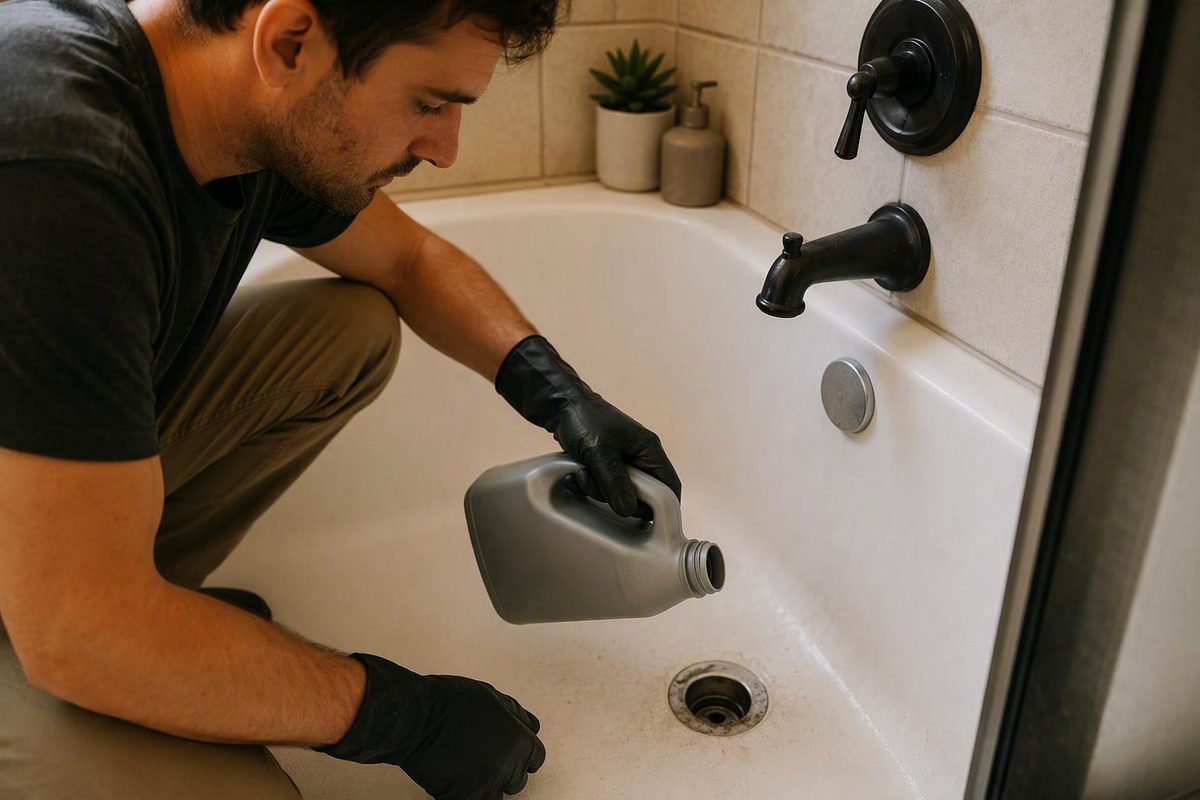
Overview
Liquid-Plumr Pro-Strength Hair Clog Eliminator is a chemical drain cleaner intended for suspected hair clogs in slow-running sinks, showers, tubs, and bathtubs. The supplied directions specify one entire bottle, a 15-minute wait, and a hot-water flush. Toilets, garbage disposals, and certain chemical combinations are explicitly excluded.
The key question is whether the symptom and drain match that stated use. Manufacturer-derived copy describes the formula as a treatment for hair and related buildup, but it does not establish that every slow drain is a hair clog. Customer reports also show variable results, including quick clearing, slow progress, and unsuccessful first treatments.
Before using the product, confirm that you have an included drain type, can follow the directed application, and have not introduced an incompatible cleaner. Pipe-compatibility claims do not override the product’s contact, ingestion, or hazardous-gas warnings.
What the product is designed to clear
The product is designed primarily for hair-related clogs. Liquid-Plumr says the formula coats pipe walls and destroys hairballs within 15 minutes, while Target’s product description calls it specially formulated for hair clogs. These are product-use claims, not proof that an unidentified blockage contains hair.
The listed applications include slow drains in bathroom sinks, kitchen sinks, showers, and bathtubs. Stop & Shop’s label-derived product information also says the formula removes hair, gunk, and soap scum. That broader wording is best understood as buildup associated with the targeted hair clog, not as evidence that the product clears every possible obstruction.
Start with the symptom. A gradually slowing shower, bathtub, or bathroom-sink drain may fit the stated hair-clog use. A slow kitchen sink appears among the listed applications, but the supplied sources do not show that this formula is intended for every kitchen blockage or establish how well it works on causes unrelated to hair. The product evidence does not support claims about grease masses, foreign objects, pipe damage, or blockages farther along the plumbing system.
A complete diagnosis cannot be made from flow speed alone. If you cannot reasonably connect the slowdown to hair or related buildup, the evidence only establishes that this is a hair-focused treatment, not that it is the correct solution for the unknown cause.
How to use it as directed
The supplied hair clog remover directions give a specific three-step treatment. Both Target and Stop & Shop present the same sequence:
- Slowly pour the entire bottle down the drain.
- Wait 15 minutes.
- Flush the drain with hot water.
The entire bottle is the stated dose for the treatment described in these sources. The 15-minute interval is also part of the method, rather than merely an estimate of when you might notice a result. Liquid-Plumr’s own product copy similarly claims that the formula works on hairballs within 15 minutes.
Follow the sequence as a unit. Pouring less than the specified bottle, substituting a different waiting period, or omitting the hot-water flush would no longer match the supplied directions. The evidence pack does not provide alternative dosing instructions for smaller clogs, different drain sizes, or partial bottles.
Some customer anecdotes describe leaving drain cleaners in place longer when results were slow. Those accounts are not product directions. Amazon’s customer-feedback summary reports mixed experiences with speed, but it does not establish that extending the soak is safe or more effective. An overnight treatment or another improvised interval should therefore not be presented as equivalent to the documented 15-minute method.
The supplied evidence also does not define a repeat-treatment schedule. Completing one directed application provides information about how your drain responded, but it does not by itself create evidence for immediately pouring in another bottle.
Pipe and septic-system compatibility
The product is marketed as compatible with a broad range of household plumbing. Target’s listing says it is safe for septic systems and for PVC, plastic, metal, and older drain pipes. The label-derived information published by Stop & Shop similarly lists plastic, metal, septic systems, and older pipes.
These are supplied product-compatibility claims tied to using the cleaner as directed. They should not be expanded into a universal guarantee covering every plumbing condition. The sources do not address already damaged pipes, unusual plumbing materials, deteriorated joints, or every possible septic-system configuration.
“All pipes” also does not mean “all drain locations.” The same product information that lists broad pipe compatibility expressly excludes toilets and garbage disposals. Material compatibility and approved application are separate decisions: a drain may connect to plastic or metal piping while still being an excluded place to pour this formula.
For an ordinary included sink, shower, tub, or bathtub drain, the available product copy supports compatibility with the named materials and septic systems. If your concern involves the condition or configuration of the plumbing rather than its basic material, the supplied evidence does not resolve that question.
Safety warnings, ingredients, and excluded uses
The clearest exclusions are toilets and garbage disposals. Both Target and Stop & Shop state that the product should not be used in either location. Broad statements about pipe compatibility do not cancel those location-specific restrictions.
The formulation information reproduced by Stop & Shop lists water, sodium hydroxide, sodium chloride, sodium hypochlorite, myristamine oxide, sodium orthosilicate, lauramine oxide, sodium cocoate, modified polycarboxylate, and several named fatty acids. This list identifies what the published product information says the formula contains. It does not, by itself, establish how much of each ingredient is present or permit conclusions about the role or potency of every component.
The same source labels the product “Danger,” says contact can cause burns, and states that it is harmful if swallowed. It also says to keep the product out of reach of children and pets. These warnings matter independently of whether the cleaner is claimed to be compatible with a particular pipe. “Safe for pipes” is a plumbing-material claim, not a statement that skin contact, eye exposure, or ingestion is safe.
Chemical mixing is another explicit boundary. The warning says not to use the product with ammonia, toilet bowl cleaners, or non-Liquid-Plumr clog removers because splashing or hazardous gases may occur. The evidence does not provide a safe ratio, neutralizing method, or exception that would make those combinations acceptable.
If another drain cleaner is already in the drain, the supplied warning establishes a mixing risk but does not say how long to wait before using this product. It also does not provide a product-specific remediation procedure for a drain that already contains an unknown chemical. Choosing an arbitrary waiting interval would therefore go beyond the evidence. Current product documentation is needed before another chemical step can be justified.
How reliable are the first-use results?
The evidence supports a manufacturer-derived first-use claim, but not a guaranteed first-use outcome. Target’s listing says the formula contains 70% more actives to clear slow-running drains the first time. Its footnote specifies that the comparison is with Liquid-Plumr Full Clog Destroyer Plus Pipeguard.
That 70% figure is a relative formulation comparison between two named products. It is not a 70% success rate, a claim that drainage will improve by 70%, or evidence that this formula is 70% more effective. The supplied materials provide no operands from which to calculate an independent performance percentage and no controlled test results showing how often one treatment succeeds.
Liquid-Plumr’s product page makes a stronger-sounding time claim, stating that the formula coats pipe walls to destroy thick hairballs within 15 minutes. That describes the intended performance of the product. It still does not establish that every slow drain contains a reachable hairball or that every correctly treated clog will clear.
Customer feedback provides a useful but limited counterpoint. Amazon’s summary says customers report mixed speeds, with some seeing fast results and others finding the product very slow. It also includes an unsuccessful customer account that recommends a plumbing snake. A Home Depot review page includes a reviewer’s statement that the product does not always work the first time.
Those reports show that experiences vary, but they are anecdotes rather than a controlled comparison. They do not reveal whether users had the same type or severity of clog, followed identical directions, or correctly identified hair as the cause. They also cannot be converted into a reliable failure rate.
The most evidence-bounded expectation is that this formula is marketed to clear hair-related slow drains with one 15-minute treatment, while actual first-use results may be quick, slow, or unsuccessful. The supplied corpus cannot assign a probability to any of those outcomes.
If the treatment fails or the clog returns
A failed treatment does not establish why the drain remained slow. The clog may not match the product’s stated hair-focused use, or the obstruction may not have responded as advertised. The supplied sources document failures, but they do not provide an authoritative repeat-dose instruction or a supported point at which another chemical application becomes appropriate.
Customer reports illustrate the uncertainty. The Amazon feedback includes a user who preferred a plumbing snake after an unsuccessful result. A Home Depot reviewer says repetitive clogs call for trying something else and describes the product as not being a long-term solution. These comments show how individual users reacted, not a manufacturer-approved escalation rule or a professional plumbing standard.
A recurring clog can reasonably change the question from “Will this clear visible hair buildup once?” to “Why does this drain keep slowing again?” The customer evidence supports recurrence as a practical concern, but it cannot diagnose an underlying cause. The corpus does not establish whether a recurring blockage is caused by retained hair, another material, a plumbing defect, or a problem elsewhere in the drain system.
The evidence also does not specify when to use mechanical removal or when to call a plumber. It would be unsupported to invent a threshold based on a certain number of treatments, a particular drainage speed, or a fixed period between clogs. What can be concluded is narrower: once one correctly performed treatment fails, the available evidence no longer supplies a clear chemical next step.
Do not treat an anecdote about longer soaking, another dose, or mechanical clearing as if it were part of the product directions. Before any further chemical action, account for what is already in the drain and the explicit prohibition against combining this formula with certain other cleaners.
Questions the supplied evidence cannot fully answer
The supplied corpus does not establish whether Liquid-Plumr Pro-Strength Hair Clog Eliminator is officially approved for use through substantial standing water. Another Liquid-Plumr formula is described as cutting through standing water, but that statement concerns Pro-Strength Clog Destroyer, not Hair Clog Eliminator. Transferring the claim between formulas would be unsupported. The Hair Clog Eliminator sources discuss slow drains without defining an acceptable amount of standing water.
The evidence also does not establish current US product-specific requirements for protective equipment or ventilation. The available warnings cover burns, harmful ingestion, access by children and pets, prohibited chemical combinations, splashing, and hazardous gases. They do not specify a complete US protective-equipment or ventilation protocol.
The Clorox Company provides an SDS landing page for the Canadian version, but the supplied page text identifies the country as Canada and does not reproduce substantive protective-equipment or ventilation requirements. It cannot be used to infer current US instructions.
For either question, consult the current label on the exact bottle and current product-specific documentation for the market where it was sold. If that documentation does not address substantial standing water, prior chemicals, protective equipment, or ventilation, the supplied evidence does not support improvising an answer.