
Check Your Badger Model, Date, Symptoms, and Next Step
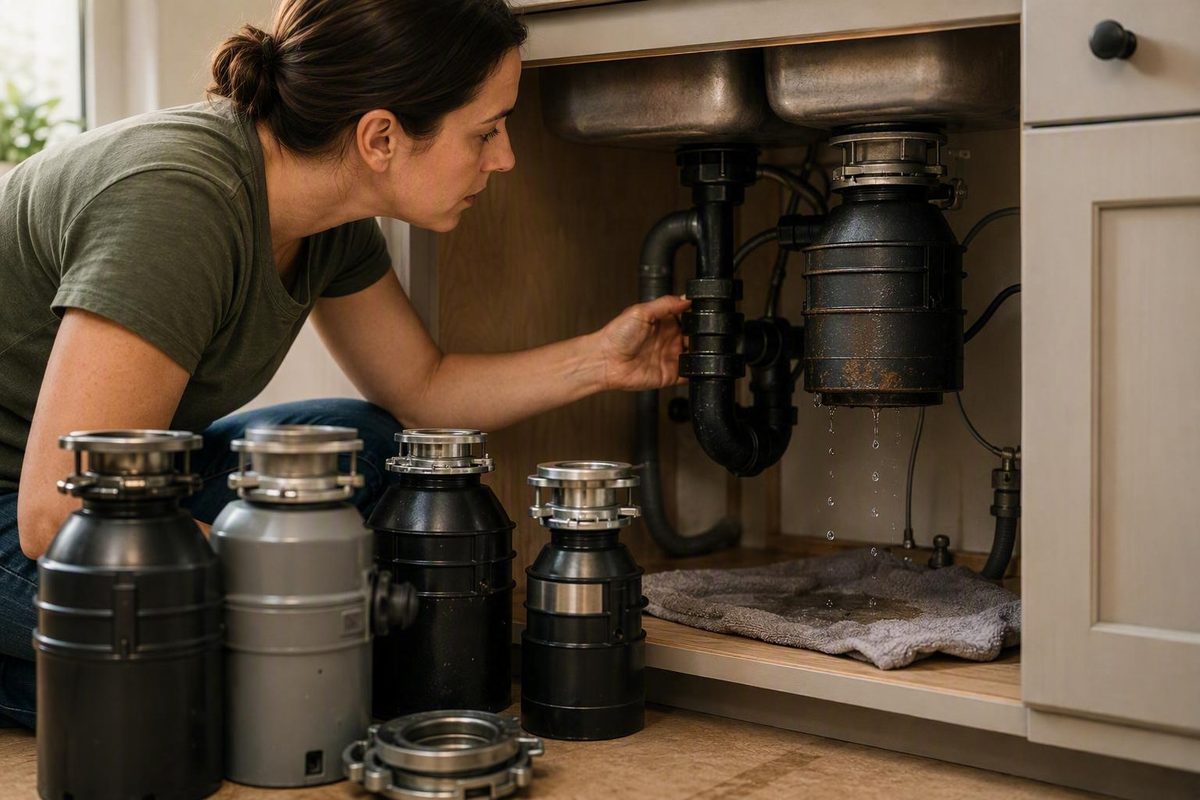
Check whether your Badger model appears in Cohen, how the reported 2018 cutoff applies, what rust and leak signs mean, and which records to save now.
The 2025 Cohen complaint names six InSinkErator disposals: Badger 1, Badger 100, Badger 1XL, Badger 5, Badger 500, and Badger 5XL. Secondary reporting describes a proposed class involving qualifying new units manufactured on or after December 15, 2018, but that is not a court-approved eligibility rule. The supplied evidence does not establish a certified class, settlement, recall, claim form, or compensation program.
The case is Cohen et al. v. InSinkErator, LLC, No. 5:25-cv-10719, filed December 16, 2025, in the U.S. District Court for the Central District of California. The six products are models named in the plaintiffs’ pleading, not models a court has found defective. Read the Cohen complaint.
Enter the label details, check the symptoms you see, and compare your actual repair and replacement quotes.
Badger Model, Date, Symptom, and Quote Lookup
This tool checks the six model names in the complaint and the reported proposed manufacture-date boundary. It cannot determine legal eligibility or decode a serial number.
1. Enter the label details
2. Mark observed symptoms
3. Compare your quotes
The supplied evidence gives no reliable repair or replacement price. Enter quotes you actually received.
4. Check documentation
Result: Enter a model to check it against the complaint.
Model: —
Reported date signal: —
Symptoms: None selected.
Quote comparison: —
Documentation: 0 of 4 items checked.
| Label model | Complaint family | Retailer description in complaint | Named in 2025 complaint? |
|---|---|---|---|
| Badger 1 | Badger 1 family | Base model | Yes |
| Badger 100 | Badger 1 family | Home Depot variant | Yes |
| Badger 1XL | Badger 1 family | Lowe’s variant | Yes |
| Badger 5 | Badger 5 family | Base model | Yes |
| Badger 500 | Badger 5 family | Home Depot variant | Yes |
| Badger 5XL | Badger 5 family | Lowe’s variant | Yes |
| Badger 5XP | Separate 2023 source | Not listed among the six Cohen models | No, based on supplied list |
Sources: 2025 Cohen complaint and supplied ClassAction.org and Top Class Actions reporting. December 15, 2018 is a reported proposed boundary, not a final eligibility rule. Unknown values are shown as —.
The Complaint Covers Two Badger Families and Six Models
The complaint calls the six named products the “Class Badgers” and organizes them into two families.
| Product family | Base model | Home Depot variant identified in the complaint | Lowe’s variant identified in the complaint |
|---|---|---|---|
| Badger 1 family | Badger 1 | Badger 100 | Badger 1XL |
| Badger 5 family | Badger 5 | Badger 500 | Badger 5XL |
Use the exact model printed on the disposal label or shown in reliable purchase, installation, or warranty records. Do not convert a Badger 1 into a Badger 100 merely because someone remembers buying it at Home Depot. Badger 1 is independently named in the complaint.
The same applies to Badger 5 and Badger 500. A retailer, exterior color, horsepower rating, mounting arrangement, or resemblance to another disposal does not establish the model.
Some reports emphasize only Badger 100, 1XL, 500, and 5XL. Those are the four retailer-specific variants. The underlying complaint also names the base Badger 1 and Badger 5, producing the complete six-model list. The ClassAction.org report describes the retailer variants and broader product families.
The supplied materials do not provide a comprehensive retailer-SKU list or production-run chart. A store receipt that says only “Badger disposal” may help establish a purchase, but it may not identify which model was installed.
The Alleged Defect Involves Galvanized-Steel Components
The plaintiffs allege that the Badger 1 and Badger 5 families contain the same or substantially similar challenged components. The complaint identifies galvanized-steel grind components and galvanized-steel upper end frames. It uses UEF to mean upper end frame.
The alleged failure sequence is that ordinary water exposure contributes to corrosion, corrosion reduces grinding performance and product life, and degraded components can eventually allow leaks. The complaint further alleges that escaping water can damage the sink cabinet, flooring, or nearby areas.
Those remain allegations. The supplied evidence does not include a judicial finding that galvanized steel caused a particular failure or that every unit in the six named models has the alleged condition. A February 2026 report similarly describes a proposed class action alleging corrosion, premature failure, leaks, and surrounding property damage. Review the reported allegations.
A Bottom Leak Is More Relevant Than Rust Alone
From beneath the sink, an owner may see exterior corrosion, a rust-colored ring or residue, a drip near the bottom seam, or worsening grinding performance. These observations are worth documenting, but none proves the complaint’s engineering theory.
The source of the water matters. A disposal can become wet because of a leaking sink flange above it, a loose dishwasher connection, a leaking discharge tube, condensation, or a leak through the disposal body. Drying the area and observing where water first reappears can help separate an external plumbing-connection leak from water emerging at the housing or bottom seam.
Do not keep operating a disposal that is dripping near its lower housing or electrical connection. Shut off its power and address the active leak. Waiting for litigation does not protect the cabinet, floor, or electrical components from continuing water exposure.
A plumber may be able to correct a leaking flange, hose, gasket, or discharge connection without replacing the disposal. A leak emerging through a corroded housing or body seam points toward replacement rather than an external plumbing repair. Preserve photographs and the removed unit when practical before disposal.
Grinding slowdown is less specific. It can accompany deterioration alleged in the complaint, but it can also have another mechanical or usage-related cause. Record when it began, whether it is continuous or intermittent, and whether it occurred before or after the first visible leak.
The December 2018 Date Is Proposed, Not Final
Secondary reporting describes the proposed nationwide class as covering qualifying new Badger units manufactured on or after December 15, 2018, or from the earliest date permitted by an applicable limitations period. It also reports that the proposal may include certain purchasers and some people who received otherwise new units through a new-home purchase, remodel, or unused gift.
That language does not create automatic eligibility. Three separate questions remain:
- Is the exact model one of the six named products?
- Do the unit’s manufacture and acquisition circumstances fit the proposed definition?
- Has a court certified a class or approved relief?
The supplied evidence answers only the first question conclusively from the model name. It does not contain a complete manufacturing-date decoder, qualifying serial-number range, or final class definition.
If the label prints a manufacture date, photograph it. If it shows only a serial number, record the complete serial without relying on an unsupported online decoder. A contractor invoice, warranty record, appliance schedule, or purchase receipt may help establish timing, but an installation date is not necessarily the manufacture date.
The materials do not resolve how a final definition might handle secondhand purchases, warranty replacements, prior reimbursements, geographic subclasses, exclusions, or units manufactured before the reported date under the alternative limitations-period language.
Repair, Replace, or Document and Wait
The correct next step depends more on the unit’s present condition than on the lawsuit’s model list.
| Condition under the sink | Practical response | What to preserve |
|---|---|---|
| Named model, dry, no performance change | Document the label and continue observing the unit | Label photo, receipt, installation or home records |
| Surface rust or residue, but no confirmed body leak | Photograph it, check for an external plumbing leak, and monitor the exact area | Dated close-ups and wider installation photos |
| Leak at flange, hose, gasket, or discharge connection | Obtain a connection-repair quote and compare it with replacement | Diagnosis, quote, invoice, before-and-after photos |
| Drip through the housing or bottom seam | Shut off power, stop using it, document the leak, and obtain a replacement assessment | Video or photos, damage records, removed unit if practical |
| Grinding slowdown without a leak | Have the mechanical condition assessed rather than assuming corrosion | Symptom timeline and service report |
| Active cabinet or flooring damage | Stop the water exposure and address the damage now | Dated damage photos, cleanup and remediation records |
No repair or replacement prices are provided in the supplied evidence. The lookup tool therefore compares quotes entered by the homeowner rather than presenting unsupported averages.
A cheaper connection repair can make sense when the disposal body is sound and the source is a serviceable flange, hose, or discharge fitting. Paying to correct an external connection does not resolve a leak through the disposal housing. Conversely, visible rust on a nearby fastener or pipe is not by itself a reason to replace the disposal.
Documenting and waiting is reasonable only while the unit remains safe and dry. An active leak should be repaired or the disposal replaced regardless of whether litigation is pending.
Badger 5XP and Rebranded Units Belong to Separate 2023 Litigation
A plaintiffs’ counsel page published in 2023 identifies a broader group of Badger and allegedly equivalent rebranded products. That list should not be merged with the six models in the 2025 Cohen complaint.
| Brand or grouping | Products reported on the 2023 counsel page |
|---|---|
| Badger | Badger 1, Badger 1XL, Badger 100, Badger 5, Badger 5XL, Badger 5XP, Badger 500 |
| Ambiguous Badger 5XP wording | Badger 5XP variants labeled “100 and 900” |
| Ace | 2000, 3000 |
| Home Depot/Wilmar/Interline | Premier models |
| Evergrind | E101, E102, FWD-1 |
| Westcraft | 7507312, 7507336, 7507302, 7507306 |
| Whirlpool | GC1000PE, WG1202PH, GC5000XE, WG1202XH, GC1000XE |
The supplied material does not establish what the ambiguous “100 and 900” wording represents, so those numbers should not be converted into additional model names.
The June 20, 2023 Milberg page identifies itself as coming from plaintiffs’ counsel and discusses litigation seeking replacement and repair costs. It is not a recall notice or a finding that every listed product is defective. Review the separate 2023 product list.
Badger 5XP, Ace, Premier, Evergrind, Westcraft, and Whirlpool products appear in that 2023 source but not in the supplied six-model list for Cohen. The evidence does not establish that the 2023 litigation and the 2025 case are identical, related, consolidated, or governed by the same product definition.
No Settlement or Claims Process Is Established
The supplied reporting specifically addressing Cohen through February 2, 2026 describes it as a proposed class action. A later attorney investigation page discusses the Badger series generally but does not establish the court docket’s status.
The reviewed materials do not establish any of the following:
- A certified class
- A ruling that InSinkErator is liable
- A judicial finding that the named models are defective
- An approved settlement or official recall
- A claim form or filing deadline
- A refund, repair, replacement, or compensation program
A complaint states allegations, proposed classes, legal theories, and requested relief. Class certification, a merits judgment, settlement approval, and claims administration are separate later stages. A court can also amend or narrow the proposed definition.
Check the current federal docket and any court-approved notice or authorized claims-administrator site before relying on a deadline or promise of payment. An attorney intake form, investigation page, article comment section, or search result is not an official claims process.
Preserve the Label, Leak Evidence, and Expenses
Photograph the complete label before removing the disposal. The image should clearly show the model, serial number, and any printed manufacture information. Take a second photograph showing the disposal in its installed position and wider images showing where water traveled.
Keep available purchase confirmations, contractor invoices, new-home appliance schedules, remodel documents, warranty correspondence, service reports, repair and replacement invoices, and records of cleanup or property damage. Note when rust, reduced grinding performance, dripping, cabinet swelling, or flooring damage first appeared.
If the unit is replaced, ask whether the removed disposal can be retained safely. A discarded unit cannot later be photographed or inspected. Retention is evidence preservation, not proof that the alleged defect caused the failure.
These records may help establish the product, timing, observed condition, and resulting expenses. They do not independently establish class membership or guarantee reimbursement. For the current model question, the controlling six-name answer remains Badger 1, Badger 100, Badger 1XL, Badger 5, Badger 500, and Badger 5XL.