
Well Pump Lifespan Explained: Typical Durations, Risks, and Ways to Extend It
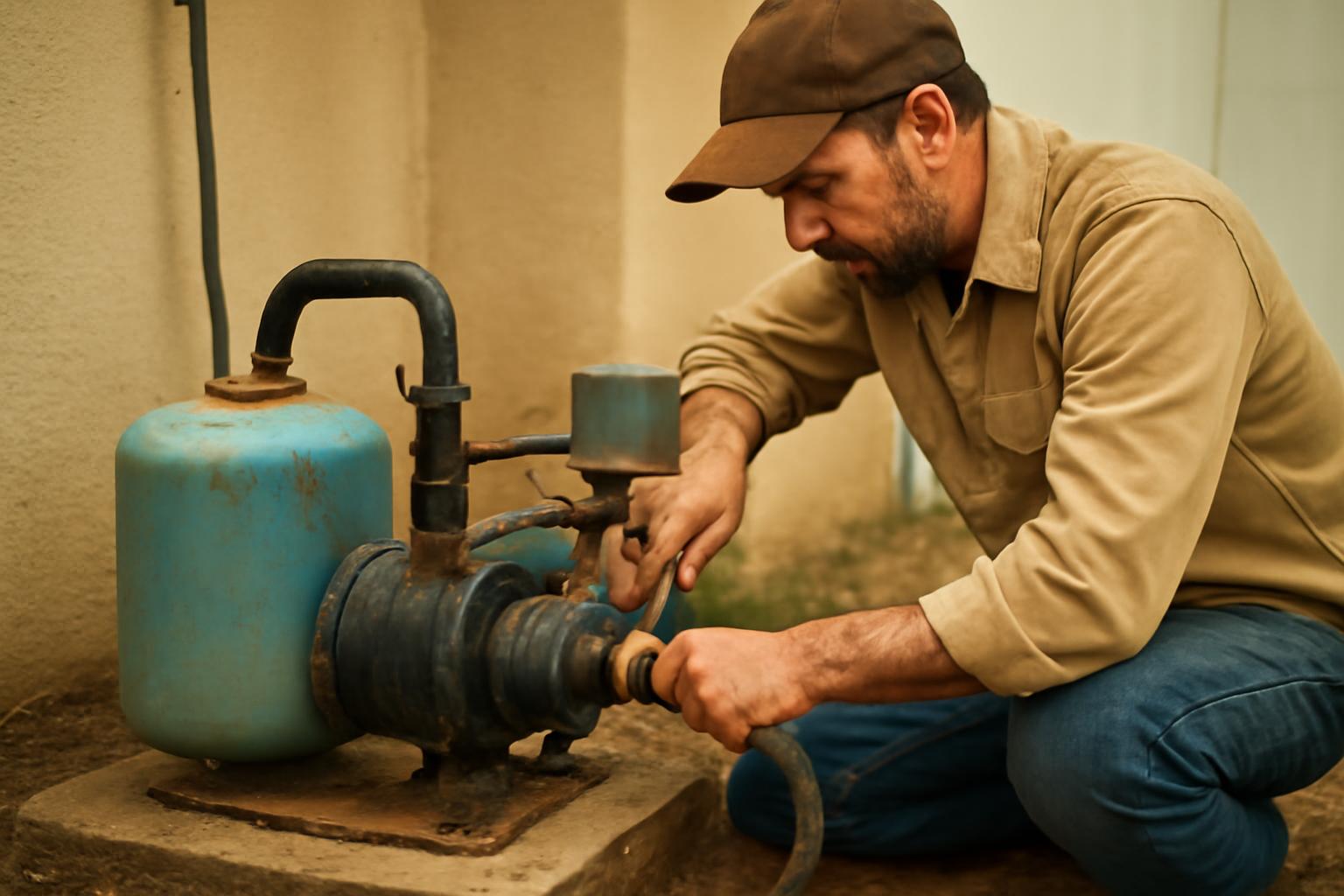
Most residential pumps last about 8 to 15 years. A failing pressure tank can cause short-cycling and faster wear, so age alone isn't enough to replace one.
Well Pump Lifespan Explained: Typical Durations, Risks, and Ways to Extend It
If you’re asking how long does a well pump last, the most defensible short answer is about 8 to 15 years for most residential systems.1234 That is not a warranty or a fixed replacement deadline. It is a planning range drawn from repeated estimates in inspection, drilling, pump-service, and manufacturer guidance.
A pump in clean water, with correct sizing, low cycling, and regular maintenance, may reach the upper end of that range and sometimes go beyond it. A pump dealing with sand, iron, acidic water, electrical stress, bad sizing, or constant on-off cycling can fail much sooner.356
For most homeowners, the practical takeaways are:
- Plan around 8 to 15 years for a typical residential well pump.1234
- Submersible pumps usually outlast jet pumps, though conditions matter more than labels alone.357
- Water quality, cycling frequency, installation quality, and maintenance often matter as much as age.2356
- Pressure tank problems can shorten pump life fast by causing short-cycling.58
- 20+ years is possible but should be treated as a best-case outcome, not the baseline.136
One more point matters up front: a private well is a system, not a single part. The well structure may last decades, while the pump, pressure tank, switch, and controls usually wear out much sooner.29 That is why pump-life questions are best answered as rules of thumb, not precise predictions.
Average Lifespan of Well Pumps
Across published industry guidance, 8 to 15 years is the clearest general estimate for residential well pump life.1234 You will also see nearby variations such as “roughly 15 years,” “10 to 15 years,” or “10 to 20 years for quality-made pumps.”41011 Those figures are not necessarily contradictory. They usually reflect different assumptions about pump type, water quality, workload, and maintenance.
A useful way to read the ranges is:
| System condition | Reasonable expectation |
|---|---|
| Most residential well pumps | 8 to 15 years |
| Better-made pumps in favorable conditions | 10 to 20 years |
| Very favorable cases | 20+ years can happen, but it is not the norm |
That last row needs care. Some sellers and service companies mention outlier pumps lasting well beyond 20 years, and a few anecdotal reports stretch farther.1112 Those cases are real enough to show what is possible, but they are not strong planning data. If you are budgeting, deciding whether to repair an aging system, or trying to avoid a surprise no-water event, the safer baseline is still 8 to 15 years.
Why is there no fixed service life? Because two wells that look similar from the kitchen sink can be very different to the pump. Lifespan changes with:
- sediment and sand levels
- iron, manganese, and hard-water minerals
- acidic or low-pH water
- well depth
- daily household demand
- irrigation or livestock use
- pressure tank size and condition
- installation quality
- electrical stability
- how often the pump starts and stops235611
So when homeowners ask for a single number, the honest answer is: use a range, then narrow it with local conditions. Age matters, but the system around the pump matters just as much.
Submersible vs. Jet Pump Lifespans
Pump type is one of the biggest reasons lifespan estimates vary.
Submersible pumps
For residential submersible well pumps, the most commonly reported lifespan is 8 to 15 years.35710 In favorable conditions, many reach the upper end of that range, and some well-maintained or premium units may run 15 to 20 years or a bit longer.613
Submersibles often last longer because they are installed down in the well, submerged in water, and they push water upward rather than pull it by suction.37 That design gives them several advantages:
- the surrounding water helps cool the motor
- they are protected from weather and above-ground temperature swings
- they are generally better suited to deeper wells
- they tend to be efficient in many deep-well applications37
That does not mean a submersible is immune to wear. Sand can abrade impellers and seals. Minerals can create buildup. Frequent starts and stops still stress the motor. And when a submersible fails, service is often more involved because the pump has to be pulled from the well.
Jet pumps
Jet-pump lifespan is less settled. The published estimates overlap, and that is exactly how homeowners should read them.
Many sources place jet pumps around 5 to 10 years.35 Others put them closer to 8 to 12 years or even 10 to 15 years when well maintained and used in favorable conditions.614 A practical synthesis is this:
- Jet pumps often land somewhere in the 5 to 15 year range
- Many have shorter service lives than comparable submersibles
- Hard-working shallow and deep jet systems often show up toward the lower end5614
Some sources split the jet category further:
- shallow-well jet pumps: often cited around 4 to 10 years or 10 to 15 years, depending on conditions and source146
- deep-well jet pumps: often cited around 5 to 10 years or 8 to 12 years146
That spread is why it is better to say “jet pumps are more variable and often shorter-lived” than to present one neat number.
Jet pumps often wear out sooner because:
- they are installed above ground
- they are more exposed to temperature swings, moisture, dust, and general environmental wear
- they pull water by suction, which is harder work in many applications than a submersible’s push-from-below design
- priming issues can add stress or signal aging equipment578
Which lasts longer in real homes?
In most homes, the safest conclusion is:
- Submersible pumps: usually 8 to 15 years, sometimes longer in excellent conditions357
- Jet pumps: more variable, often shorter-lived, with many estimates clustering lower than submersible ranges5614
That is one reason submersibles are commonly preferred for deeper wells.714 But type is only part of the story. A badly sized submersible in sandy water can fail early. A gently used jet pump in decent conditions can outlast expectations. Type matters; operating conditions decide the real outcome.
Factors That Shorten Well Pump Life
Early pump failure is often a stress problem, not just an age problem. The usual culprits are predictable.
Poor water quality
Water quality is one of the biggest drivers of pump lifespan.356
Common troublemakers include:
- sand
- sediment
- silt
- iron
- manganese
- hard-water minerals
- acidic or low-pH water
These hurt pumps in different ways. Sand and sediment act like abrasive grit inside the pump, wearing impellers, seals, and bearings. Mineral-heavy water can leave buildup that reduces efficiency and makes the pump work harder. Acidic water can corrode metal parts in the pump and other system components.36
This is why two pumps of the same age can come out of different wells in very different shape.
Frequent cycling
Every start-up adds stress. Pumps are built to run, but they wear faster when they switch on and off too often.568
This is the classic short-cycling problem. Common causes include:
- an undersized pressure tank
- a failing pressure tank bladder
- pressure switch issues
- leaks in the plumbing system
- water-use patterns that cause lots of small draws568
If the tank cannot store enough pressurized water, the pump has to start more often. That repeated start-stop behavior is hard on the motor. Several sources specifically point to pressure-tank failure as a common reason pumps wear out earlier than expected.58
Improper sizing
A pump has to match both the well and the home’s demand. When it does not, lifespan suffers.3613
Two different sizing mistakes can cause trouble:
- an undersized pump may run too long, struggle to keep up, or overheat
- an oversized pump may move water too aggressively for the system and contribute to cycling problems613
Sizing decisions depend on:
- well depth
- yield
- household demand
- irrigation load
- pressure settings
- tank capacity
This is one of the costliest places to guess.
Installation issues
Even a good pump can have a short life if the installation is poor.236
Potential installation-related problems include:
- incorrect pump depth
- improper wiring or control setup
- mismatched pressure settings
- bad connections
- poor alignment between pump selection and the well’s real yield or sediment conditions
A young pump can fail simply because it was never set up correctly.
Power surges and electrical problems
Pumps rely heavily on their motors and controls, so electrical stress matters.36
Lightning, unstable electrical service, faulty wiring, or repeated fluctuations can damage a motor or control components. In some cases, a surge can ruin a pump quickly. In others, smaller electrical problems shorten life gradually.6
Heavy use, especially irrigation
Usage patterns change lifespan. A home with modest indoor water demand places less strain on a pump than a property that also uses well water for:
Heavy use can mean more cycles, longer run times, or both.
Dry running or continuous running
A pump is meant to move water, not air. If it runs dry, overheating and damage can follow.613 At the other extreme, a pump that runs continuously may be fighting a leak, low well yield, or a pressure problem.6
Neither condition should be treated as normal.
In short, the biggest threats to pump life are usually clear: abrasive water, corrosive water, short-cycling, bad sizing, poor installation, electrical stress, and overwork.
Signs Your Well Pump Is Failing
Pump failure is not always sudden. Often, the system gives warning signs first. The important caveat is that those signs may point to the pump, the pressure tank, the controls, the well, or the plumbing. A symptom is a reason to investigate, not always a reason to replace the pump.
Low or inconsistent water pressure
This is one of the most common warning signs.346
You might notice:
- weaker showers
- faucets with less force than usual
- pressure that fluctuates during use
- pressure that starts strong and fades
A weakening pump is one possible cause, but so are tank problems, clogged filters, or other restrictions in the system.
Frequent short-cycling
If the pump turns on and off too often, something is wrong.568
In a home, this may look like:
- the pump starting with very small water draws
- rapid pressure swings
- repeated on-off operation over short periods
This often points to a pressure-tank problem, especially a failed bladder or waterlogged tank, but it also accelerates pump wear.
Strange noises
Grinding, rattling, sputtering, or rough operation can all be warning signs.34
Jet pumps are easier to hear because they are above ground. With submersibles, homeowners may notice the signs indirectly through pipe vibration, pressure changes, or noisy controls rather than hearing the pump itself.
Air in the lines
If faucets spit air or sputter, the system may be drawing air somewhere it should not.36
Possible causes include:
- pump wear
- piping leaks
- dropping water level
- well supply issues
- suction-side problems in jet-pump systems
Discolored or cloudy water
Cloudy, dirty, rusty, or sediment-laden water can be a warning sign, especially when it appears alongside pressure or flow changes.36
Possible causes include:
- disturbed sediment
- pump wear
- well-screen or well-condition problems
- corrosion-related issues
- low-water conditions pulling in more debris
Rising electric bills
A pump that is running too often, running too long, or losing efficiency may use more power.346 A higher electric bill alone is not proof of pump failure, but it matters more when it shows up with pressure or water-delivery changes.
No water at all
No water is the clearest sign that the system has failed or shut down.34
Before assuming the pump is dead, homeowners can check a few basics:
- tripped breaker
- power loss
- obvious reset issues on related equipment
If power is present and there is still no water, the next step is usually professional diagnosis.
Continuous running
A pump that never seems to shut off is also a red flag.36
That may point to:
- a plumbing leak
- pressure-tank trouble
- low well yield
- pressure-switch problems
- a pump struggling to reach cutoff pressure
Continuous running can overheat and damage the pump if ignored.
The main takeaway: these warning signs overlap. Low pressure does not always mean “replace the pump.” Short-cycling does not always mean the pump is bad. But any of these symptoms can shorten pump life if left unresolved.
Role of Pressure Tanks and Other Components
A well pump does not operate by itself. Its lifespan is tied closely to the rest of the system, especially the pressure tank.
Why the pressure tank matters
The pressure tank stores water under pressure so the pump does not need to start every time you open a faucet.58 That matters because repeated starts are one of the biggest causes of pump wear.
When the tank is healthy and properly matched to the system:
- the pump starts less often
- pressure delivery is steadier
- the motor sees less start-up stress
When the tank is failing, especially if the bladder has failed or the tank is waterlogged:
That is why a “pump problem” sometimes turns out to be a tank problem that has been stressing the pump for months.
How long does a pressure tank last?
Published guidance usually places pressure-tank lifespan around 7 to 15 years, with several sources clustering around 7 to 12 years or 10 to 15 years.259
That means pump and tank lifespans often overlap. If one is failing, it is smart to inspect the other instead of treating them as unrelated.
Can a larger tank help?
Often, yes. An appropriately sized larger pressure tank can reduce cycling because it gives the system more usable drawdown volume between pump starts.611 The key word is appropriately. Bigger is not automatically better in every setup, but too little drawdown is often hard on pumps.
For homeowners, the practical checkpoint is simple: if the pump starts with very small water uses, or cycles noticeably more than it used to, the tank and pressure settings deserve attention.
How long does the well itself last?
The well structure is a different story from the pump. The well casing and borehole often last 30 to 50 years or more, and some sources cite 40 to 50+ years for properly constructed residential wells.29
That surprises many homeowners, but it is normal for:
- the well structure to last decades
- the pump to need replacement roughly every decade or so
- the pressure tank to last on a similar but separate schedule
- the controls and switches to wear on their own timetable
Electrical components and controls
Some drilling guidance places electrical components and controls in the 10 to 20 year range as a rule of thumb.2 That category can include switches, control boxes, and related hardware, but actual life depends heavily on moisture, power quality, and service conditions.
This matters because electrical problems can mimic pump failure. A pump may appear dead when the actual fault is in a switch, relay, or control component.
The broader lesson is simple: pump life is system life. If you diagnose only the pump, you can miss the cause.
Maintenance Tips to Extend Pump Life
You cannot guarantee a pump will last 15 years, but you can improve the odds.
1. Schedule regular inspections
Routine inspection helps catch small problems before they turn into a pump failure.2410
A good rule of thumb is:
- pay attention to the system year-round as a homeowner
- have the well system checked at least annually
- treat professional inspection every 1 to 2 years as a common maintenance benchmark, especially for older systems or submersible pumps21015
A homeowner can monitor symptoms such as pressure changes, visible leaks, unusual cycling, dirty water, or breaker trips. A professional can go further with pressure checks, electrical testing, control evaluation, and diagnosis of issues that are not visible at the surface.
2. Test water quality at least yearly
The EPA recommends private well owners test water at least once a year.16 That guidance is mainly about water safety, but it also helps with pump longevity.
Testing can reveal conditions that shorten pump life, such as:
Testing does not fix the pump by itself. It tells you what kind of environment the pump is working in.
3. Manage sediment if your well has it
If sand or sediment is a known issue, some form of sediment management may be warranted.615 That could mean a sediment filter or another treatment approach suited to the water conditions.
The goal is straightforward: reduce abrasive material before it causes ongoing wear to the pump and downstream plumbing.
4. Keep the pressure tank healthy
Pressure-tank care is pump care.
Watch for:
- short-cycling
- pressure swings
- reduced drawdown
- signs of tank failure
- age that overlaps normal tank lifespan58
If the tank is failing, replacing it may protect the pump from further wear.
5. Make sure the system is properly matched
If you are replacing a pump or modifying the system, proper sizing is one of the biggest life-extension decisions you can make.613
That means matching the pump to:
- well depth
- well yield
- household demand
- irrigation load
- pressure settings
- tank capacity
A system can appear to work while quietly shortening its own lifespan.
6. Use surge protection where appropriate
Because electrical problems can damage motors and controls, surge protection is a sensible precaution for many well systems.615 This is especially relevant in areas with storms, lightning exposure, or unstable power.
7. Avoid dry running
A pump should not run without water.613 Low-yield wells, drought conditions, leaks, or control problems can increase that risk. If your property has a history of low-water events, ask a well professional whether additional controls or protections make sense.
8. Don’t ignore changes in performance
Homeowners often get warning signs before total failure:
- lower pressure
- more frequent cycling
- cloudy water
- strange noises
- inconsistent flow
- higher energy use346
Treat those changes as early alerts.
9. Maintain accessible above-ground components
For above-ground equipment such as jet pumps or visible control areas, basic care may include:
- keeping the area clean and dry where applicable
- checking for visible corrosion or leaks
- noticing loose-looking connections or moisture problems
- following manufacturer guidance on any service items
Some above-ground pumps may have maintenance points such as lubrication, but that depends on the design.13 If you are not sure, defer to the manufacturer or a technician rather than guessing.
10. Know where DIY stops
Most homeowner maintenance is about observation and simple checks, not invasive repair. Reasonable homeowner actions often include monitoring pressure behavior, checking the breaker, noticing leaks, and scheduling testing or service. Pulling a submersible pump, opening energized electrical gear, or diagnosing internal pump faults is usually technician work.
It makes sense to call a professional when you have:
- no water
- continuous running
- repeated breaker trips
- persistent short-cycling
- suspected tank failure
- signs of air or sediment entering the system
- a pump that may need to be pulled from the well
Good maintenance extends life partly because it shortens the time between first symptom and correct diagnosis.
When to Replace Your Well Pump
A well pump does not need replacement on a fixed birthday, but age still matters.
A practical rule is to start thinking more seriously about replacement once a residential pump is in the 10 to 15 year range, especially if it is also showing symptoms.46 That does not mean every 10-year-old pump should be replaced. It means the odds of age-related wear are high enough that repair decisions deserve more scrutiny.
Replace based on age plus symptoms
Replacement becomes more likely when age combines with problems such as:
- low or inconsistent pressure
- repeated short-cycling
- noisy or rough operation
- cloudy or dirty water linked to pump performance
- rising electric use
- no-water events
- continuous running
- clear loss of efficiency346
An older pump with a major failure is different from a newer pump with a single bad switch.
Repair vs. replace: four useful questions
-
How old is the pump? A pump near or beyond the common 8 to 15 year window is harder to justify repairing heavily.123
-
What actually failed? If the issue is a pressure switch, control, or tank, the pump may still have useful life left. If the motor or internal pump components are failing, replacement becomes more likely.
-
Has performance dropped? A pump that still runs but delivers poor pressure, cycles badly, or struggles to reach cutoff may be nearing the end even if it has not fully stopped.
-
Are repair costs stacking up? Repeated service calls on an aging pump can make replacement the more practical path.4
Don’t budget around 30 years
A few pumps do last exceptionally long, but well pumps do not usually last 30 years.12 Mechanical wear, electrical stress, seals, corrosion, and cycling usually catch up first. For planning purposes, it is better to view a 30-year pump as a rare exception than as something to count on.
Replace younger pumps when the cause is serious
Age is not everything. A pump may need replacement well before 8 years if it has been damaged by:
- bad sizing
- flawed installation
- harsh water
- severe short-cycling
- electrical damage
- dry running
- heavy-duty use beyond the original design3613
A younger pump is not automatically a healthy pump.
Get an on-site evaluation
Because well systems vary so much, the best replacement decision usually comes from an on-site professional evaluation.34 That matters because replacing the pump without fixing the root cause can set up the next pump to fail early too.
For most homeowners, the practical takeaway is: plan around 10 to 15 years, move faster if warning signs appear, and do not rely on age alone without diagnosis.
FAQ
Can a well pump last 20 years or more?
Yes, some well pumps can last 20 years or more, especially submersible units in clean water with good sizing, moderate use, and low cycling.3613 But that is better treated as a best-case outcome than a standard expectation. For planning, the stronger baseline is still 8 to 15 years.1234
Why do some well pumps fail before 8 years?
Early failure usually points to stress: sand or sediment, corrosive water, short-cycling from a bad or undersized pressure tank, poor sizing, poor installation, electrical damage, dry running, or unusually heavy use.5614 In those cases, replacing the pump alone may not solve the real problem.
How often should I inspect my well pump?
A sensible approach is ongoing homeowner monitoring, at least annual system attention, and professional inspection on a regular schedule—often every 1 to 2 years as a rule of thumb, especially for aging systems or harder-to-access submersible setups.21015 You should call sooner if you notice pressure changes, air sputtering, cycling problems, breaker trips, or any no-water event.
Does water quality testing help pumps last longer?
Yes, indirectly. Water testing can reveal sand, sediment, iron, manganese, hardness, or acidic water that may be abrading, clogging, or corroding the system.3615 Once you know those conditions exist, you can respond with treatment, filtration, or maintenance planning. The EPA’s yearly testing recommendation also makes testing a good safety practice for private-well owners.16
Most residential well pumps deliver about 8 to 15 years of service, but that range is only the start of the conversation. Water quality, cycling frequency, tank condition, sizing, and maintenance often matter more than calendar age. If you want the longest realistic life from your system, focus on yearly water testing, routine system checks, and quick attention to pressure or cycling changes. And when a pump starts acting up, get the whole well system evaluated rather than guessing from one symptom.
-
America’s Choice Inspections, How Long Does a Home’s Well Pump Last?; Cardinal Home Services, How Long Will Your Well Pump Last?; Wragg Brothers, Maximize Your Well Pump’s Life: How Long Will a Well Pump Last? ↩↩↩↩↩↩
-
Bemis Well Drilling & Water Conditioning, The Lifetime of a Well: What to Expect and How to Make Yours Last 40+ Years. ↩↩↩↩↩↩↩↩↩↩↩↩↩↩↩
-
America’s Choice Inspections, How Long Does a Home’s Well Pump Last? ↩↩↩↩↩↩↩↩↩↩↩↩↩↩↩↩↩↩↩↩↩↩↩↩↩↩↩↩↩↩↩↩↩↩↩
-
Wragg Brothers, Maximize Your Well Pump’s Life: How Long Will a Well Pump Last?; Keyser Well Drilling, How to Extend the Life of Your Water Well Pump. ↩↩↩↩↩↩↩↩↩↩↩↩↩↩↩
-
G&C Plumbing, How Long Do Well Pumps & Tanks Last? Lifespan by Type & Usage. ↩↩↩↩↩↩↩↩↩↩↩↩↩↩↩↩↩↩↩↩↩
-
SC Well Service, Well Pump Lifespan: 8-15 Years (How to Extend It). ↩↩↩↩↩↩↩↩↩↩↩↩↩↩↩↩↩↩↩↩↩↩↩↩↩↩↩↩↩↩↩↩↩↩↩↩↩↩↩↩↩
-
SC Well Service, Jet Pump vs Submersible Pump: Which Is Better?; Cardinal Home Services, How Long Will Your Well Pump Last? ↩↩↩↩↩↩↩
-
G&C Plumbing, How Long Do Well Pumps & Tanks Last? Lifespan by Type & Usage; America’s Choice Inspections, How Long Does a Home’s Well Pump Last? ↩↩↩↩↩↩↩↩↩
-
Night Owl Monitoring, How Long Does a Water Well Last?; Bemis Well Drilling & Water Conditioning, The Lifetime of a Well. ↩↩↩
-
An Pump, 7 Best Practices for Maximizing the Lifespan of Submersible Well Pumps; Keyser Well Drilling, How to Extend the Life of Your Water Well Pump. ↩↩↩↩↩
-
RPS Water Pumps, How Many Years Should a Submersible Well Pump Last? ↩↩↩↩
-
Night Owl Monitoring, How Long Does a Water Well Last? FAQ on pumps rarely lasting 30 years. ↩↩
-
Epp Well Solutions, How to Extend the Lifespan of Your Well Pump. ↩↩↩↩↩↩↩↩↩↩
-
SC Well Service, Jet Pump vs Submersible Pump: Which Is Better? ↩↩↩↩↩↩↩
-
Keyser Well Drilling, How to Extend the Life of Your Water Well Pump; An Pump, 7 Best Practices for Maximizing the Lifespan of Submersible Well Pumps. ↩↩↩↩↩↩
-
U.S. EPA, Private Wells (
epa.gov/privatewells), as linked and summarized in America’s Choice Inspections: private well owners should test their water at least once a year. ↩↩