
Flushable Wipes Stuck in Scaled Cast Iron Pipes: Spot the Signs, Clear Safely, and Prevent Recurrence
A flushable wipe stuck in a cast iron scale pipe is rarely just “a toilet problem.” In older homes, the toilet may still flush, at least at first, while the…
By Miles Carver ·
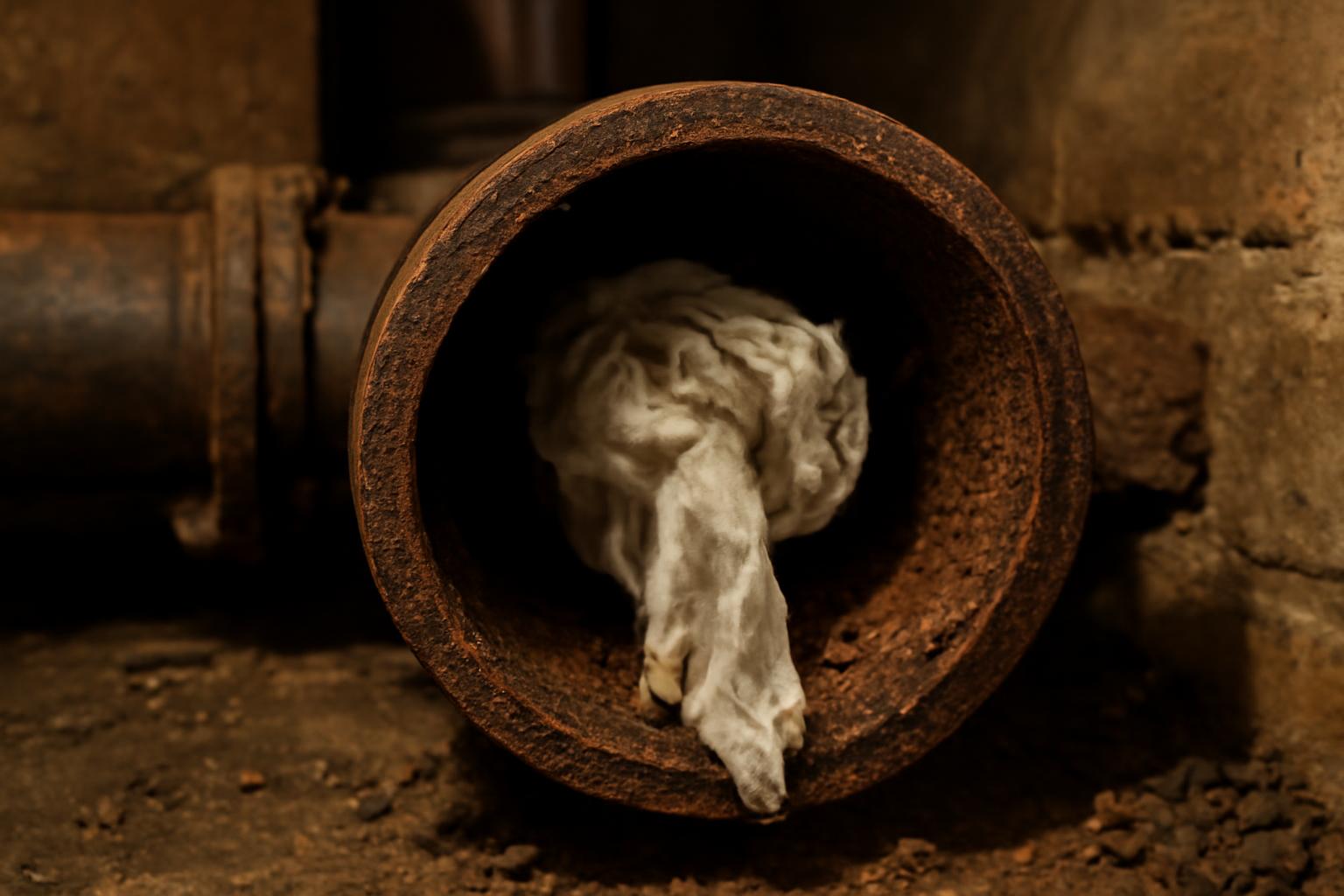
A flushable wipe stuck in a cast iron scale pipe is rarely just “a toilet problem.” In older homes, the toilet may still flush, at least at first, while the real trouble begins farther down the line where a wipe catches on rust scale, a rough joint, a slight offset, or a sagging section. Once that first wipe hangs up, the pipe starts collecting everything else that follows: paper, grease, hair, soap residue, and solids.
That is why these clogs confuse homeowners so often. Nothing dramatic may happen on day one. A plunger might seem to help. A basic snake may restore flow for a short stretch. Then the tub gurgles when the toilet flushes, the bathroom sink slows, or the lowest drain in the house backs up again. The symptom pattern matters as much as the clog itself.
The practical goal is not to argue with the word “flushable.” It is to answer three questions in the right order:
- Is the blockage near one fixture, or deeper in the cast iron system?
- Is there a limited DIY attempt worth making?
- When does recurrence mean you need a camera inspection instead of another blind snake?
If you want a broader symptom-first framework for household drain problems before you start, DrainFinder’s main drain-diagnosis overview is a useful house reference for separating simple fixture clogs from main-line warnings.
When to Call a Plumber: The Drain Symptoms That Mean Stop DIYing: Most drain clogs are DIY-fixable in under 30 minutes. These seven symptoms are the exceptions — signs of main-line, sewer, or structural problems that get worse if you wait.
Why Flushable Wipes Get Stuck in Cast Iron Scale Pipes
The core difference between toilet paper and wipes is not whether both disappear from the bowl. It is what happens after that. Toilet paper is designed to lose strength quickly in water. Wipes are designed to stay durable while wet, which is helpful in use and troublesome in a drain line. Plumbing companies that work on older systems repeatedly describe the same failure sequence: the wipe clears the toilet, stays largely intact, and then snags when it meets rough cast-iron walls, scale, a belly, or an offset (Arco Plumbing).
That rough interior is what makes aging cast iron so different from newer plastic pipe. As cast iron ages, corrosion, rust, and mineral buildup create a rough, narrowed interior surface. Instead of acting like a smooth chute, the pipe starts behaving more like sandpaper. In homes that still have original drainage from before about the 1970s, that roughness is a major reason wipes catch more readily than they would in a smoother line (Main Line Rebuild).
Once a wipe catches, it becomes an anchor point. The next wipe may snag on it. Toilet paper can wrap around it. Grease can coat it. Hair and soap residue can bind into the mass. Over time, what began as one sheet of durable material can turn into a rope, wad, or dense mixed obstruction. Field reports from plumbers and sewer-line companies consistently describe that kind of gradual accumulation rather than a single neat “plug” sitting in the pipe.
This is also why a single wipe often does not create an immediate toilet overflow. It may pass the bowl and trap, travel partway down the branch or main, and then lodge farther downstream. From there, it quietly sets up the next blockage. In other words, the delay is part of what makes the problem so misleading. A wipe can “flush” in the everyday sense while still failing in the plumbing sense.
Pipe imperfections beyond scale matter too. Wipes are more likely to catch where a line has a rough hub, a slight misalignment, a sag, a bend, or existing debris on the pipe wall. Sewer-line guidance about wipe clogs describes those snag points broadly as rough surfaces, joints, and bends where wipes start collecting grease and other waste (Eagerton Plumbing).
That distinction matters because it changes the fix. If you remove only the newest wipe mass but leave behind the rough, narrowed cast iron that trapped it, the line may drain again for a while without being truly restored. In that sense, the wipe is often the trigger, while the scaled pipe is the condition that made the trigger effective.
Signs Your Cast Iron Pipes Have a Stuck Wipe Clog
The strongest clue is not what one fixture does by itself. It is what several fixtures do together. When wipes build up farther down a stack or building drain, the toilet, tub, and sink may all start draining poorly around the same time. Gurgling, sewer odor, or backups in the lowest drain are also common warning signs when the shared path out of the house is restricted rather than one local trap alone (Eagerton Plumbing).
Wipe-related clogs in scaled cast iron often have a recognizable rhythm. First, everything seems a little slow. Then one fixture reacts when another is used. A toilet flush makes the tub burp. Running the sink changes the bowl level. A shower drains, but sluggishly, and the toilet starts gurgling. Those cross-fixture interactions usually mean the restriction is beyond the individual fixture.
Recurring clogs after snaking are another strong clue. Forum cases involving baby wipes in cast iron describe temporary restoration after augering, followed by the same bathroom group clogging again because material remained snagged farther down the line. In those anecdotes, the important pattern was not “the snake failed completely,” but “the snake opened a path without really clearing the cause” (Plbg.com forum discussion).
At the same time, the symptom pattern does not prove wipes are the only culprit. Grease, roots, severe scale, or a sagging line can create many of the same symptoms. A house-wide slow drain does not diagnose wipes by itself. What it does tell you is that you are likely past the point of a simple local toilet or sink clog.
The absence of an immediate overflow does not rule wipes out, either. A wipe can hang up far enough downstream that the toilet still looks normal for a while. If the line is only partly restricted, the system may continue draining—slowly—until enough additional debris arrives to turn that restriction into a real stoppage. In older cast iron systems, that delayed failure is a common part of the story.
Diagnose Branch vs Main Line: Is It a Wipe in Your Cast Iron Stack?
Start with the simplest division: one fixture or many. If only one toilet is slow and the nearby sink and tub behave normally, the clog is more likely in the toilet, trap, or short branch serving that fixture. If two or more fixtures slow at once—especially on the same floor or stack—think beyond the local fixture.
As a homeowner rule of thumb, DrainFinder’s overview treats a single slow drain as a likely branch issue and multiple slow drains as a main-stack or sewer-line warning. That matches the broader field guidance in cast-iron wipe discussions, which treat cross-fixture symptoms as a sign the problem is deeper than one trap or fixture arm (DrainFinder overview).
A main-line restriction often announces itself through interactions between fixtures. Flush the toilet and hear the tub gurgle. Run the sink and watch the toilet water shift. Shower water drains slowly and the bowl starts burping. Those are shared-line symptoms. They do not tell you with certainty that the obstruction is wipes, but they do tell you the clog is probably not sitting just inside the toilet.
At that point, the problem is no longer “try harder.” It is “locate the obstruction without damaging the system.”
Age and material help you judge risk, but only up to a point. Homes built before about the 1970s are more likely to still have some original cast iron, and field guidance aimed at those homes consistently describes scaled cast iron as more vulnerable to wipe snags than smoother PVC (Main Line Rebuild). Still, visible pipe in a basement tells you only so much.
There are some useful visual clues for homeowners:
That last point is where many people get tripped up. Homeowners can often identify likely pipe material. They usually cannot identify internal condition without seeing inside the line. If you have older cast iron and recurring shared-fixture symptoms, the safest assumption is not that you know the line’s condition. It is that you do not.
A few symptom combinations should move you quickly out of DIY mode even before wipes are confirmed:
- multiple fixtures on different levels slowing together,
- sewage odor plus intermittent drainage trouble,
- recent augering followed by quick recurrence,
- backup showing up in the lowest drain,
- or hard cable resistance well beyond the obvious fixture run.
Those signs do not prove a wipe snag in the stack. They do show that you are dealing with a system problem, not just a toilet problem.
Safe DIY Removal Attempts for Flushable Wipes in Cast Iron
You can make a DIY attempt, but the goal needs to stay narrow: relieve or remove a nearby obstruction without turning an old-pipe problem into a damaged-fixture problem. This is not the situation for repeated test flushes, random chemicals, or oversized tools.
A reasonable first sequence is the least aggressive one. Consumer wipe-clog guidance recommends starting with hot tap water and a little dish soap, then using a proper flange plunger, and then moving to a toilet auger if needed. That same guidance also stresses that the wipe itself is not something you should expect a magic liquid to dissolve quickly (Phoenix Wipes).
A safe homeowner sequence looks like this:
- Stop flushing repeatedly. Every flush can add more paper and water to a partial obstruction.
- Let a high bowl settle before you do anything else. You want working room, not an overflow.
- Use a flange plunger, not a flat sink plunger. Controlled strokes work better than wild pounding.
- Try hot tap water with a little dish soap. Pour from about waist height for some force, but use hot tap water, not boiling water.
- Move to a toilet auger if plunging fails. Work slowly when you feel resistance rather than forcing it.
If you suspect a dropped object rather than a soft clog, change approach before you snake. DrainFinder’s homeowner guidance treats hard-object drops as a wet-vac-first problem, not a “keep pushing” problem. That distinction matters because a wipe mass may be hookable, while a toy, cap, or other object may need retrieval instead of further shoving down the line (DrainFinder overview).
For homeowner tools, stay small and manual. DrainFinder describes 1/4-inch or 5/16-inch hand snakes as typical homeowner-scale tools, and Phoenix Wipes notes that a toilet auger uses a protective boot to reduce the chance of marring porcelain during toilet work (DrainFinder overview; Phoenix Wipes). The important principle is not the exact brand. It is that homeowner work should stay in the realm of small mechanical removal, not large powered sewer-cleaning equipment.
That means a few practical limits:
- If resistance is deep, firm, and not near the fixture, stop before you kink cable or misdiagnose the problem.
- If the line clears briefly and then quickly clogs again, treat that as partial relief, not proof of a clean pipe.
- If multiple fixtures are already involved, DIY becomes a much weaker bet.
What not to do matters just as much.
Do not rely on harsh drain chemicals for a wipe clog. Forum advice about recurring baby-wipe blockages in cast iron specifically rejects the idea of a safe chemical dissolver for the wipes, and consumer guidance says bleach is ineffective on wipe fabric while sulfuric-acid-type products carry heat, fume, and burn risks (Plbg.com forum discussion; Phoenix Wipes).
Likewise, do not jump straight to a large powered snake because the problem “must be farther down.” DrainFinder’s general homeowner cautions say bigger motorized snakes can damage vulnerable fittings in some systems, and recurring wipe cases in cast iron often turn out to be diagnosis-and-access problems, not “not enough force” problems. If the line needs real sewer cleaning, that is usually a cleanout-and-camera job, not a bigger cable through a toilet opening.
The smartest DIY threshold is simple: if the clog seems close and you can attempt gentle mechanical removal, try it once. If the symptoms are shared, deep, or recurring, stop before the job shifts from unclogging to repair.
When to Call a Plumber: Camera Inspection and Hydro-Jetting
If the clog keeps returning after plunging, augering, or even professional snaking, stop treating the problem as a one-time blockage. In recurring cast-iron wipe cases, the repeated story is temporary flow restoration followed by another backup because residual wipes remain snagged downstream or the rough pipe keeps trapping new debris. Plumbers in forum discussions about exactly that pattern commonly steer homeowners toward a camera, a cleanout, and better access instead of more blind snaking through a removed toilet (Plbg.com forum discussion).
A camera inspection matters for two separate reasons.
First, it tells you what is in the line. Slow drains and backups can come from wipes, roots, grease, heavy scale, a sagging section, or some combination of them. Without a camera, a plumber may know there is a restriction without knowing whether it is a wipe rope hanging on scale, a root mass at a joint, or a section so narrowed that ordinary paper keeps catching.
Second, it tells you whether the pipe can safely handle the cleaning being proposed. Cast-iron specialists consistently recommend scoping before and after cleaning because hydro-jetting is useful only when the line is still structurally serviceable. If the wall is badly corroded, cracked, or too thin, the question changes from “How do we clean this?” to “Is this pipe a candidate for rehab or replacement instead?” (Main Line Rebuild).
For homeowners, the most useful part of a camera inspection is not the video itself. It is what the findings mean for the next decision. In practical terms:
- Isolated wipe mass in an otherwise decent line: targeted clearing may be enough.
- Heavy scale with trapped debris but sound walls: camera-guided cleaning or hydro-jetting may make sense.
- Roots at joints or clear misalignment: cleaning alone may not stop recurrence.
- Severe corrosion, leaks, or very poor wall condition: the line may be beyond dependable cleaning.
That is a much better decision tree than repeating the same snake because the toilet drained for a few days.
Hydro-jetting gets mentioned often because it can do two jobs at once: remove the clogging mass and wash scale and residue off the pipe wall. But the evidence base here is best read as field consensus, not a universal rule. In serviceable cast iron, contractors report that jetting can clear wipe-related buildup and descale the line. In weak cast iron, it may be too aggressive or only a short-term measure before a bigger repair. “Jet it” is not the real answer. “Scope it, judge the wall condition, then choose the cleaning method” is the real answer.
Access matters too.
If a plumber recommends a camera and jetting, ask plain-language questions:
- Was the line scoped first?
- What did the camera show about wall condition and scale?
- Is the goal cleaning a serviceable line, or proving that the line is worn out?
- Do you have proper access through a cleanout, or are you still working through a fixture?
Those questions help separate a durable plan from a repeat visit.
That is exactly why recurring “it worked for a little while” stories should push you toward seeing the line rather than guessing at it.
Cast Iron Scale Buildup: Beyond Wipes to Long-Term Pipe Health
Wipes get the attention because they trigger the backup. Scale is often the quieter underlying condition. Cast iron is prone to corrosion, rust, blockage from debris and mineral buildup, leaks, root intrusion, and structural wear as it ages. In that broader picture, wipes are not the only threat. They are simply one of the materials most likely to snag when the interior has already become rough and narrowed (Pipeflow Solutions).
That matters because you can remove the current obstruction and still have a pipe that remains clog-prone. If the camera shows heavy internal scaling, the line may keep catching normal toilet paper, grease, and bathroom debris even after the wipes are gone. In that case, the wipe was the match; the scaled cast iron was the tinder.
This is where interpretation matters more than panic. A camera can show whether you are dealing with:
- mostly surface roughness on an otherwise usable pipe,
- heavy scale that may respond to cleaning,
- root entry through joints,
- sagging or offset sections that keep trapping debris,
- or corrosion so advanced that cleaning will not buy reliable service.
Routine inspection and cleaning are commonly recommended for aging cast iron for exactly that reason. The value is not just preventing the next clog. It is learning whether the line is still maintainable or already in decline.
For weakened but not collapsed lines, some companies offer trenchless rehabilitation or internal coating approaches rather than excavation. The evidence pack supports the existence of those options and the general idea that they can address some cast-iron problems without full digging, but not the claim that every pipe layout is a fit. The right takeaway is modest: rehab may be an option between endless cleaning and full replacement, depending on what the inspection shows.
It is also important to separate cause of clog from cause of crack. In a plumbing forum discussion about whether baby wipes cracked a no-hub cast-iron sewer pipe, the broad consensus was that the crack was much more likely due to age, weakness, or material failure, while the clog may have made the leak or backup more noticeable. In other words, wipes clog pipes; they are not a well-supported explanation for cast iron suddenly splitting on their own (Plumbing Forums discussion).
That is the sensible risk model for homeowners. Wipes usually do not “break” cast iron by themselves. But a blocked line can worsen the consequences of an already weak system by increasing backups, exposing leaks, and forcing attention onto sections that were already deteriorating. So if a clog and a leak show up together, do not assume the wipe created the structural defect. It may simply have revealed it.
Replacement becomes a practical conversation when camera findings stack up in the wrong direction: recurring wipe snags, heavy scale, poor wall condition, leaks, root intrusion, or misalignment that cleaning will not solve. At that point, the line has stopped being just a clogging problem and started being a reliability problem.
Prevention: Keep Flushable Wipes Out of Cast Iron Pipes Forever
The shortest prevention advice is still the best: flush only toilet paper, pee, and poop. Put wipes in the trash, even if the package says flushable.
That rule matters most in scaled cast iron because the pipe already has the roughness and narrowing that make snagging more likely. But it is not just an old-house rule. Wipes can still cause problems in smoother systems if they meet grease, roots, joints, or existing debris. Plumbers who work on both old and new systems make that point repeatedly: the wipe does not have to fail at the bowl to fail in the line (Arco Plumbing).
Prevention works best when it is explicit, not assumed:
- keep a lined trash can next to every toilet,
- tell guests and children that “flushable” does not mean safe for your plumbing,
- make wipe disposal easy and normal if someone in the home needs them,
- and do not rely on “only once in a while.”
Household habits matter because wipe clogs usually build gradually. The family thinks the occasional wipe “must have been fine” because nothing happened immediately. Then weeks later the line is slow, and no one connects the two.
If you use enzyme products at all, think of them as slow maintenance for organic residue around grease, not as a wipe cure. Consumer wipe-clog guidance is clear on that point: enzymes may help with surrounding organic waste over time, but they do not reliably dissolve the wipe material itself (Phoenix Wipes).
For older homes, prevention also means paying attention after the first incident. If you already had one wipe-related backup in original cast iron, your threshold for future inspection should be lower. That does not mean every house needs constant scheduled service. It does mean recurrence should not surprise you, and a camera check can be a sensible preventive step when you already know the line is rough and vulnerable.
In practical terms, prevention is mostly about removing the trigger. Scaled cast iron may still need cleaning, monitoring, or eventual rehabilitation. But once wipes are out of the system, you eliminate one of the most reliable ways to turn a rough old pipe into a recurring emergency.
A flushable wipe stuck in a cast iron scale pipe is not just bad luck. It is a predictable interaction between durable wipe material and an aging rough-walled drainage system. Diagnose it by the symptom pattern, keep DIY efforts limited and mechanical, insist on seeing the line before major cleaning decisions, and then break the cycle by keeping wipes out of the system altogether.
Do flushable wipes really break down in cast iron pipes?
Not in a way you should trust. The best-supported guidance across plumber field reports is that wipes can clear the toilet but stay intact long enough to snag on rough cast-iron walls, scale, joints, or existing debris. In old cast iron, that is enough to start a delayed clog even when nothing dramatic happens right away.
Can chemicals dissolve wipes stuck in scaled cast iron?
As a practical homeowner fix, no. The evidence pack supports avoiding the search for a magic liquid solution. Harsh drain chemicals are a poor match for wipe material, bleach is not useful on synthetic wipe fabric, and stronger chemical products carry their own safety and system-risk tradeoffs. Mechanical removal or professional cleaning is the more defensible path.
Will one flushable wipe instantly clog my cast iron pipe?
Usually not instantly, but that does not make it safe. A single wipe may clear the bowl, travel downstream, and become the first thing that hangs on scale or a rough joint. The actual stoppage may not show up until paper, grease, hair, or other debris builds around it later. The right mindset is not “one wipe always clogs” or “one wipe cannot matter.” It is “one wipe can start a delayed clog.”
How do I know if my pipes are cast iron and scaled?
You can often make an educated guess about the material, but not the internal condition. Cast iron is heavy, dark metal and may have hubbed joints or no-hub couplings with banded clamps. Older homes are more likely to still have some of it. For that, you need an inspection.
Is snaking enough, or do I need hydro-jetting for wipe clogs?
Sometimes snaking is enough for a nearby obstruction or to restore flow temporarily. But if the clog keeps coming back, involves multiple fixtures, or sits in a heavily scaled section of cast iron, snaking often acts more like a short-term opening than a full cleanup. In those cases, the more reliable sequence is camera first, then the cleaning method that matches the actual pipe condition. If the cast iron is still sound, jetting may help remove both the trapped wipe mass and the scale that keeps catching debris. If the pipe is too deteriorated, the camera may point toward rehab or replacement instead.