
Gaskets in Home Plumbing: What They Do, Where They Fail, and When to Act
If you searched for “what is a gaskets,” the standard singular is gasket and the plural is gaskets.
By Miles Carver ·
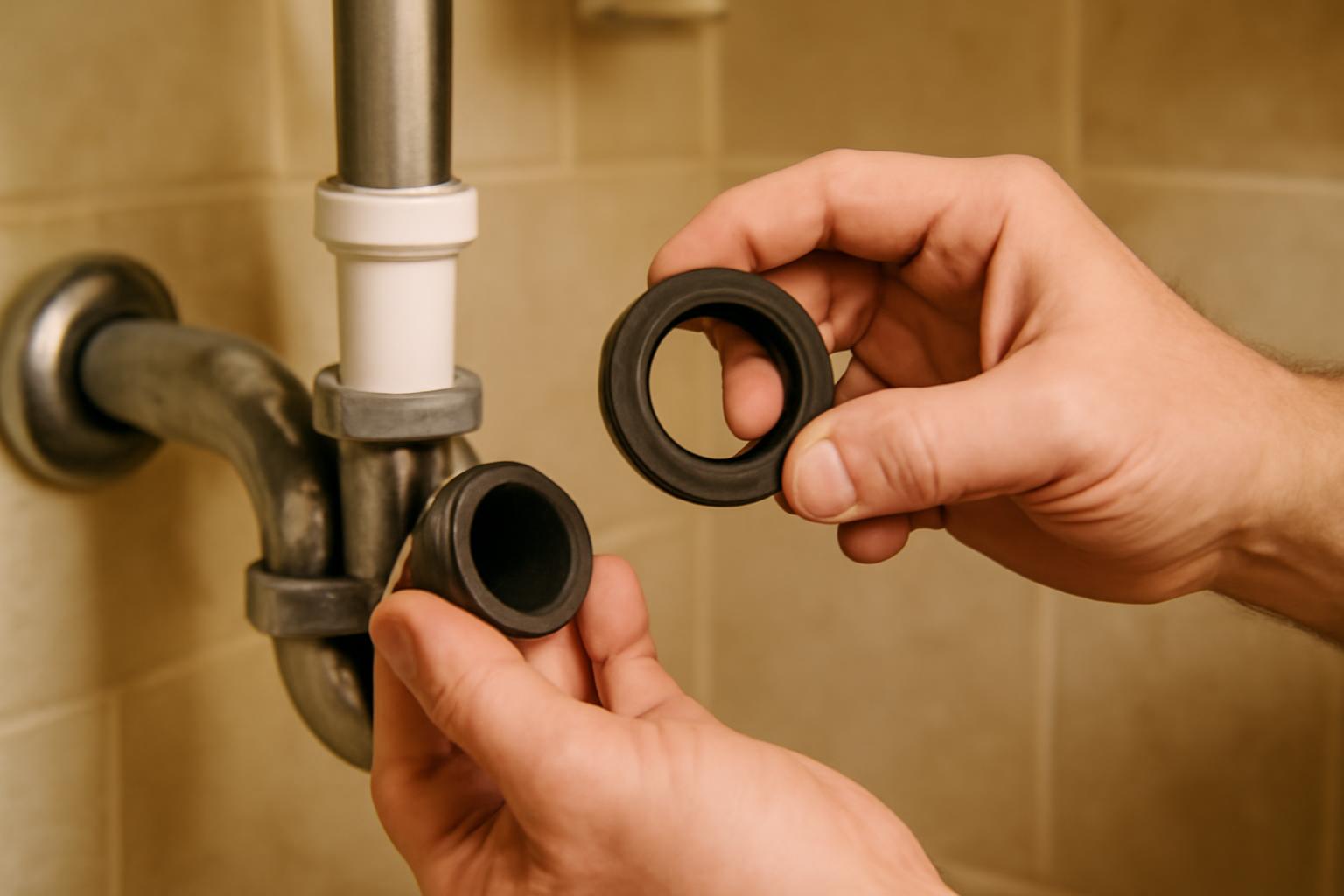
If you searched for “what is a gaskets,” the standard singular is gasket and the plural is gaskets.
In broad mechanical terms, a gasket is a deformable sealing piece placed between mating surfaces so that, when the parts are assembled and compressed together, the gasket fills small gaps and helps prevent leakage. General gasket references describe that role as a static seal: it works between joined parts that are clamped together rather than parts that are meant to move against each other.
For homeowners, that definition matters most when a drain assembly leaks at a joint rather than when a pipe is clogged. In the evidence behind this article, the clearest residential example is a concealed bathtub waste-and-overflow assembly, where a leaking gasket is one possible cause of water escaping behind or below the tub. DrainFinder also warns that repeated use of sodium hydroxide or sulfuric acid drain cleaners can degrade older PVC and rubber gaskets.
That narrower focus is important. A gasket is mainly a leak-control part, not a general explanation for every slow drain, backup, or sewer problem in a house. If several fixtures are draining slowly at once, DrainFinder points away from a simple fixture-level sealing issue and toward a main stack or sewer-line problem instead.
So the practical homeowner question is not just “What is a gasket?” It is:
- what kind of part does that word describe,
- where are you most likely to encounter it in home drain work,
- what symptoms suggest a leaking joint rather than a clog,
- and when is the problem local enough to inspect yourself versus serious enough to stop and call a plumber?
What a Gasket Does in Your Home’s Plumbing
At its simplest, a gasket is a mechanical seal. General references describe it as a piece of material that fills the space between two mating surfaces to prevent leakage when the joint is tightened.
Two details matter most:
-
It seals by compression. The gasket is squeezed between parts during assembly.
-
It is meant for a static joint. In the usual gasket definition, the joined parts are not supposed to keep rotating or sliding against each other in normal use.
That broad definition helps explain why the term shows up around drain assemblies. A plumbing joint can look solid and still have tiny irregularities where water could escape. The gasket’s job is to take up those small imperfections and help the assembled parts behave like one watertight connection.
For homeowners, the most useful translation is this:
- a gasket is usually not the visible decorative part
- it is usually not the stopper you touch
- it is the sealing part inside the assembled connection
That distinction is especially helpful with tubs. DrainFinder’s bathtub drain guide separates the stopper you operate from the hidden drain-and-overflow assembly behind or below the tub. In that concealed assembly, a leaking gasket is one possible cause of a drain leak. If you need a parts map, DrainFinder’s guide to types of bathtub drains is useful because it separates the visible flange and stopper from the hidden shoe, overflow elbow, connecting tubes, and tee.
Homeowners also run into a language problem here. In casual repair talk, people may say gasket, washer, or seal for small leak-preventing parts that are doing related jobs. That overlap is real, but it can also cause shopping mistakes. A helpful working definition is:
- gasket: compressible sealing piece between assembled parts
- seal: broader term for leak-preventing components
- washer: a common retail term for some smaller sealing parts, especially in household repairs
So what does a gasket do in home plumbing? It helps two joined parts stay watertight where hard surfaces alone may not seal reliably.
Common Locations for Gaskets in Residential Drains
The strongest, most directly supported household example in this evidence set is the bathtub waste-and-overflow assembly.
That is the hidden drain assembly that connects:
- the tub’s drain opening,
- the overflow opening,
- and the piping that leads toward the trap.
DrainFinder notes that a leaking gasket can be one possible issue in these concealed assemblies, and that access may require getting behind or below the tub. That matters because tub leaks are often misread at first. Homeowners may see a ceiling stain below the bathroom or water appearing during tub use without realizing the problem is in a hidden drain connection rather than in the supply piping.
This is one reason bathtub drain leaks can be frustrating: the visible hardware does not show you the whole assembly.
Beyond tubs, homeowners often use the word gasket loosely for other drain-joint sealing parts near fixtures. But this is where careful wording matters. The evidence behind this article does not support treating every under-sink drain connection as a gasket problem by default, and it does not support presenting branch-line or in-wall drain issues as ordinary homeowner gasket swaps.
A better way to think about location is by repair visibility:
Fixture-level assemblies
These are the places closest to the sink or tub where homeowners are most likely to notice a leak first. In practical terms, this is where terms like gasket, washer, and seal tend to come up in DIY conversations.
Concealed fixture assemblies
This is where the bathtub waste-and-overflow belongs. The problem is still at the fixture, but the parts may be hidden behind the tub wall, under the floor, or above the ceiling below.
Deeper branch, stack, and sewer piping
This is where the “gasket” idea usually stops being a helpful homeowner diagnosis. If the problem is deeper in the wall, in the main stack, or in the sewer line, the question is usually not “Which gasket do I replace from the room side?”
DrainFinder’s symptom-first guidance is useful here. If two or more fixtures drain slowly at the same time, the site points away from a single local branch issue and toward the main stack or sewer line. That is an important distinction because it keeps you from blaming a small sealing part for a system-wide drainage symptom it probably does not explain.
So where do homeowners most meaningfully encounter gaskets in residential drain work?
- most clearly in concealed tub drain and overflow assemblies
- sometimes in the broader, everyday language people use for small sealing parts at visible drain joints
- much less usefully as an explanation for in-wall, main-line, or sewer problems
Gasket Materials Used in Home Plumbing
General gasket references list a wide range of materials, including:
- rubber
- silicone
- neoprene
- plastic-based materials
- PTFE
- metal
- and other composites
That broad list is useful for understanding the category, but homeowners should not treat it as a shopping list for ordinary drain troubleshooting. The practical point in this evidence set is narrower.
DrainFinder specifically warns that repeated use of harsh chemical drain cleaners can degrade older PVC and rubber gaskets. That tells you two important things right away:
- Rubber and rubber-like sealing parts are relevant in residential drain assemblies.
- Material matters because some household chemicals can damage older sealing components over time.
General gasket references also emphasize why softer materials are common in sealing work: the part needs to be able to deform enough to fill slight irregularities between joined surfaces. That makes the broad categories easier to understand:
- rubber and similar elastomeric materials are associated with flexibility and conformability
- silicone and neoprene show up in general gasket discussions as alternatives with different resistance properties
- PTFE and metal are also real gasket materials, but they are much more commonly discussed in industrial or extreme-duty contexts
For homeowners, the safest takeaway is not “pick the fanciest material.” It is:
- match the replacement part to the actual assembly,
- pay attention to the size and profile,
- and do not assume a general industrial material discussion maps neatly onto a residential tub or sink repair.
This is also where context matters. Broad gasket sources discuss PTFE and metal in environments involving aggressive chemicals, very high temperatures, or high pressure. That is a very different context from the older PVC and rubber drain gaskets DrainFinder warns about in residential plumbing.
So if you are trying to understand gasket materials in a home-drain context, keep the hierarchy simple:
- rubber and similar flexible materials are the most homeowner-relevant part of the conversation here
- chemical exposure matters, especially with repeated cleaner use
- industrial material categories may be technically accurate in general, but they are not the center of an ordinary residential drain diagnosis
How Gaskets Fail and Cause Drain Problems
A gasket failure is best understood as a loss of sealing at a joint.
Because a gasket works by being compressed between mating surfaces, failure usually means the part is no longer sealing the way it should. General references describe gaskets as deformable materials that fill irregularities; once that seal is compromised, leakage becomes possible.
For a homeowner, the most important correction is this:
A bad gasket is primarily a leak clue, not a clog explanation.
That distinction clears up a lot of confusion.
Signs that fit a gasket or joint-sealing problem better
- Water appears at or below a joint
- Leakage shows up when the fixture is draining
- A tub-related leak seems to come from the hidden drain/overflow assembly area
- The problem is localized to one fixture
Signs that point away from a gasket and toward a drain-system problem
DrainFinder says to start with symptoms. On that standard:
- slow drainage
- standing water
- gurgling
- backflow into another fixture
- multiple fixtures draining slowly at the same time
do not read like a simple gasket failure. Those symptoms point more toward a clog, a vent issue, or a main-line problem.
This is the key diagnostic separation the original query often needs. Homeowners use “drain problem” as one bucket, but the bucket actually contains at least two very different categories:
- Water cannot get through the system properly
- Water is getting out of the system where it should not
A gasket belongs mostly to category two.
That does not mean leaks and clogs can never appear together in real life. They can. But when you are deciding what kind of problem you have, the cleaner rule is:
- If water escapes from a joint, think sealing problem first
- If water stays in the fixture or backs up, think flow problem first
Bathtub assemblies are a good example. DrainFinder says a leaking gasket is one possible issue in the concealed waste-and-overflow assembly. That is a classic leak-path problem. It is not the same thing as saying the gasket itself is why the whole bathroom drains slowly.
This distinction also keeps homeowners from chasing the wrong repair:
- replacing a sealing part will not clear a main-line blockage
- using clog treatment will not fix a failed tub drain gasket
- a system-wide drainage symptom should not be reduced to one visible wet joint without evidence
In short, when gaskets fail, the most direct homeowner symptom is leakage at a connection, especially at a fixture-level assembly.
Chemical Cleaners and Gasket Damage Risks
This is one of the clearest, best-supported points in the entire topic.
DrainFinder warns that sodium hydroxide and sulfuric acid drain cleaners can degrade older PVC and rubber gaskets with repeated use.
That statement matters because it connects three things homeowners often treat separately:
- a recurring slow drain,
- repeated chemical treatment,
- and a later leak from an older drain assembly.
Just as important, DrainFinder says those products work on hair, not grease. So repeated dosing is not only a material-risk issue; it can also be a sign that the product is being used against the wrong clog type.
The supported lesson here is not that every single chemical use instantly ruins a drain assembly. The supported warning is specifically about repeated use and about older PVC and rubber gaskets.
That leads to a practical homeowner rule:
- if you have already used a harsh cleaner repeatedly,
- and the drain still is not truly fixed,
- or a new leak appears afterward,
stop treating it like a product problem and start treating it like a diagnosis problem.
Why? Because repeated chemical use can muddy the picture. You may still have the original clog, but now you may also have damage to older sealing parts.
A common bad cycle looks like this:
- The fixture starts draining slowly.
- A chemical cleaner is poured in.
- The improvement is incomplete or temporary.
- Another round is used.
- The original symptom returns.
- A new symptom appears, such as leakage at a joint or tub assembly.
At that point, more chemical is a poor next move. DrainFinder’s own guidance suggests that location and symptoms matter more than product choice. If the problem keeps returning, you need to figure out whether you have:
- hair near the fixture,
- grease in a kitchen line,
- a vent or trap issue,
- a local drain obstruction,
- or a deeper main-line problem.
And if the assembly is older, repeated chemical exposure adds one more risk: the sealing parts themselves may no longer be trustworthy.
So do drain cleaners ruin gaskets? They can, especially with repeated use on older PVC and rubber gasketed parts.
Gaskets vs Seals in Plumbing Contexts
This is where homeowner terminology gets slippery.
General gasket references commonly draw a distinction like this:
- gaskets are used in static joints
- seals are a broader category and are often associated with moving parts or dynamic applications
That distinction is helpful, but it should be handled with some flexibility because retail language is not always precise.
For practical household plumbing, here is the cleanest version:
Gasket
A compressible part between joined surfaces that are assembled and then expected to stay put.
Seal
A broader leak-prevention term. It may refer to a gasket, but it can also refer to parts used in more active or moving assemblies.
O-ring
A specific sealing form, not a generic name for every flat or shaped household drain part.
Washer
A common retail and repair word for smaller sealing pieces, especially where homeowner product naming is less formal.
Why does this matter?
Because if you only remember that all these parts “stop leaks,” you can still buy the wrong thing. A flat gasket, a shaped tub drain gasket, a slip-joint washer, and an O-ring are not automatically interchangeable just because each can be described loosely as a seal.
This is also why the static-joint idea is useful in home plumbing. A concealed tub waste-and-overflow assembly fits the general gasket logic well: joined parts, compressed connection, leak prevention at a non-moving joint. That is much closer to the general gasket definition than to the kind of dynamic seal discussions you see for pumps, engines, motors, or rotating shafts.
So is a plumbing gasket the same as a seal?
Not exactly. A gasket is usually one kind of seal, and in homeowner plumbing it most often makes sense to think of it as the sealing part in a static assembled joint.
DIY Gasket Checks and Replacement Thresholds
Some gasket-related problems are reasonable for a homeowner to inspect. Others cross the line quickly because the assembly is hidden or the symptoms no longer look local.
A good first step is not repair. It is observation.
Start by identifying when the water appears
Ask:
- Does the leak happen only when the fixture is draining?
- Does it happen during filling?
- Is the area wet even when the fixture has not been used?
That sequence helps separate likely drain-side issues from supply-side issues.
For accessible areas, dry first and watch fresh leakage
If the leak is under a sink or in another reachable spot, clear the area, dry the outside of the plumbing, run the fixture, and watch for the first point where new moisture appears. Even without naming the exact part yet, that tells you whether the problem looks:
- localized and visible,
- higher up than it first appeared,
- or hidden farther back than you can safely reach.
For tubs, look for access before attempting diagnosis
DrainFinder specifically notes that a leaking gasket in a concealed waste-and-overflow assembly may require access behind or below the tub. That changes the DIY threshold immediately.
If there is an access panel behind the tub, or an unfinished/open area below, you may be able to observe the assembly while someone uses and drains the tub. If there is no access, the problem may be real even if the failed part itself is small.
DIY is more realistic when:
- the issue is one fixture
- the leak looks localized
- the relevant joint or assembly is actually accessible
- you can identify the exact sealing part to be replaced
Stop and escalate when:
- the tub drain assembly is concealed and you cannot access it
- water is entering a wall, floor, or finished ceiling
- two or more fixtures are slow at the same time
- sewage backs up into another fixture
- a snake hits resistance far into the line
- water appears near the foundation
Those last conditions come straight out of DrainFinder’s broader stop-threshold guidance for drain work. They are important here because they signal that the problem has moved beyond “replace the small sealing part you can see.”
Another useful principle comes from DrainFinder’s broader symptom-first approach: do not force a local explanation onto a system symptom. A visible wet joint can tempt you to keep tightening or replacing parts at the fixture, but if the whole floor is draining poorly, you likely have a second problem—or a different problem altogether.
So can you fix a leaking gasket yourself? Sometimes yes. But the safe answer is narrower than many DIY articles make it sound:
- yes, if the leak is local and the assembly is accessible
- maybe not, if the fixture assembly is concealed
- no as a first assumption, if the symptoms are system-wide rather than local
When to Call a Plumber for Gasket Issues
The right time to call a plumber is when the problem stops looking like one reachable leak and starts looking like hidden damage, no-access work, or system behavior.
Call promptly if you see any of the following:
- backflow into another fixture
- multiple slow drains at the same time
- sewage smells that do not fit a simple visible leak
- water near the foundation
- sewage or wastewater surfacing outdoors
- saturated ground or symptoms suggesting drain-field trouble
- a bathtub drain leak that appears to involve a concealed waste-and-overflow assembly with no practical access
These signs matter because a gasket may still be part of the story, but it is unlikely to be the whole story.
DrainFinder’s main-line guidance says that if two or more fixtures drain slowly at once, the issue is not just a branch clog at one fixture. Its sewer stop conditions say to stop DIY work if sewage backs up into a second fixture, if a snake hits resistance far into the line, or if water appears near the foundation. And its drain-field planning guide says that surfacing sewage or a field that no longer accepts wastewater needs prompt professional attention.
That larger principle is worth carrying back down to bathroom scale:
confirm what actually failed before approving or attempting the wrong repair.
DrainFinder’s drain-field article makes that point explicitly for septic work: a broken pipe, pump problem, distribution issue, full tank, or temporary overload can look similar from a distance. The same logic applies to fixture-level leaks. A ceiling stain below a bathroom does not automatically prove a cracked pipe. It could be a concealed drain connection. And a hidden tub leak does not automatically prove the whole tub assembly needs replacement. But neither is it something to guess at blindly when access is poor.
A good plumber call is often triggered by one of three things:
1. The assembly is hidden
You suspect the leak is behind or below the tub and you cannot inspect it without opening finished surfaces.
2. The symptoms are no longer local
What started as “one wet spot” now includes slow drainage elsewhere, backflow, or sewer smell.
3. The stakes are increasing
Water is reaching drywall, ceilings, floors, or structural areas where delay can turn a small sealing problem into a bigger restoration problem.
The cheapest move is not always doing it yourself. Sometimes it is stopping early enough to avoid chasing the wrong diagnosis.
Do chemical drain cleaners damage gaskets?
They can. DrainFinder says sodium hydroxide and sulfuric acid drain cleaners can degrade older PVC and rubber gaskets with repeated use.
The important supported qualifier is repeated use. If the drain keeps coming back or a new leak appears after repeated chemical treatment, stop adding cleaner and inspect the assembly or call a plumber.
What causes a leaking gasket in a bathtub drain?
DrainFinder identifies a leaking gasket as one possible issue in a concealed waste-and-overflow assembly.
The practical challenge is access. These assemblies are often behind or below the tub, so even a small failed sealing part can be difficult to confirm or replace without an access panel or work from below.
Where are gaskets located in a P-trap?
This is one of those places where homeowner terminology gets messy. In under-sink repair language, people often say gasket for the small sealing part at a trap joint even when the replacement part may be sold as a washer.
So if you are diagnosing a P-trap leak, focus less on the word and more on the joint: identify which visible connection is leaking and match the replacement part by shape, size, and application.
Can I replace a home plumbing gasket myself?
Often, yes—if the leak is local and the assembly is accessible.
That is most realistic when:
- one fixture is involved,
- the leaking point is visible,
- and the part can be identified without opening walls or ceilings.
DIY becomes much less realistic when the suspected gasket is in a concealed bathtub waste-and-overflow assembly, when there is no access behind or below the tub, or when the symptoms suggest a main-line, sewer, or septic issue rather than one leaking joint.