
Know Your Toilet's Weight Before Moving It
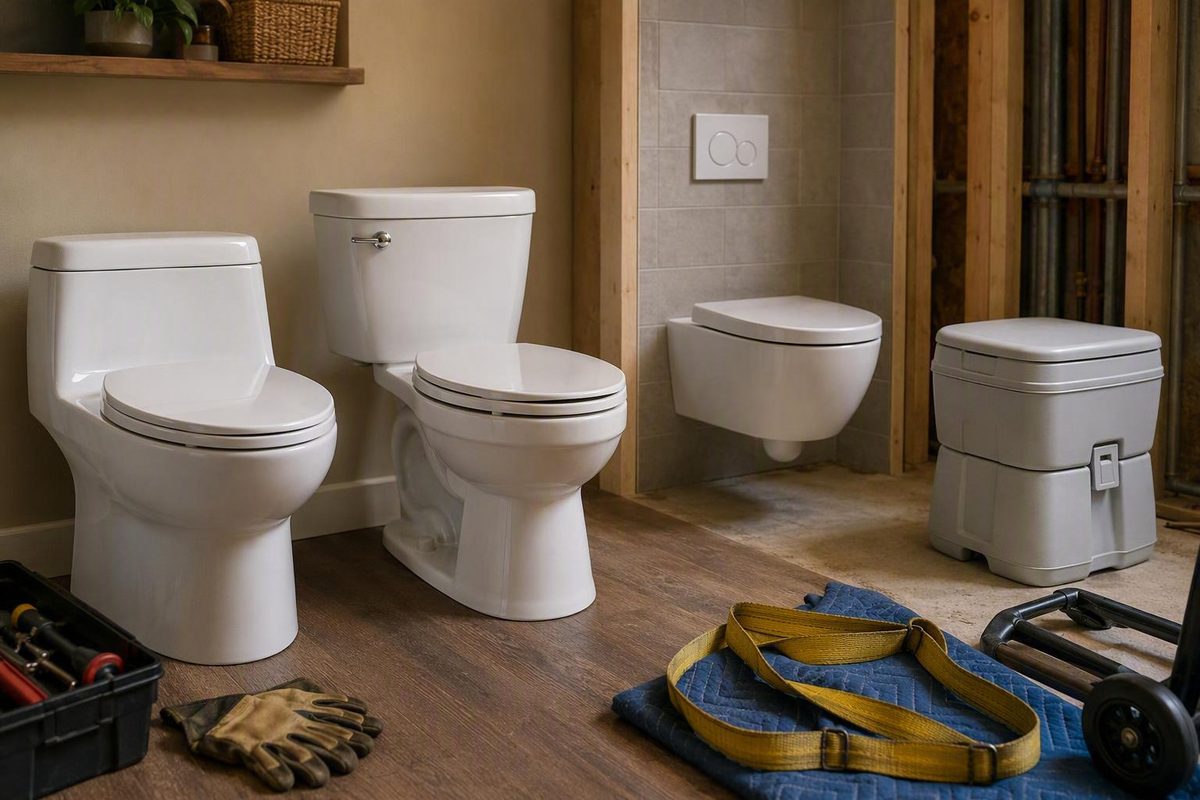
A two-piece toilet often splits into a roughly 50-to-60-pound bowl and a 25-to-40-pound tank. A one-piece keeps the full load in one awkward unit.
Most residential toilets weigh about 70 to 120 pounds (32 to 54 kg) before installation, but the useful answer depends on the design. A two-piece toilet can often be moved as a roughly 50-to-60-pound bowl and a 25-to-40-pound tank, while a one-piece toilet keeps the full load in one awkward unit. Wall-hung bowls and portable toilets are lighter, but an in-wall carrier or a filled waste tank changes what must actually be handled.
Use the model’s current specification sheet whenever possible. A category range is useful for planning; it is not a substitute for the listed weight of the exact toilet in front of you.
Toilet weight at a glance
| Toilet type | Useful planning range | What the number usually describes |
|---|---|---|
| One-piece vitreous china | 80–120 lb (36–54 kg) | The integrated bowl and tank; some listings give shipping weight |
| Two-piece vitreous china | 70–100 lb (32–45 kg) total | Bowl and tank are boxed and lifted separately |
| Wall-hung ceramic bowl | 50–80 lb (23–36 kg) | The visible bowl only; the concealed carrier and tank are separate |
| Portable self-contained toilet | 10–15 lb (4.5–7 kg) empty | Empty net weight, before fresh water or waste is added |
These are planning bands, not load ratings. For another real-world reference, Hastings Mutual describes a connected toilet as roughly 70–100 pounds, with a 25-to-40-pound tank and a bowl of 50 pounds or more. Shape matters as much as the scale reading: toilets are bulky, unevenly balanced, fragile, and difficult to grip.
Weight by toilet type and material
One-piece toilets
A one-piece toilet combines the vitreous-china tank and bowl into one casting. There is no tank-to-bowl joint and no option to split the fixture into two manageable loads. Plan for about 80–120 pounds, then verify the model.
Manufacturer sheets show how much one-piece models can vary. TOTO lists a 99-pound shipping weight for the vitreous-china UltraMax MS854114SL, while the Aquia MS654114MF is listed at 112 pounds shipping weight. Both figures are shipping weights, not promises about the exact installed load.
The main moving problem is not just mass. The center of gravity is offset, the glazed surface offers poor handholds, and the base can crack if it is set down hard or unevenly. A one-piece toilet should generally be treated as a two-person lift.
Two-piece toilets
A two-piece toilet is usually easier to move because its vitreous-china bowl and tank detach. A reasonable total planning range is about 70–100 pounds, but the separate component weights are more useful at the doorway or staircase.
For example, TOTO’s Drake II two-piece specification lists shipping weights of 57.3 pounds for the bowl and 31.5 pounds for the tank. That is 88.8 pounds across the two china components, before treating the separately listed seat, packaging, water, and installation hardware as distinct items.
If the toilet is already installed, removing the tank first can turn one awkward lift into two smaller ones. Do not assume every tank can be separated while full or while supply connections remain attached; follow the model’s installation instructions.
Wall-hung toilets
For a wall-hung toilet, ask which part is being weighed. The visible ceramic bowl often falls around 50–80 pounds, but the concealed steel carrier and tank are another load inside the wall.
TOTO’s AP wall-hung system sheet lists a 68-pound shipping weight for the vitreous-china bowl and 38 pounds for the in-wall tank system. It also specifies framing requirements for the carrier. The system’s supported-user load is not the same thing as the bowl’s own weight.
This distinction matters during both remodeling and structural planning. Do not fasten a wall-hung bowl directly to ordinary finish material or infer adequate support from a weight estimate. Use the specified carrier, required blocking or framing, manufacturer instructions, and applicable local plumbing and building rules. If the wall must be opened or framing must be changed, use a qualified installer.
Portable toilets
Portable toilets are generally molded plastic rather than vitreous china, so they can be much lighter. Empty planning weights of about 10–15 pounds are common for compact self-contained models. Dometic lists its high-density-polyethylene SaniPottie 965 at 14 pounds net weight.
Empty weight is only the starting point. Fresh water and waste add mass, and a partially filled tank can shift while being carried. Empty and service the unit according to its manual before transport; never use the empty product weight to judge whether a filled waste tank is safe to lift.
Shipping weight, dry weight, and installed weight are different
Product listings use weight labels inconsistently, so check the heading beside the number:
- Net or dry weight generally means the fixture without water. Whether the seat, lid, mounting hardware, or electronic bidet is included depends on the listing.
- Shipping weight is a logistics figure. It may include a carton and packing material, and two-piece toilets may publish separate shipping weights for the bowl, tank, and seat.
- Installed fixture weight includes the toilet plus installed accessories, hardware, and water remaining in the tank and bowl.
- Structural or service load includes people and forces applied during use. This is the relevant design question for a wall carrier or questionable floor, and it cannot be derived from shipping weight alone.
For a new toilet, read the specification sheet and package labels. For an old toilet with no model information, use the upper end of the planning range and assume residual water is present until it has been drained and sponged out.
Can one person lift a toilet?
Being able to deadlift the stated weight does not make a toilet a good solo lift. OSHA’s material-handling guidance says to use two or more people for loads heavier than 50 pounds, keep the load close, avoid twisting, and turn with the feet. Those principles are especially relevant to a toilet because its mass sits away from the body and its surfaces are hard to grip.
Before lifting:
- Clear the route, doorways, and destination. Put down cardboard, a moving blanket, or another stable protective surface.
- Shut off the supply, flush, and remove remaining water. Keep a bucket and towels ready.
- Disconnect the supply and all fasteners. Never lift by the seat, lid, tank lid, supply tube, or flush hardware.
- Separate a two-piece tank when the manufacturer’s procedure allows it.
- Use a helper or a suitable lifting aid. Grip the solid bowl body, keep it close, move smoothly, and step instead of twisting.
If a toilet starts to fall, move clear rather than trying to catch the china. A dropped fixture can crack into sharp pieces as well as injure the person handling it.
Removing a used toilet safely
Weight is only one part of removal. Oatey’s wax-ring replacement procedure calls for shutting off the water, flushing and removing remaining water, disconnecting the supply, removing the closet-bolt nuts, breaking the wax seal, and lifting the toilet straight up. It also recommends rubber gloves and help with the lift.
Treat the old wax ring, residual water, and flange area as dirty plumbing materials. Wear gloves, protect nearby finishes, and wash up after handling them. Keep the drain opening safely protected while work is paused so tools and debris cannot fall in and sewer gas is not left with an open path; use a purpose-made plug or a method permitted by local practice, and remove it before resetting the toilet.
Stop and call a licensed plumber or appropriate contractor if you find a cracked or badly corroded flange, a soft or visibly damaged subfloor, active sewage backup, widespread suspect mold, or framing that needs repair. Those conditions need inspection rather than a heavier wax ring or more force on the bolts. On a septic system, an active backup is also a reason to stop using fixtures and get the system assessed.
For smart toilets or bidet seats, disconnect power according to the product manual before moving anything. If electrical work, a concealed carrier, structural reinforcement, or code/permit questions are involved, use qualified local help.
The practical answer
For planning, expect a conventional toilet to weigh 70–120 pounds, with one-piece models at the heavier and harder-to-handle end. A two-piece model may total a similar amount but can be split into a roughly 50-to-60-pound bowl and a lighter tank. A wall-hung bowl can weigh around 50–80 pounds before counting its concealed carrier, while an empty portable toilet may be only 10–15 pounds.
The exact model sheet decides the number; the shape, water, accessories, route, and supporting structure decide whether the move is safe. When in doubt, drain it fully, split detachable components, and use a second person.