
Drainage Pipe: Identify Its Job Before Repairing or Replacing It
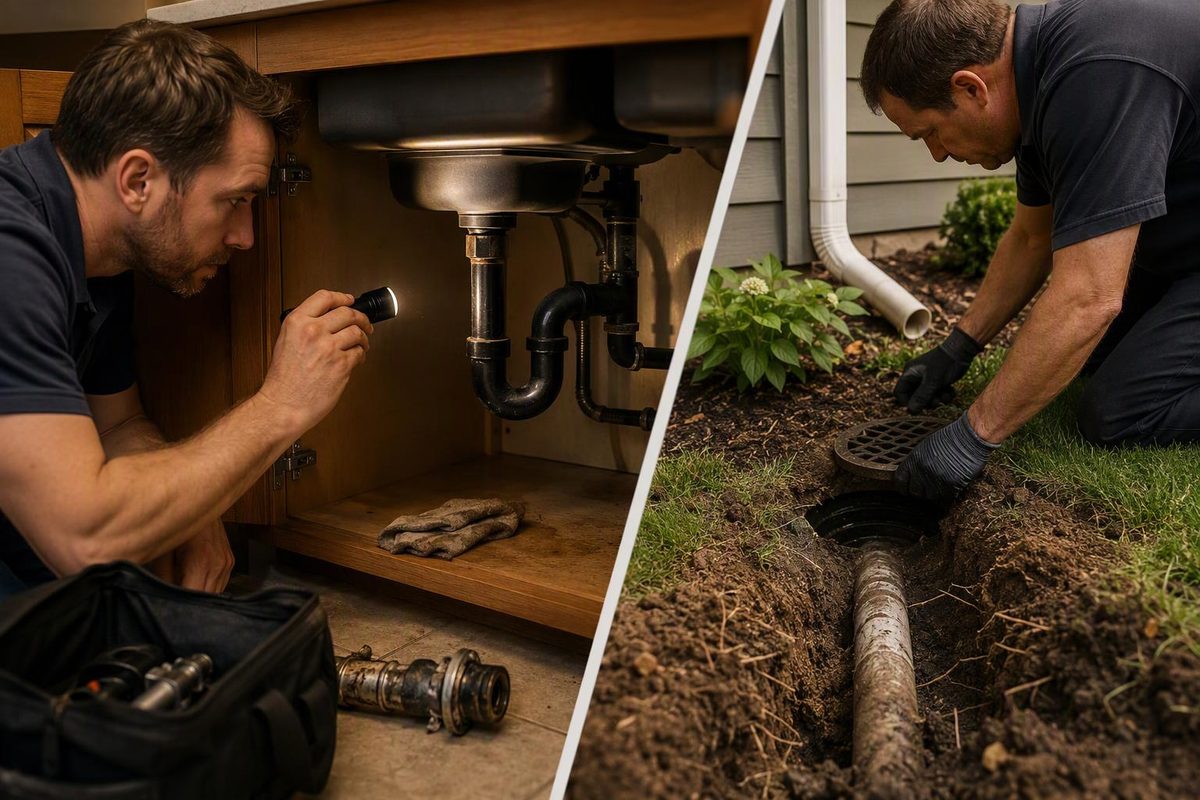
Distinguish household drain pipe from yard drainage, check the symptom pattern, and know what to verify before clearing or replacing a pipe.
A drainage pipe may carry household wastewater, collect groundwater, or move rainwater away from a catch basin or downspout. Those jobs require different pipe systems. Before choosing a cleaner, tool, or replacement section, identify where the water comes from and where the pipe leads.
If water is already backing up indoors, deal with that symptom first—not the pipe material.
1. Start where water appears
Use what you have already observed. Do not repeatedly flush toilets or run appliances to reproduce a backup.
If chemical drain cleaner is still in a blocked drain, leave it undisturbed and tell the plumber what you used. Follow its label precautions rather than switching to another cleaner or a tool. For example, Drano Max Gel’s precautions prohibit plunging during or after use because product may remain if the drain did not clear.
| What you observe | Where to focus first | Safe next step |
|---|---|---|
| One sink, shower, or tub drains slowly; other fixtures appear normal | That fixture’s opening, trap, or branch drain | Check for reachable hair or debris at the strainer or removable stopper, provided no chemical cleaner remains |
| Several fixtures drain poorly, or using one makes water rise in another | A shared drain farther downstream | Stop adding water if a backup is developing; arrange professional diagnosis |
| Water emerges from a basement floor drain | Possible wastewater backup—not automatically a foundation-drain problem | Stop water use and keep people and pets away from the affected area |
| Outdoor pooling appears during rain without indoor drain trouble | Surface runoff or subsurface drainage | Observe the water’s path and inspect accessible grates and outlets |
| Water leaks from an exposed drain pipe during fixture use | That pipe or joint | Stop using the affected fixture until the leak is assessed |
One affected fixture makes a local restriction a reasonable starting point, but it does not prove the blockage is directly beneath it. Likewise, several affected fixtures do not establish whether the fault is in the house drain, private sewer connection, or public sewer.
Cincinnati’s sewer district identifies both private-pipe blockages or breaks and public-sewer problems as causes of backups. Its guide also explains that wastewater can emerge through floor drains and other low-level fixtures. See the district’s sewer-backup guide.
Stop point: For an active wastewater backup, stop using sinks, toilets, showers, laundry, and dishwashers. Do not enter standing water where electrical appliances are present or touch affected electrical equipment until power is safely shut off; the district’s safety guidance warns of these hazards.
Check your sewer utility’s emergency reporting procedure while arranging help: some utilities want the city contacted first, while others advise calling a plumber first. Middleton’s guidance and Portland’s guidance illustrate that difference. If your home uses septic, tell the service provider.
For basement wetness without a clear fixture connection, distinguish floor drains, perimeter drains, and sump systems before assuming a plumbing clog.
2. Identify the pipe’s job
Household drain pipe
The drain, waste, and vent system—abbreviated DWV—serves household plumbing. Its drain pipes carry wastewater; its vents provide an air path. PVC and ABS are plastic DWV materials, and Charlotte Pipe describes its DWV products as intended for gravity-fed waste drainage. Its catalog lists pressure piping separately. A plastic pipe’s appearance alone is not enough to identify its intended service. Charlotte Pipe’s product guide
Trace only what is safely visible. A pipe connected to a sink trap gives you a useful starting point; a pipe disappearing into a wall or slab does not reveal its complete route.
Solid outdoor drainage pipe
Here, solid means non-perforated—not necessarily rigid. This pipe moves collected water from one point to another, such as from a downspout or catch basin toward a suitable outlet. ADS distinguishes non-perforated pipe for point-to-point gravity flow from perforated pipe for subsurface collection. ADS drainage-products brochure
Perforated outdoor drainage pipe
Holes or slots allow surrounding water to enter along the pipe’s length. In a traditional French drain, the pipe works with aggregate and filtration to collect water and direct it toward an outlet. It is not simply a buried extension of a downspout. NDS French-drain guide
Septic drain-field piping is a separate wastewater-treatment application. Do not treat it as an ordinary yard-drain repair.
3. Verify specifications before buying
Photograph the exposed pipe’s printed markings and nearby fittings. Record:
- Material: PVC, ABS, HDPE, or another identified material.
- Product designation: DWV, schedule, SDR/DR, and any ASTM standard shown.
- Size: Printed nominal size, plus measured outside diameter when selecting a coupling.
- Construction: Perforated or non-perforated; corrugated or smooth-wall.
- Joint: Solvent-welded socket, gasketed connection, threaded/slip-joint assembly, or mechanical coupling.
Do not buy by color and nominal diameter alone. Charlotte Pipe, for example, specifies DR 35 gravity sewer pipe to ASTM D3034 with sewer-main outside dimensions and manufacturer/local-code installation requirements. That designation matters more than a shelf label saying “drain pipe.” DR 35 specification
For mixed materials, verify the approved transition method and installation location; see ABS-to-PVC joining considerations.
4. Set the repair boundary
A reasonable first DIY check is removing reachable debris from a strainer or removable stopper, or clearing leaves from an accessible outdoor grate. Wear gloves, and avoid opening sewage-contaminated systems.
Stop before cutting concealed pipe, excavating near a foundation, forcing a cable through an unidentified line, or replacing buried drainage without a confirmed outlet and installation plan. Outdoor drainage needs suitable grading and discharge; NDS also calls for checking local requirements and locating underground utilities before digging. NDS installation guidance
For recurring sewer-line blockages, ask whether cleaning followed by a recorded camera inspection is appropriate before approving replacement. Cincinnati’s guide recommends cleaning the building sewer before a video inspection for damage or blockages. See its plumber-selection guidance.
Give the plumber the affected fixtures, rainfall timing, previous repairs, pipe-marking photos, and any cleaners or tools already used. Those details are more useful than naming a pipe material as the presumed cause.