
ABS vs PVC Drain Pipes: Which Fits Your Home Plumbing Repair?
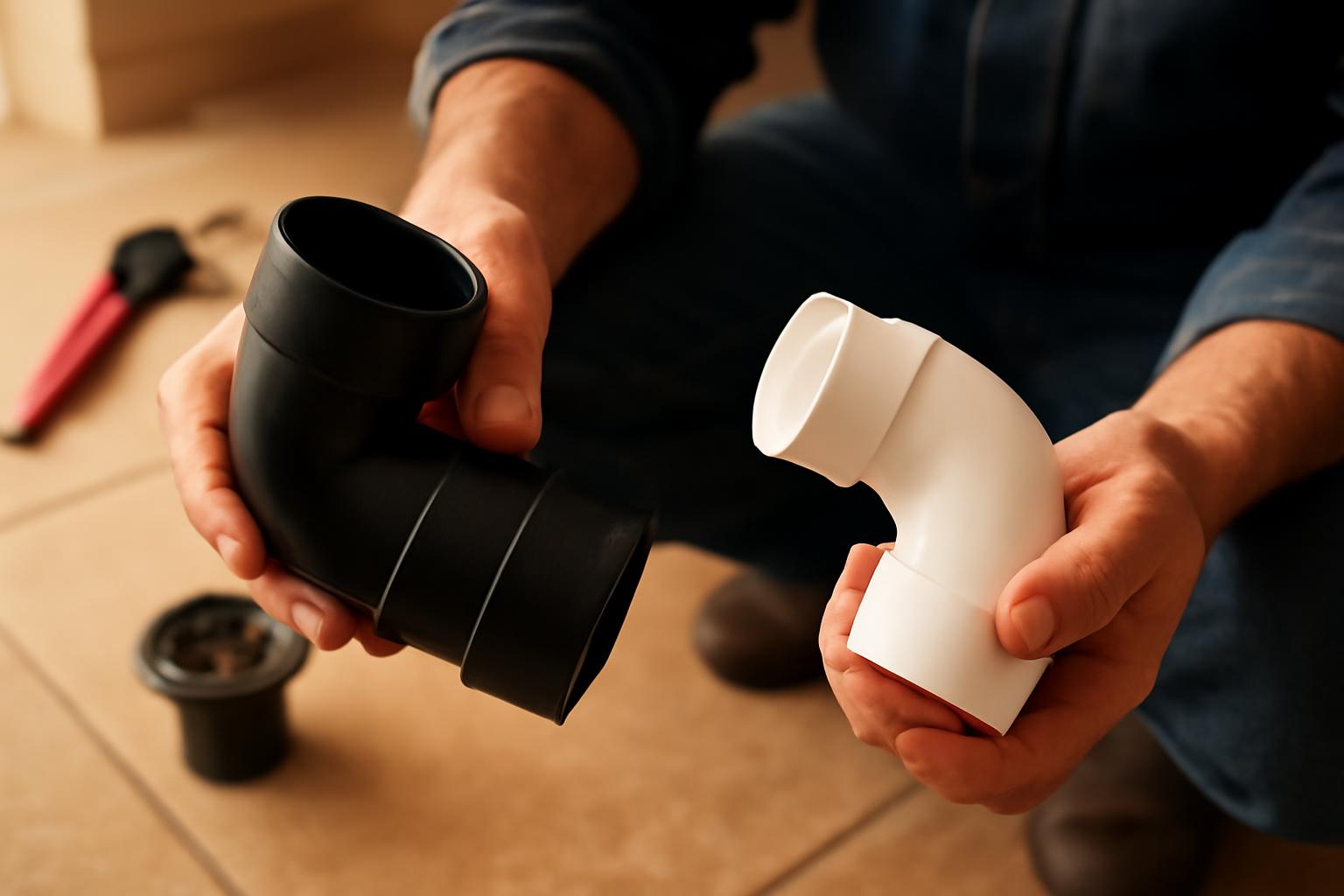
If the materials must connect, use an approved transition fitting or coupling and verify that the specific fitting and location are allowed by local code.
If you are comparing ABS vs PVC for a home drain repair, the best answer is usually not “which plastic is better in general?” It is which material matches your existing drain system, fits the installation location, and is allowed by local code.
For residential drain-waste-vent (DWV) piping, both materials are common. Both are used in home drain systems because they handle water exposure and many normal drain conditions well. But homeowners do notice real differences when they cut out a bad fitting, replace a trap arm, or swap a tub waste assembly. ABS is usually black, rigid, impact-resistant, and joined with a one-step cement. PVC is usually white or light gray, somewhat more flexible, and commonly favored where quieter indoor drains matter.
Most DIY mistakes are not complicated. They are simple mistakes with expensive consequences:
- misidentifying the existing pipe,
- buying the wrong fittings,
- using the wrong cement,
- or trying to connect ABS and PVC casually as if all plastic drain pipe works the same way.
If you keep one rule in mind through this whole comparison, let it be this: match what is already installed unless you have a clear, code-approved reason to do otherwise.
Identifying ABS vs PVC Pipes in Your Home Drains
The fastest way to tell ABS vs PVC apart is usually visual.
ABS pipe is black. PVC pipe is typically white or light gray.
That color difference is what most homeowners notice first under a sink, in a basement ceiling, at a laundry drain, or behind an access panel. If the exposed drain pipe is solid black, it is usually ABS. If it is white or pale gray, it is usually PVC.
That said, color alone is not enough when you are buying parts for a repair. Paint, age, dirt, and poor lighting can fool you. Before you cut or shop, check a few things:
- Printed markings on the pipe
- Labels or markings on fittings
- The cement type used on nearby joints
- Where the pipe is installed
Printed pipe markings are often the best confirmation. If the lettering is still readable, it usually tells you the material directly. That is better than guessing from memory or trying to identify a pipe from a phone photo taken in a dark cabinet.
Context can help, but only as a clue. In many homes, interior exposed branch drains are often PVC, while ABS appears in some existing DWV systems and is also commonly associated with colder conditions or tougher drain locations. That does not make indoor PVC or cold-weather ABS a universal rule. Regional practice varies. Some homes use one material throughout. Others have a legal transition point where one plastic changes to the other with an approved fitting.
For a homeowner replacing a single section of visible drain, the safest habit is simple: match the material already there.
Tub and bath drains are easy to misidentify
Bathtub repairs deserve extra caution because the visible hardware can mislead you. The stopper style you see from inside the tub does not tell you whether the concealed drain-and-overflow assembly is ABS, PVC, brass, or something else.
Waste-and-overflow assemblies are sold in multiple materials, including ABS and PVC, so if you are replacing part of a tub drain you need to match:
- the existing material, and
- the approved joint method
That is especially important when you are replacing only one section rather than the full assembly. A new PVC kit next to an existing ABS branch drain can turn a simple tub repair into a transition-and-code problem.
A practical identification routine before you buy parts
If you are standing in front of a leaky drain and trying to avoid an extra store trip, this sequence helps:
- Check the easiest exposed section first. Under-sink drains, basement runs, or access panels usually give a clearer view than a pipe stub at the wall.
- Wipe off dust, grime, or overspray. Pipe markings are often there but unreadable until cleaned.
- Photograph the pipe and the fitting together. Color plus printed markings plus fitting style gives you a much better reference at the store.
- Do not rely on one disconnected part alone. Someone may have mixed materials in a past repair.
- If the system looks mixed, find the actual transition point before assuming anything.
If you are unsure whether you are looking at a drain, a vent, or another plastic line, stop before cutting. The identification step feels basic, but it is where many bad repairs start.
Core Material Differences: Composition and Properties
ABS and PVC are both plastics, but they are not the same plastic.
- ABS stands for acrylonitrile butadiene styrene
- PVC stands for polyvinyl chloride
That chemistry matters less to a homeowner than the way each material behaves in actual drain work. Across the drain-pipe comparisons in the evidence reviewed, ABS is consistently described as tougher and more impact-resistant, while PVC is consistently described as somewhat more flexible and better at reducing drain noise.
Those are the differences you actually feel and hear during a repair.
The BPA question is not a good way to choose drain pipe
This is the weakest and least useful part of most online ABS-vs-PVC comparisons, so it deserves a careful reset.
Some comparison sources say ABS contains BPA and PVC does not. But one general comparison source in the evidence says the opposite. Because the evidence set itself conflicts on that point, BPA is not a reliable basis for choosing DWV drain pipe in a homeowner repair.
The practical takeaway is simpler:
- online BPA claims about ABS vs PVC are inconsistent,
- the evidence reviewed does not support using BPA claims as the deciding factor,
- and for residential drain repairs, the important questions are still compatibility, joining method, exposure conditions, and code compliance.
If you are fixing a sink drain, replacing a tub waste assembly, or patching a branch line, chemistry arguments from generic plastics content are far less important than whether the replacement actually fits the system.
Physical traits that matter in real drain repairs
For homeowners, the material differences that matter most are mechanical and practical.
ABS traits that matter in drain work
- Commonly described as more impact-resistant
- Usually feels more rigid
- Often preferred where knocks, vibration, or rough handling are possible
- Commonly treated as a strong choice where cold conditions are a concern
- Joined with a one-step ABS cement
PVC traits that matter in drain work
- Commonly described as more flexible
- Better known for muffling the sound of flowing water
- Widely used in residential DWV systems
- Commonly favored where quiet indoor drainage matters
- Usually installed with primer plus PVC cement
Both are generally described as durable, low-cost plastics used in residential drain systems. Both are also described as resistant to water exposure and many common drain-related chemicals. For a homeowner, that means the decision is rarely about one pipe being “good” and the other being “bad.” It is about choosing the right one for the repair in front of you.
Cost usually is not the deciding factor in a small repair
The evidence reviewed does not support a dependable universal winner on price for homeowner drain repairs. Even if one source or seller frames one material as cheaper, that is not a stable enough rule to drive the choice.
In a real repair, the bigger cost differences usually come from things like:
- whether you need primer plus cement,
- how many fittings you need,
- whether you must reopen a wall,
- whether you accidentally create a leak and have to repair it twice,
- and whether changing materials forces you into a code-sensitive transition.
That is why homeowners should treat material match as more important than chasing a supposed price edge on a short section of drain pipe.
Installation: One-Step ABS Cement vs PVC Primer Process
For many DIY drain repairs, ABS is simpler to install than PVC.
That does not mean ABS is automatically the better choice. It means the joining process is usually more straightforward.
In common DWV work:
- ABS uses a one-step solvent cement
- PVC usually uses a two-step process: primer first, then cement
That difference matters most in the exact situations homeowners struggle with: cramped vanity cabinets, awkward overhead work, tub access openings, and repairs where alignment has to happen quickly.
How ABS installation usually works
With ABS, the typical process is:
- Dry-fit the pipe and fittings
- Cut the pipe square
- Remove burrs
- Apply the correct ABS cement
- Push the joint together
- Hold it briefly so it does not push back out
The main advantage is speed. There is no separate primer step in the usual ABS drain-pipe process.
That makes ABS attractive for straightforward repairs where:
- access is tight,
- the pipe run is short,
- alignment is awkward,
- or you simply want fewer steps to manage before the cement grabs.
How PVC installation usually works
With PVC, the common DWV process is more involved:
- Dry-fit the parts
- Cut and deburr
- Apply the correct primer
- Apply the correct PVC cement
- Assemble the joint
- Hold the joint in place so it does not back out
DIY guidance in the evidence set commonly describes holding a PVC joint together for about 5 to 10 seconds after assembly. Some sources also describe allowing up to about an hour before normal handling or use, depending on product instructions and conditions.
The safest rule is not to memorize a generic number. It is to follow the instructions on the actual primer and cement you are using.
Why this difference matters so much in DIY repairs
Most homeowner drain work is not difficult because the concept is hard. It is difficult because the work area is bad.
You may be:
- kneeling inside a vanity,
- twisting around a toilet supply line,
- working behind a laundry machine,
- reaching into a tub access cavity,
- or trying to line up a trap arm before the cement sets.
In those situations, fewer steps reduce the chance of mistakes.
But “easier” does not mean “better for your house.” If the pipe in your home is already PVC, you should not switch to ABS just because the solvent process seems faster. Matching the existing system is usually the better repair decision.
Installation rules that matter with both materials
Use the right cement for the pipe
Do not treat all plastic-pipe glue as interchangeable. ABS cement is for ABS. PVC cement and primer are for PVC.
Dry-fit before you open the can
Once solvent cement is on the parts, you have very little time to rethink orientation.
Cut square and clean the edge
A crooked cut or a heavy burr can undermine a joint that otherwise looked fine.
Keep the surfaces clean and reasonably dry
Dirt, dust, standing water, and oily residue all work against a good solvent bond.
Fully seat the pipe
A joint that only looks inserted can become a leak later.
For homeowners, the real installation rule is straightforward: use the material already in the system and follow the correct joining method for that material without improvising.
Strength, Temperature, and Noise in Home Drain Lines
When homeowners ask which drain pipe is “stronger,” they usually mean one of three things:
- Which one is less likely to crack if it gets bumped?
- Which one handles difficult temperature conditions better?
- Which one makes less noise in the wall?
ABS and PVC do not answer those questions the same way.
Impact and rough handling
ABS is more consistently described as the better choice for impact resistance. It is usually treated as the tougher pipe where the line may get knocked, bumped, or jostled.
That can matter in places like:
- unfinished basements,
- garages,
- crawlspaces,
- utility rooms,
- or exposed drain runs near storage areas.
PVC is still widely used and durable in normal residential drain service, but in side-by-side comparisons it is usually described as less impact-tough than ABS.
Cold conditions
Across the sources reviewed, ABS is more consistently associated with better cold-weather toughness. Some sources outside strictly residential fixed-home DWV discussions cite very low temperature thresholds for ABS, but those exact figures are not the best basis for homeowner decision-making here.
The more defensible takeaway is practical:
- ABS is commonly treated as the stronger choice where cold exposure and impact risk overlap
- PVC is more often described as less ideal when severe cold and brittleness are concerns
So if you are repairing a drain in an unconditioned crawlspace, garage, or other cold-exposed area, ABS has a real reputation advantage. That does not mean every cold-climate home should switch materials. It means exposure conditions matter.
Heat and temperature stress
PVC is often described in the evidence as performing well in normal residential drain use but as more likely to soften or deform under higher heat than ABS. Some general-material and adjacent-market sources attach exact heat figures to PVC, but those numbers are not strong enough here to serve as precise homeowner design limits for residential DWV work.
The safer takeaway is this:
- keep either material within its intended drain application,
- keep drain lines away from avoidable heat stress,
- and do not use a neat online temperature figure as a substitute for product instructions or code guidance.
In ordinary residential drain service, neither material should be installed as though unusual heat exposure does not matter.
Noise in walls and ceilings
PVC usually gets the edge here.
Many sources describe PVC as better at muffling the sound of water flow, while ABS is more often described as transmitting more sound. That makes PVC a common preference where quiet indoor drainage matters, such as:
- bathroom branches near bedrooms,
- kitchen drains near living spaces,
- and finished-wall runs where pipe noise is noticeable.
Pipe material is not the only reason a drain sounds loud, though. Noise is also affected by:
- support and strapping,
- whether the pipe touches framing,
- insulation in the wall or floor cavity,
- fixture flow volume,
- and stack routing.
So if a homeowner asks which pipe is usually quieter in otherwise similar indoor conditions, the evidence points to PVC. If the question is which pipe is tougher against impact and cold exposure, the evidence points to ABS.
A useful homeowner summary
If you need a quick field decision guide:
- Impact-prone or rougher locations: ABS usually has the edge
- Cold-exposed drain locations: ABS is more often favored
- Quiet indoor drains: PVC usually has the edge
- Minor movement or a little more flex: PVC is commonly favored
That still does not override the main rule: the best repair pipe is usually the one that matches the system you already have.
Best Uses: Indoor vs Outdoor Home Drains
A common homeowner shorthand is:
- PVC for indoor residential drains
- ABS for underground, cold-exposed, or impact-prone drain locations
That is a useful starting point, but it is only a starting point.
Where PVC often makes sense
PVC is commonly preferred indoors because it is:
- quieter,
- widely used in residential DWV systems,
- and commonly described as a bit more forgiving where minor movement and noise reduction matter.
That makes PVC a natural fit for many interior drain situations, including:
- bathroom branch drains,
- kitchen drains,
- laundry drain connections,
- visible drain repairs in finished homes,
- and other interior vent-and-drain runs where matching existing white pipe is the obvious move.
Where ABS often makes sense
ABS is commonly favored where the repair location is tougher on the pipe itself, such as:
- exposed drain runs that may get bumped,
- colder unconditioned spaces,
- some underground or sewer-related DWV work,
- and repairs where impact resistance matters more than quiet operation.
If you are repairing a section in a rougher utility area or a colder crawlspace, ABS is often the material homeowners and plumbers expect to see.
Match the existing system first
This matters more than generic indoor-outdoor advice.
For most homeowners, the best-use rule is not “white pipe inside, black pipe outside.” It is:
If your house already has ABS drain piping, use compatible ABS parts for the repair. If it already has PVC, use compatible PVC parts.
That avoids:
- unnecessary transitions,
- compatibility mistakes,
- cement confusion,
- and code questions you did not need to create.
Sunlight and exterior exposure require extra caution
This is an area where online advice becomes messy fast, so homeowners should slow down here.
The evidence reviewed includes guidance warning that unprotected PVC can degrade in direct sunlight. Other guidance warns that ABS should be kept out of direct sunlight or protected where codes or product instructions require it.
The safest summary is not that one material “wins” sunlight exposure universally. It is this:
- do not assume either bare plastic drain pipe is carefree in prolonged direct sun,
- for any exposed exterior run, check the product listing and manufacturer instructions,
- and confirm what your local code allows or requires.
So if your repair is on an exterior wall, below a deck, near an outdoor laundry connection, or anywhere else that will sit in sun, do not settle the question from a generic online comparison. Treat it as a product-and-code question.
Kitchen and bath branch lines vs buried or rougher runs
For everyday kitchen and bathroom drain repairs, PVC is often the more typical indoor choice, especially where quiet performance matters. For buried lines, colder locations, or more impact-prone drain conditions, ABS is often favored in comparative guidance.
But homeowners should resist turning that pattern into a blanket rule. For a repair, the better questions are:
- What is already installed?
- What conditions will this section actually see?
- What joining method does this material require?
- What does local code allow?
Those questions lead to better repair decisions than trying to crown a universal winner.
Joining ABS and PVC: Restrictions and Safe Methods
This is where many DIY drain repairs go wrong.
Do not directly glue ABS to PVC with ordinary solvent cement and assume that is a proper fix.
The materials are different. Their bonding methods differ. Their movement characteristics differ. And many codes or local practices control how they can be connected.
The evidence reviewed is consistent on the main homeowner point:
- Do not treat ABS-to-PVC joining as a casual glue job
- if the materials must connect, use an approved transition fitting or coupling
- and verify that the specific fitting and location are allowed by local code
Why direct gluing is a problem
The issue is not just whether the joint seems to stick on day one. The issue is whether the connection is:
- the correct joining method for the two materials,
- appropriate for movement and expansion differences,
- and accepted for that installation by code and inspection standards.
A connection can feel solid and still be the wrong repair.
When homeowners run into this problem
ABS-to-PVC questions usually come up when:
- a previous repair used a different material,
- the store only has the trap or fitting you need in the other plastic,
- a new tub waste-and-overflow assembly does not match the existing branch line,
- or an older house already has a deliberate material change at some point in the system.
In those cases, the answer is not “use more glue.” It is “use the correct transition hardware.”
What a safer transition method looks like
The evidence repeatedly points to approved transition couplings, often described as a:
- rubber sleeve with a metal shield or jacket, or
- another listed plastic-to-plastic transition coupling
The exact fitting matters. So does where it is installed.
Accessibility matters too
Before installing an ABS-to-PVC transition, confirm whether the joint is allowed to be:
- left accessible,
- concealed in a wall,
- buried,
- or used only in certain parts of the DWV system.
That matters because some transition methods may be more acceptable in one location than another. If the repair will disappear behind finished drywall or under a floor, you need to be more careful, not less.
Best practice for homeowners
If you are in the store wondering whether it is okay to switch materials for convenience, the safest answer is usually no.
Match the existing material when possible. If you cannot, use a listed transition fitting and confirm the method with:
- local code,
- the product listing,
- permit instructions if applicable,
- or a licensed plumber/inspector.
For a small drain repair, avoiding the transition entirely is often the simplest and safest choice.
Local Codes and Testing for ABS/PVC Drain Pipes
Local code matters more in the ABS vs PVC decision than many homeowners expect.
Both materials are common in residential DWV work, but what is allowed, where it is allowed, and how transitions must be handled can vary by jurisdiction. Some areas have long-standing regional preferences. Some are stricter about one material or the other. Some care most about the fitting standard and transition method rather than the color of the pipe itself.
That means a perfectly normal repair choice in one area may raise questions in another.
What local codes can affect
Depending on where you live, code or inspection practice may affect:
- whether ABS is accepted for the application,
- whether PVC is the typical approved material,
- how ABS-to-PVC transitions must be made,
- whether a certain coupling type is required,
- whether the joint must remain accessible,
- and what testing method is expected for new work or rough-in work.
Some sources also note that certain regions historically lean more toward ABS in colder areas and PVC in warmer areas. That can be a useful regional pattern, but it is not a code shortcut.
Do not assume one plumbing approval means all plumbing approval
Some guidance in the evidence set notes that material approval can differ by application. A material discussed one way for DWV is not automatically approved the same way for potable water or every other plumbing use.
For this article, the key point is narrower: we are talking about residential drain piping, not every plastic pipe use in the house.
Testing: air vs water
For new or substantially altered plastic drain piping, the evidence reviewed strongly warns against air testing and indicates that model-code and manufacturer guidance do not approve air testing of plastic systems in the way some people assume.
The safety reason is straightforward: compressed air stores energy. If something fails, that stored energy can release violently.
Because of that, the safer homeowner guidance is:
- do not treat air testing as a DIY shortcut for plastic DWV work,
- follow the locally required test method,
- and expect that water testing is the safer, commonly recommended direction in the evidence reviewed.
For hydrostatic water testing, the evidence emphasizes that air should be expelled from the system before testing and that the applicable instructions and code requirements should be followed.
What this means in practice
For a simple accessible repair under a sink, “testing” may just mean:
- running water,
- draining the fixture several times,
- and checking every joint carefully.
For rough-in work, permit work, or concealed piping, the standard is higher. That is where you should be working from:
- local code,
- permit instructions,
- manufacturer guidance,
- and inspector or plumber direction.
When to call a professional
Bring in a licensed plumber or confirm with the local inspector when:
- you are changing materials,
- you are working on a main drain or stack,
- the repair will be concealed,
- the project requires a permit,
- or you are unsure what test method the jurisdiction expects.
That is not overkill. It is the difference between a repair that stays fixed and one that fails inspection or leaks behind a wall.
Maintenance: Cleaners, Snakes, and DIY Safety
Homeowners often start researching ABS vs PVC because something is already wrong: a slow sink, a stubborn tub drain, a backed-up laundry line, or a leak at a fitting.
So the material comparison is only part of the real question. The other part is: what tools and cleaners can you use without making the problem worse?
Start with the least aggressive method
For typical residential branch clogs, the safest DIY mindset is to start with the least aggressive tool that fits the symptom.
That usually means:
- clearing hair or debris at the stopper,
- cleaning a trap if appropriate,
- or using a small hand snake before moving up to powered equipment.
The evidence reviewed directly supports a standard hand snake for PVC branch drains, commonly in the 1/4-inch to 5/16-inch cable range, and notes that a 25-foot hand snake suits many household clogs. Even when the visible system is ABS or the exact material is unclear, the homeowner lesson still holds: low-force clearing is safer than jumping straight to aggressive power equipment.
Be much more cautious with motorized snakes
This is where DIY damage becomes expensive.
The clearest warning in the evidence is about thin-wall PVC: larger motorized snakes can crack fittings or stress the system because of cable torque, especially when you do not know the pipe specification or the condition of the fittings.
For homeowners, the right takeaway is broader than PVC alone:
- pipe wall thickness matters,
- age and brittleness matter,
- unknown previous repairs matter,
- and the condition of glued fittings matters.
So before using powered drain equipment, ask:
- Is this a typical branch clog, or could it be deeper?
- Do I know what pipe and fittings are actually in the wall?
- Am I dealing with older or questionable plastic?
- Am I about to trade a clog for a broken drain line?
If the answer is uncertain, slow down.
Chemical cleaners are not harmless just because the label says “safe for pipes”
Both ABS and PVC are often described as resistant to many chemicals, but that does not mean repeated chemical drain-cleaner use is harmless over time.
The clearest homeowner warning in the evidence concerns older PVC and rubber components. Repeated use of cleaners containing sodium hydroxide or sulfuric acid can degrade older PVC and rubber gaskets.
That means:
- a cleaner may not instantly destroy the pipe,
- but repeated use can still age seals and vulnerable components,
- especially in older drain systems.
If your drain is slow, a better order of operations is often:
- Confirm it is a single-fixture problem rather than a main-line issue
- Remove and clean the stopper if accessible
- Clean the trap if appropriate
- Use a small hand snake
- Use an enzyme treatment for maintenance if desired
The evidence reviewed describes enzyme treatments as safe on all pipe materials. They are slower and less dramatic than caustic cleaners, but they are also much gentler.
Test repairs with water
After any repair, test with water before you call it done.
For an accessible repair, that means:
- fill and drain the fixture more than once,
- watch every joint,
- and use a dry paper towel to detect light seepage.
For a tub waste-and-overflow repair, test both:
- the main drain path, and
- the overflow path
For larger work, follow the locally required testing process rather than improvising.
Know the DIY stop point
A homeowner can often safely handle:
- trap replacement,
- simple visible branch-drain cut-ins,
- accessible fitting replacement,
- and gentle clog clearing.
A homeowner should usually stop and call a pro when:
- more than one fixture is backing up,
- the clog is beyond hand-snake range,
- the repair requires an ABS-to-PVC transition in a concealed space,
- the pipe serves a main stack or sewer connection,
- or the code and testing rules are not clear.
That is the practical end of the ABS vs PVC question for most houses. Identify the pipe correctly, match the material, use the correct joining method, and avoid tools or chemicals that create a second repair.
In most homes, there is no universal winner. ABS usually makes more sense where impact resistance, cold exposure, and a simpler one-step solvent process matter. PVC usually makes more sense where quiet indoor drainage and slight flexibility matter. But the best repair decision is still the one that matches the system already in place and fits local code.
How do I identify ABS vs PVC drain pipes in my home?
Look first at color, then confirm with printed pipe markings.
- ABS is typically solid black
- PVC is typically white or light gray
If you can read the print on the pipe, that is the best confirmation. Also look at the repair context: many indoor branch drains are PVC, while some existing DWV systems may use ABS. For bathtub drains and waste-and-overflow assemblies, either material may appear, so match the existing assembly instead of guessing from the visible stopper style.
Can homeowners mix ABS and PVC in the same drain system?
Not by directly gluing them together with ordinary solvent cement as a convenience repair.
If ABS and PVC need to connect, use an approved transition fitting or coupling, such as a listed rubber-sleeve-and-metal-jacket style or another listed plastic-to-plastic transition connector. Then confirm that the fitting is allowed by local code for that exact location. When possible, the simpler approach is to match the existing material and avoid creating a transition at all.
Which pipe is quieter for bathroom or kitchen drains?
PVC is generally the quieter choice in indoor drain lines.
It is commonly described as better at muffling water-flow noise, while ABS is more often described as transmitting more sound. Real-world noise also depends on support, insulation, framing contact, and routing, but if quiet indoor drainage is the priority, PVC usually gets the edge.
Is air testing safe for new ABS or PVC drain installs?
As a DIY practice, no.
The evidence reviewed strongly warns against air testing plastic drain piping because compressed air stores energy and a failure can release it violently. It also indicates that model-code and manufacturer guidance do not approve air testing of plastic piping in the way many people assume. For new or altered DWV work, follow the locally required test method, which commonly points homeowners toward water testing rather than air.
What tools are safe for snaking ABS or PVC drains?
For typical household branch clogs, the safest starting point is a small hand snake rather than a large powered machine.
The evidence reviewed directly supports a 1/4-inch or 5/16-inch hand snake for PVC branch drains and warns against large motorized snakes on thin-wall PVC or unknown pipe conditions because cable torque can crack fittings. The same homeowner principle applies more broadly: start with the least aggressive tool, and if a hand snake cannot clear the clog, stop before escalating into equipment that may damage the drain system.